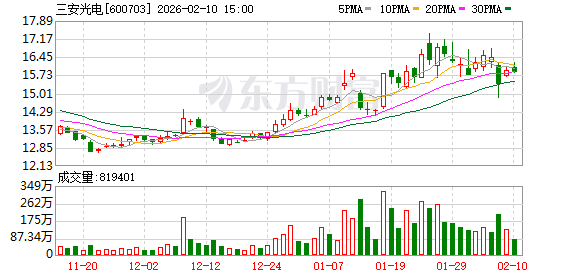
SANAN(600703)

Search documents
三安光电旗下公司在台州成立新公司
3 6 Ke· 2026-02-11 03:28
Core Viewpoint - Recently, Taizhou Anrui Optoelectronics Co., Ltd. was established with a registered capital of 10 million RMB, focusing on manufacturing smart vehicle-mounted devices, lighting fixtures, integrated circuit design, integrated circuit manufacturing, and semiconductor lighting components [1] Company Summary - The legal representative of Taizhou Anrui Optoelectronics Co., Ltd. is Zhu Jianming [1] - The company is wholly owned by Wuhu Anrui Optoelectronics Co., Ltd., which is a subsidiary of Sanan Optoelectronics [1]

三安光电:湖南三安的碳化硅产品已向台达等头部客户实现量产
Zheng Quan Ri Bao· 2026-02-10 14:15
Group 1 - The core viewpoint of the article highlights that Sanan Optoelectronics has successfully achieved mass production of silicon carbide products for data center and AI server power supply applications [2] - The company has established partnerships with leading clients such as Delta, Lite-On, Vertiv, Great Wall, and Flex [2]

三安光电:湖南三安已拥有8吋碳化硅衬底产能1000片/月
Zheng Quan Ri Bao Zhi Sheng· 2026-02-10 12:40
Group 1 - The core viewpoint of the article highlights Sanan Optoelectronics' current production capacity in silicon carbide substrates and chips, indicating significant advancements in their manufacturing capabilities [1] - Hunan Sanan has an 8-inch silicon carbide substrate capacity of 1,000 pieces per month and an epitaxy capacity of 2,000 pieces per month, along with an 8-inch silicon carbide chip capacity of 1,000 pieces per month [1] - The company has initiated the construction of a 12-inch silicon carbide substrate capacity, which has already been sent for customer sample verification [1] Group 2 - An additional capacity of 2,000 pieces per month is being established by Ansys and Chongqing Sanan, with production gradually being released [1]
三安光电20260205
2026-02-10 03:24
Summary of Sanan Optoelectronics Conference Call Company Overview - Sanan Optoelectronics focuses on the research and production of compound semiconductor epitaxial chips and has expanded into materials. The main business segments are UED (compound semiconductors) and integrated circuits [2][3]. Key Business Insights - **UED Business**: The target for high-end products in the UED segment has been raised to 60%, currently at about 20%. High-end products have a gross margin approximately 30 percentage points higher than low-end products. Prices for low-end products will see a slight increase starting January 1, 2026, reflecting cost pressures [2][3]. - **Integrated Circuits**: This segment includes RF front-end (GaAs, GaN), optical technology, and power batteries. Both GaN and GaAs RF segments are currently profitable, while filters are expected to reach breakeven or profitability by 2026 [2][3]. - **GaAs Solar Cells**: The GaAs division aims for a conversion efficiency of 34.5% by 2025, with projected revenue of approximately 170 million yuan, accounting for about 10% of the division's revenue. The focus is on rigid three-junction epitaxial chips and expanding flexible solar cell orders [2][5]. Flexible Solar Wing Development - The flexible solar wing weighs only a quarter of the rigid version and has higher conversion efficiency. Since the second half of 2024, there has been significant interest from domestic and international clients, indicating a potential increase in order share [2][6]. - Current production scale for flexible batteries is 1%-2% of total capacity, with a yield of 93%-95%, lower than the 97%-98% yield of rigid batteries. However, as production increases, costs are expected to drop to half or even a third of rigid battery costs [2][7]. Market Demand and Future Projections - The international market for GaAs solar cells is expected to surpass the domestic market by 2025, with demand projected to grow 3 to 5 times by Q3 2026 and potentially reach 8 times the current level by 2027 [2][9]. - If all 124 MOCVD machines are dedicated to solar cell production, conservative revenue estimates exceed 1 billion yuan, with a potential upper limit of 9 billion yuan and a gross margin exceeding 30% [2][13]. Competitive Landscape - The company has a significant market share in the LED sector, which constitutes 90% of its overall business. The technology used in LED production is applicable to flexible solar cells, enhancing production efficiency [2][8]. - Flexible solar cells are expected to gain a larger market share as production scales up, with the company confident in its competitive advantages in technology and production processes [2][28]. R&D and Future Directions - Sanan Optoelectronics invests over 10% of its revenue annually in R&D, aiming to create a comprehensive range of compound semiconductor products. Despite previous challenges in matching investment with output, the company is focused on improving revenue and returns for investors [2][33][34]. Conclusion - Sanan Optoelectronics is positioned for growth in the compound semiconductor and solar cell markets, with strategic plans to enhance product offerings and expand market share through technological advancements and increased production capacity.
砷化镓板块强势 三安光电涨幅居前
Xin Lang Zheng Quan· 2026-02-10 02:19
Group 1 - The gallium arsenide sector is experiencing strong performance, with companies like Sanan Optoelectronics showing significant gains [1] - As of 10:15 AM, the stock prices in this sector are rising sharply, indicating positive market sentiment [1]
全球航天强国加码太空光伏!卫星组网驱动产业化提速,海内外共振拉升产业估值中枢
Xin Lang Cai Jing· 2026-02-09 10:09
Core Viewpoint - The articles highlight the growing interest and investment in space photovoltaic technology among various companies in China, indicating a significant potential for growth in this sector by 2026 as commercialization accelerates. Group 1: Company Overview - Xizi Clean Energy (002534) is a leading clean energy equipment manufacturer in China, focusing on high-performance perovskite photovoltaic technology and aiming to become a core supplier of materials for space photovoltaics by 2026 [1][24]. - Shanghai Port Construction (605598) is a major infrastructure company that is expanding into space photovoltaic systems, leveraging its engineering capabilities to support commercial space projects [2][25]. - TuoRi New Energy (002218) has a long-standing presence in the photovoltaic industry and is optimizing its space photovoltaic products, expecting to increase market share by 2026 [3][26]. - Mingyang Smart Energy (601615) is acquiring technology to enhance its capabilities in space solar cell development, aiming to integrate its wind and solar energy expertise [4][28]. - Woge Optoelectronics (603773) specializes in flexible solar wing materials for satellites, with a focus on high-temperature resistant films, anticipating significant growth in the space photovoltaic sector [5][29]. Group 2: Growth Outlook - Companies are expected to benefit from the rapid commercialization of space photovoltaics, with projections indicating substantial growth opportunities by 2026 [1][2][3][4][5]. - The synergy between commercial aerospace and space photovoltaic industries is anticipated to drive rapid business growth for companies like Shanghai Port Construction and Mingyang Smart Energy [2][4]. - The demand for flexible solar wings and high-efficiency photovoltaic materials is expected to surge, positioning companies like Woge Optoelectronics and TuoRi New Energy as key players in the market [3][5]. Group 3: Technological Advancements - Companies are focusing on developing materials that can withstand extreme space conditions, such as high-performance perovskite and flexible solar films, which are crucial for the success of space photovoltaic applications [1][5][6]. - The integration of advanced technologies, such as N-type solar cells and high-efficiency components, is being prioritized by firms like Junda Co. (002865) and Sanan Optoelectronics (600703) to enhance their competitive edge in the space photovoltaic market [6][10][35]. - The ongoing research and development efforts in high-efficiency solar technologies are expected to yield breakthroughs that will facilitate the commercialization of space photovoltaic solutions by 2026 [3][4][5][6].



商业航天深度:太空光伏的技术底层逻辑(附29页PPT)
材料汇· 2026-02-08 15:24
Core Viewpoint - The article discusses the emergence of a new era in satellite technology, emphasizing the urgent need for efficient power supply systems for satellites as China prepares to launch a significant number of satellites by the end of 2025 [6][9]. Group 1: Satellite Launch and Development - By the end of 2025, China plans to submit approximately 203,000 satellites to the ITU, covering 14 satellite constellations, with the Radio Innovation Institute applying for two constellations, each with 96,714 satellites, totaling nearly 193,000 satellites [7][8]. - Major operators and commercial satellite companies are also advancing medium-scale constellations, with China Mobile applying for 2,520 satellites, Yuxin Satellite for 1,296, and Guodian Gaoke for 1,132 [8][10]. - As of December 2025, the overall launch completion rate for major domestic constellations remains low, indicating they are in the early stages of network formation [13]. Group 2: Starlink Program and Launch Trends - The Starlink program exhibits a clear generational rhythm, with cumulative launches reaching approximately 11,034 satellites and applications totaling about 41,943 as of January 2026 [2][16]. - The annual launch volume has increased significantly, with projections for 2025 reaching around 3,200 satellites, reflecting a trend of accelerating deployment [15][20]. - Starlink's V1 to V3 satellites utilize crystalline silicon technology to prioritize supply chain scalability and system-level cost reduction, while V4 may adopt P-type silicon HJT or P-type silicon HJT-perovskite tandem structures [3][4]. Group 3: Photovoltaic Technology in Space - The current mainstream technology for space photovoltaic applications in China is multi-junction gallium arsenide (GaAs), although there is ongoing testing and validation of perovskite systems by various companies [4][26]. - The high unit price of GaAs photovoltaic cells is becoming a significant factor limiting system economics, prompting the industry to explore lower-cost alternatives such as silicon-based and perovskite technologies [21][34]. - The article highlights the unique requirements for photovoltaic cells in space, including radiation resistance, thermal stability, and long-term reliability under extreme conditions [22][25]. Group 4: Industry Outlook and Recommendations - The acceleration of satellite launches and the continuous validation of new photovoltaic technologies indicate a rising industry outlook and long-term growth potential for the space photovoltaic sector [5][6]. - The article recommends a "buy" rating for the space photovoltaic industry, citing key companies such as Maiwei Co., Aotewi, and others as relevant investment targets [5][6].



三安光电跌6.33% 海通证券安信证券在其高点唱多
Zhong Guo Jing Ji Wang· 2026-02-06 09:43
Core Viewpoint - The stock price of Sanan Optoelectronics (600703.SH) has declined by 6.33% to 15.38 yuan as of the market close on February 6, 2023, following a peak of 44.92 yuan since its listing on August 4, 2021 [1]. Group 1 - Sanan Optoelectronics' stock price reached a high of 44.92 yuan on August 4, 2021, marking a significant milestone since its listing [1]. - The stock has experienced a notable decline, with a current price of 15.38 yuan, reflecting a decrease of 6.33% [1]. - Analysts from Anxin Securities and Haitong Securities had previously issued positive reports on Sanan Optoelectronics on July 31, 2021, maintaining "Buy-A" and "Outperform" ratings respectively [1]. Group 2 - Anxin Securities' report by analyst Ma Liang emphasized the reduction in LED inventory levels and accelerated progress in Sanan's integration, supporting a "Buy-A" investment rating [1]. - Haitong Securities' report by analyst Zhu Jinsong highlighted the continuous optimization of product structure and rapid growth of Sanan's integration, leading to an "Outperform" rating [1].
每日研究一家上市公司——第六十五家三安光电(湖北)
Sou Hu Cai Jing· 2026-02-06 08:48
Core Viewpoint - Sanan Optoelectronics is a leading player in the compound semiconductor industry, particularly in the LED chip and third-generation semiconductor sectors, with a strong focus on technological innovation and a comprehensive industrial layout [5][20][54]. Company Overview - Sanan Optoelectronics Co., Ltd. was established in November 2000 and listed on the Shanghai Stock Exchange in 2008, focusing on the research, production, and sales of compound semiconductor materials and devices [5][6]. - The company has transformed from a single LED chip manufacturer to a platform enterprise covering both LED chips and integrated circuits, establishing a business structure that balances mature cash flow with high-growth new businesses [5][7]. Historical Performance - The stock price reached a historical high of 44.72 yuan in 2021, driven by industry trends, performance improvements, and significant investments in Mini/Micro LED technology [10][11]. - The stock price has since declined, with the latest price at 15.38 yuan as of February 6, 2026, reflecting a 26.58% increase since 2025 [2]. Market Position - Sanan Optoelectronics holds a global market share of 28%-32% in the LED chip sector, leading both domestically and internationally [20]. - The company is also a key player in the Mini/Micro LED market, achieving over 120% year-on-year growth in chip shipments in 2023 [20]. Business Segments - The main business segments include LED epitaxial chips, integrated circuit products, and power electronic devices, with LED epitaxial chips accounting for approximately 65% of total revenue in the first half of 2025 [21][22]. - The company is recognized for its advanced technology in the third-generation semiconductor field, particularly in silicon carbide and gallium nitride RF chips [20][22]. Financial Performance - For the first three quarters of 2025, the company reported total revenue of 138.17 billion yuan, a year-on-year increase of 16.55%, but faced a net profit decline of 64.15% to 88.61 million yuan [29][30]. - The gross profit margin improved to 13.65%, although it remains below the industry average [30]. Competitive Advantages - Sanan Optoelectronics boasts strong technological innovation capabilities, with over 4,200 patents and significant R&D investment, amounting to 13.23 billion yuan in 2024 [24][54]. - The company has established a full industrial chain in the silicon carbide sector, enhancing its cost control and quality assurance [24][25]. Shareholder Structure - The controlling shareholder is Xiamen Sanan Electronics Co., Ltd., with a significant portion of shares pledged, raising concerns about share stability [38][39]. - Institutional investors hold over 50% of the company's shares, indicating strong market confidence [45]. Investment Outlook - The company is positioned for long-term growth in the compound semiconductor sector, despite facing short-term challenges related to competition and profitability [54][63]. - The focus on high-value products and new business developments is expected to drive future revenue growth [54].
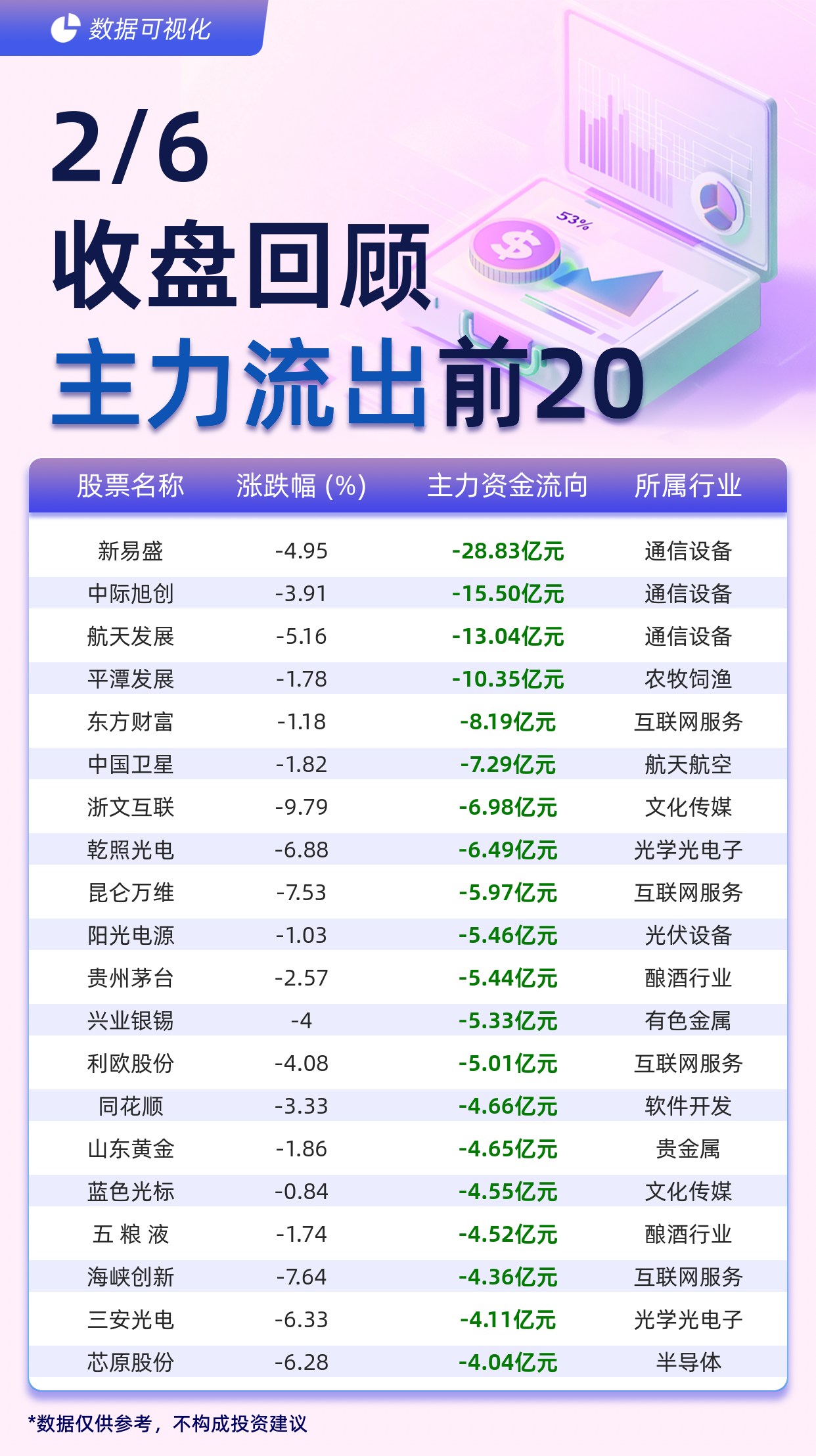
主力个股资金流出前20:新易盛流出28.83亿元、中际旭创流出15.50亿元
Jin Rong Jie· 2026-02-06 07:29
Group 1 - The main stocks with significant capital outflows include Xinyi Technology (-28.83 billion), Zhongji Xuchuang (-15.50 billion), and Aerospace Development (-13.04 billion) [1] - The sectors affected by the capital outflows primarily include communication equipment, internet services, and optical electronics [2][3] - The largest percentage decline in stock prices was observed in Zhejiang Wenlian, which fell by 9.79% [2] Group 2 - Other notable stocks with substantial capital outflows include Guizhou Moutai (-5.44 billion), Sunshine Power (-5.46 billion), and Sanan Optoelectronics (-4.11 billion) [1][3] - The overall trend indicates a negative sentiment in the market, particularly in the communication equipment and internet service sectors [2][3] - The data reflects a broader market trend of capital withdrawal, impacting various industries including agriculture, aerospace, and cultural media [1][2]