
WINGTECH(600745)

Search documents
安世半导体风波仍在持续,闻泰科技重要股东突然宣布减持
Mei Ri Jing Ji Xin Wen· 2025-11-05 22:21
Core Viewpoint - Wentech Technology (600745.SH) is facing significant challenges due to a major shareholder's plan to reduce its stake amid the ongoing turmoil surrounding Nexperia, a key subsidiary in the semiconductor industry [1][5]. Shareholder Actions - The second-largest shareholder, Wuxi Guolian Integrated Circuit Investment Center, plans to reduce its holdings by up to 37.34 million shares, representing 3% of the total share capital, valued at approximately 1.608 billion yuan based on the closing price of 43.08 yuan on November 5 [2][3]. - The reduction is attributed to the shareholder's operational needs, with the planned period for the sale set from November 27, 2025, to February 26, 2026 [3]. Financial Performance - In Q3 2025, Wentech reported a significant net profit increase of 279.29%, despite a 77.38% decline in total revenue to 4.427 billion yuan [6]. - The semiconductor business, primarily driven by Nexperia, generated 4.3 billion yuan in revenue, marking a 12.20% year-on-year increase, with a gross margin of 34.56% [6]. Nexperia's Situation - Nexperia is currently embroiled in a control dispute, leading to significant disruptions in the global automotive supply chain, with warnings from industry associations about potential production halts [5][6]. - Wentech has expressed uncertainty regarding the future performance of its semiconductor business, contingent on the resolution of Nexperia's control issues by the end of 2025 [6]. Customer Relations and Supply Chain - Nexperia China has assured customers of its ability to meet orders despite the supply chain disruptions caused by Nexperia's actions in the Netherlands [9]. - The Chinese Ministry of Commerce has criticized the Dutch government's interference in Nexperia's operations, emphasizing that the Dutch side bears full responsibility for the ensuing supply chain crisis [11].

安世半导体风波仍在持续,闻泰科技重要股东突然宣布减持:最高价值超16亿元!公司第三季度净利大增279%
Mei Ri Jing Ji Xin Wen· 2025-11-05 15:01
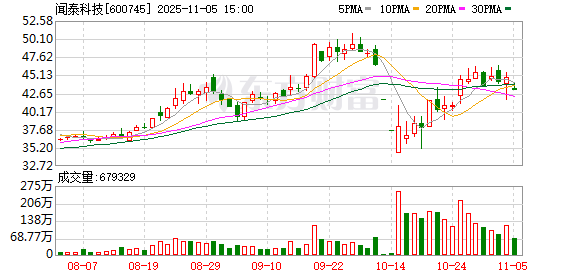
Core Viewpoint - The second largest shareholder of Wentai Technology, Wuxi Guolian Integrated Circuit Investment Center, plans to significantly reduce its stake, which may impact the company's stock performance and investor sentiment [1][3]. Shareholder Reduction Plan - Wuxi Guolian plans to reduce its holdings by up to 24.89 million shares through block trading (up to 2% of total shares) and up to 12.44 million shares through centralized bidding (up to 1% of total shares), totaling a maximum of 37.34 million shares (up to 3% of total shares) [1]. - The reduction is attributed to the shareholder's operational needs, with the reduction period set from November 27, 2025, to February 26, 2026 [1]. Financial Performance - As of the end of Q3, Wuxi Guolian held 7.77% of Wentai Technology's shares, making it the second-largest shareholder [3]. - For Q3 2025, Wentai Technology reported a revenue of 4.43 billion yuan, a year-on-year decrease of 77.38%, while net profit attributable to shareholders surged by 279.29% to 1.04 billion yuan [8][9]. - The semiconductor business, particularly Nexperia, has become the main revenue source for Wentai Technology, contributing 14.72 billion yuan in revenue and 2.30 billion yuan in net profit in 2024 [10]. Market Reaction - As of November 5, Wentai Technology's stock price fell by 3.6% to 43.08 yuan, although it has increased over 24% since mid-October [6]. - The total market capitalization of Wentai Technology is approximately 53.62 billion yuan [6]. Nexperia Situation - Nexperia, a core subsidiary of Wentai Technology, is facing a control dispute that has raised concerns about its operational stability and potential impacts on revenue and profit [10][15]. - The Chinese subsidiary of Nexperia has assured customers of its ability to meet orders despite the ongoing issues, emphasizing its commitment to supply chain reliability [12]. Government Involvement - The Chinese Ministry of Commerce has criticized the Dutch government's interference in Nexperia's internal affairs, stating that it has escalated the global supply chain crisis [15]. - The ministry has called for constructive solutions to stabilize the situation and protect the rights of Chinese enterprises [15].


闻泰科技:第二大股东拟减持不超3%股份;航天宏图被暂停军队采购资格3年|公告精选
2 1 Shi Ji Jing Ji Bao Dao· 2025-11-05 13:48
Group 1 - Sanjiang Shopping's second largest shareholder, Alibaba Zetai, plans to reduce its stake by up to 3%, equating to a maximum of 16.43 million shares, with a reduction period from November 27, 2025, to February 26, 2026 [1] - Jiayuan Technology has signed a cooperation framework agreement with CATL to expand their business relationship in the supply and development of new battery anode materials, including solid-state battery copper foil [1] - Kabeiyi has invested 100 million yuan to establish a wholly-owned subsidiary in Shanghai to accelerate the development of components for humanoid robots, aligning with the company's long-term strategic planning [2] Group 2 - Aerospace Hongtu has been suspended from military procurement for three years due to alleged violations in a portable drone project, effective from July 6, 2024, to July 6, 2027 [3] - Hengyuan Coal Power intends to acquire 100% equity of Hongneng Coal Industry and Changsheng Energy from Shanxi Black Cat for 440 million yuan, while also assuming debts of 1.137 billion yuan [4] - Zhangzhou Development's wholly-owned subsidiary has received a tax refund, expected to increase the net profit for 2025 by 6.3847 million yuan [5] Group 3 - Shima Power's shareholder, Chen Xiaoqin, reduced his stake by 1% from September 17 to November 5, 2025, totaling 4.3168 million shares [6] - Wentai Technology's second largest shareholder, Wuxi Guolian Integrated Circuit Investment Center, plans to reduce its stake by up to 3%, totaling 37.3391 million shares, during the same reduction period as Sanjiang Shopping [7] - Standard Shares has elected Wang Kunyuan as the chairman of the board, with a term until the board's term ends [8] Group 4 - Xiling Power plans to acquire 100% equity of Weipai Automotive Electronics (Shanghai) Co., Ltd., with the transaction not constituting a related party transaction or major asset restructuring [9] - *ST Tianshan reported a 242.54% year-on-year increase in livestock sales revenue for October [10] - Muyuan Foods reported a 22.28% year-on-year decline in October's pork sales revenue, totaling 10.331 billion yuan [10]
闻泰科技第二大股东再度减持3%股份
Xin Hua Cai Jing· 2025-11-05 13:40
Core Viewpoint - Wentech Technology announced a plan for major shareholder Wuxi Guolian Integrated Circuit Investment Center to reduce its stake by up to 3% through block trading and centralized bidding, citing the need for the shareholder's operational plans [2][3] Shareholder Reduction Plan - Wuxi Guolian Integrated Circuit Investment Center plans to reduce its holdings by up to 24.89 million shares (2% of total share capital) through block trading and up to 12.44 million shares (1% of total share capital) through centralized bidding, totaling a maximum of 37.34 million shares [2] - The reduction period is set from November 27, 2025, to February 26, 2026 [2] Shareholder Background - As of the end of Q3, Wuxi Guolian Integrated Circuit Investment Center held 7.77% of Wentech Technology, making it the second-largest shareholder [3] - This marks the second reduction by Wuxi Guolian, following a previous announcement on June 5, 2025, to reduce up to 3% of its shares [3] Company Performance - Wentech Technology reported a revenue of 29.769 billion yuan for the first three quarters, a year-on-year decrease of 44%, while net profit attributable to shareholders was 1.513 billion yuan, an increase of 265.09% [3] - In Q3 alone, revenue was 4.427 billion yuan, down 77.38% year-on-year, but net profit was 1.04 billion yuan, up 279.29% [3] Semiconductor Business Concerns - The company addressed concerns regarding its subsidiary, Anshi Semiconductor, stating that the future trajectory and potential impacts of recent events are difficult to quantify, leading to uncertainty about the continuation of the semiconductor business's positive momentum [4] - If control of Anshi cannot be restored by the end of 2025, the company may face risks of revenue, profit, and cash flow adjustments [4] Market Performance - As of November 5, Wentech Technology's stock closed at 43.08 yuan per share, down 3.90%, with a total market capitalization of 53.62 billion yuan, reflecting an 11.09% increase year-to-date [4]
增减持公告汇总丨这家公司股东拟3000万元—6000万元增持股份





Di Yi Cai Jing· 2025-11-05 13:20
Group 1 - Hualan Co., Ltd. plans to increase its shareholding by 30 million to 60 million yuan [1] - Kaili Medical's directors and executives collectively increased their holdings by 460,000 shares [1] - Zuming Co., Ltd.'s actual controller and shareholders plan to reduce their holdings by no more than 4% [1] Group 2 - Wentai Technology's Wuxi Guolian Integrated Circuit Investment Center intends to reduce its holdings by no more than 3% [1] - Kaimete Gas's shareholders plan to reduce their holdings by no more than 3% [1] - Kechuan Technology's Shi Huiqing intends to reduce his holdings by no more than 3% [1] Group 3 - Sanjiang Shopping's Alibaba Zhitai plans to reduce its holdings by no more than 3% [1] - Anbiping's Zhuji Gaotejia and its concerted parties plan to reduce their holdings by no more than 1% [1] - Tianyi Co., Ltd.'s controlling shareholder and specific shareholders plan to reduce their holdings by no more than 1% [1] Group 4 - Kangsong Co., Ltd.'s shareholder Jiangsu Ruijin plans to reduce his holdings by no more than 1% [1] - Ankai Bus's shareholders plan to reduce their holdings by no more than 1% [1] - Chenguang New Materials' Haojing Borui plans to reduce its holdings by no more than 0.96% [1] Group 5 - Hanbo High-tech's directors, executives, and shareholders plan to reduce their holdings by no more than 0.12% [1] - Chujian New Materials' directors plan to reduce their holdings by no more than 2 million shares [1]
闻泰科技:关于股东减持股份计划公告
Zheng Quan Ri Bao· 2025-11-05 12:40
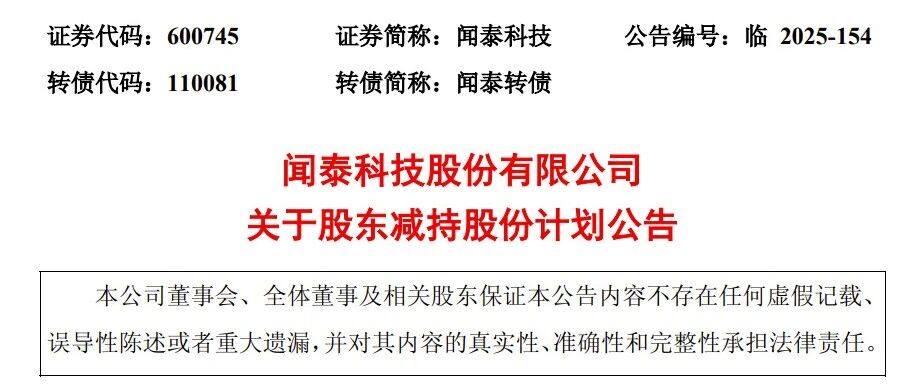
证券日报网讯 11月5日晚间,闻泰科技发布公告称,本次减持计划实施前,公司持股5%以上股东无锡 国联集成电路投资中心(有限合伙)持有公司股票96,718,566股,占公司总股本的7.77%。无锡国联 集成电路投资中心(有限合伙)计划通过大宗交易方式减持公司股份数量不超过24,892,720股(不超 过公司截至2025年11月4日公司总股本的2%)、通过集中竞价交易方式减持公司股份数量不超过12, 446,360股(不超过公司截至2025年11月4日公司总股本的1%),将于本减持计划公告之日起15个交易 日后的3个月内进行,减持价格视市场情况确定。 (文章来源:证券日报) ...
闻泰科技公告
是说芯语· 2025-11-05 11:30
Group 1 - The core point of the article is that Wentech Technology (600745.SH) announced a plan for significant share reduction by a major shareholder, Wuxi Guolian Integrated Circuit Investment Center, which will reduce its holdings by up to 37.34 million shares, accounting for no more than 3% of the company's total share capital [1] Group 2 - The share reduction will occur through block trading, with a maximum of 24.89 million shares (2% of total share capital) and through centralized bidding, with a maximum of 12.44 million shares (1% of total share capital) [1] - The reason for the reduction is due to the shareholder's own operational plans, with the reduction period set from November 27, 2025, to February 26, 2026 [1]
闻泰科技股东无锡国联拟减持不超3%股份
Zhi Tong Cai Jing· 2025-11-05 11:03
智通财经APP讯,闻泰科技(600745.SH)公告,公司股东无锡国联集成电路投资中心(有限合伙)计划通过 大宗交易方式减持公司股份数量不超过2489.272万股(不超过公司截至2025年11月4日公司总股本的 2%)、通过集中竞价交易方式减持公司股份数量不超过1244.636万股(不超过公司截至2025年11月4日公 司总股本的1%),将于本减持计划公告之日起15个交易日后的3个月内进行,减持价格视市场情况确 定。 ...
闻泰科技(600745) - 关于股东减持股份计划公告
2025-11-05 10:48
| 证券代码:600745 | 证券简称:闻泰科技 | 公告编号:临 2025-154 | | --- | --- | --- | | 转债代码:110081 | 转债简称:闻泰转债 | | 本公司董事会、全体董事及相关股东保证本公告内容不存在任何虚假记载、 误导性陈述或者重大遗漏,并对其内容的真实性、准确性和完整性承担法律责任。 重要内容提示: | 股东名称 | 无锡国联集成电路投资中心(有限合伙) | | | | --- | --- | --- | --- | | 股东身份 | 控股股东、实控人及一致行动人 | □是 | √否 | | | 直接持股 5%以上股东 | √是 | □否 | | | 董事、监事和高级管理人员 | □是 | √否 | | | 其他: | | | | 持股数量 | 96,718,566股 | | | | 持股比例 | 7.77% | | | 一、减持主体的基本情况 1 大股东持股的基本情况:本次减持计划实施前,闻泰科技股份有限公 司(以下简称"公司")持股 5%以上股东无锡国联集成电路投资中心 (有限合伙)持有公司股票 96,718,566 股,占公司总股本 7.77%,上述 股份 ...
闻泰科技:股东无锡国联集成电路投资中心拟减持不超3%公司股份
Xin Lang Cai Jing· 2025-11-05 10:46
Core Viewpoint - Wuxi Guolian Integrated Circuit Investment Center (Limited Partnership), a shareholder holding more than 5% of the shares, plans to reduce its holdings in Wentai Technology through block trading and centralized bidding from November 27, 2025, to February 26, 2026, due to its own operational needs [1] Summary by Category - **Shareholding Reduction Plan** - The shareholder intends to reduce up to 24.8927 million shares through block trading, accounting for 2% of the company's total share capital [1] - Additionally, the shareholder plans to reduce up to 12.4464 million shares through centralized bidding, representing 1% of the company's total share capital [1] - **Market Conditions and Uncertainty** - The reduction price will be determined based on market conditions, indicating potential variability in the execution of the plan [1] - The implementation of this reduction plan carries uncertainty [1]