
WINGTECH(600745)

Search documents
闻泰科技:股东无锡国联集成电路拟减持不超3%股份
Mei Ri Jing Ji Xin Wen· 2025-11-05 10:45
Core Viewpoint - Wentech Technology (600745.SH) announced that its major shareholder, Wuxi Guolian Integrated Circuit Investment Center (Limited Partnership), plans to reduce its holdings through block trading and centralized bidding, totaling up to 37.34 million shares, which is 3% of the company's total share capital [1] Summary by Category Shareholder Reduction Plan - The shareholder intends to reduce holdings by up to 24.89 million shares (2% of total share capital) through block trading [1] - Additionally, up to 12.45 million shares (1% of total share capital) will be reduced through centralized bidding [1] - The total reduction will not exceed 37.34 million shares, representing 3% of the company's total share capital [1] Timing and Reason - The reduction period is set from November 27, 2025, to February 26, 2026 [1] - The reason for the reduction is stated as the shareholder's own operational needs [1]

闻泰科技:无锡国联集成电路投资中心拟减持公司不超过3%股份
Zheng Quan Shi Bao Wang· 2025-11-05 10:41
人民财讯11月5日电,闻泰科技(600745)11月5日公告,持股7.77%的股东无锡国联集成电路投资中心 (有限合伙)计划通过大宗交易及集中竞价交易方式,减持公司股份不超过3733.91万股(占公司截至2025 年11月4日公司总股本的3%)。 ...
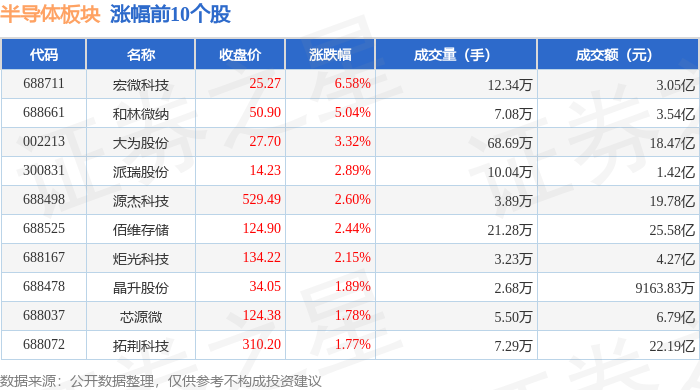
半导体板块11月5日跌0.79%,中晶科技领跌,主力资金净流出43.16亿元
Zheng Xing Xing Ye Ri Bao· 2025-11-05 08:42
Core Viewpoint - The semiconductor sector experienced a decline of 0.79% on November 5, with Zhongjing Technology leading the drop. Meanwhile, the Shanghai Composite Index rose by 0.23% and the Shenzhen Component Index increased by 0.37% [1][2]. Semiconductor Sector Performance - The semiconductor sector's main stocks showed mixed performance, with notable gainers including Hongwei Technology (+6.58%), Helin Micro-Nano (+5.04%), and Dawi Co. (+3.32%). Conversely, Zhongjing Technology led the decline with a drop of 6.56% [1][2]. - The trading volume and turnover for key stocks were significant, with Dawi Co. achieving a turnover of 1.847 billion yuan and Hongwei Technology reaching 305 million yuan [1][2]. Capital Flow Analysis - On the same day, the semiconductor sector saw a net outflow of 4.316 billion yuan from institutional investors, while retail investors contributed a net inflow of 3.2 billion yuan [2][3]. - Specific stocks like TuoJing Technology and Dawi Co. experienced varying levels of net inflow and outflow from different investor categories, indicating diverse investor sentiment within the sector [3].


中国半导体崛起,闻泰向荷兰发最后通牒:恢复安世前CEO,否则芯片出口全面受阻
Xin Lang Cai Jing· 2025-11-04 13:39
Core Viewpoint - The conflict between China's semiconductor giant, Wingtech Technology, and the Dutch government highlights the fragility of global supply chains and poses a risk of production halts in European industries due to the potential disruption of chip exports from China [1][3]. Group 1: Company Relations and Actions - Wingtech Technology demands the reinstatement of the former CEO of Nexperia, a semiconductor company acquired in 2020, as a condition for continuing chip exports from China [1][3]. - The Dutch government's actions, including the forced removal of the CEO under the pretext of national security, are viewed as lacking substantial evidence and damaging to international market rules [1][3]. - Nexperia's chip production heavily relies on packaging and testing processes conducted in China, which are critical for global market access [3]. Group 2: Economic and Industry Implications - The semiconductor crisis has led to warnings from the European Automobile Manufacturers Association (ACEA) about potential production halts for European car manufacturers due to chip shortages [3]. - The impact of the Nexperia incident extends beyond the semiconductor industry, affecting aerospace, defense, and other critical sectors [3]. - Wingtech's actions are seen as a defense of corporate rights and a call for the Dutch government to apologize and compensate for economic losses incurred due to the forced takeover [3][4]. Group 3: Broader Industry Context - The incident symbolizes the rise of the Chinese semiconductor industry, which has been improving its technological capabilities and reducing reliance on foreign entities [4]. - The outcome of this conflict may determine whether global supply chain stability can be maintained and if the Dutch government will acknowledge and rectify its actions [4].

中美休战,荷兰成了炮灰!
Jin Tou Wang· 2025-11-04 13:25
Core Viewpoint - The article discusses the implications of the Dutch government's actions against the semiconductor company Nexperia, a subsidiary of Wingtech Technology, highlighting the unintended consequences for both the Netherlands and its European allies in the semiconductor supply chain [1][2]. Group 1: Dutch Government Actions - The Dutch government imposed dual restrictions on Nexperia, which aligns with U.S. export control measures, raising suspicions of coordinated efforts against Chinese assets [1][2]. - Following the restrictions, China retaliated with export controls, affecting major automotive manufacturers in Europe, including Honda, Volkswagen, BMW, and Mercedes, leading to potential production halts [2][3]. Group 2: Semiconductor Industry Dynamics - Nexperia's operational structure includes significant manufacturing capabilities in China, with 70%-80% of its production capacity located there, particularly in Dongguan, which handles 70% of global shipments [3][6]. - The article emphasizes that despite the Dutch restrictions, the short-term impact on Nexperia's operations may be mitigated by domestic Chinese semiconductor manufacturers like SMIC and Huahong, which can cover 80% of specifications [6]. Group 3: Geopolitical Context - The actions of the Dutch government are seen as part of a broader strategy by the U.S. and its allies to curb China's semiconductor industry, with the Netherlands acting as a key player in this geopolitical landscape [7][9]. - The article suggests that the long-standing global division of labor led by the U.S. and Europe is collapsing, with China beginning to reshape the rules of the semiconductor game [10][12]. Group 4: Future Implications - The ongoing geopolitical tensions are expected to continue affecting companies like Nexperia, with the potential for further restrictions and competitive dynamics in the semiconductor sector [12][13]. - The article concludes that the current situation serves as a warning to smaller nations about the shifting balance of power in the semiconductor industry and the need for strategic adjustments [13].

AI PC概念下跌2.49%,主力资金净流出37股
Zheng Quan Shi Bao Wang· 2025-11-04 09:24
Market Performance - The AI PC concept index declined by 2.49%, ranking among the top declines in the concept sector as of the market close on November 4 [1] - Within the AI PC sector, companies such as Baiwei Storage, Xinghuan Technology, and Demingli experienced significant declines, while Wen Tai Technology, Haopeng Technology, and China Great Wall saw slight increases of 1.38%, 0.32%, and 0.18% respectively [1] Capital Flow - The AI PC concept sector experienced a net outflow of 3.877 billion yuan, with 37 stocks seeing net outflows, and 12 stocks having outflows exceeding 100 million yuan [2] - Shenghong Technology led the outflow with a net withdrawal of 622 million yuan, followed by Changying Precision, Lingyi Technology, and Tongfu Microelectronics with outflows of 495 million yuan, 294 million yuan, and 278 million yuan respectively [2] - The stocks with the highest net inflows included Pengding Holdings, Haopeng Technology, and Aohai Technology, with inflows of 65.96 million yuan, 23.06 million yuan, and 8.61 million yuan respectively [3] Stock Performance - The top decliners in the AI PC concept included Shenghong Technology (-1.22%), Changying Precision (-5.33%), and Lingyi Technology (-2.30%) [2] - Notable gainers in the sector were Wen Tai Technology (+1.38%) and Haopeng Technology (+0.32%) despite the overall decline [1][3]


【摩根看世界】劫持安世:华盛顿主导了一场“一箭双雕”的阳谋
Guan Cha Zhe Wang· 2025-11-04 06:50
Core Points - The ongoing conflict between ASML China and the Dutch government highlights a significant shift in the geopolitical landscape regarding technology and trust [1][10] - The Dutch government invoked a 72-year-old law to take control of ASML, citing national security concerns, which has raised alarms about the predictability of Western markets [1][5][10] Company Overview - ASML was founded in 2017 and is headquartered in Nijmegen, Netherlands, producing semiconductors for various sectors including automotive and consumer electronics, employing over 14,000 people globally [3] - The company was acquired by China's Wingtech Technology for approximately $3.6 billion in 2018, making it one of the few large chip manufacturers in Europe under Chinese control [3] Legal and Regulatory Context - The Dutch government applied the "Goods Availability Act" to ASML, a law originally designed for wartime resource management, indicating a redefinition of what constitutes critical infrastructure [5][6] - This law allows the government to intervene in private companies when the availability of key products is at risk, now extending to the semiconductor industry [5][6] Geopolitical Implications - The actions taken by the Dutch government are closely coordinated with Washington, indicating a broader strategy to control advanced technology and its production locations [6][7] - The political environment has shifted from efficiency to security, impacting global manufacturing, particularly in the automotive sector [7][9] Economic Consequences - China's response to the Dutch decision includes restrictions on low-end and automotive-grade chip exports to Europe, affecting ASML's operations and the broader supply chain [9][10] - The situation has led to significant operational challenges for ASML, with its factories in China unable to ship products and European management under government oversight [9][10] Broader Trends - The ASML case illustrates a structural transformation in global trade, where the free flow of capital and technology is increasingly influenced by political considerations [10][11] - The incident signifies a new threshold in China-Europe relations, with both sides facing heightened anxieties over technological dependencies and market access [10][11]

事关安世半导体!商务部,最新发声
Zheng Quan Shi Bao Wang· 2025-11-04 06:36
Core Viewpoint - The Chinese government expresses strong discontent regarding the Dutch government's interference in Nexperia's operations, emphasizing that such actions have severely impacted the global semiconductor supply chain and calling for a constructive resolution to the issue [1][2]. Group 1: Government and Legal Actions - The Dutch government issued an administrative order on September 30, which interfered with Nexperia's internal affairs, leading to a court ruling that stripped Chinese companies of their equity rights, violating their legitimate interests [1]. - On October 12, Wentai Technology announced that Nexperia faced dual restrictions from the Dutch government and courts, including a one-year freeze on assets and operations, which has significant implications for its global operations [4]. Group 2: Supply Chain Impact - Nexperia Netherlands announced on October 26 that it would stop supplying wafers to Nexperia China, causing disruptions in production and contributing to global semiconductor supply chain instability [1][4]. - Nexperia China has established sufficient inventories to meet customer demands through the end of the year and is actively working on contingency plans to ensure long-term supply resilience [12]. Group 3: Company Responses and Claims - Nexperia China refutes claims made by Nexperia Netherlands regarding contract payment failures, stating that the allegations are unfounded and that Nexperia Netherlands owes over RMB 1 billion in outstanding payments [7][8]. - The management of Nexperia Netherlands is accused of prioritizing personal interests over the company's overall welfare, which has led to significant losses for the company and its employees [9].
事关安世半导体!商务部,最新发声
证券时报· 2025-11-04 06:24
Core Viewpoint - The article discusses the ongoing issues surrounding Nexperia, a semiconductor company, highlighting the Dutch government's interference and its impact on the global semiconductor supply chain [1][2]. Group 1: Government Interference - The Dutch government issued an administrative order on September 30, which improperly intervened in Nexperia's internal affairs, leading to a court ruling that stripped Chinese companies of their equity rights, severely infringing on their legitimate interests [1]. - The Dutch government has not shown a constructive attitude in negotiations, exacerbating the global supply chain crisis [1][2]. Group 2: Supply Chain Disruption - On October 26, Nexperia announced it would stop supplying wafers to its Chinese subsidiary, causing significant disruption in the semiconductor supply chain [1]. - Nexperia China has established sufficient inventories to meet customer demands until the end of the year and is actively working on contingency plans to ensure long-term supply resilience [3][13]. Group 3: Financial Disputes - Nexperia Netherlands claims that the suspension of wafer supply is due to local management's failure to comply with contractual payment terms, which Nexperia China strongly refutes, stating that the Dutch entity owes over 1 billion RMB in outstanding payments [6][8]. - The management at Nexperia Netherlands is accused of prioritizing personal interests over the company's overall interests, violating professional ethics and corporate governance [8][9]. Group 4: Customer Relations - The unilateral suspension of supply by Nexperia Netherlands disregards customer interests and severely undermines trust, which is deemed an extremely irresponsible act [11]. - Nexperia China emphasizes its commitment to customer interests and the quality of its products, asserting that the supply disruption will not affect its ability to fulfill customer commitments [14].
一场控制权争夺,撕裂全球半导体命脉
Tai Mei Ti A P P· 2025-11-04 02:25
Core Viewpoint - The control struggle over Nexperia, a semiconductor company, has led to a significant supply chain crisis affecting global automotive production, highlighting the geopolitical tensions between the Netherlands and China [1][10]. Group 1: Supply Chain Impact - Nexperia's production capacity has been severely disrupted, with a 30% reduction in parking space and one-third of packaging equipment idle due to wafer supply interruptions from its Dutch headquarters [1]. - Major automotive manufacturers, including Volkswagen and BMW, have halted production lines due to critical chip shortages, with the European automotive industry warning of a potential 15% reduction in production capacity if the crisis continues [7][11]. - The crisis has led to a tenfold increase in the price of basic chips, with costs exceeding 3 yuan per unit, directly impacting global automotive production plans [5][7]. Group 2: Historical Context and Acquisition - Nexperia's origins trace back to the 1920s, evolving through various ownerships, including a significant acquisition by a Chinese consortium in 2016 for $2.75 billion, which was seen as a strategic move to fill gaps in China's automotive semiconductor market [2][3]. - The acquisition by Wingtech Technology in 2019 for 34 billion yuan transformed Nexperia into a key player in the automotive semiconductor sector, significantly increasing its revenue and market share [3][4]. Group 3: Legal and Political Dynamics - The Dutch government invoked a 1952 law to freeze Nexperia's assets and remove its Chinese CEO, citing concerns over financial resource misuse and technology transfer risks [4][5]. - The legality of the Dutch court's decision has been questioned, with Wingtech asserting its rights as the 100% controlling shareholder, while the timing of the Dutch intervention aligns with U.S. pressures on Chinese management [5][6]. - The geopolitical context reveals that the Netherlands is aligning with U.S. semiconductor restrictions, reflecting broader strategic concerns about China's technological advancements [10][11]. Group 4: Future Implications and Lessons - The crisis underscores the vulnerabilities of global supply chains, particularly the reliance on a single region for critical components, prompting discussions about regional redundancy in production [13][14]. - The situation serves as a cautionary tale for Chinese companies regarding the importance of political risk assessment in overseas acquisitions, emphasizing the need for a more integrated operational approach to mitigate geopolitical risks [14][16]. - The ongoing conflict illustrates the potential for political actions to disrupt established business contracts, raising concerns about the future of international investments and the sanctity of contracts [14][15].