
Bank Of Jiangsu(600919)

Search documents
开年高管密集增持!银行股"吸金"能否延续?
Zheng Quan Shi Bao· 2026-01-19 14:47
Group 1 - The core viewpoint of the article highlights a trend of significant share buybacks by executives and institutional shareholders in several listed banks at the beginning of 2026, indicating a positive signal for stock price support [1][4] - In 2025, over half of the A-share listed banks experienced share buybacks from institutional shareholders or executives, reflecting a strong interest in the banking sector as a low-valuation area [1][4] - The performance of bank stocks has been strong over the past two years, but the market style shift in the second half of 2025 put pressure on bank stock performance, raising questions about the sustainability of this trend in 2026 [1][4] Group 2 - Several banks, including Changshu Bank and Chongqing Rural Commercial Bank, have seen their executives increase their holdings, with specific examples of share purchases and the number of shares involved [2][3] - Notably, Nanjing Bank received significant institutional shareholder support, with a major shareholder increasing their stake by 1.23 billion shares, raising their ownership from 13.02% to 14.02% [3] - The trend of share buybacks is a continuation of the previous year's activities, with 26 banks showing significant buyback actions, and 17 of them reported net increases in holdings [5][6] Group 3 - The article notes that the banking sector's performance has been mixed, with a 7% increase in bank stocks in 2025, significantly lower than other sectors like metals and electronics [9] - Analysts predict that the banking sector will continue to attract long-term and risk-averse capital in 2026, with expectations of improved net interest income growth due to narrowing interest margins [10] - The investment focus for 2026 is expected to shift towards banks with strong performance growth or those with convertible bond expectations, as well as a potential internal differentiation within the banking sector [10]


开年高管密集增持!银行股“吸金”能否延续?
券商中国· 2026-01-19 13:53
Core Viewpoint - The article highlights a trend of significant share buybacks by executives and institutional shareholders in various listed banks at the beginning of 2026, indicating a positive signal for stock price recovery and reflecting confidence in the banking sector's value and growth prospects [1][4]. Group 1: Recent Buybacks - In early 2026, several banks, including Changshu Bank and Chongqing Rural Commercial Bank, saw executives and institutional shareholders actively increase their holdings [2][3]. - Changshu Bank's executives purchased a total of 120,000 shares at an average price of 6.96 yuan per share, with the stock price rising by 1.58% to 7.08 yuan [2]. - Chongqing Rural Commercial Bank's management team collectively bought 192,000 shares within a price range of 6.36 to 6.42 yuan per share [3]. Group 2: Overall Buyback Trends - In 2025, over half of A-share listed banks experienced share buybacks from institutional shareholders or executives, continuing into 2026 [1][4]. - A total of 26 banks had significant buyback actions, with 17 banks showing net increases in holdings, while 8 banks had reductions [6]. - Nanjing Bank was the top performer in buybacks, with institutional shareholders acquiring approximately 674 million shares, corresponding to a market value increase of about 7.378 billion yuan [6]. Group 3: Market Performance and Outlook - The banking sector has shown a recovery in valuation, with a notable 34.39% increase in 2024, but the growth slowed to only 7% in 2025, underperforming compared to other sectors [9]. - Analysts express mixed views on the sustainability of bank stocks attracting long-term and risk-averse capital in 2026, with expectations of improved net interest income growth and a focus on wealth management [10]. - The banking sector is anticipated to experience further internal differentiation, with larger banks and those focused on wealth management likely to outperform [10].


银行股配置重构系列八:指数基金波动,优质银行股超跌
Changjiang Securities· 2026-01-19 12:44
Investment Rating - The investment rating for the banking sector is "Positive" and is maintained [13]. Core Insights - The market sentiment has significantly improved since the beginning of the year, leading to substantial net outflows from major index funds like CSI 300 and SSE 50, with bank stocks experiencing the highest decline among primary sectors [2][6]. - Despite the recent pressure on bank stocks due to net outflows from index funds, there is an expectation that the market will continue to focus on high-quality bank stocks with stable or improving fundamentals, presenting good investment opportunities [2][8]. - The pricing power of fundamental factors for bank stocks is expected to increase in 2026, with a projected reversal in net interest income growth and stable performance from major banks [10]. Summary by Sections Market Dynamics - Since Q3 2025, bank stocks have been under pressure due to capital outflows, primarily from public funds and ETFs, reflecting a shift in institutional investor strategies [6][7]. - The net outflow from CSI 300 and SSE 50 ETFs reached 103.6 billion and 19.7 billion respectively during January 15-16, significantly above normal levels [7]. Valuation and Dividend Yield - Bank stocks are considered systematically undervalued under the PB-ROE framework, with current PB valuations below net asset value [9]. - The expected dividend yields for major state-owned banks have risen above 4%, with some leading banks like China Merchants Bank and Jiangsu Bank reaching yields of 5% to 6% [9][26]. Performance Outlook - Major banks are expected to maintain stable growth in 2026, with credit growth projected to be flat year-on-year, focusing on operational efficiency rather than scale [10]. - The non-interest income pressure from financial market activities has eased, and overall revenue growth is anticipated to be driven by net interest income [10].



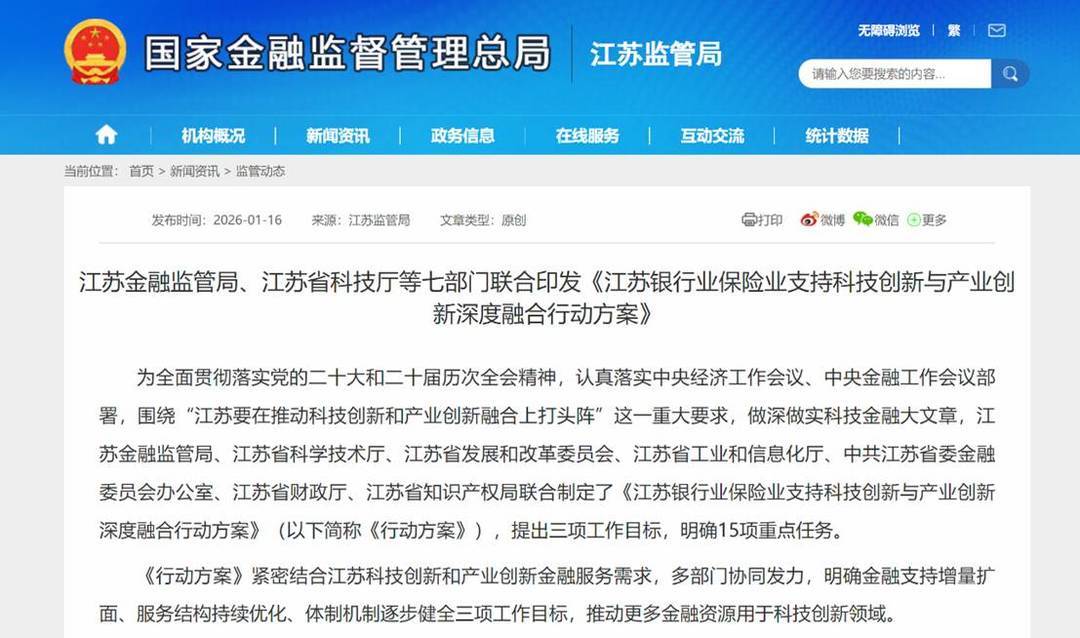
金融支持科技创新与产业创新深度融合,江苏七部门联合印发行动方案
Yang Zi Wan Bao Wang· 2026-01-19 06:55
Core Viewpoint - The Jiangsu Financial Regulatory Bureau, along with several provincial departments, has jointly developed an action plan to support the deep integration of technology and industrial innovation in Jiangsu, aiming to enhance financial services for technological innovation and industry development [1][3]. Group 1: Action Plan Overview - The action plan is designed to implement the spirit of the 20th National Congress of the Communist Party and subsequent meetings, focusing on Jiangsu's role in promoting the integration of technological and industrial innovation [3]. - It sets three main goals: increasing financial support, optimizing service structures, and gradually improving institutional mechanisms to channel more financial resources into technology innovation [3][4]. Group 2: Key Tasks - The action plan outlines 15 key tasks across four areas: 1. Enhancing professional service capabilities, including improving organizational structures and risk management [4]. 2. Innovating product service systems, such as expanding technology finance policy trials and increasing technology credit [4]. 3. Strengthening support for key areas, including backing technological research and modern industrial system construction [4]. 4. Promoting external collaboration, focusing on information sharing and establishing financial reward mechanisms [4]. Group 3: Financial Goals - By the end of 2025, the total balance of technology loans in Jiangsu is projected to reach 5.46 trillion yuan, an increase of 800.3 billion yuan from the beginning of the year, reflecting a growth rate of 17.18% [5].
银行资负跟踪20260119:降准降息还有空间
GF SECURITIES· 2026-01-19 04:26
Investment Rating - The industry investment rating is "Buy" [3] Core Viewpoints - The report indicates that there is still room for further cuts in reserve requirement ratios and interest rates, with a focus on structural monetary policy support for high-quality economic development [15][19] - The central bank has implemented a reduction of 0.25 percentage points in various structural monetary policy tool rates, signaling a supportive monetary policy stance [15][19] - The report emphasizes the importance of timing for future policy implementations, particularly in relation to government bond issuance peaks and the maturity schedule of high-interest bank deposits [15] Summary by Sections 1. Monetary Policy Adjustments - The report notes a reduction of 0.25 percentage points in structural monetary policy tool rates, with a focus on supporting key areas through increased re-lending [15] - Future attention is directed towards December economic data and January LPR [22] 2. Central Bank Dynamics and Market Rates - The central bank conducted a total of 9,515 billion yuan in 7-day reverse repos at an interest rate of 1.40%, with a net injection of 9,741 billion yuan [16] - The report highlights that the funding rates remained stable, with expectations of slight increases due to tax payments and government bond net repayments [16] 3. Bank Financing Tracking - The report indicates that the total outstanding amount of interbank certificates of deposit (CDs) is 19.09 trillion yuan, with an average issuance rate of 1.65% [20] - The report also notes that there were no commercial bank bond issuances during the period, with a total outstanding commercial bank bond size of 3.38 trillion yuan [20]


银行业周报:结构性工具降息扩容,对公贷款有望支撑开门红-20260119
Yin He Zheng Quan· 2026-01-19 03:31
Investment Rating - The report maintains a "Recommended" rating for the banking sector, highlighting the continued dividend value of bank stocks and the positive outlook for the sector [39]. Core Insights - The expansion of structural monetary policy tools and interest rate cuts is expected to support banks in stabilizing their interest margins and enhance support for key areas of the real economy [5][39]. - The report anticipates a marginal improvement in corporate financing demand, with public loans expected to continue supporting the bank's credit growth in early 2026 [5][39]. - The report emphasizes the importance of monitoring the effectiveness of policies and the potential for further monetary easing, including a projected 50 basis points (BP) reduction in reserve requirements and a 10-20 BP cut in interest rates throughout the year [8][39]. Summary by Sections Latest Research Insights - The People's Bank of China (PBOC) has reduced the interest rates on various structural monetary policy tools by 25 BP, which is expected to enhance banks' credit allocation to key sectors [7][8]. - The PBOC's measures include increasing the quotas for re-lending to small and medium-sized enterprises and expanding support for technology innovation and green financing [7][8]. Market Performance - The banking sector underperformed the market, with a decline of 3.03% compared to a 0.57% drop in the CSI 300 index [5][15]. - The report notes that only three A-share banks saw an increase in stock prices, while the majority experienced declines [15]. Investment Recommendations - The report suggests focusing on banks that are likely to benefit from the structural monetary policy changes, recommending specific banks such as Industrial and Commercial Bank of China, Agricultural Bank of China, and Postal Savings Bank of China [39]. - The report highlights the ongoing dividend appeal of bank stocks, driven by factors such as low interest rates and substantial dividend payouts [39]. Financial Data - As of December, the total social financing (TSF) showed a year-on-year increase of 8.3%, with corporate loans demonstrating a notable increase, indicating a recovery in financing demand [9][10]. - The report projects that the total new RMB loans in January 2026 will be approximately 5.5-5.6 trillion yuan, with public loans expected to perform slightly better than the previous year [12][39].



社融增速放缓,信贷仍是企业强、居民弱:银行业周报(20260112-20260118)-20260118
Huachuang Securities· 2026-01-18 09:46
Investment Rating - The report maintains a "Buy" recommendation for the banking sector [1]. Core Insights - The report highlights a slowdown in social financing growth, indicating that credit remains strong for enterprises but weak for households [1]. - In December 2025, the social financing growth rate decreased by 0.2 percentage points to 8.3%, continuing the trend observed in the second half of 2025 [4]. - The report emphasizes that government bonds are the main support for social financing, contributing significantly to the overall increase in financing [4]. - The investment logic for 2026 is expected to shift from purely defensive to a combination of dividends and growth, with a focus on banks with high dividends and low valuations [5]. Summary by Sections Industry Basic Data - The banking sector consists of 42 listed companies with a total market capitalization of approximately 1.15 trillion yuan and a circulating market value of about 790 billion yuan [1]. Market Performance - The absolute performance of the banking sector over the past month is 5.0%, with a relative performance of 2.8% compared to the broader market [2]. Financing and Credit Data - In December 2025, new social financing amounted to 2.21 trillion yuan, which is a year-on-year decrease of 646.2 billion yuan, primarily due to a reduction in government bonds [4]. - The report notes that new RMB loans in December were 910 billion yuan, a year-on-year decrease of 80 billion yuan, with household loans showing a negative growth trend [4]. Investment Recommendations - The report suggests focusing on three main investment lines: state-owned banks and large commercial banks, quality joint-stock banks and city commercial banks with strong performance, and city commercial banks benefiting from regional policies [5]. - Specific banks recommended for investment include China Merchants Bank, CITIC Bank, Ping An Bank, and several city commercial banks [5].
城商行板块1月16日跌1.27%,江苏银行领跌,主力资金净流出2.29亿元
Zheng Xing Xing Ye Ri Bao· 2026-01-16 08:56
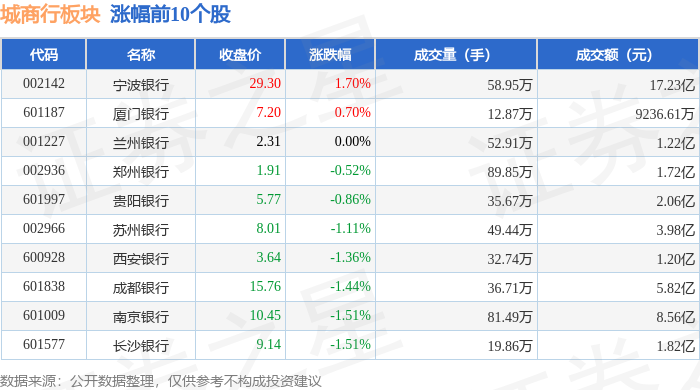
Core Viewpoint - The city commercial bank sector experienced a decline of 1.27% on January 16, with Jiangsu Bank leading the drop. The Shanghai Composite Index closed at 4101.91, down 0.26%, while the Shenzhen Component Index closed at 14281.08, down 0.18% [1]. Group 1: Stock Performance - Ningbo Bank closed at 29.30, up 1.70% with a trading volume of 589,500 shares and a transaction value of 1.723 billion [1]. - Xiamen Bank closed at 7.20, up 0.70% with a trading volume of 128,700 shares and a transaction value of 92.3661 million [1]. - Jiangsu Bank closed at 9.76, down 2.69% with a trading volume of 2,061,300 shares and a transaction value of 2.033 billion [2]. - Shanghai Bank closed at 9.64, down 2.43% with a trading volume of 961,200 shares and a transaction value of 933.3 million [2]. Group 2: Capital Flow - The city commercial bank sector saw a net outflow of 229 million from main funds, while speculative funds had a net inflow of 716 million, and retail investors experienced a net outflow of 487 million [2]. - Hangzhou Bank had a main fund net inflow of 153 million, while retail investors saw a net outflow of 113 million [3]. - Nanjing Bank recorded a main fund net inflow of 70.5 million and a retail net outflow of 131 million [3].

银行行业点评报告:企业信贷超季节性增长,信贷投放前置趋势或延续
KAIYUAN SECURITIES· 2026-01-16 05:44
Investment Rating - Investment rating: Positive (maintained) [2] Core Viewpoints - In December, corporate credit experienced a seasonal growth, with expectations that the credit issuance in Q1 2026 may reach the highest level in history [4] - The report highlights that while the year-end credit issuance slowed down, the impact of debt reduction policies has weakened, allowing for stable credit growth [4] - The report indicates that the demand for corporate loans has shown signs of recovery, with a year-on-year increase of 5.8 trillion yuan in December, although the overall demand still requires further observation [4] - The report notes that the new issuance rates for corporate and personal housing loans have stabilized at 3.10%, reflecting a shift in bank lending strategies [5][6] Summary by Sections Credit Market Analysis - December saw a new issuance of 910 billion yuan in RMB loans, a year-on-year decrease of 80 billion yuan, with a balance growth rate of 6.4% [4] - The corporate loan structure improved, with short-term and medium-to-long-term loans increasing by 3.9 trillion yuan and 2.9 trillion yuan respectively [4] - The report emphasizes that the overall credit demand from residents remains weak, with a year-on-year decrease of 441.6 billion yuan in December [4] Social Financing and Government Bonds - In December, social financing increased by 2.2 trillion yuan, a year-on-year decrease of 646.2 billion yuan, with a stock growth rate of 8.3% [5] - The slowdown in government bond issuance has been identified as a drag on social financing, with new government bonds issued at 683.3 billion yuan, one of the lowest levels of the year [5] Monetary Supply and Deposits - M2 growth in December was 8.5%, while M1 growth fell to 3.8% [6] - The report notes that the increase in fiscal deposits may indicate a weaker year-end fiscal spending compared to the previous year [6] Investment Recommendations - The report suggests that banks with strong wealth management businesses and active financial environments in key regions will benefit from the stable growth policies [7] - Recommended banks include CITIC Bank, with beneficiaries including Agricultural Bank of China, China Merchants Bank, and others [7]

银行行业点评报告:政策支撑稳增长,关注Q1银行景气度修复行情
KAIYUAN SECURITIES· 2026-01-16 03:11
Investment Rating - The investment rating for the banking industry is "Positive" (maintained) [2] Core Viewpoints - The report emphasizes that policy support is crucial for stabilizing growth, with a focus on the recovery of banking sector sentiment in Q1 [4][7] - The People's Bank of China (PBOC) has indicated the feasibility of further interest rate cuts and reserve requirement ratio (RRR) reductions due to high current levels of RRR and a stable exchange rate environment [4] - Structural monetary policy tools have been introduced to lower the overall financing costs in society, with specific interest rate cuts for various loans [5] - The resumption of government bond trading operations by the PBOC is aimed at enhancing the monetary policy toolkit and ensuring smooth issuance of government bonds [6] Summary by Sections Monetary Policy and Economic Recovery - The PBOC's recent measures include a potential for 1-2 interest rate cuts within the year, with a possible reduction of 10 basis points each time, with the earliest cut expected in Q1 [4] - The report notes that the core Consumer Price Index (CPI) has shown positive growth, indicating effective policy collaboration [7] Banking Sector Performance - The banking sector is expected to benefit from improved economic conditions, with a significant increase in credit issuance anticipated in January, potentially the highest in history [7] - Banks with strong wealth management capabilities and those in active financial environments are likely to gain more from the supportive policy landscape [7] Recommendations - The report recommends focusing on banks such as CITIC Bank, Construction Bank, Agricultural Bank, and others, which are expected to benefit from the current economic recovery and policy support [7]