Bank Of Jiangsu(600919)

Search documents
银行行业:2025年12月金融数据点评:企业中长贷边际修复,关注政策成效释放
Yin He Zheng Quan· 2026-01-16 03:11
Investment Rating - The report maintains a "Recommended" rating for the banking industry [1] Core Insights - The banking sector is experiencing a marginal recovery in medium to long-term loans, with a focus on the effectiveness of policy measures being released [1] - Social financing (社融) has shown a year-on-year decrease, with a month-on-month decline in growth rate. In December, new social financing amounted to 2.21 trillion yuan, a year-on-year decrease of 645.7 billion yuan [5] - The growth of RMB loans and corporate bonds has made a significant positive contribution to social financing increment, with RMB loans increasing by 975.7 billion yuan in December, a year-on-year increase of 135.5 billion yuan [5] - Corporate loans have shown a notable increase, with a total increase of 1.1 trillion yuan in December, a year-on-year increase of 580 billion yuan, indicating a marginal recovery in financing demand from the real economy [5] - The M2 growth rate has risen, with M1 and M2 increasing by 3.8% and 8.5% year-on-year, respectively [5] - The report suggests that the government bond's contribution to social financing has weakened towards the end of the year, while RMB credit shows signs of marginal improvement, primarily supported by corporate loans [5] Summary by Sections Social Financing - In December, the total social financing stock increased by 8.3% year-on-year, with a month-on-month decline of 0.2 percentage points [5] - The structure of corporate loans has improved, with medium to long-term loans increasing by 330 billion yuan and short-term loans by 370 billion yuan [5] Loan Data - As of the end of December, the balance of RMB loans from financial institutions increased by 6.4% year-on-year, remaining stable compared to the previous month [5] - The demand for loans from the household sector remains weak, with a decrease of 916 billion yuan in December, a year-on-year decrease of 4.416 trillion yuan [5] Investment Recommendations - The report emphasizes the continued attractiveness of the banking sector's dividend value, recommending specific banks such as Industrial and Commercial Bank of China, Agricultural Bank of China, and others [5]






银行今十条:央行明确2026年降准降息仍有空间;梁衍波拟任青岛农商行董事长;凌晨点外卖触发银行卡风控,四川农商行回应...
Jin Rong Jie· 2026-01-15 12:35
Monetary Policy - The People's Bank of China (PBOC) confirmed that there is still room for interest rate cuts and reserve requirement ratio (RRR) reductions in 2026, maintaining a moderately accommodative monetary policy [1] - On January 19, 2026, the PBOC will lower the re-lending and re-discount rates by 0.25 percentage points, with new rates set at 0.95%, 1.15%, and 1.25% for 3-month, 6-month, and 1-year re-lending respectively [1] Liquidity Injection - The PBOC conducted a 900 billion yuan reverse repo operation on January 15, 2026, resulting in a net injection of 300 billion yuan, marking the fifth consecutive month of increased reverse repo operations [2] - This action is part of an ongoing effort to maintain adequate liquidity in the market ahead of the Spring Festival [2] Housing Loan Rates - Starting January 1, 2026, the national housing provident fund loan rates were adjusted to 2.6% for first homes and 3.075% for second homes, nearing historical lows [3] - Future adjustments to these rates will depend on the macroeconomic environment and the recovery of the real estate market [3] Deposit Market Trends - Short-term large-denomination time deposit rates have declined, with some banks offering rates that have entered the "0" range, reducing their attractiveness compared to regular fixed deposits [4] - This trend reflects the ongoing marketization of deposit rates and is influenced by the overall monetary policy environment [4] Wealth Management Industry - As of December 2025, 14 leading wealth management companies reported a combined scale of 25.41 trillion yuan, showing a year-on-year growth of approximately 13.3% despite a slight decline from the peak in November [5] - The overall wealth management industry reached a peak of nearly 34 trillion yuan in November 2025, marking a significant increase of over 4 trillion yuan since the beginning of the year [5] Bank Dividends - In early 2026, three banks distributed nearly 300 billion yuan in dividends, indicating a faster pace of dividend distribution compared to previous years [6] - This trend reflects the banks' operational stability and provides tangible returns to shareholders, boosting market confidence [6] Payment Services - Visa announced that Chinese cardholders can now link their Visa cards to Apple Pay, with eight banks initially supporting this service [7] - This development enhances the convenience of cross-border payments for domestic cardholders and aligns with the global trend of contactless transactions [7] Leadership Changes - Liang Yanbo has been nominated as the candidate for the chairman of Qingdao Rural Commercial Bank, pending approval from the shareholders' meeting [9] - Liang has extensive experience within the Shandong rural credit system, having held various leadership positions [9] Banking Operations - Sichuan Rural Commercial Bank addressed concerns regarding card transaction limits that triggered risk controls, clarifying that users can adjust these limits through mobile banking or at bank counters [10] - This response aims to alleviate customer concerns and streamline the process for adjusting transaction limits [10] Global Economic Outlook - The World Bank reported that global economic resilience has exceeded expectations, but the income gap between rich and poor countries continues to widen [11] - The projected growth rate for per capita income in developing economies is 3% for 2026, which is lower than the average growth rate from 2000 to 2019 [11]


城商行板块1月15日跌0.59%,青岛银行领跌,主力资金净流入2.21亿元
Zheng Xing Xing Ye Ri Bao· 2026-01-15 08:59
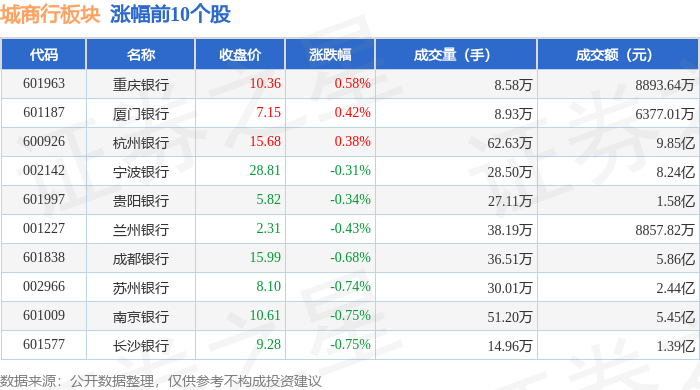
Market Performance - The city commercial bank sector declined by 0.59% on January 15, with Qingdao Bank leading the decline [1] - The Shanghai Composite Index closed at 4112.6, down 0.33%, while the Shenzhen Component Index closed at 14306.73, up 0.41% [1] Individual Stock Performance - Chongqing Bank closed at 10.36, up 0.58% with a trading volume of 85,800 shares and a transaction value of 88.94 million [1] - Xiamen Bank closed at 7.15, up 0.42% with a trading volume of 89,300 shares and a transaction value of 63.77 million [1] - Hangzhou Bank closed at 15.68, up 0.38% with a trading volume of 626,300 shares and a transaction value of 9.85 billion [1] - Ningbo Bank closed at 28.81, down 0.31% with a trading volume of 285,000 shares and a transaction value of 824 million [1] - Chengdu Bank closed at 15.99, down 0.68% with a trading volume of 365,100 shares and a transaction value of 586 million [1] Capital Flow Analysis - The city commercial bank sector saw a net inflow of 221 million from institutional investors and a net inflow of 296 million from speculative funds, while retail investors experienced a net outflow of 517 million [2] - Hangzhou Bank had a net inflow of 123 million from institutional investors, accounting for 12.51% of its total [3] - Shanghai Bank had a net inflow of 97.02 million from institutional investors, representing 20.87% of its total [3] - Nanjing Bank had a net inflow of 37.40 million from institutional investors, making up 6.86% of its total [3]



苏常柴A:关于收到江苏银行股份有限公司现金分红款的公告
Zheng Quan Ri Bao· 2026-01-14 12:36
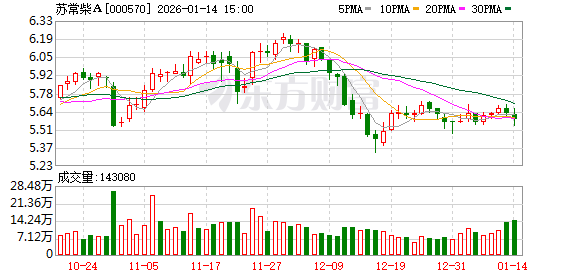
Group 1 - The core point of the article is that Suchang Chai A has approved a profit distribution plan for Jiangsu Bank for the year 2025, which includes a cash dividend of 0.3309 yuan per share [2] - The company holds 23.4 million shares of Jiangsu Bank, which will result in a total cash dividend of approximately 7.74306 million yuan, contributing to the company's investment income [2] - The company has recently received the full amount of the cash dividend as per the approved distribution plan [2]

城商行板块1月14日跌2.11%,北京银行领跌,主力资金净流出7.29亿元
Zheng Xing Xing Ye Ri Bao· 2026-01-14 08:58
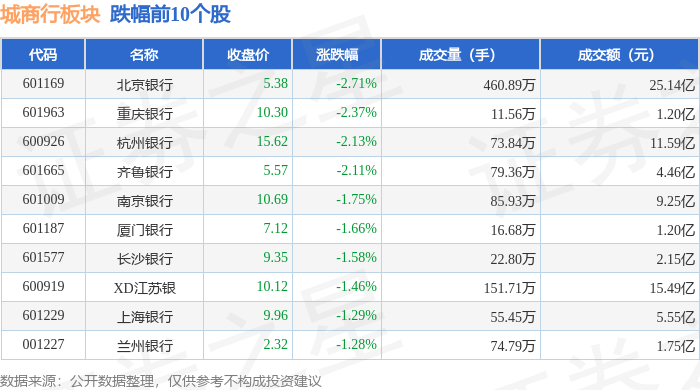
Core Viewpoint - The city commercial bank sector experienced a decline of 2.11% on January 14, with Beijing Bank leading the drop, while the overall market showed mixed results with the Shanghai Composite Index down 0.31% and the Shenzhen Component Index up 0.56% [1] Group 1: Market Performance - The closing price of Beijing Bank was 5.38, down 2.71%, with a trading volume of 4.6089 million shares and a transaction value of 2.514 billion [1] - Other notable declines included Chongqing Bank at 10.30 (-2.37%), Hangzhou Bank at 15.62 (-2.13%), and Qilu Bank at 5.57 (-2.11%) [1] - The city commercial bank sector saw a net outflow of 729 million in main funds, while retail investors contributed a net inflow of 53.1975 million [1] Group 2: Fund Flow Analysis - Hangzhou Bank had a main fund net inflow of 1.20 billion, but a net outflow from retail investors of 92.9469 million [2] - Suzhou Bank recorded a net inflow of 52.503 million from main funds, while retail investors had a net outflow of 54.0558 million [2] - Shanghai Bank experienced a main fund net inflow of 45.3249 million, with a retail net outflow of 46.6735 million [2]

苏常柴A:收到江苏银行现金分红款774.306万元
Ge Long Hui· 2026-01-14 08:30
Core Viewpoint - Jiangsu Bank has approved a cash dividend distribution plan for the first half of 2025, which will benefit the company through its shareholding in the bank [1] Group 1: Dividend Distribution - Jiangsu Bank's 2025 interim profit distribution plan includes a cash dividend of 0.3309 yuan per share (tax included) [1] - The company holds 23.4 million shares of Jiangsu Bank, which will result in a total cash dividend of 7.74306 million yuan, contributing to the company's investment income [1] - The company has recently received the full amount of the dividend [1]
苏常柴A(000570.SZ):收到江苏银行现金分红款774.306万元
Ge Long Hui A P P· 2026-01-14 08:26
Core Viewpoint - Suchang Chai A (000570.SZ) announced the approval of a cash dividend distribution plan for the first half of 2025, with a payout of 0.3309 yuan per share (including tax) [1] Group 1: Dividend Distribution - Jiangsu Bank's 2025 interim profit distribution plan was approved, allowing for a cash dividend of 0.3309 yuan per share [1] - Suchang Chai currently holds 23.4 million shares of Jiangsu Bank, which will result in a total cash dividend of 7.74306 million yuan, recognized as investment income [1] - The company has received the full amount of the dividend recently [1]
国际金价飙升引爆银行“淘金热”
Jin Tou Wang· 2026-01-14 06:08
Group 1 - International gold prices have been rising, prompting both domestic and foreign banks to launch gold-linked structured deposit products, which appeal to conservative investors due to their "capital protection" and yield flexibility [2] - Several banks have introduced related products since the beginning of 2026, with potential maximum annual yields reaching 4.5% [2] - Foreign banks' products have high entry thresholds and longer terms, such as DBS Bank requiring a minimum investment of $10,000 for a 12-month term, while HSBC China requires $20,000 for a 3-year term, and Standard Chartered Bank has a minimum subscription of $75,000 for an 18-month term [2] Group 2 - In contrast, domestic banks offer more accessible products with shorter terms and lower risks, with institutions like Jiangsu Bank, Shanghai Rural Commercial Bank, and China Merchants Bank having minimum investment amounts generally around $1,000 and terms ranging from 7 to 90 days [2] - Experts from the Beijing Wealth Management Industry Association indicate that the current trend of de-dollarization and geopolitical fluctuations are driving demand for gold, which remains strong in the market [2] - Companies are actively participating in the allocation of such products, although investors are advised to choose wisely, as structured deposits, while promising capital protection, have returns linked to market performance [2]
泰州金融监管分局同意江苏银行兴化昭阳支行开业
Jin Tou Wang· 2026-01-14 04:17
二、核准江苏银行兴化昭阳支行业务范围为:经银行保险监督管理机构或其他有行政许可权的机构批准 并经上级机构授权办理的业务。 三、接此批复文件后,江苏银行兴化昭阳支行应按照有关规定领取许可证并办理开业前的相关手续。开 业后及时向泰州金融监管分局报告相关情况。 2026年1月8日,泰州金融监管分局发布批复称,《江苏银行(600919)泰州分行关于兴化昭阳支行开业 的请示》(苏银泰发〔2025〕105号)收悉。经审核,现批复如下: 一、同意江苏银行股份有限公司兴化昭阳支行开业,营业场所为江苏省泰州市兴化市海德国际7号地块 A楼英武中路71、73、75号。 ...
城商行板块1月13日涨1.55%,宁波银行领涨,主力资金净流入2.38亿元
Zheng Xing Xing Ye Ri Bao· 2026-01-13 09:06
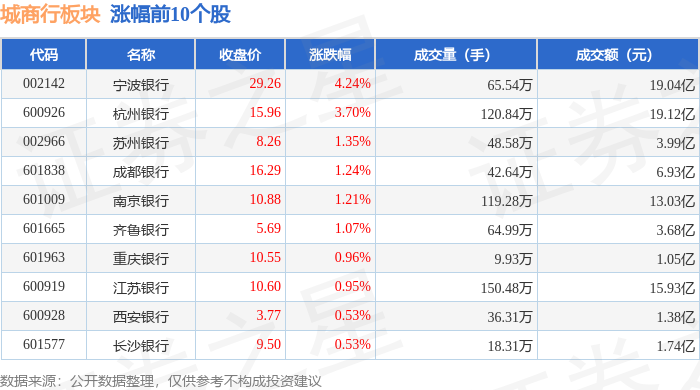
Core Insights - The city commercial bank sector experienced a rise of 1.55% on January 13, with Ningbo Bank leading the gains [1] - The Shanghai Composite Index closed at 4138.76, down 0.64%, while the Shenzhen Component Index closed at 14169.4, down 1.37% [1] Stock Performance - Ningbo Bank (002142) closed at 29.26, up 4.24%, with a trading volume of 655,400 shares and a transaction value of 1.904 billion [1] - Hangzhou Bank (600926) closed at 15.96, up 3.70%, with a trading volume of 1,208,400 shares and a transaction value of 1.912 billion [1] - Suzhou Bank (002966) closed at 8.26, up 1.35%, with a trading volume of 485,800 shares [1] - Chengdu Bank (601838) closed at 16.29, up 1.24%, with a trading volume of 426,400 shares and a transaction value of 693 million [1] - Nanjing Bank (600109) closed at 10.88, up 1.21%, with a trading volume of 1,192,800 shares and a transaction value of 1.303 billion [1] - Qilu Bank (601665) closed at 5.69, up 1.07%, with a trading volume of 649,900 shares and a transaction value of 368 million [1] - Chongqing Bank (601963) closed at 10.55, up 0.96%, with a trading volume of 99,300 shares and a transaction value of 10.5 million [1] - Jiangsu Bank (616009) closed at 10.60, up 0.95%, with a trading volume of 1,504,800 shares and a transaction value of 1.593 billion [1] - Xi'an Bank (600928) closed at 3.77, up 0.53%, with a trading volume of 363,100 shares and a transaction value of 13.8 million [1] - Changsha Bank (601577) closed at 9.50, up 0.53%, with a trading volume of 183,100 shares and a transaction value of 174 million [1] Capital Flow - The city commercial bank sector saw a net inflow of 238 million from institutional investors, while retail investors contributed a net inflow of 199 million [2] - The sector experienced a net outflow of 437 million from speculative funds [2] Individual Stock Capital Flow - Hangzhou Bank (600926) had a net inflow of 70.42 million from institutional investors, while it faced a net outflow of 12.4 million from speculative funds [3] - Shanghai Bank (601229) saw a net inflow of 66.71 million from institutional investors, with a net outflow of 33.15 million from speculative funds [3] - Ningbo Bank (002142) had a net inflow of 37.18 million from institutional investors, with a net outflow of 1.4 million from speculative funds [3] - Suzhou Bank (002966) experienced a net inflow of 34.87 million from institutional investors, while facing a net outflow of 24.25 million from speculative funds [3] - Jiangsu Bank (601577) had a net inflow of 20.83 million from institutional investors, with a net outflow of 15.24 million from speculative funds [3]