
NJBK(601009)

Search documents
知名QFII,加仓!
Zhong Guo Ji Jin Bao· 2025-09-28 10:11
Core Insights - Nanjing Bank has seen significant share increases from major shareholders, particularly from BNP Paribas, which raised its stake from 16.14% to 17.02% by acquiring 108,093,950 shares [2][3] - The bank's stock price experienced a rebound after a previous decline, with shares trading at 10.46 CNY on September 22 and closing at 11.26 CNY on September 26 [3] Shareholder Activity - BNP Paribas (QFII) increased its holdings from 419,851,157 shares (3.40%) to 527,945,107 shares (4.27%) through concentrated bidding on the Shanghai Stock Exchange [3] - Zijin Trust, a subsidiary of Zijin Group, acquired 56,779,800 shares (0.46%) between July 18 and September 10, raising its total stake from 12.56% to 13.02% [5] - Nanjing Gaoke also increased its holdings by 7,507,700 shares, raising its stake from 8.94% to 9.00% during the period from July 24 to August 4 [5] Context of Share Increases - The increases in shareholding are attributed to the dilution of ownership percentages following the early redemption of "Nanjing Bank Convertible Bonds," which raised the total share count to 12,363,567,245 [5] - Following the bond redemption, major shareholders experienced a decrease in their ownership percentages, prompting them to increase their stakes to maintain or enhance their equity positions [5]



南京银行(601009) - 南京银行股份有限公司关于持股5%以上股东权益变动触及1%刻度的提示性公告
2025-09-28 08:00
| 证券代码:601009 | | 证券简称:南京银行 | 公告编号:2025-070 | | --- | --- | --- | --- | | 优先股简称:南银优 | 1 | | 优先股代码:360019 | | 南银优 | 2 | | 360024 | 南京银行股份有限公司关于持股 5%以上股东权益 变动触及 1%刻度的提示性公告 本公司大股东法国巴黎银行及法国巴黎银行(QFII)保证向本公司提供的信息真 实、准确、完整,没有虚假记载、误导性陈述或重大遗漏。 本公司董事会及全体董事保证公告内容与信息披露义务人提供的信息一致。 近日,南京银行股份有限公司(以下简称"本公司")收到大股东法国巴 黎银行《关于增持南京银行股份有限公司股份的告知函》,法国巴黎银行(QFII) 于 2025 年 9 月 22 日至 2025 年 9 月 26 日期间以自有资金通过上海证券交易所交 易系统以集中竞价交易方式增持本公司股份。现将法国巴黎银行及法国巴黎银行 (QFII)有关权益变动情况公告如下: 一、 信息披露义务人及其一致行动人的基本信息 1.身份类别 | | □控股股东/实际控制人及其一致行动人 □其他 5%以上大股 ...
固收深度报告20250927:从42家上市银行半年报解读银行债券投资“攻守道”





Soochow Securities· 2025-09-27 14:32
1. Report Industry Investment Rating No information about the report industry investment rating is provided in the given content. 2. Core Viewpoints of the Report - External environment factors such as interest rate fluctuations, bond supply - demand, and policy orientation jointly impact bond investment returns. In H1 2025, the bond investment of 42 listed banks showed certain characteristics in scale, structure, and profit and loss, but there are still challenges in maintaining stable returns in the future [1]. - The overall bond investment scale of 42 listed banks expanded steadily in H1 2025. There were differences in the investment structure among different types of banks, with state - owned banks and city commercial banks having stable growth in the bond allocation portfolio, while joint - stock banks and rural commercial banks increased their efforts in the bond trading portfolio. The bond investment portfolio generally presented a pattern of "stable foundation and flexible gain" [1]. - The coupon income of 42 listed banks was generally stable in H1 2025 but showed a slight year - on - year decline. The fair value change loss was significant, and the investment income increased. However, the bond investment of the banking industry still faces pressure to maintain stable returns [1]. 3. Summary According to the Table of Contents 3.1 42 Listed Banks' Bond Investment Volume - **Overall Bond Investment Scale: Steady Expansion**: In H1 2025, the total scale of the three types of bond - type financial assets of 42 listed banks showed a steady expansion trend. The growth of debt investment - type financial assets measured at amortized cost was relatively slow, while the growth of trading financial assets measured at fair value and included in current profits and losses was relatively large, indicating that banks increased the proportion of trading positions [9]. - **Differentiated Bond Investment Distribution Structures among Different Bank Types**: In H1 2025, state - owned banks and city commercial banks showed stable growth in the bond allocation portfolio, which may be related to their participation in the primary - market issuance of important national and regional bond varieties. Joint - stock banks and rural commercial banks slightly weakened their bond allocation power but significantly increased their efforts in the bond trading portfolio, showing a differentiated feature of "stable allocation by large banks and prominent trading flexibility by small and medium - sized banks" [13]. - **Bond Investment Allocation Tilted towards Government - Related Bonds**: In H1 2025, commercial banks increased their allocation of government - related bonds, with an average month - on - month increase of about 10% for state - owned banks, joint - stock banks, and city commercial banks, and a slightly smaller increase for rural commercial banks. The allocation of financial bonds and other bonds was differentiated. All banks held a relatively large scale of government - related bonds, followed by financial bonds and credit - related bonds [18]. - **Correlation between Financial Asset Types and Bond Variety Structures**: The banking industry maintained a stable growth of interest - rate bonds in the bond allocation portfolio and increased the allocation of credit bonds, while the allocation of financial bonds was relatively weak. In the bond trading portfolio, interest - rate bonds and financial bonds were the core varieties, with a more significant increase than credit bonds, showing a "stable foundation and flexible gain" pattern [22]. 3.2 42 Listed Banks' Bond Investment Profit and Loss - **Coupon Income: Generally Stable and Still the Main Source of Income**: In H1 2025, the total coupon income of 42 listed banks decreased slightly year - on - year. Although the scale of held - to - maturity bonds increased, the decline in the coupon rate of newly issued bonds led to a decrease in coupon income. In the future, coupon income is still expected to be the main source of bond investment income for commercial banks [26]. - **Fair Value Change Loss: Losses in the Trading Level**: In H1 2025, the total fair value change loss of 42 listed banks decreased significantly year - on - year, indicating that it was difficult to obtain capital gains through short - term trading in the volatile bond market, and there were floating losses in bond trading [28]. - **Investment Income: Growth in All Bank Types**: In H1 2025, the actual investment income of 42 listed banks in the bond field increased significantly year - on - year. Although the book value appreciation of bond - type trading financial assets and other debt investment - type financial assets was not as good as that of the previous year, banks could still increase their investment income by selling floating - profit old bonds and waiting for the maturity of high - coupon bonds [31]. 3.3 Attribution and Summary - **External Environment Driving Factors: Interest Rate Fluctuations, Bond Supply - Demand, and Policy Orientation Jointly Impact Bond Investment Returns**: In H1 2025, the "more adjustments and fewer opportunities" bond market environment led to a general decline in the prices of existing bonds, resulting in a significant year - on - year decline in the fair value change loss of listed banks' bond investment. The supply of national bonds, local government bonds, and policy - based financial bonds increased, but the coupon rate of newly issued bonds decreased, leading to a decline in coupon income. Regulatory policies indirectly affected bond investment performance [35]. - **Banking Industry's Bond Investment Pressure and Future Outlook** - Overall Income Shows a Positive Trend but There Are Still Hidden Concerns: In H1 2025, the actual bond investment income of 42 listed banks increased slightly year - on - year, but the coupon income faced downward pressure in the interest - rate downward cycle, and it was more difficult to obtain spread income through band trading. Since H2 2025, the "stock - strong and bond - weak" pattern has emerged, and the loss caused by fair value change will be more obvious [3]. - Different Bank Types Show Differentiated Performance, and State - owned Banks' Pressure Is Relatively Controllable: State - owned banks can maintain a certain profit - making ability in the low - interest - rate volatile bond market due to their advantages in bond allocation and trading portfolios. Joint - stock banks, city commercial banks, and rural commercial banks are more vulnerable, and they may increase their capital allocation in the equity market, commodity market, and related structured fixed - income products in the future [3].
华明电力装备股份有限公司 关于为下属全资公司提供担保的进展公告
Zhong Guo Zheng Quan Bao - Zhong Zheng Wang· 2025-09-27 00:39
Summary of Key Points Core Viewpoint - The company, Huaming Power Equipment Co., Ltd., has signed a guarantee contract with Nanjing Bank to provide a joint liability guarantee for its wholly-owned subsidiary, Shanghai Huaming Electric Equipment Manufacturing Co., Ltd., for a loan of 50 million RMB [1][3]. Group 1: Guarantee Overview - On September 26, 2025, the company signed a guarantee contract with Nanjing Bank to secure a loan for Shanghai Huaming amounting to 50 million RMB, including interest, penalties, and other fees [1][3]. - Prior to this guarantee, the total guarantee balance for Shanghai Huaming was 913 million RMB, which increased to 963 million RMB after this transaction [2]. Group 2: Guarantee Approval Process - The company held board meetings on April 10, 2025, and May 15, 2025, to approve the proposal for bank credit guarantees, which was subsequently ratified at the 2024 annual general meeting [1][2]. Group 3: Basic Information of the Guaranteed Entity - Shanghai Huaming Electric Equipment Manufacturing Co., Ltd. was established on April 3, 1995, with a registered capital of 39.11225 million RMB and is located in Shanghai [2]. - The company specializes in manufacturing power facility equipment and related technical services [2]. Group 4: Main Content of the Guarantee Agreement - The guarantee period is set for three years from the maturity date of the principal debt, with provisions for extensions if the principal debt is deferred [3]. - The maximum guarantee amount is capped at 50 million RMB, covering principal, interest, penalties, and other fees [3]. Group 5: Cumulative External Guarantee and Status - As of the announcement date, the total guarantee amount provided by the company and its subsidiaries is 2.0325 billion RMB, with actual guarantees amounting to 450.0281 million RMB, representing 14.15% of the company's audited net assets for 2024 [4]. - There are no overdue guarantees or litigation issues related to the external guarantees provided by the company [4].

银行行业资金流入榜:农业银行、工商银行等净流入资金居前
Zheng Quan Shi Bao Wang· 2025-09-26 09:41
Market Overview - The Shanghai Composite Index fell by 0.65% on September 26, with 10 industries experiencing gains, led by the oil and petrochemical sector with a rise of 1.17% and the environmental sector with a 0.38% increase [1] - The banking sector saw a slight increase of 0.08% [1] - The computer and electronics sectors faced the largest declines, with drops of 3.26% and 2.75% respectively [1] Capital Flow Analysis - The main capital outflow from the two markets totaled 83.579 billion yuan, with five industries experiencing net inflows [1] - The automotive industry led the net inflow with 0.882 billion yuan, despite a decline of 0.56% in its stock price [1] - The banking sector also saw a net inflow of 0.566 billion yuan, with a daily increase of 0.08% [1] Banking Sector Performance - The banking sector had 42 listed stocks, with 25 stocks rising and 11 stocks falling on the day [2] - Notable net inflows in the banking sector included Agricultural Bank with 0.180 billion yuan, followed by Industrial and Commercial Bank with 0.114 billion yuan, and Nanjing Bank with 0.08877 billion yuan [2] - The stocks with the largest net outflows included Jiangsu Bank, Ningbo Bank, and Hangzhou Bank, with outflows of 0.0659835 billion yuan, 0.0505540 billion yuan, and 0.0371151 billion yuan respectively [2][3] Individual Stock Performance - Agricultural Bank's stock increased by 0.15% with a turnover rate of 0.12% and a main capital flow of 180.29 million yuan [2] - Industrial and Commercial Bank's stock rose by 0.41% with a turnover rate of 0.10% and a main capital flow of 113.51 million yuan [2] - Nanjing Bank's stock saw a significant increase of 2.36% with a turnover rate of 0.66% and a main capital flow of 88.77 million yuan [2] - Other notable performances included Ping An Bank with no change in stock price and a capital flow of 69.46 million yuan, while Shanghai Bank increased by 1.01% with a capital flow of 12.39 million yuan [2]

南京银行涨2.00%,成交额5.87亿元,主力资金净流入996.41万元
Xin Lang Cai Jing· 2025-09-26 06:05
Group 1 - The core stock price of Nanjing Bank increased by 2.00% on September 26, reaching 11.22 CNY per share, with a total market capitalization of 138.72 billion CNY [1] - Year-to-date, Nanjing Bank's stock price has risen by 7.36%, with a 7.06% increase over the last five trading days and a 0.90% increase over the last 20 days, while it has decreased by 7.04% over the last 60 days [1] - The main business revenue composition of Nanjing Bank includes 48.79% from banking operations, 25.90% from funding operations, 24.98% from personal banking, and 0.33% from other operations [1] Group 2 - As of June 30, the number of shareholders of Nanjing Bank was 75,500, a decrease of 5.26% from the previous period, while the average circulating shares per person increased by 29.37% to 161,432 shares [2] - For the first half of 2025, Nanjing Bank reported a net profit attributable to shareholders of 12.619 billion CNY, representing a year-on-year growth of 8.84% [2] - Nanjing Bank has distributed a total of 45.939 billion CNY in dividends since its A-share listing, with 17.128 billion CNY distributed in the last three years [3] Group 3 - The top ten circulating shareholders of Nanjing Bank include Hong Kong Central Clearing Limited, which holds 351 million shares, an increase of 51.727 million shares from the previous period [3]
南京银行无锡分行跨境金融服务再升级 “出口快贷2.0”赋能外贸企业高质量发展
Yang Zi Wan Bao Wang· 2025-09-25 14:10
Core Insights - Nanjing Bank has successfully launched the upgraded "Export Quick Loan 2.0" product, providing a comprehensive financing solution for small and micro foreign trade enterprises [5][6] - The product allows for quick approval and disbursement of international trade financing, addressing liquidity pressures faced by exporters [5] Group 1: Product Features - The "Export Quick Loan 2.0" offers a financing limit of up to 3.87 million yuan and an additional 100,000 yuan for derivative trading [5] - The product utilizes digital risk control technology and scenario-based service concepts to enhance the foreign trade financing experience [5] - It provides online approval without the need for collateral, with a maximum credit loan of 10 million yuan available [5] Group 2: Service Efficiency - The financing and derivative trading limits were approved on the same day the application was made via mobile scan, demonstrating the efficiency of the service [5] - The entire process from application to the completion of export financing and forward exchange business took only two working days [5] Group 3: Future Plans - Nanjing Bank's Wuxi branch plans to continue focusing on the actual needs of foreign trade enterprises, enriching its financial product system and innovating service models [6] - The bank aims to enhance its cross-border financial service capabilities to support the high-quality development of foreign trade enterprises [6]

城商行板块9月25日跌0.94%,重庆银行领跌,主力资金净流出2.78亿元
Zheng Xing Xing Ye Ri Bao· 2025-09-25 08:37
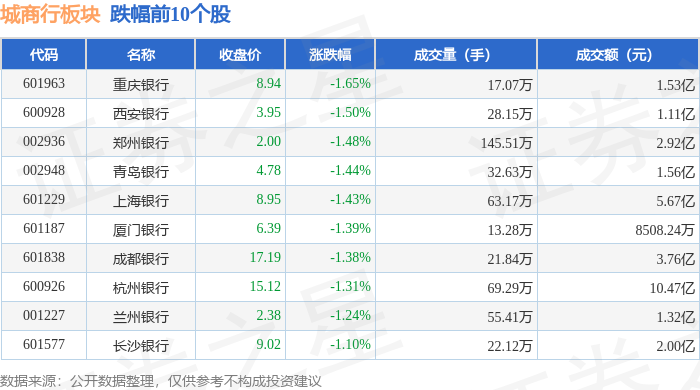
Market Performance - The city commercial bank sector declined by 0.94% on September 25, with Chongqing Bank leading the decline [1] - The Shanghai Composite Index closed at 3853.3, down 0.01%, while the Shenzhen Component Index closed at 13445.9, up 0.67% [1] Individual Stock Performance - Chongqing Bank closed at 8.94, down 1.65% with a trading volume of 170,700 shares and a transaction value of 153 million [1] - Other notable declines include Xi'an Bank down 1.50% to 3.95, Zhengzhou Bank down 1.48% to 2.00, and Qingdao Bank down 1.44% to 4.78 [1] - Shanghai Bank and Xiamen Bank also saw declines of 1.43% and 1.39%, respectively [1] Capital Flow Analysis - The city commercial bank sector experienced a net outflow of 278 million from institutional investors, while retail investors saw a net inflow of 152 million [1] - The table indicates that Suzhou Bank had a significant net outflow from institutional investors of 48.08 million, while Qilu Bank had a net inflow of 25.86 million [2] - Chongqing Bank specifically had a net outflow of 5.68 million from institutional investors but a net inflow of 10.91 million from retail investors [2]

小红日报|标普红利ETF(562060)9月24日龙虎榜
Xin Lang Ji Jin· 2025-09-25 01:05
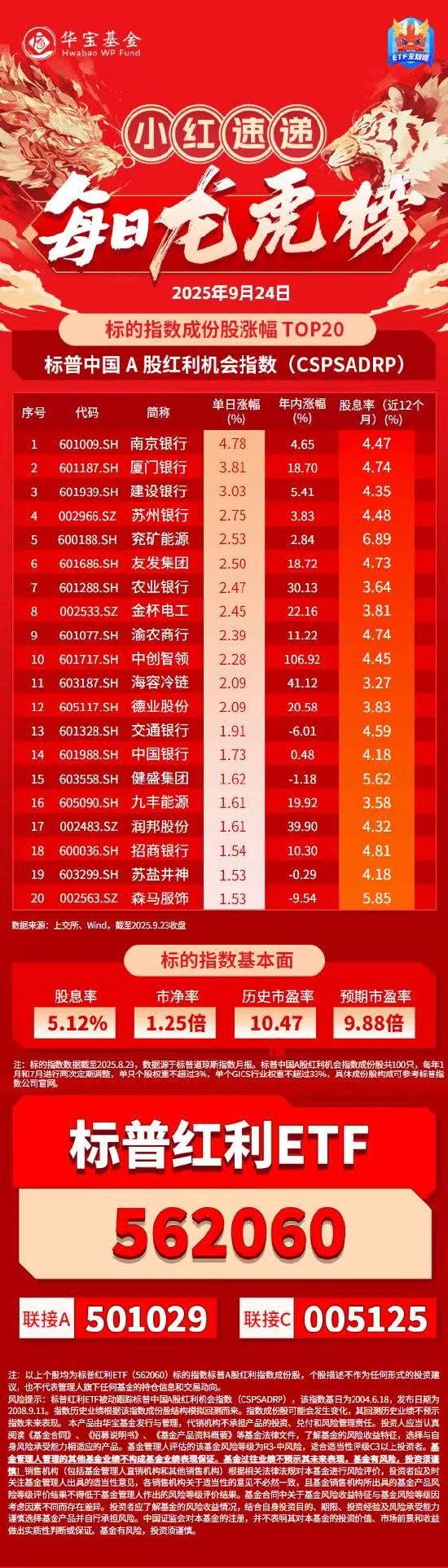
Group 1 - The article highlights the top 20 stocks in the S&P China A-Share Dividend Opportunity Index, showcasing their performance in terms of daily increase, year-to-date increase, and dividend yield [1] - Nanjing Bank (601009.SH) leads with a daily increase of 4.78% and a year-to-date increase of 4.65%, with a dividend yield of 4.47% [1] - Xiamen Bank (601187.SH) shows a significant year-to-date increase of 18.70%, with a daily increase of 3.81% and a dividend yield of 4.74% [1] Group 2 - Agricultural Bank of China (601288.SH) has a remarkable year-to-date increase of 30.13%, with a daily increase of 2.47% and a dividend yield of 3.64% [1] - China Merchants Bank (600036.SH) reports a daily increase of 1.54% and a year-to-date increase of 10.30%, with a dividend yield of 4.81% [1] - The article also notes the formation of a MACD golden cross signal, indicating a positive trend for certain stocks [3]



双枪科技股份有限公司 关于子公司为公司提供担保的进展公告
Zhong Guo Zheng Quan Bao - Zhong Zheng Wang· 2025-09-24 22:46
Group 1 - The company plans to provide a total guarantee amount of 81.85 million yuan for its subsidiaries in 2025, with 9 million yuan to be provided by wholly-owned subsidiaries to the company [2] - The company has signed a maximum guarantee contract with Nanjing Bank for a credit limit of 5 million yuan [3] - The guarantee is within the approved limit and is a joint liability guarantee with a guarantee period of three years [5] Group 2 - As of the announcement date, the company's external guarantees are solely for its wholly-owned subsidiaries, with a total external guarantee balance of 33.45 million yuan, accounting for 38.39% of the company's latest audited net assets [6] - There are no overdue external guarantees or guarantees involved in litigation as of the current date [6]