NJBK(601009)

Search documents
跨境流动性跟踪20260208:贸易回流比率再度回正,服务逆差大幅收窄
GF SECURITIES· 2026-02-09 01:11
Investment Rating - The industry rating is "Buy" [4] Core Views - The trade return ratio has turned positive again, and the service trade deficit has significantly narrowed [16][18] - The cross-border capital flow is expected to gradually return, positively impacting domestic liquidity [5][19] - The service trade deficit for December 2025 was 966 billion CNY, a year-on-year decrease of 466 billion CNY, with a full-year deficit of 13,760 billion CNY, down 2,544 billion CNY, approximately 16% [18] Summary by Sections 1. Current Observation - The State Administration of Foreign Exchange (SAFE) released data on China's international balance of payments for December 2025, indicating a potential impact on the central bank's willingness to settle foreign exchange [16] - The trade return ratio is at a historical high, with a monthly unconverted trade net outflow of 447 billion CNY, a year-on-year increase of 1,392 billion CNY [17] 2. Arbitrage Trading Returns - The arbitrage trading return rate for 10Y US Treasury bonds in CNY has dropped significantly to -1.77%, indicating a shift in cross-border capital dynamics [17] 3. Service Trade Deficit - The service trade deficit has narrowed significantly, with major contributions from improved policies for foreign visitors, reduced international shipping costs, and enhanced competitiveness in high-tech services [18] 4. Cross-Border Liquidity Outlook - Despite the recent appointment of Kevin Warsh as the next Federal Reserve Chair, the trend of cross-border capital return is expected to continue, influenced by the Fed's monetary policy stance [19][21] - The short-term liquidity in the US remains tight, with limited space for balance sheet reduction, while long-term prospects depend on economic performance [20][21]




美股大涨能否引燃A股红包行情?净利润连增5年的公司出炉,光模块龙头业绩爆了
Xin Lang Cai Jing· 2026-02-08 23:35
Core Viewpoint - The 2025 annual reports of listed companies are being released, revealing a number of companies with strong performance and continuous profit growth over the past five years [1][16]. Group 1: Company Performance - A total of 62 companies have reported continuous net profit growth for five consecutive years, with significant representation from the machinery, banking, automotive, and pharmaceutical industries [5][16]. - The machinery sector shows a remarkable increase in net profit, with a year-on-year growth of over 290% for 2025, driven by cost reduction and efficiency improvements, as well as expansion into emerging markets [5][16]. - In the banking sector, eight companies are included, with China Merchants Bank achieving a net profit exceeding 150 billion yuan, marking a historical high [5][16]. - The automotive and pharmaceutical sectors each have six companies reporting substantial profit growth, with specific companies like Asia-Pacific Shares and Ninebot Company-WD showing net profit increases of over 50% for 2025 [5][16]. Group 2: Significant Growth Companies - Among the 62 companies, 49 have doubled their net profits, 14 have increased profits by over five times, and six have seen growth exceeding ten times, including Asia-Pacific Shares and Ninebot Company-WD [6][17]. - Zhongji Xuchuang, a leader in optical modules, reported a net profit of 9.8 billion yuan for 2025, with a year-on-year increase of nearly 90%, benefiting from strong demand for computing infrastructure [6][17]. - Companies like Cai Bai Shares and Hunan Gold have seen significant stock price increases, with Cai Bai Shares rising over 71% since 2026 and reporting a net profit of no less than 1.06 billion yuan for 2025, reflecting a growth of over 190% compared to five years ago [19][21]. Group 3: Institutional Research and Market Performance - Nearly 20 of the 62 companies have received institutional research since 2026, with Ninebot Company-WD and Zhongji Xuchuang receiving over 75 institutional inquiries each [21][22]. - The average stock price increase for the 62 companies is close to 8% for 2026, with 11 companies seeing cumulative increases exceeding 20% [18][22]. - Cai Bai Shares and Hunan Gold have both reported significant stock performance, with Hunan Gold's net profit growth exceeding 460% compared to five years ago [19][21].





实干笃行三十载,跃向未来再出发
Jiang Nan Shi Bao· 2026-02-08 13:34
伴着"十五五"开局的奋进号角,踏着金融服务中国式现代化和强国建设的铿锵步伐,南京银行迎来成立30周年的历史时 刻! 1996年2月8日,南京银行从古城金陵39家城市信用社的合并改制起步,成为国内首批设立的城商行之一。30年来,发轫 于金融改革洗礼,成长于经济腾飞浪潮,南京银行深刻诠释"服务地方经济、服务中小企业、服务城乡居民"的初心使 命,把自身成长融入城市发展、企业壮大、人民幸福的时代底色,实现了从地方银行到国内系统重要性银行的蜕变,谱 写了城商行改革发展的壮美篇章。 30年倾力奉献,情系民生践行金融担当。连续15年、累计捐资2020万元,开展"圆梦行动"慈善助学活动;冠名支持南京 马拉松、世界田联室内锦标赛等城市体育盛事,与广大市民共享金融增益;开展金融知识进社区、进校园活动,构建安 全和谐的金融生态环境……持续践行"责任金融、和谐共赢"的文化理念。南京银行的30年,是一部初心为民、反哺社会 的责任史。 扎根地方 积微成著 铸就跨越发展 30年峥嵘淬炼,创新基因根植发展血脉。2001年,率先引入国际金融公司投资入股,创下单一外资股东持股比例新高; 2005年,牵手战略投资者法国巴黎银行,打造中外金融合作典 ...

南京银行成立南银研究院
Jing Ji Guan Cha Wang· 2026-02-08 09:17
据了解,南银研究院下设五个研究组,具体包括战略策略、行业区域、财富金市、组织运营和数字科技 等,同时明确研究内容、建立配套运营机制,着力强化对经营管理的支持赋能作用。各研究组将深耕专 业领域,聚焦前瞻性、全局性课题,推进专业研究与成果应用,为金融赋能现代化体系建设和经济社会 高质量发展提供创新动能。 南京银行党委书记、董事长谢宁表示,南银研究院是该行洞见未来的"战略智库"、产业深耕的"关键抓 手"、价值创造的"研用闭环"、激活组织的"内生引擎"、拥抱科技的"创新平台"。未来将与各方伙伴一 道共建平台、共享资源、共促发展,推动更多优质研究成果落地应用,同心协力为中国式现代化和金融 强国建设贡献更大力量。 南银研究院的揭牌成立,对推动金融服务迭代升级,构建"金融+场景+生态"综合金融服务模式具有重 要意义。 经济观察网 2月8日,南京银行(601009)举办南银研究院成立仪式。 据悉,成立南银研究院是南京银行面向未来、拥抱变革、开创新局而作出的战略选择。 ...
南京银行成立30周年:三十载笃行致远,三万亿再启新程
Di Yi Cai Jing· 2026-02-07 23:30
伴着"十五五"开局的奋进号角,踏着金融服务中国式现代化和强国建设的铿锵步伐,南京银行迎来成立 30周年的历史时刻! 1996年2月8日,南京银行从古城金陵39家城市信用社的合并改制起步,成为国内首批设立的城商行之 一。30年来,发轫于金融改革洗礼,成长于经济腾飞浪潮,南京银行深刻诠释"服务地方经济、服务中 小企业、服务城乡居民"的初心使命,把自身成长融入城市发展、企业壮大、人民幸福的时代底色,实 现了从地方银行到国内系统重要性银行的蜕变,谱写了城商行改革发展的壮美篇章。 积微成著,铸就跨越发展 30年开拓进取,综合金融构建集团优势。2006年,投资入股日照银行;2009年,投资参股江苏金融租赁 和芜湖津盛农商银行,发起设立宜兴阳羡和昆山鹿城两家村镇银行;2013年,投资组建鑫元基金;2020 年,设立全资子公司南银理财;2022年,设立南银法巴消费金融公司。南京银行的30年,是一部与时俱 进、深化布局的发展史。 30年砥砺前行,稳健经营刷新成长高度。资产规模相继跨过百亿、千亿、万亿大关,站上3万亿元台 阶;存、贷款规模分别突破1.6万亿元和1.4万亿元。自上市以来,营业收入从19亿元增长至超550亿元, 净利 ...
银行业周报:银行行情再出发
ZHESHANG SECURITIES· 2026-02-07 10:24
Investment Rating - The industry investment rating is "Positive" (maintained) [4] Core Insights - Bank stocks have outperformed the market, with the banking index rising by 1.70% while the CSI 300 index fell by 1.33%, indicating a shift in market sentiment towards underperforming sectors [1] - Quality city commercial banks have shown superior performance, with city commercial banks increasing by 3.27% compared to state-owned banks at 0.35% and joint-stock banks at 1.84% [1] - The banking sector is expected to enter a growth cycle in 2026, with projected revenue and net profit growth rates of 2.8% and 2.6% respectively, indicating a gradual recovery [3] - The opportunity cost of investing in bank stocks remains low, with a 10-year government bond yield at 1.80% and bank stock dividends around 4.4%, providing a 2.6 percentage point premium [3] - The report emphasizes the importance of new growth drivers, particularly recommending Nanjing Bank for its strong management and market position [3] Summary by Sections Industry Performance - The banking sector ranked sixth among 31 primary industries, with a weekly increase of 1.70% [1] - The performance of various bank types showed that city commercial banks had the highest weekly increase at 3.27% [1] Individual Bank Events - Qilu Bank reported a 5.1% year-on-year increase in revenue and a 14.6% increase in net profit, aligning with market expectations [2] - Ningbo Bank's executive appointment was approved, indicating stability in management [2] Investment Outlook - The report maintains a positive outlook for bank stocks in 2026, suggesting a rebalancing of market styles and a favorable environment for bank valuations [3] - Recommendations include major state-owned banks and a focus on mid-sized banks with new growth potential, particularly Nanjing Bank, Shanghai Bank, and others [4][6]

盐城首笔数据双质押融资落地
Sou Hu Cai Jing· 2026-02-07 05:20
1月30日 为企业发放500万元专项授信 这一创新模式的落地标志着 我市在推动数据要素市场化配置改革中 取得关键性进展 为全市数据要素价值转化开辟了新通道 盐城数融智升科技有限公司成立于2022年2月28日,是高新技术企业、科技型中小企业。该公司还获得 江苏省双软企业认证、盐城市"黄海明珠"领军人才创业企业等称号。公司深耕工业数据价值服务领域, 打造"数据平台+产品生态+线下服务"核心模式,致力于推动传统制造企业数字化转型。作为我市首家 完成数据资产入表的民营企业,数融智升已构建起"数据产品登记—资产入表—价值评估—银行授信"的 完整流程。此次双质押融资的落地,标志着企业的数据资源与知识产权价值获得金融机构正式认可。同 时,这也推动"数据资产化—评估确权—金融授信"全链路闭环的形成。这一过程为区域企业提供了切实 可行的数据融资路径,助力更多企业迈向数字资产化的新时代。南京银行盐城分行积极响应市大数据产 业协会"盘活数据资产"工作,在了解企业融资需求后第一时间对接,该行市、县高效联动开辟绿色审批 通道,开创性整合企业数据要素与知识产权作为本笔授信的缓释措施,实现数据从"生产要素"到"可融 资资产"的关键转化,为 ...
年终奖理财竞赛升级:发力“一站式配置”服务
Zhong Guo Jing Ying Bao· 2026-02-06 18:54
Core Insights - The banking sector is shifting from single product sales to comprehensive wealth management solutions, driven by declining interest rates and increasing competition [3][4] - Financial institutions are focusing on customized financial products to meet diverse customer needs, particularly in the context of year-end bonuses [2][3] Group 1: Market Trends - Banks are introducing tailored financial strategies to cater to different risk appetites, emphasizing low-risk investment products like fixed-income and "fixed income plus" offerings [1][2] - The demand for low-volatility, fixed-income products is rising, aligning with customer preferences for stable value growth [6] Group 2: Strategic Shifts - The transition to comprehensive wealth management is a response to pressures from both market conditions and operational challenges, including narrowing net interest margins and intensified competition from various financial service providers [4][3] - The regulatory environment is pushing banks to enhance their service offerings and ensure responsible selling practices, particularly in light of the shift towards net value products [4] Group 3: Investment Recommendations - Investors are advised to adopt a defensive asset allocation strategy, focusing on liquidity management and diversification to mitigate risks associated with volatile assets [5][7] - A three-step approach for year-end financial planning is suggested: clarify fund usage, assess risk tolerance, and select appropriate financial products [5][6]

南京银行转让604笔个人不良贷款,要求受让方不暴力催收
Xin Lang Cai Jing· 2026-02-06 09:20
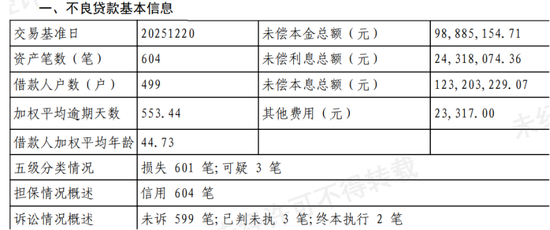
Core Viewpoint - Nanjing Bank has announced the transfer of non-performing assets, specifically personal non-performing loans related to credit card overdrafts, with a total outstanding principal of approximately 98.89 million yuan and total outstanding interest of about 24.32 million yuan, indicating a significant focus on managing and disposing of non-performing loans [1][2][13]. Group 1: Non-Performing Loan Transfer Details - The asset package consists of 604 loans from 499 borrowers, with a weighted average overdue period of 553.44 days and an average borrower age of 44.73 years [1][2][17]. - The total outstanding principal is 98.89 million yuan, total outstanding interest is 24.32 million yuan, and the total outstanding principal and interest amount to approximately 123.20 million yuan [2][15]. - The classification of the loans shows 601 as losses and 3 as suspicious [14][15]. Group 2: Conditions for Potential Buyers - Interested buyers must conduct individual investigations of the non-performing loans and agree to bear the risks associated with the disposal of these assets [3][16]. - Buyers are required to commit to using only legal means for the collection of these loans and are prohibited from transferring the loans to third parties or using violent collection methods [3][16]. Group 3: Retail Business Performance - Nanjing Bank has emphasized retail banking as a key area, launching a "three-year doubling plan for retail value customers" to enhance channel development and product creation [3][16]. - As of mid-2025, the bank's personal loan balance reached 3319.49 billion yuan, with a year-on-year increase of 117.55 billion yuan, reflecting a growth rate of 3.67% [4][17]. - Consumer loans accounted for over 62% of the total personal loans, while credit card overdrafts represented only 4.43% [4][17]. Group 4: Loan Growth and Quality - By the end of Q3 2025, the personal loan balance increased to 3383.47 billion yuan, marking a growth of 5.67% compared to the end of the previous year [20]. - The non-performing loan ratio for personal loans rose to 1.33%, up from 1.29% at the end of the previous year, indicating a slight increase in loan quality concerns [10][22]. - Despite the increase in non-performing loans, the retail segment achieved a revenue of 117.02 billion yuan in the first three quarters of 2025, with a year-on-year growth rate of 22.10% [12][22].
开年险资调研忙 新质生产力受关注
Zhong Guo Zheng Quan Bao· 2026-02-06 03:50
Core Insights - Insurance capital management is increasingly focused on deep research of individual stocks and industries, with significant interest in A-share listed companies as indicated by over 300 companies being researched since the beginning of 2026 [1][2] Group 1: Research Trends - A total of 96 insurance companies and 32 insurance asset management companies have participated in the research of A-share listed companies since the beginning of 2026 [2] - Key players such as Taiping Pension, Changjiang Pension, and China Life Pension have conducted over 30 research sessions each within a month [2] - Regional banks and sectors like electronic components, semiconductor materials, and devices are receiving heightened attention from insurance capital [2] Group 2: Investment Strategies - Insurance capital views company research as a crucial part of investment strategy, often focusing on high-quality stocks with long-term growth potential [3] - The demand for high dividend stocks is driven by the need for stable cash flow in a low-interest-rate environment, with banks being a primary focus for insurance capital [4] - Insurance capital is increasingly adopting a dividend strategy, favoring high dividend stocks to stabilize returns amid pressure on fixed-income yields [4] Group 3: Focus on New Productive Forces - Insurance capital is aligning with long-term investments in new productive forces, particularly in technology innovation and emerging strategic industries [5] - There is a focus on investing in sectors with real technological barriers and clear business models that can deliver performance [5] Group 4: Investment Paths - For mature technology leaders, insurance capital is likely to invest directly for excess returns, while for emerging tech sectors, indirect investments through ETFs or industry funds are preferred to manage risks [6] - The insurance capital sector is particularly interested in AI-driven technology and high-end manufacturing, with a strategy to invest in companies with clear business models and strong competitive advantages [6]