NJBK(601009)

Search documents
南京银行(601009) - 南京银行股份有限公司关联交易公告
2025-08-28 12:32
优先股简称:南银优 1 优先股代码:360019 南银优 2 360024 南京银行股份有限公司 关联交易公告 特别提示: 本公司董事会及全体董事保证本公告内容不存在任何虚假记载、误导性陈述 或者重大遗漏,并对其内容的真实性、准确性和完整性承担法律责任。 证券简称: 南京银行 证券代码: 601009 编号: 2025-063 重要内容提示: 关联交易内容 本公司与董事、监事、高级管理人员及其关联方开展的一般性存款、支付结 算、信用卡、贷款、购买金融产品等授信类、服务类、资产转移类、存款和其他 类日常金融产品或服务关联交易。 该关联交易事项需提交股东大会审议。 关联交易影响 该事项对本公司正常经营活动及财务状况无重大影响。 一、关联交易概述 (一)本次关联交易基本情况及主要内容 (二)与本公司的关联关系 根据《中华人民共和国公司法》《银行保险机构关联交易管理办法》等相关 规定,本公司董事、监事、高级管理人员及其近亲属,前述人员直接或间接控制 的企业,以及与董事、监事、高级管理人员有其他关联关系的关联方(以下简称 "董事、监事、高级管理人员及其关联方")为本公司关联方。本公司与前述关 联方之间的交易构成关联交易 ...

南京银行(601009) - 南京银行股份有限公司关于召开2025年第一次临时股东大会的通知
2025-08-28 12:31
证券代码:601009 证券简称:南京银行 公告编号:2025-064 优先股简称:南银优 1 优先股代码:360019 南银优 2 360024 南京银行股份有限公司 关于召开2025年第一次临时股东大会的通知 本公司董事会及全体董事保证本公告内容不存在任何虚假记载、误导性陈述 或者重大遗漏,并对其内容的真实性、准确性和完整性承担法律责任。 重要内容提示: 一、 召开会议的基本情况 (四)现场会议召开的日期、时间和地点 股东大会召开日期:2025年9月16日 本次股东大会采用的网络投票系统:上海证券交易所股东大会网络投票 系统 (一)股东大会类型和届次 2025年第一次临时股东大会 (二)股东大会召集人:董事会 (三)投票方式:本次股东大会所采用的表决方式是现场投票和网络投票相结合的 方式 召开的日期时间:2025 年 9 月 16 日 14 点 30 分 召开地点:江苏省南京市建邺区江山大街 88 号公司河西总部大楼四楼 401 会议室 (五)网络投票的系统、起止日期和投票时间。 网络投票系统:上海证券交易所股东会网络投票系统 网络投票起止时间:自2025 年 9 月 16 日 至2025 年 9 月 1 ...
南京银行(601009) - 南京银行股份有限公司第十届监事会第十次会议决议公告
2025-08-28 12:30
第十届监事会第十次会议决议公告 证券简称: 南京银行 证券代码: 601009 编号: 2025-062 优先股简称:南银优 1 优先股代码:360019 南银优 2 360024 南京银行股份有限公司 表决结果:同意 9 票;弃权 0 票;反对 0 票。 特别提示: 本公司监事会及全体监事保证本公告内容不存在任何虚假记载、误导性陈述 或者重大遗漏,并对其内容的真实性、准确性和完整性承担法律责任。 南京银行股份有限公司(以下简称"本公司")第十届监事会第十次会议于 2025 年 8 月 28 日以现场方式在本公司河西总部大楼召开。会议通知及会议文件 已于 2025 年 8 月 18 日发出。会议由监事长吕冬阳先生提议召开并主持。会议应 到监事 9 人,实到监事 9 人。会议符合《中华人民共和国公司法》《中华人民共 和国证券法》等法律、法规及《南京银行股份有限公司章程》的有关规定。会议 表决和通过了如下决议: 一、关于审议《南京银行股份有限公司 2025 年半年度报告及摘要》的议案 表决结果:同意 9 票;弃权 0 票;反对 0 票。 具体详见本公司在上海证券交易所网站披露的《南京银行股份有限公司 2025 年 ...
南京银行(601009) - 南京银行股份有限公司第十届董事会第十二次会议决议公告
2025-08-28 12:28
证券简称: 南京银行 证券代码: 601009 编号: 2025-061 优先股简称:南银优 1 优先股代码:360019 南京银行股份有限公司 第十届董事会第十二次会议决议公告 特别提示: 本公司董事会及全体董事保证本公告内容不存在任何虚假记载、误导性陈述 或者重大遗漏,并对其内容的真实性、准确性和完整性承担法律责任。 南京银行股份有限公司(以下简称"本公司")第十届董事会第十二次会议 于 2025 年 8 月 28 日以现场会议方式在本公司河西总部大楼召开。会议通知及会 议文件已于 2025 年 8 月 18 日以电子邮件方式发出。谢宁董事长主持了会议。本 次董事会会议应到有表决权董事 10 人,实到董事 10 人。本公司监事及高级管理 人员列席了本次会议。会议符合《中华人民共和国公司法》《中华人民共和国证 券法》等法律、法规及《南京银行股份有限公司章程》的有关规定。 会议对如下议案进行了审议并表决: 一、关于审议《南京银行股份有限公司 2025 年半年度报告及摘要》的议案 本议案已经本公司董事会审计委员会事前认可。 南银优 2 360024 同意 10 票;弃权 0 票;反对 0 票。 具体详见本公司在 ...
南京银行(601009) - 2025 Q2 - 季度财报
2025-08-28 12:00
Part I [Important Notice and Definitions](index=4&type=section&id=Part%20I%20Important%20Notice%20and%20Definitions) [Important Notice](index=4&type=section&id=%E9%87%8D%E8%A6%81%E6%8F%90%E7%A4%BA) This section contains important notices for the company's semi-annual report, approved by the board, unaudited but reviewed by an accounting firm, with the board authorized to decide on interim profit distribution and no major foreseeable risks identified - Report approved by the board, unaudited but reviewed by **Ernst & Young Hua Ming LLP**[8](index=8&type=chunk) - Shareholders' meeting authorizes the board to decide on **2025 interim profit distribution plan**, not exceeding net profit attributable to ordinary shareholders for the period[8](index=8&type=chunk) - No non-operating funds occupied by controlling shareholders or related parties, nor any external guarantees in violation of decision-making procedures[9](index=9&type=chunk) - No major foreseeable risks, with primary operational risks including credit risk, market risk, liquidity risk, and operational risk[9](index=9&type=chunk) [Definitions](index=5&type=section&id=%E9%87%8A%E4%B9%89) This section defines common terms used in the report to ensure consistent understanding of its content - "Company/This Company" refers to Nanjing Bank Co., Ltd. and its subsidiaries; "Parent Company/The Bank/This Bank/The Entire Bank" refers to Nanjing Bank Co., Ltd[11](index=11&type=chunk) - Lists abbreviations for regulatory bodies including the People's Bank of China, China Securities Regulatory Commission, National Financial Regulatory Administration, and Shanghai Stock Exchange[11](index=11&type=chunk) - Defines major subsidiaries and associates, such as Nanjing Bank Wealth Management, Xinyuan Fund, Nanjing Bank Paribas Consumer Finance, and Rizhao Bank[11](index=11&type=chunk) Part II [Company Profile](index=6&type=section&id=Part%20II%20Company%20Profile) [I. Company Basic Information](index=6&type=section&id=%E4%B8%80%E3%80%81%E5%85%AC%E5%8F%B8%E5%9F%BA%E6%9C%AC%E4%BF%A1%E6%81%AF) This section introduces Bank of Nanjing's legal name, registered address, legal representative, unified social credit code, website, and customer service number - Company's legal Chinese name is **Nanjing Bank Co., Ltd.**, legal representative is **Xie Ning**[13](index=13&type=chunk) - Company's registered address is No. 88 Jiangshan Avenue, Jianye District, Nanjing City, with historical changes listed[13](index=13&type=chunk) - Company website is **http://www.njcb.com.cn**, national unified customer service number is **95302**[13](index=13&type=chunk) [II. Contact Persons and Information](index=6&type=section&id=%E4%BA%8C%E3%80%81%E8%81%94%E7%B3%BB%E4%BA%BA%E5%92%8C%E8%81%94%E7%B3%BB%E6%96%B9%E5%BC%8F) This section provides the names, contact addresses, phone numbers, faxes, and email addresses of the company's board secretary and securities affairs representatives - Board Secretary is **Jiang Zhichun**, Securities Affairs Representatives are **Yao Xiaoying** and **Cai Aoran**[14](index=14&type=chunk) - Contact address is Board Office, Bank of Nanjing, No. 88 Jiangshan Avenue, Jianye District, Nanjing, Jiangsu Province[14](index=14&type=chunk) - Contact phone number is **025-86775067**, email is **boardoffice@njcb.com.cn**[15](index=15&type=chunk) [III. Information Disclosure and Document Availability](index=7&type=section&id=%E4%B8%89%E3%80%81%E4%BF%A1%E6%81%AF%E6%8A%AB%E9%9C%B2%E5%8F%8A%E5%A4%87%E7%BD%AE%E5%9C%B0%E7%82%B9) This section lists the company's selected information disclosure media and websites, as well as the stock exchange website and location for semi-annual report availability - Selected media for information disclosure include **"Shanghai Securities News"**, **"China Securities Journal"**, **"Securities Times"**, **"Securities Daily"**[16](index=16&type=chunk) - The stock exchange website for semi-annual report disclosure is **http://www.sse.com.cn**[16](index=16&type=chunk) - Semi-annual report is available at Shanghai Stock Exchange and the company's Board Office[16](index=16&type=chunk) [IV. Company Shares and Convertible Bonds Overview](index=7&type=section&id=%E5%9B%9B%E3%80%81%E5%85%AC%E5%8F%B8%E8%82%A1%E7%A5%A8%E5%8F%8A%E5%8F%AF%E8%BD%AC%E5%80%BA%E6%A6%82%E5%86%B5) This section outlines the company's A-shares, preferred shares, and convertible corporate bonds listed on the Shanghai Stock Exchange, including their abbreviations, codes, and custodians - Company's ordinary A-shares are abbreviated as **Nanjing Bank**, code **601009**[17](index=17&type=chunk) - Company's preferred shares include **Nanjing Preferred 1 (code 360019)** and **Nanjing Preferred 2 (code 360024)**[17](index=17&type=chunk) - Company's convertible corporate bonds are abbreviated as **Nanjing Convertible Bonds**, code **113050**[17](index=17&type=chunk) [V. Intermediary Institutions](index=7&type=section&id=%E4%BA%94%E3%80%81%E4%B8%AD%E4%BB%8B%E6%9C%BA%E6%9E%84%E6%83%85%E5%86%B5) This section discloses information about the domestic accounting firm engaged by the company, including its name, office address, and signing certified public accountants - The domestic accounting firm engaged by the company is **Ernst & Young Hua Ming LLP (Special General Partnership)**[18](index=18&type=chunk) - Office address is 50th Floor, Shanghai World Financial Center, No. 100 Century Avenue, Pudong New Area, Shanghai[18](index=18&type=chunk) - Signing certified public accountants are **Xu Peijing** and **Huang Beiyi**[18](index=18&type=chunk) [VI. Major Honors During the Reporting Period](index=8&type=section&id=%E5%85%AD%E3%80%81%E6%8A%A5%E5%91%8A%E6%9C%9F%E4%B8%BB%E8%A6%81%E8%8D%A3%E8%AA%89%E6%83%85%E5%86%B5) This section lists the significant honors received by the company during the reporting period, covering international rankings, spiritual civilization construction, charity, and financial service innovation - Ranked **86th** in The Banker's 2025 Top 1000 World Banks, up **5 places** from 2024[19](index=19&type=chunk) - Awarded **"National Civilized Unit"** for four consecutive terms, and the company's Youth League Committee awarded **"National May Fourth Red Flag Youth League Committee"**[19](index=19&type=chunk) - Awarded **"Jiangsu Charity Star" Loving Unit** by Jiangsu Charity Federation[19](index=19&type=chunk) - Received **"2024 Annual Excellent Institution Award"** from the People's Bank of China Clearing Center and eight institutional awards from Agricultural Development Bank of China[19](index=19&type=chunk) Part III [Key Accounting Data and Financial Indicators](index=9&type=section&id=Part%20III%20Key%20Accounting%20Data%20and%20Financial%20Indicators) [I. Key Accounting Data and Financial Indicators for Comparable Periods](index=9&type=section&id=%E4%B8%80%E3%80%81%E5%8F%AF%E6%AF%94%E6%9C%9F%E9%97%B4%E4%B8%BB%E8%A6%81%E4%BC%9A%E8%AE%A1%E6%95%B0%E6%8D%AE%E5%92%8C%E8%B4%A2%E5%8A%A1%E6%8C%87%E6%A0%87) This section details the company's key accounting data and financial indicators for January-June 2025 compared to the same periods in 2024 and 2023, showing steady revenue and profit growth, significant increase in net cash flow from operating activities, and expanding asset and liability scale 2025 January-June Key Accounting Data | Indicator | 2025 Jan-Jun (RMB Thousand) | 2024 Jan-Jun (RMB Thousand) | YoY Change (%) | | :--- | :--- | :--- | :--- | | Operating Revenue | 28,480,211 | 26,215,568 | 8.64 | | Operating Profit | 15,356,880 | 14,123,051 | 8.74 | | Total Profit | 15,340,688 | 14,102,989 | 8.78 | | Net Profit Attributable to Listed Company Shareholders | 12,619,215 | 11,594,146 | 8.84 | | Net Cash Flow from Operating Activities | 119,496,372 | -59,284,903 | 301.56 | | Basic Earnings Per Share (RMB/share) | 1.13 | 1.12 | 0.89 | | Diluted Earnings Per Share (RMB/share) | 1.03 | 0.97 | 6.19 | 2025 June 30 Scale Indicators | Indicator | 2025 June 30 (RMB Thousand) | 2024 Dec 31 (RMB Thousand) | Change from Year-End (%) | | :--- | :--- | :--- | :--- | | Total Assets | 2,901,437,947 | 2,591,399,702 | 11.96 | | Total Liabilities | 2,691,297,099 | 2,399,443,325 | 12.16 | | Net Assets Attributable to Listed Company Shareholders | 206,630,632 | 188,529,458 | 9.60 | | Total Deposits | 1,645,524,976 | 1,496,171,763 | 9.98 | | Total Loans | 1,387,173,410 | 1,256,398,078 | 10.41 | - In June 2025, the company completed the distribution of 2024 year-end cash dividends, with a cash dividend of **RMB 0.19931 per share (tax inclusive)**[21](index=21&type=chunk) [II. Non-Recurring Items](index=10&type=section&id=%E4%BA%8C%E3%80%81%E6%89%A3%E9%99%A4%E9%9D%9E%E7%BB%8F%E5%B8%B8%E6%80%A7%E6%8D%9F%E7%9B%8A%E9%A1%B9%E7%9B%AE) This section presents the company's net profit after deducting non-recurring items for January-June 2025, detailing the specific components and amounts of non-recurring gains and losses 2025 January-June Non-Recurring Items | Item | Amount (RMB Thousand) | | :--- | :--- | | Other Non-Operating Income and Expenses | 16,192 | | Impact of Minority Interests | 2,517 | | Income Tax Impact | 33,704 | | Asset Disposal Gains | -18,185 | | Other Income | -132,823 | | **Total** | **-98,595** | - For January-June 2025, the company's net profit after deducting non-recurring items was **RMB 12,520,620 thousand**, a **9.09% year-on-year increase**[21](index=21&type=chunk) [III. Key Accounting Data for the Past Three Years](index=10&type=section&id=%E4%B8%89%E3%80%81%E8%BF%91%E4%B8%89%E5%B9%B4%E4%B8%BB%E8%A6%81%E4%BC%9A%E8%AE%A1%E6%95%B0%E6%8D%AE) This section provides the company's key accounting data for the past three years up to the end of the reporting period, including total assets, total liabilities, total loans, and total deposits, illustrating the continuous growth and structural changes in the company's balance sheet Key Accounting Data for the Past Three Years (RMB Thousand) | Item | 2025 June 30 | 2024 Dec 31 | 2023 Dec 31 | | :--- | :--- | :--- | :--- | | Total Assets | 2,901,437,947 | 2,591,399,702 | 2,288,275,916 | | Total Loans | 1,387,173,410 | 1,256,398,078 | 1,099,073,306 | | Of which: Corporate Loans | 1,055,224,330 | 936,203,836 | 815,098,888 | | Retail Loans | 331,949,080 | 320,194,242 | 283,974,418 | | Total Liabilities | 2,691,297,099 | 2,399,443,325 | 2,115,681,851 | | Total Deposits | 1,645,524,976 | 1,496,171,763 | 1,369,407,772 | | Of which: Corporate Demand Deposits | 306,710,657 | 275,509,549 | 273,476,437 | | Corporate Time Deposits | 779,020,833 | 743,859,463 | 669,135,811 | | Savings Demand Deposits | 48,571,449 | 47,292,015 | 43,415,837 | | Savings Time Deposits | 511,052,588 | 429,205,845 | 383,213,192 | - As of June 30, 2025, the company's total assets approached **RMB 2.9 trillion**, total loans exceeded **RMB 1.38 trillion**, and total deposits exceeded **RMB 1.64 trillion**[25](index=25&type=chunk) [IV. Supplementary Financial Indicators for the Past Three Years up to the End of the Reporting Period](index=11&type=section&id=%E5%9B%9B%E3%80%81%E6%88%AA%E8%87%B3%E6%8A%A5%E5%91%8A%E6%9C%9F%E6%9C%AB%E5%89%8D%E4%B8%89%E5%B9%B4%E8%A1%A5%E5%85%85%E8%B4%A2%E5%8A%A1%E6%8C%87%E6%A0%87) This section provides supplementary financial indicators for the past three years up to the end of the reporting period, reflecting trends in profitability, asset quality, and efficiency Supplementary Financial Indicators for the Past Three Years (%) | Key Indicators (%) | 2025 Jan-Jun (Period-End) | 2024 (Period-End) | 2023 (Period-End) | | :--- | :--- | :--- | :--- | | Return on Total Assets | 0.92 | 0.83 | 0.85 | | Net Interest Spread | 1.63 | 1.64 | 1.73 | | Net Interest Margin | 1.86 | 1.94 | 2.04 | | Capital Adequacy Ratio | 13.63 | 13.72 | 13.53 | | Tier 1 Capital Adequacy Ratio | 11.07 | 11.12 | 11.40 | | Core Tier 1 Capital Adequacy Ratio | 9.47 | 9.36 | 9.39 | | Non-Performing Loan Ratio | 0.84 | 0.83 | 0.90 | | Provision Coverage Ratio | 311.65 | 335.27 | 360.58 | | Loan Loss Provision Ratio | 2.60 | 2.77 | 3.23 | | Cost-to-Income Ratio | 25.07 | 28.08 | 30.47 | - In the first half of 2025, the company's **return on total assets was 0.92%**, **non-performing loan ratio was 0.84%**, and **cost-to-income ratio was 25.07%**[27](index=27&type=chunk) - **Provision coverage ratio was 311.65%**, and **loan loss provision ratio was 2.60%**, indicating sufficient risk coverage capacity[27](index=27&type=chunk) [V. Financial Ratio Analysis for Comparable Periods](index=11&type=section&id=%E4%BA%94%E3%80%81%E5%8F%AF%E6%AF%94%E6%9C%9F%E9%97%B4%E8%B4%A2%E5%8A%A1%E6%AF%94%E7%8E%87%E5%88%86%E6%9E%90) This section provides a detailed analysis of the company's financial ratios for profitability, capital adequacy, asset quality, and efficiency for January-June 2025 compared to the same period in 2024, highlighting the changes and magnitudes 2025 January-June Key Financial Ratio Changes | Profitability | 2025 Jan-Jun | 2024 Jan-Jun | Change | | :--- | :--- | :--- | :--- | | Weighted Average Return on Net Assets | 7.66% | 7.98% | Decreased by 0.32 percentage points | | Return on Total Assets | 0.92% | 0.97% | Decreased by 0.05 percentage points | | Net Interest Spread | 1.63% | 1.64% | Decreased by 0.01 percentage points | | Net Interest Margin | 1.86% | 1.96% | Decreased by 0.10 percentage points | | Net Interest Income Share | 54.94% | 48.87% | Increased by 6.07 percentage points | | Non-Interest Net Income Share | 45.06% | 51.13% | Decreased by 6.07 percentage points | | **Capital Adequacy Ratios** | **2025 June 30** | **2024 Dec 31** | **Change** | | Capital Adequacy Ratio | 13.63% | 13.72% | Decreased by 0.09 percentage points | | Tier 1 Capital Adequacy Ratio | 11.07% | 11.12% | Decreased by 0.05 percentage points | | **Asset Quality Indicators** | **2025 June 30** | **2024 Dec 31** | **Change** | | Non-Performing Loan Ratio | 0.84% | 0.83% | Increased by 0.01 percentage points | | Provision Coverage Ratio | 311.65% | 335.27% | Decreased by 23.62 percentage points | | Loan Loss Provision Ratio | 2.60% | 2.77% | Decreased by 0.17 percentage points | | **Efficiency Analysis** | **2025 Jan-Jun** | **2024 Jan-Jun** | **Change** | | Cost-to-Income Ratio | 25.07% | 28.08% | Decreased by 3.01 percentage points | - **Net interest income's share of revenue increased by 6.07 percentage points**, while **non-interest net income's share decreased by 6.07 percentage points**, indicating a change in revenue structure[30](index=30&type=chunk) - **Cost-to-income ratio decreased by 3.01 percentage points to 25.07%**, showing significant efficiency improvement[30](index=30&type=chunk) [VI. Changes and Reasons for Key Financial Indicators](index=13&type=section&id=%E5%85%AD%E3%80%81%E4%B8%BB%E8%A6%81%E8%B4%A2%E5%8A%A1%E6%8C%87%E6%A0%87%E5%A2%9E%E5%87%8F%E5%8F%98%E5%8A%A8%E5%B9%85%E5%BA%A6%E5%8F%8A%E5%8E%9F%E5%9B%A0) This section explains the changes and primary reasons for the company's key financial indicators during the reporting period, reflecting business expansion and improved profitability Changes and Reasons for Key Financial Indicators | Key Financial Indicator | 2025 June 30 (RMB Thousand) | Change from Previous Year-End (%) | Primary Reason | | :--- | :--- | :--- | :--- | | Total Assets | 2,901,437,947 | 11.96 | Increase in debt investments, loans, and advances | | Total Liabilities | 2,691,297,099 | 12.16 | Increase in customer deposits | | Net Assets Attributable to Listed Company Shareholders | 206,630,632 | 9.60 | Increase in capital reserves and retained earnings | | **Key Financial Indicator** | **2025 January to June (RMB Thousand)** | **Change from Same Period Last Year (%)** | **Primary Reason** | | Operating Revenue | 28,480,211 | 8.64 | Increase in interest income | | Operating Profit | 15,356,880 | 8.74 | Increase in operating revenue | | Net Profit | 12,705,112 | 8.97 | Increase in operating revenue | - **Total assets grew by 11.96%**, primarily due to an increase in debt investments, loans, and advances[33](index=33&type=chunk) - **Total liabilities grew by 12.16%**, primarily due to an increase in customer deposits[33](index=33&type=chunk) - **Operating revenue, operating profit, and net profit all grew by over 8%**, primarily due to an increase in interest income[33](index=33&type=chunk) Part IV [Management Discussion and Analysis](index=14&type=section&id=Part%20IV%20Management%20Discussion%20and%20Analysis) [I. Industry Development Overview](index=14&type=section&id=%E4%B8%80%E3%80%81%E5%85%AC%E5%8F%B8%E6%89%80%E5%B1%9E%E8%A1%8C%E4%B8%9A%E5%8F%91%E5%B1%95%E6%83%85%E5%86%B5) Since 2025, China's economy has been stable and improving, with sustained macro policy efforts, and the banking sector actively serves the real economy, maintaining stable credit asset quality, sufficient risk coverage, and stable liquidity, while focusing on the "five key areas" of finance - In 2025, China's economy was generally stable and improving, with effective implementation of macro policies and growing new drivers[35](index=35&type=chunk) - China's banking sector maintained overall stable credit asset quality, sufficient risk coverage, and stable liquidity indicators[35](index=35&type=chunk) - Commercial banks continued to focus on the **"five key areas" of finance**, supporting high-quality development of the real economy[35](index=35&type=chunk) [II. Company's Main Business and Operating Model](index=14&type=section&id=%E4%BA%8C%E3%80%81%E5%85%AC%E5%8F%B8%E4%BB%8E%E4%BA%8B%E4%B8%BB%E8%A6%81%E4%B8%9A%E5%8A%A1%E3%80%81%E7%BB%8F%E8%90%A5%E6%A8%A1%E5%BC%8F%E6%83%85%E5%86%B5) Nanjing Bank, as the first A-share listed city commercial bank in China, is based in Jiangsu, radiating to the Yangtze River Delta and Beijing, primarily engaged in corporate banking, retail banking, treasury business, and other operations, with no significant changes in its operating model or main business during the reporting period - The company is the first city commercial bank listed on the main board of the Shanghai Stock Exchange, with services radiating across the Yangtze River Delta and Beijing[36](index=36&type=chunk) - Main businesses include accepting public deposits, issuing loans, handling settlements, issuing financial bonds, interbank lending, and bank card services[36](index=36&type=chunk) - During the reporting period, the company's operating model and main business did not undergo significant changes[36](index=36&type=chunk) [III. Development Strategy and Core Competitiveness](index=14&type=section&id=%E4%B8%89%E3%80%81%E5%8F%91%E5%B1%95%E6%88%98%E7%95%A5%E4%B8%8E%E6%A0%B8%E5%BF%83%E7%AB%9E%E4%BA%89%E5%8A%9B) The company's strategic vision is to "build a first-class regional comprehensive financial service provider in China," continuously enhancing comprehensive strength and high-quality development through deep cultivation of quality regional economies, strengthening Party building, maintaining strategic focus, talent development, and ESG practices [(I) Strategic Positioning](index=14&type=section&id=(%E4%B8%80)%E6%88%98%E7%95%A5%E5%AE%9A%E4%BD%8D) The company will adhere to the strategic vision of "building a first-class regional comprehensive financial service provider in China," striving to become an industry benchmark for regional development and a service leader meeting all customer needs through excellent service, refined management, reform and innovation, and risk control - Strategic vision is to **"build a first-class regional comprehensive financial service provider in China"**[37](index=37&type=chunk) - Focusing on "first-class in China" requirements, taking responsibility as a national systemically important bank, and building a first-class brand for high-quality development[37](index=37&type=chunk) - Targeting "comprehensive financial service provider" goal, adhering to customer-centricity, leveraging group synergy, and building a service benchmark[38](index=38&type=chunk) [(II) Core Competitiveness Analysis](index=15&type=section&id=(%E4%BA%8C)%E6%A0%B8%E5%BF%83%E7%AB%9E%E4%BA%89%E5%8A%9B%E5%88%86%E6%9E%90) The company's core competitiveness lies in its deep cultivation of local economies in quality operating regions, continuous strengthening of Party building and scientific corporate governance, consistent strategic focus for high-quality development, enhanced human resource management for a talented workforce, and adherence to core values for social welfare - Leveraging the Yangtze River Delta and Beijing regions' high-quality operating areas, deeply cultivating local economies, providing profound market space[39](index=39&type=chunk) - Corporate governance system guided by Party building, with standardized operations of the shareholders' meeting, board of directors, supervisory board, and senior management, and a scientific and reasonable equity structure[40](index=40&type=chunk) - The company was successfully selected as a national systemically important bank in 2023, scientifically formulated a new five-year strategic plan, and maintained strategic focus[41](index=41&type=chunk) - The average age of parent company's official employees is **34 years**, with **99.14% holding a bachelor's degree or higher**, and **33.85% holding master's or doctoral degrees**[42](index=42&type=chunk) - Always integrating its development into the overall local economic development and highly valuing the company's ESG performance[43](index=43&type=chunk) [IV. Overview of Company Operations During the Reporting Period](index=16&type=section&id=%E5%9B%9B%E3%80%81%E6%8A%A5%E5%91%8A%E6%9C%9F%E5%85%AC%E5%8F%B8%E7%BB%8F%E8%90%A5%E6%83%85%E5%86%B5%E7%BB%BC%E8%BF%B0) In the first half of 2025, Nanjing Bank achieved steady progress in all aspects under national strategy and local development guidance, with stable revenue and profit growth, balanced asset and liability development, and robust key indicators, further enhancing development quality and efficiency through major projects like the "President's Project" - In the first half of 2025, the company's various operations showed steady progress and positive trends, with stable revenue and profit growth, and more balanced segment development[44](index=44&type=chunk) 2025 First Half Operating Overview | Indicator | 2025 June End (billion RMB) | Change from Year-End (%) | | :--- | :--- | :--- | | Total Assets | 29014.38 | 11.96 | | Total Loans | 13871.73 | 10.41 | | Total Liabilities | 26912.97 | 12.16 | | Total Deposits | 16455.25 | 9.98 | | **Profitability** | **2025 First Half (billion RMB)** | **YoY Increase (%)** | | Operating Revenue | 284.80 | 8.64 | | Net Profit Attributable to Parent Company Shareholders | 126.19 | 8.84 | | **Key Indicators** | **2025 First Half** | **Change from Year-End** | | Return on Total Assets (ROA) | 0.92% | - | | Net Interest Spread | 1.63% | - | | Net Interest Margin | 1.86% | - | | Core Tier 1 Capital Adequacy Ratio | 9.47% | - | | Non-Performing Loan Ratio | 0.84% | Increased by 0.01 percentage points | | Provision Coverage Ratio | 311.65% | Decreased by 23.62 percentage points | - The company advanced major projects through the "President's Project", with the **cost-to-income ratio decreasing by 3.01 percentage points to 25.07%**, demonstrating significant achievements in cost reduction and efficiency improvement[46](index=46&type=chunk) [V. Discussion and Analysis of Main Operations During the Reporting Period](index=17&type=section&id=%E4%BA%94%E3%80%81%E6%8A%A5%E5%91%8A%E6%9C%9F%E5%86%85%E4%B8%BB%E8%A6%81%E7%BB%8F%E8%90%A5%E6%83%85%E5%86%B5%E8%AE%A8%E8%AE%BA%E4%B8%8E%E5%88%86%E6%9E%90) This section deeply analyzes key changes in the company's income statement, balance sheet, and cash flow statement during the reporting period, detailing loan asset quality, capital adequacy, liquidity, and off-balance sheet items, showing steady growth in operating revenue and net profit, continuous optimization of asset and liability structure, stable asset quality, capital adequacy meeting regulatory requirements, and ample liquidity - Operating revenue and net profit attributable to parent company shareholders increased by **8.64%** and **8.84%** year-on-year, respectively[47](index=47&type=chunk) - Total assets and total liabilities increased by **11.96%** and **12.16%** respectively from the end of last year, with total loans growing by **10.41%** and total deposits by **9.98%**[33](index=33&type=chunk) - Non-performing loan ratio was **0.84%**, an increase of **0.01 percentage points** from the end of last year; provision coverage ratio was **311.65%**, a decrease of **23.62 percentage points** from the end of last year, indicating stable asset quality[45](index=45&type=chunk) - Capital adequacy ratio was **13.63%**, Tier 1 capital adequacy ratio was **11.07%**, and core Tier 1 capital adequacy ratio was **9.47%**, all meeting regulatory requirements[155](index=155&type=chunk) [(I) Income Statement Analysis](index=17&type=section&id=(%E4%B8%80)%E5%88%A9%E6%B6%A6%E8%A1%A8%E5%88%86%E6%9E%90) During the reporting period, the company's operating revenue and net profit attributable to parent company shareholders both achieved steady growth, with net interest income's share increasing, while non-interest net income's share decreased, and both business and management expenses and credit impairment losses increased 2025 January-June Income Statement Key Data | Item | 2025 Jan-Jun (RMB Thousand) | 2024 Jan-Jun (RMB Thousand) | YoY Change (%) | | :--- | :--- | :--- | :--- | | Operating Revenue | 28,480,211 | 26,215,568 | 8.64 | | Net Interest Income | 15,646,217 | 12,810,598 | 22.13 | | Non-Interest Net Income | 12,833,994 | 13,404,970 | -4.26 | | Operating Expenses | -13,123,331 | -12,092,517 | 8.52 | | Net Profit Attributable to Parent Company Shareholders | 12,619,215 | 11,594,146 | 8.84 | - **Net interest income increased by 22.13% year-on-year**, accounting for **54.94% of operating revenue**, a **6.07 percentage point increase year-on-year**[49](index=49&type=chunk) - **Non-interest net income decreased by 4.26% year-on-year**, accounting for **45.06% of operating revenue**, a **6.07 percentage point decrease year-on-year**[49](index=49&type=chunk) - **Investment income increased by 23.05% year-on-year to RMB 8.086 billion**, while **fair value change income decreased by 60.13% year-on-year to RMB 1.714 billion**[69](index=69&type=chunk)[75](index=75&type=chunk)[78](index=78&type=chunk) - **Credit impairment losses increased by 12.07% year-on-year to RMB 5.521 billion**, primarily from loans and advances measured at amortized cost[47](index=47&type=chunk)[80](index=80&type=chunk) [(II) Balance Sheet Analysis](index=23&type=section&id=(%E4%BA%8C)%E8%B5%84%E4%BA%A7%E8%B4%9F%E5%80%BA%E8%A1%A8%E5%88%86%E6%9E%90) As of the end of the reporting period, the company's total assets and total liabilities both achieved double-digit growth, with total loans and total deposits steadily increasing, and significant growth in corporate loans and individual deposits; in the asset structure, debt investments and other debt investments increased, while trading financial assets decreased; in the liability structure, customer deposits were the main growth driver, and the interest rate paid on individual deposits declined 2025 June 30 Total Assets Composition | Item | Amount (RMB Thousand) | Share (%) | Change from Year-End (%) | | :--- | :--- | :--- | :--- | | Total Assets | 2,901,437,947 | 100.00 | 11.96 | | Loans and Advances | 1,354,555,962 | 46.69 | 10.56 | | Trading Financial Assets | 371,641,289 | 12.81 | -21.26 | | Debt Investments | 470,690,224 | 16.22 | 49.56 | | Other Debt Investments | 419,331,881 | 14.45 | 44.09 | 2025 June 30 Total Liabilities Composition | Item | Amount (RMB Thousand) | Share (%) | Change from Year-End (%) | | :--- | :--- | :--- | :--- | | Total Liabilities | 2,691,297,099 | 100.00 | 12.16 | | Customer Deposits | 1,680,550,992 | 62.44 | 10.01 | | Bonds Payable | 470,396,615 | 17.48 | 4.33 | | Financial Assets Sold Under Repurchase Agreements | 100,935,981 | 3.75 | 650.81 | - **Corporate loan balance was RMB 1,055.224 billion**, an increase of **RMB 119.020 billion** from the end of last year, a **12.71% increase**; **individual loan balance was RMB 331.949 billion**, an increase of **RMB 11.755 billion** from the end of last year, a **3.67% increase**[88](index=88&type=chunk) - **Total deposits were RMB 1,645.525 billion**, an increase of **RMB 149.353 billion** from the end of last year, a **9.98% increase**; **interest rate paid on individual deposits decreased by 20 basis points** from the beginning of the year[120](index=120&type=chunk)[122](index=122&type=chunk) - As of the end of the reporting period, the company owned Nanjing Bank Wealth Management, Xinyuan Fund, Nanjing Bank Paribas Consumer Finance, and other eight equity investment institutions, demonstrating significant comprehensive operational advantages[105](index=105&type=chunk) [(III) Analysis of Changes in Cash Flow Statement Items](index=33&type=section&id=(%E4%B8%89)%E7%8E%B0%E9%87%91%E6%B5%81%E9%87%8F%E8%A1%A8%E7%9B%B8%E5%85%B3%E7%A7%91%E7%9B%AE%E5%8F%98%E5%8A%A8%E5%88%86%E6%9E%90) During the reporting period, the company's net cash flow from operating activities significantly turned positive, primarily due to a substantial increase in customer deposits and interbank deposits; net cash outflow from investing activities increased, while net cash inflow from financing activities significantly decreased, mainly affected by reduced investment recovery and increased debt repayment 2025 January-June Net Cash Flow | Item | 2025 Jan-Jun (RMB Thousand) | 2024 Jan-Jun (RMB Thousand) | Change (%) | | :--- | :--- | :--- | :--- | | Net Cash Flow from Operating Activities | 119,496,372 | -59,284,903 | 301.56 | | Net Cash Flow Used in Investing Activities | -149,598,128 | -75,793,954 | -97.37 | | Net Cash Flow from Financing Activities | 21,713,011 | 141,876,011 | -84.70 | - **Net cash flow from operating activities increased by RMB 178.781 billion year-on-year**, primarily due to an increase in net customer deposits and interbank deposits[130](index=130&type=chunk) - **Net cash outflow from investing activities increased by RMB 73.804 billion year-on-year**, primarily due to a decrease in cash received from investment recovery[130](index=130&type=chunk) - **Net cash inflow from financing activities decreased by RMB 120.163 billion year-on-year**, primarily due to an increase in cash paid for debt repayment[130](index=130&type=chunk) [(IV) Items with Changes Exceeding 30% in Comparative Financial Statements](index=33&type=section&id=(%E5%9B%9B)%E6%AF%94%E8%BE%83%E5%BC%8F%E4%BC%9A%E8%AE%A1%E6%8A%A5%E8%A1%A8%E4%B8%AD%E5%8F%98%E5%8C%96%E5%B9%85%E5%BA%A6%E8%B6%85%E8%BF%87%2030%25%E4%BB%A5%E4%B8%8A%E9%A1%B9%E7%9B%AE%E7%9A%84%E6%83%85%E5%86%B5) During the reporting period, the company's precious metals, debt investments, other debt investments, other equity instrument investments, trading financial liabilities, and repurchase agreements for financial assets significantly increased, while derivative financial assets/liabilities, provisions, other comprehensive income, and fair value change income substantially decreased, mainly due to business expansion, fair value valuation changes, and increased platform fee expenses Major Accounting Items with Changes Exceeding 30% | Major Accounting Item | Period-End or Period (RMB Thousand) | Change (%) | Primary Reason | | :--- | :--- | :--- | :--- | | Precious Metals | 7,393,717 | 12,235.81 | Increase in precious metals business scale | | Derivative Financial Assets | 7,963,167 | -34.72 | Fair value valuation changes of derivative transactions | | Debt Investments | 470,690,224 | 49.56 | Increase in debt investment scale | | Other Debt Investments | 419,331,881 | 44.09 | Increase in other debt investment scale | | Other Equity Instrument Investments | 2,455,845 | 33.60 | Increase in valuation of other equity instrument investments | | Trading Financial Liabilities | 1,092,850 | 97.47 | Increase in trading financial liabilities scale | | Derivative Financial Liabilities | 7,275,681 | -41.04 | Fair value valuation changes of derivative transactions | | Financial Assets Sold Under Repurchase Agreements | 100,935,981 | 650.81 | Increase in financial assets sold under repurchase agreements | | Provisions | 771,211 | -42.32 | Decrease in provisions | | Other Comprehensive Income | 2,365,955 | -37.30 | Impact of fair value changes in other debt investments | | Fee and Commission Expenses | 641,450 | 84.28 | Increase in platform fee expenses | | Fair Value Change Income | 1,714,404 | -60.13 | Impact of fair value changes in trading financial assets | [(V) Loan Asset Quality](index=33&type=section&id=(%E4%BA%94)%E8%B4%B7%E6%AC%BE%E8%B5%84%E4%BA%A7%E8%B4%A8%E9%87%8F%E6%83%85%E5%86%B5) During the reporting period, the company's key loan asset quality indicators remained stable, with a slight increase in the non-performing loan ratio but still good risk coverage; the company continuously strengthened proactive risk management, intensified non-performing asset disposal, prudently conducted real estate industry credit business, and strictly adhered to government-related credit policies - At the end of the reporting period, the **non-performing loan ratio was 0.84%**, an increase of **0.01 percentage points** from the end of last year; **loan impairment provision balance was RMB 36.132 billion**, with a **provision coverage ratio of 311.65%**[134](index=134&type=chunk)[135](index=135&type=chunk) - **Overdue loan ratio was 1.27%**, flat with the end of last year; **special mention loan ratio was 1.06%**, a **0.14 percentage point decrease** from the end of last year[135](index=135&type=chunk) 2025 June 30 Five-Category Loan Classification | Item | Loan Amount (RMB Thousand) | Share (%) | | :--- | :--- | :--- | | Pass | 1,361,438,768 | 98.10 | | Special Mention | 14,657,639 | 1.06 | | Substandard | 5,204,202 | 0.38 | | Doubtful | 1,661,927 | 0.12 | | Loss | 4,727,708 | 0.34 | | **Total Loans** | **1,387,690,244** | **100.00** | - Parent company's **corporate non-performing loan ratio was 0.65%**, and **individual non-performing loan ratio was 1.43%**, an increase of **0.14 percentage points** from the end of last year, but a **0.03 percentage point decrease** from the end of the first quarter[143](index=143&type=chunk)[144](index=144&type=chunk) - The company actively implemented real estate financial support policies; as of the end of the reporting period, **corporate loans to real estate amounted to RMB 62.717 billion**, with a **non-performing ratio of 2.07%**; **individual mortgage loans amounted to RMB 84.660 billion**, with a **non-performing ratio of 0.82%**[150](index=150&type=chunk) - During the reporting period, the company continuously intensified non-performing asset disposal through proactive risk management, increased collection efforts, market-based disposal, and efficient write-offs[147](index=147&type=chunk) [(VI) Capital Adequacy and Liquidity Analysis](index=38&type=section&id=(%E5%85%AD)%E8%B5%84%E6%9C%AC%E5%85%85%E8%B6%B3%E7%8E%87%E5%8F%8A%E6%B5%81%E5%8A%A8%E6%80%A7%E5%88%86%E6%9E%90) As of the end of the reporting period, the company's capital adequacy ratio, Tier 1 capital adequacy ratio, and core Tier 1 capital adequacy ratio all met regulatory requirements, and the leverage ratio remained stable; the liquidity coverage ratio and net stable funding ratio also exceeded regulatory standards, indicating that the company's liquidity situation is generally ample and well-controlled 2025 June 30 Capital Adequacy Ratios | Item | 2025 June 30 | 2024 Year-End | | :--- | :--- | :--- | | Capital Adequacy Ratio (%) | 13.63 | 13.72 | | Tier 1 Capital Adequacy Ratio (%) | 11.07 | 11.12 | | Core Tier 1 Capital Adequacy Ratio (%) | 9.47 | 9.36 | - **Leverage ratio was 6.14%**, **net Tier 1 capital was RMB 207,881,424 thousand**, and **adjusted on- and off-balance sheet assets were RMB 3,385,700,561 thousand**[160](index=160&type=chunk) - **Liquidity coverage ratio was 146.87%**, and **net stable funding ratio was 112.95%**, both meeting regulatory requirements[162](index=162&type=chunk)[164](index=164&type=chunk)[207](index=207&type=chunk) - The company faces liquidity risk factors such as asset-liability structure adjustments, increased demand for long-term asset allocation, and intensified deposit competition, but stress tests show sufficient payment capacity even in crisis scenarios[208](index=208&type=chunk) [(VII) Off-Balance Sheet Items with Potential Significant Impact on Financial Position and Operating Results](index=40&type=section&id=(%E4%B8%83)%E5%8F%AF%E8%83%BD%E5%AF%B9%E8%B4%A2%E5%8A%A1%E7%8A%B6%E5%86%B5%E4%B8%8E%E7%BB%8F%E8%90%A5%E6%88%90%E6%9E%9C%E9%80%A0%E6%88%90%E9%87%8D%E5%A4%A7%E5%BD%B1%E5%93%8D%E7%9A%84%E8%A1%A8%E5%A4%96%E9%A1%B9%E7%9B%AE%E4%BD%99%E9%A2%9D%E5%8F%8A%E5%85%B6%E9%87%8D%E8%A6%81%E6%83%85%E5%86%B5) As of the end of the reporting period, the company's total off-balance sheet credit commitments amounted to **RMB 577.864 billion**, with bank acceptance bills and others accounting for the largest proportion; pledged assets and derivative financial instruments also had significant scales, and these off-balance sheet items could have a material impact on the company's financial position and operating results 2025 June 30 Off-Balance Sheet Item Balances | Category | 2025 June 30 (RMB Thousand) | 2024 Dec 31 (RMB Thousand) | | :--- | :--- | :--- | | Credit Commitments | 577,863,868 | 590,297,787 | | Of which: Loan Commitments | 16,043,141 | 75,948,657 | | Bank Acceptance Bills and Others | 360,422,933 | 342,757,739 | | Guarantees Issued | 60,953,461 | 45,199,153 | | Letters of Credit Issued | 94,841,216 | 78,539,691 | | Unused Credit Card Limits | 45,603,117 | 47,852,547 | | Pledged Assets | 284,875,125 | 208,089,065 | | Capital Expenditure Commitments | 338,858 | 387,113 | | Derivative Financial Instruments | 2,091,856,537 | 1,893,243,680 | [VI. Analysis of Main Business During the Reporting Period](index=40&type=section&id=%E5%85%AD%E3%80%81%E6%8A%A5%E5%91%8A%E6%9C%9F%E4%B8%BB%E8%90%A5%E4%B8%9A%E5%8A%A1%E5%88%86%E6%9E%90) During the reporting period, the company's three main business segments—corporate finance, retail finance, and financial markets—all achieved steady development, with corporate finance deepening reforms, retail finance deepening transformation, and the financial market segment maintaining a stable trend, while Nanjing Bank Wealth Management and Xinyuan Fund saw both volume and quality improvements, continuously enhancing brand momentum - Corporate finance segment's **corporate loan balance was RMB 1,055.224 billion**, an increase of **12.71%** from the end of last year; **corporate deposit balance was RMB 1,085.731 billion**, an increase of **6.51%** from the end of last year[169](index=169&type=chunk) - Retail finance segment's **retail revenue was RMB 7.644 billion**, a **21.40% year-on-year increase**; **retail profit was RMB 0.829 billion**; **individual deposit balance was RMB 559.624 billion**, an increase of **17.45%** from the end of last year[177](index=177&type=chunk) - Financial market segment's **asset custody business total scale was RMB 3.66 trillion**, an increase of **7.33%** from the beginning of the year; **Nanjing Bank Wealth Management product scale was RMB 543.257 billion**, a **14.74% increase** from the beginning of the year; **Xinyuan Fund's non-money market public fund scale was RMB 140.096 billion**, a **10.38% increase** year-on-year[190](index=190&type=chunk)[191](index=191&type=chunk)[193](index=193&type=chunk) [(I) Corporate Finance Segment Deepens Reform, Gathers New Momentum for Transformation and Development](index=40&type=section&id=(%E4%B8%80)%E5%85%AC%E5%8F%B8%E9%87%91%E8%9E%8D%E6%9D%BF%E5%9D%97%E6%B7%B1%E5%8C%96%E6%94%B9%E9%9D%A9%E7%89%B5%E5%BC%95%EF%BC%8C%E9%9B%86%E8%81%9A%E8%BD%AC%E5%9E%8B%E5%8F%91%E5%B1%95%E6%96%B0%E5%8A%A8%E8%83%BD) The corporate finance segment deepened reforms, focusing on the main channel of the real economy and continuously optimizing financial supply structure, tilting credit resources towards key areas such as green finance, inclusive small and micro businesses, and technology finance, achieving significant loan balance growth, and enhancing value operation quality and efficiency and international business service capabilities through customer cultivation, scenario acceleration, and cross-border breakthroughs - **Corporate loan balance was RMB 1,055.224 billion**, an increase of **RMB 119.020 billion** from the end of last year, a **12.71% increase**; **corporate deposit balance was RMB 1,085.731 billion**, an increase of **RMB 66.362 billion** from the end of last year, a **6.51% increase**[169](index=169&type=chunk) - **Green finance loan balance was RMB 258.327 billion**, an increase of **RMB 56.169 billion** from the beginning of the year, a **27.79% increase**[171](index=171&type=chunk) - **Inclusive small and micro enterprise loan balance was RMB 151.198 billion**, an increase of **RMB 16.811 billion** from the beginning of the year, a **12.51% growth rate**, **1.80 percentage points higher than the average growth rate of all loans**[172](index=172&type=chunk) - **Supply chain finance business volume was RMB 168.9 billion**, a **42.17% year-on-year increase**; **Xinyun Treasury signed 3,059 group clients**, a net increase of **1,269 clients** from the end of 2024, a **70.89% increase**[174](index=174&type=chunk) - During the reporting period, underwrote nearly **RMB 150 billion** in non-financial enterprise debt financing instruments, ranking first in Jiangsu Province and maintaining a stable national ranking[175](index=175&type=chunk) [(II) Retail Finance Deepens Transformation and Development, Operating Quality and Efficiency Steadily Improving](index=43&type=section&id=(%E4%BA%8C)%E9%9B%B6%E5%94%AE%E9%87%91%E8%9E%8D%E6%B7%B1%E5%8C%96%E8%BD%AC%E5%9E%8B%E5%8F%91%E5%B1%95%EF%BC%8C%E7%BB%8F%E8%90%A5%E8%B4%A8%E6%95%88%E7%A8%B3%E4%B8%AD%E5%90%91%E5%A5%BD) The retail finance segment adheres to the value proposition of "customer-centric, wealth-driven, scenario-essential," deepening customer service operations, promoting wealth management transformation, optimizing asset management strategies, and accelerating scenario ecosystem and technology team building, with retail revenue and profit growing steadily and asset quality remaining stable during the reporting period - **Retail revenue was RMB 7.644 billion**, a **21.40% year-on-year increase**; **retail profit was RMB 0.829 billion**[177](index=177&type=chunk) - **Individual deposit balance was RMB 559.624 billion**, an increase of **RMB 83.126 billion** from the end of last year, a **17.45% increase**; **interest rate paid on individual deposits decreased by 20 basis points** from the beginning of the year[177](index=177&type=chunk)[180](index=180&type=chunk) - **Wealth private banking high-net-worth client count increased by 13.90%** from the beginning of the year, and **private banking client financial asset scale increased by 17.05%** from the beginning of the year; **agency sales intermediate income grew by over 25%** year-on-year[180](index=180&type=chunk) - **Nanjing Bank Paribas Consumer Finance Co., Ltd. operating revenue was RMB 2.740 billion**, a **33.75% year-on-year increase**, and **net profit was RMB 0.143 billion**, a **97.36% year-on-year increase**[182](index=182&type=chunk) - Parent company's **individual loan non-performing ratio decreased by 3 basis points** from the end of the first quarter, with asset quality steadily improving[182](index=182&type=chunk) [(III) Financial Market Segment Adheres to Strategic Guidance, Continues Stable Development Trend](index=46&type=section&id=(%E4%B8%89)%E9%87%91%E8%9E%8D%E5%B8%82%E5%9C%BA%E6%9D%BF%E5%9D%97%E5%9D%9A%E6%8C%81%E6%88%98%E7%95%A5%E5%BC%95%E9%A2%86%EF%BC%8C%E5%BB%B6%E7%BB%AD%E7%A8%B3%E5%81%A5%E5%8F%91%E5%B1%95%E6%80%81%E5%8A%BF) In a complex market environment, the financial market segment maintained a stable and upward operating trend by meticulously studying asset investment and trading strategies, precisely executing diversified strategies, and focusing on key project breakthroughs; interbank business cultivated clients, treasury operations were refined, asset custody business continued to expand, and Nanjing Bank Wealth Management and Xinyuan Fund saw both volume and quality improvements, continuously enhancing brand momentum - Interbank business has approved over **3,400 interbank institutions**, strengthening analysis, flexible trading, strict cost control, and active innovation[187](index=187&type=chunk) - **Precious metals trading volume on Shanghai Gold Exchange was RMB 234.1746 billion**, a **472% year-on-year increase**[189](index=189&type=chunk) - **Asset custody business total scale was RMB 3.66 trillion**, an increase of **RMB 0.25 trillion** from the beginning of the year, a **7.33% increase**[190](index=190&type=chunk) - **Nanjing Bank Wealth Management product scale was RMB 543.257 billion**, a **14.74% increase** from the beginning of the year, ranking first in Pudai Standard City Commercial Bank Wealth Management Institutions' Income Capability for **6 consecutive years**[191](index=191&type=chunk) - **Xinyuan Fund's non-money market public fund scale was RMB 140.096 billion**, a **10.38% increase** year-on-year[193](index=193&type=chunk) [VII. Focusing on Value Creation, Deepening Technology Empowerment, Striving to Write a Grand Chapter in Digital Finance](index=48&type=section&id=%E4%B8%83%E3%80%81%E8%81%9A%E7%84%A6%E4%BB%B7%E5%80%BC%E5%88%9B%E9%80%A0%EF%BC%8C%E6%B7%B1%E5%8C%96%E7%A7%91%E6%8A%80%E8%B5%8B%E8%83%BD%EF%BC%8C%E5%A5%8B%E5%8A%9B%E4%B9%A6%E5%86%99%E6%95%B0%E5%AD%97%E9%87%91%E8%9E%8D%E5%A4%A7%E6%96%87%E7%AB%A0) The company adheres to integrity and innovation, focusing on "digital-real integration, digital empowerment, and data foundation" to comprehensively build scenario-based services and deepen digital transformation, enhancing the intelligence of customer operations, business services, and management empowerment, while continuously increasing investment in financial technology R&D, with 14 new patent applications in the first half - The company takes "four capabilities and four transformations" as its evolution direction, with intelligence and engineering as engines, to empower the entire value chain of financial technology for operations and management[194](index=194&type=chunk) - In the first half, **14 new patent applications** were filed, forming a patent matrix covering intelligent risk control, digital assets, scenario finance, and other fields[194](index=194&type=chunk) - In corporate finance digital services, an **"Industrial Brain" intelligent platform** was built, with **scenario implementation increasing by 190% year-on-year** in the first half[195](index=195&type=chunk) - In retail finance digital services, the "customer-centric" digital operation system was deepened, with the **"Marketing Brain" achieving a doubled marketing conversion rate** in non-value customer upgrade scenarios[196](index=196&type=chunk) - In financial market digital services, the research platform supports automatic generation of over **20 types of research reports**, and overall efficiency of treasury back-office operations improved by **25%**[197](index=197&type=chunk) - In intelligent risk control and digital operations, **116 rules were smoothly integrated into 39 business processes**, and development efficiency improved by **50%**[198](index=198&type=chunk) - In AI capability building, a reserve of **100+ scenarios** covering marketing acquisition, process optimization, and other areas was formed, with **71 benchmark scenarios successfully launched**[199](index=199&type=chunk) [VIII. Items Related to Fair Value Measurement](index=50&type=section&id=%E5%85%AB%E3%80%81%E4%B8%8E%E5%85%AC%E5%85%81%E4%BB%B7%E5%80%BC%E8%AE%A1%E9%87%8F%E7%9B%B8%E5%85%B3%E7%9A%84%E9%A1%B9%E7%9B%AE) The company has established strict fair value valuation management methods, adhering to the principle of independent front-office trading, back-office valuation, and risk management; as of the end of the reporting period, financial assets and liabilities measured at fair value are presented in three levels, with debt instrument investments, other debt investments, and derivative financial assets/liabilities being the main items - The company formulated the **"Bank of Nanjing Financial Instrument Fair Value Valuation Management Measures"**, to standardize the internal control system for fair value measurement[200](index=200&type=chunk) - Valuation adheres to the principle of independence among front-office trading, back-office valuation, and risk management departments, with a model development and validation team within the risk management department[200](index=200&type=chunk) 2025 June 30 Fair Value Measurement Level Distribution | Item | Level 1 (RMB Thousand) | Level 2 (RMB Thousand) | Level 3 (RMB Thousand) | Total (RMB Thousand) | | :--- | :--- | :--- | :--- | :--- | | Trading Financial Assets | 163,869,086 | 175,967,285 | 30,916,993 | 370,753,364 | | Other Debt Investments | 144,600 | 419,187,281 | - | 419,331,881 | | Derivative Financial Assets | - | 7,963,167 | - | 7,963,167 | | Trading Financial Liabilities | - | -1,092,850 | - | -1,092,850 | | Derivative Financial Liabilities | - | -7,275,681 | - | -7,275,681 | [IX. Reasons and Impact of Changes in Accounting Policies, Accounting Estimates, or Major Accounting Error Corrections](index=51&type=section&id=%E4%B9%9D%E3%80%81%E5%85%AC%E5%8F%B8%E4%BC%9A%E8%AE%A1%E6%94%BF%E7%AD%96%E3%80%81%E4%BC%9A%E8%AE%A1%E4%BC%B0%E8%AE%A1%E5%8F%98%E6%9B%B4%E6%88%96%E9%87%8D%E5%A4%A7%E4%BC%9A%E8%AE%A1%E5%B7%AE%E9%94%99%E6%9B%B4%E6%AD%A3%E7%9A%84%E5%8E%9F%E5%9B%A0%E5%8F%8A%E5%BD%B1%E5%93%8D) During the reporting period, there were no major accounting error corrections, and detailed information on accounting policies and accounting estimates has been disclosed in the notes to the financial statements - During the reporting period, there were no major accounting error corrections[202](index=202&type=chunk) - Information on accounting policies, accounting estimates, etc., can be found in the notes to the financial statements, "I. Basis of Preparation of Interim Financial Statements and Statement of Compliance with Enterprise Accounting Standards" and "II. Significant Accounting Estimates and Judgments Made in Applying Accounting Policies"[202](index=202&type=chunk) [X. Various Risks Faced by the Company and Corresponding Countermeasures](index=51&type=section&id=%E5%8D%81%E3%80%81%E5%85%AC%E5%8F%B8%E9%9D%A2%E4%B8%B4%E7%9A%84%E5%90%84%E7%A7%8D%E9%A3%8E%E9%99%A9%E5%8F%8A%E7%9B%B8%E5%BA%94%E5%AF%B9%E7%AD%96) The company faces various operational risks, including credit risk, market risk, liquidity risk, compliance risk, operational risk, legal risk, information technology risk, and reputational risk, and has implemented a series of comprehensive and refined management measures to effectively identify, measure, monitor, and control these risks - Company's main operational risks include credit risk, market risk, liquidity risk, and operational risk[9](index=9&type=chunk) - The company has taken various measures to effectively manage and control all types of operational risks, as detailed in Part IV Management Discussion and Analysis "X. Various Risks Faced by the Company and Corresponding Countermeasures"[9](index=9&type=chunk) [(I) Credit Risk and Countermeasures](index=51&type=section&id=(%E4%B8%80)%E4%BF%A1%E7%94%A8%E9%A3%8E%E9%99%A9%E5%8F%8A%E5%AF%B9%E7%AD%96) The company comprehensively enhances credit risk management by strengthening policy guidance, optimizing full-process credit management, intensifying early warning and screening, refining measurement tools, and developing an intelligent risk control system, effectively controlling asset quality - Strengthen policy guidance, issue a **"1+N+X" credit policy system**, formulate annual risk limit plans, and strengthen credit risk concentration management[203](index=203&type=chunk) - Optimize full-process credit management, refine due diligence standards, revise rating management systems, optimize collateral management, and enhance intelligent post-credit management[203](index=203&type=chunk) - Strengthen early warning management and risk screening, enrich the early warning signal indicator system, promote credit risk screening, and formulate annual asset quality targets strictly[204](index=204&type=chunk) - Develop an intelligent risk control system, advance the second phase of the intelligent risk control project cluster, launch a unified risk data middle platform, and expand the monitoring scope of the risk cockpit[204](index=204&type=chunk) [(II) Market Risk and Countermeasures](index=52&type=section&id=(%E4%BA%8C)%E5%B8%82%E5%9C%BA%E9%A3%8E%E9%99%A9%E5%8F%8A%E5%AF%B9%E7%AD%96) The company effectively manages and controls market risk by formulating market risk management strategies, optimizing limit and authorization management systems, strengthening market risk review for new products, and enhancing monitoring and reporting, ensuring compliant and stable business development - Formulate annual market risk management work priorities, clarify work arrangements and control requirements, and continuously improve market risk-related management systems[205](index=205&type=chunk) - Optimize market risk limit and authorization management system, clarify risk bottom lines based on external market and business development plans[205](index=205&type=chunk) - Strengthen market risk review for new products and businesses, identify and assess market risks in innovative products, and ensure compliant operations[205](index=205&type=chunk) - Closely monitor changes in macroeconomics, monetary and fiscal policies, regularly monitor market fluctuations and risk exposure changes, and strengthen risk assessment[205](index=205&type=chunk) [(III) Liquidity Risk and Countermeasures](index=53&type=section&id=(%E4%B8%89)%E6%B5%81%E5%8A%A8%E6%80%A7%E9%A3%8E%E9%99%A9%E5%8F%8A%E5%AF%B9%E7%AD%96) The company has established a sound liquidity risk management governance structure and strategy, using tools such as cash flow analysis, limit management, and stress testing for identification, measurement, monitoring, and control; during the reporting period, the company's liquidity situation was generally ample and well-controlled, with liquidity coverage ratio and net stable funding ratio both meeting regulatory requirements - A sound liquidity risk management governance structure has been established, clarifying the responsibilities of the board of directors, senior management, and various departments[206](index=206&type=chunk) - Adopt a "prudent and cautious" liquidity risk management strategy and asset-liability allocation strategy to maintain appropriate liquidity[206](index=206&type=chunk) - As of the end of June 2025, the **liquidity coverage ratio was 146.87%**, and the **net stable funding ratio was 112.95%**, both meeting regulatory requirements[207](index=207&type=chunk) - Regular stress tests are conducted, and results show that the company can maintain sufficient payment capacity in crisis scenarios[208](index=208&type=chunk) [(IV) Compliance Risk and Countermeasures](index=54&type=section&id=(%E5%9B%9B)%E5%90%88%E8%A7%84%E9%A3%8E%E9%99%A9%E5%8F%8A%E5%AF%B9%E7%AD%96) The company comprehensively enhances internal control and compliance management by formulating annual work guidelines, systematically implementing new regulatory rules, continuously strengthening employee behavior management and case prevention, reinforcing inspection and supervision, and promoting compliance culture, building a strong defense line for compliant operations - Formulate and issue the **"2025 Internal Control and Compliance Work Guidance Opinions"**, clarifying the basic principles, overall ideas, and main tasks for the bank's internal control and compliance management for the year[209](index=209&type=chunk) - In accordance with the **"Measures for the Compliance Management of Financial Institutions"**, formulate new rule implementation plans and promote their orderly implementation[209](index=209&type=chunk) - Improve and perfect employee behavior management and case prevention systems, enrich employee abnormal behavior monitoring models, and conduct in-depth investigations of abnormal clues[209](index=209&type=chunk) - Strengthen inspection and supervision of key areas, important positions, and key businesses, focusing on root cause rectification[210](index=210&type=chunk) - Focus on key groups and key areas, carry out compliance culture promotion activities, and guide cadres and employees to strengthen compliance awareness[210](index=210&type=chunk) [(V) Operational Risk and Countermeasures](index=55&type=section&id=(%E4%BA%94)%E6%93%8D%E4%BD%9C%E9%A3%8E%E9%99%A9%E5%8F%8A%E5%AF%B9%E7%AD%96) The company continuously enhances its operational risk management mechanisms and response capabilities by improving operational risk management systems, deepening the implementation of new rules, optimizing management tools, and strengthening business continuity management - Further improve operational risk management systems, revise management methods for identification, assessment, monitoring, and reporting, and formulate systems for weighted asset measurement and stress testing[212](index=212&type=chunk) - Deepen the implementation of new operational risk management rules and new capital rules, optimizing aspects such as loss data collection, capital measurement models, and management tool application[212](index=212&type=chunk) - Continuously optimize operational risk management tools, enrich sources of loss event clues, improve the loss database, and enhance the effectiveness of indicator monitoring[212](index=212&type=chunk) - Effectively strengthen business continuity management, organize self-assessments, revise special emergency plans for important businesses, and improve plan effectiveness[212](index=212&type=chunk) [(VI) Legal Risk and Countermeasures](index=55&type=section&id=(%E5%85%AD)%E6%B3%95%E5%BE%8B%E9%A3%8E%E9%99%A9%E5%8F%8A%E5%AF%B9%E7%AD%96) The company comprehensively enhances legal risk management by deeply promoting contract management, continuously conducting legal due diligence for innovative businesses, constantly improving litigation and legal affairs outsourcing management, strengthening legal talent development, and enhancing legal risk management informatization - Continuously promote the construction of a standardized contract system, optimize contract usage and template filling, and enhance the intelligence of contract filling[213](index=213&type=chunk) - Continuously conduct legal due diligence for innovative businesses, proactively intervene to analyze and evaluate legal risks, and assist in drafting and revising relevant legal documents[213](index=213&type=chunk) - Continuously improve and perfect litigation management mechanisms, strengthen process management of litigation cases, integrate internal and external professional resources, and prevent litigation legal risks[213](index=213&type=chunk) - Establish and improve training and exchange mechanisms for legal affairs management personnel, build a learning and improvement platform, and continuously enhance professional capabilities and performance[214](index=214&type=chunk) - Further optimize the functions of legal affairs management systems, enhancing the intelligence of contract, litigation, and lawyer management[214](index=214&type=chunk) [(VII) Information Technology Risk and Countermeasures](index=56&type=section&id=(%E4%B8%83)%E4%BF%A1%E6%81%AF%E7%A7%91%E6%8A%80%E9%A3%8E%E9%99%A9%E5%8F%8A%E5%AF%B9%E7%AD%96) The company comprehensively enhances information technology risk management capabilities by continuously strengthening information technology risk monitoring and early warning, effectively promoting the implementation of regulatory rating opinions, optimizing and improving risk assessment mechanisms, and strengthening data security management - Conduct annual re-examination of key information technology risk indicators, improve monitoring mechanisms, and strengthen early warning[215](index=215&type=chunk) - Research, analyze, and implement regulatory findings and rectification suggestions item by item, formulating rectification and improvement plans[215](index=215&type=chunk) - Optimize and improve information technology risk assessment mechanisms, refining assessment points in areas such as cybersecurity, data security, and outsourcing management[215](index=215&type=chunk) - Formulate the **"Bank of Nanjing Data External Provision Security Management Measures"**, launch data security monitoring system construction projects and risk assessment and certification projects, comprehensively enhancing data security management capabilities[215](index=215&type=chunk) [(VIII) Reputational Risk and Countermeasures](index=56&type=section&id=(%E5%85%AB)%E5%A3%B0%E8%AA%89%E9%A3%8E%E9%99%A9%E5%8F%8A%E5%AF%B9%E7%AD%96) The company comprehensively enhances reputational risk management by continuously strengthening public opinion monitoring and analysis, actively conducting public opinion assessment and judgment, constantly improving comprehensive public opinion management, and deeply promoting the accumulation of reputational capital, building a positive public opinion ecosystem - Continue to comprehensively monitor and analyze public opinion, strengthen in-depth public opinion analysis, and improve monitoring levels[216](index=216&type=chunk) - Conduct layered and categorized public opinion pre-assessments, regularly conduct public opinion judgments, and proactively resolve reputational risks[216](index=216&type=chunk) - Implement reputational risk stress tests, formulate and issue departmental management requirements, and regularly conduct public opinion hidden danger investigations and reputational risk management inspections[216](index=216&type=chunk) - Focus on "five key areas" and financial empowerment for high-quality development, carry out thematic publicity, highlight the essence of finance for the people, sponsor international sports events, and strengthen new media communication[217](index=217&type=chunk) [XI. Structured Entities Controlled by the Company](index=57&type=section&id=%E5%8D%81%E4%B8%80%E3%80%81%E5%85%AC%E5%8F%B8%E6%8E%A7%E5%88%B6%E7%9A%84%E7%BB%93%E6%9E%84%E5%8C%96%E4%B8%BB%E4%BD%93%E6%83%85%E5%86%B5) Structured entities consolidated by the company include funds, asset management plans, and trust plans, to which the Group has not provided financial support; structured entities not consolidated primarily include wealth management products managed by the Group, special purpose trusts established for asset securitization, publicly offered securities investment funds, and specific client asset management plans, as well as wealth management products, asset-backed securities, fund trust plans, and asset management plans invested by the Group - Consolidated structured entities include funds, asset management plans, and trust plans, to which the Group has not provided financial support[218](index=218&type=chunk) - The total scale of wealth management products managed by the Group not included in consolidation is **RMB 543.287 billion**, with the Group's investment book value in them being **RMB 3.073 billion**[470](index=470&type=chunk) - The balance of publicly offered securities investment funds and specific client asset management plans initiated by the Group but not included in consolidation is **RMB 229.193 billion**[472](index=472&type=chunk) - The book value of structured entities (wealth management, trust and asset management plans, asset-backed securities, funds) invested by the Group not included in consolidation totals **RMB 224 billion**[473](index=473&type=chunk) [XII. Discussion and Analysis of Future Development](index=57&type=section&id=%E5%8D%81%E4%BA%8C%E3%80%81%E6%9C%AA%E6%9D%A5%E5%8F%91%E5%B1%95%E7%9A%84%E8%AE%A8%E8%AE%BA%E4%B8%8E%E5%88%86%E6%9E%90) The company will focus on high-quality development as its primary task, deepening reform and innovation, serving the real economy, strengthening technology empowerment, preventing and resolving risks, enhancing refined management, and adhering to Party building leadership, while recognizing potential risks such as a complex and severe external environment, insufficient domestic demand, and intensified competition from peers and other industries [(I) Industry Landscape and Trends](index=57&type=section&id=(%E4%B8%80)%E8%A1%8C%E4%B8%9A%E6%A0%BC%E5%B1%80%E5%92%8C%E8%B6%8B%E5%8A%BF) Future development trends in the banking industry include adhering to the political
南京银行:2025年上半年净利润同比增长8.84%
Xin Lang Cai Jing· 2025-08-28 11:47
南京银行公告,2025年上半年营业收入284.8亿元,同比增长8.64%。净利润126.19亿元,同比增长 8.84%。 ...
做优绿色金融大文章!上半年江苏银行业新增绿色贷款8830亿元——余额5.37万亿、占比19.11%
Zhong Guo Fa Zhan Wang· 2025-08-28 11:14
Core Viewpoint - Jiangsu Bank is actively promoting green finance to support the province's transition to a low-carbon economy, with significant growth in green loans and a commitment to enhancing financial services for sustainable development [1][9]. Policy System Improvement - Jiangsu Financial Regulatory Bureau is implementing a green finance regulatory policy framework, focusing on enhancing financial supply in key areas and optimizing green finance service mechanisms [2]. - A self-assessment of green finance policy implementation was conducted among 121 banking and insurance institutions, leading to the development of improvement plans [2]. Mechanism Construction - Local banks are integrating green finance into their strategic frameworks, with boards of directors overseeing the implementation of green finance strategies [3]. - Major banks have set specific green finance development goals, with significant new green loan issuances reported, such as 1,591 million yuan from ICBC Jiangsu Branch [3]. Professional Capability Enhancement - Banks are establishing specialized departments and mechanisms to manage green finance, with over a hundred dedicated institutions in the region [4]. - Differentiated credit policies are being implemented to restrict funding for high-energy-consuming projects, while promoting green industries [4][5]. Diverse Product and Service Offerings - Banks are innovating green financial products, including loans linked to carbon performance and ecological product values [6]. - Various financing tools are being offered to support enterprises in raising funds for green projects, including green bonds and asset-backed securities [6]. Effective Process Management - A comprehensive risk management framework is in place, ensuring strict adherence to environmental and social governance standards during the lending process [7]. - Financial technology is being utilized to enhance the effectiveness of risk management in green finance [7]. Strong Support in Key Areas - Banks are focusing on critical areas such as ecological protection, pollution prevention, and achieving carbon neutrality goals, with substantial loan growth reported in these sectors [8][9]. - Specific loan amounts have been allocated for projects aimed at environmental restoration and clean energy development, demonstrating a commitment to sustainable financing [8][9].




城商行板块8月27日跌1.48%,贵阳银行领跌,主力资金净流出9.11亿元
Zheng Xing Xing Ye Ri Bao· 2025-08-27 08:46
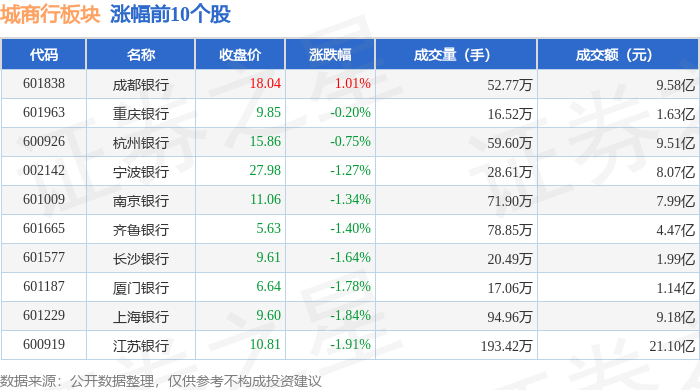
Market Overview - On August 27, the city commercial bank sector fell by 1.48%, with Guiyang Bank leading the decline [1] - The Shanghai Composite Index closed at 3800.35, down 1.76%, while the Shenzhen Component Index closed at 12295.07, down 1.43% [1] Individual Stock Performance - Chengdu Bank closed at 18.04, up 1.01% with a trading volume of 527,700 shares and a transaction value of 958 million [1] - Guiyang Bank closed at 6.16, down 2.53% with a trading volume of 713,000 shares and a transaction value of 44.5 million [2] - Beijing Bank closed at 6.08, down 2.41% with a trading volume of 2,160,300 shares and a transaction value of 1.329 billion [2] - Jiangsu Bank had a closing price of 10.81, down 1.91% with a trading volume of 1,934,200 shares and a transaction value of 2.11 billion [2] Capital Flow Analysis - The city commercial bank sector experienced a net outflow of 911 million from institutional investors, while retail investors saw a net inflow of 502 million [2] - The table of capital flow indicates that Chongqing Bank had a net outflow of 36.1 million from institutional investors, while Chengdu Bank had a net inflow of 9.59 million [3] - The overall trend shows that institutional investors are withdrawing funds while retail investors are increasing their positions in certain banks [2][3]


A股银行股走弱,邮储银行跌超3%
Ge Long Hui A P P· 2025-08-27 05:54
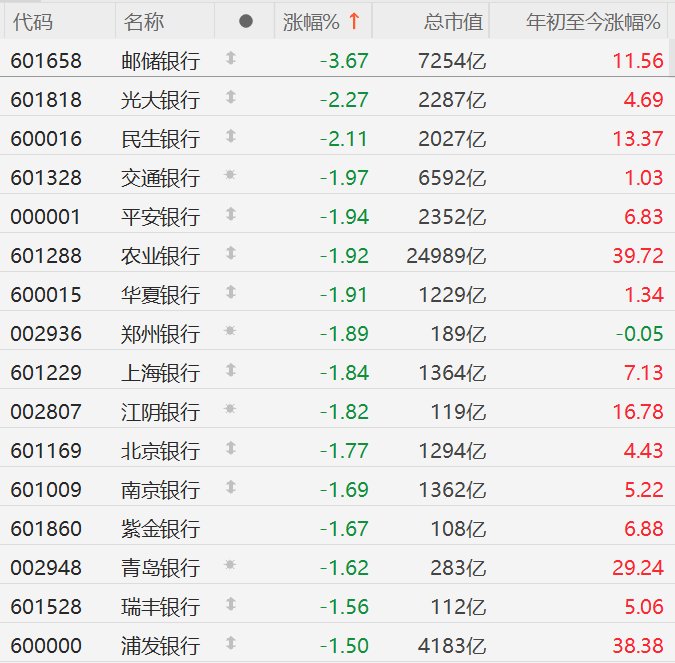
Core Viewpoint - The A-share banking sector is experiencing a continuous decline, with notable drops in several major banks' stock prices, indicating a bearish trend in the market [1]. Group 1: Stock Performance - Postal Savings Bank of China (邮储银行) saw a decline of 3.67%, with a total market capitalization of 725.4 billion [2]. - China Everbright Bank (光大银行) decreased by 2.27%, with a market cap of 228.7 billion [2]. - Minsheng Bank (民生银行) fell by 2.11%, having a market value of 202.7 billion [2]. - Agricultural Bank of China (农业银行) dropped by 1.92%, with a significant market cap of 2,498.9 billion [2]. - Other banks such as Huaxia Bank (华夏银行) and Bank of Communications (交通银行) also experienced declines, with respective drops of 1.91% and 1.97% [2]. Group 2: Year-to-Date Performance - Despite the recent declines, Postal Savings Bank has a year-to-date increase of 11.56% [2]. - Minsheng Bank shows a year-to-date increase of 13.37% [2]. - Agricultural Bank of China has a substantial year-to-date increase of 39.72%, indicating strong performance earlier in the year [2].



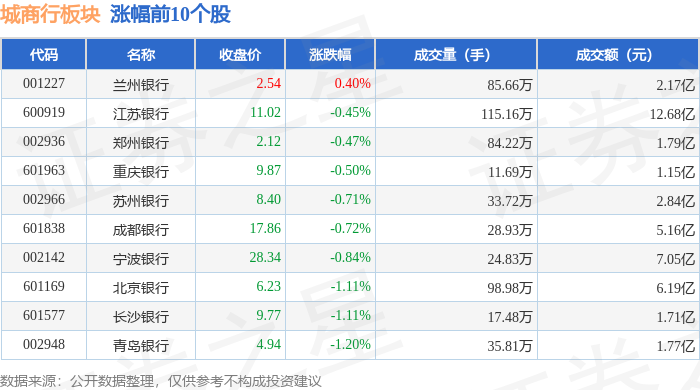
城商行板块8月26日跌1.04%,贵阳银行领跌,主力资金净流出1.91亿元
Zheng Xing Xing Ye Ri Bao· 2025-08-26 08:36
Market Overview - On August 26, the city commercial bank sector declined by 1.04%, with Guiyang Bank leading the drop [1] - The Shanghai Composite Index closed at 3868.38, down 0.39%, while the Shenzhen Component Index closed at 12473.17, up 0.26% [1] Individual Stock Performance - Guiyang Bank closed at 6.32, down 2.17%, with a trading volume of 746,000 shares and a transaction value of 472 million [2] - Jiangsu Bank closed at 11.02, down 0.45%, with a trading volume of 1.15 million shares and a transaction value of 1.27 billion [1] - Other notable declines include Ningbo Bank at 28.34 (-0.84%) and Beijing Bank at 6.23 (-1.11%) [1][2] Capital Flow Analysis - The city commercial bank sector experienced a net outflow of 191 million from main funds, while speculative funds saw a net inflow of 331 million [2] - Retail investors had a net outflow of 140 million [2] Detailed Capital Flow for Selected Banks - Jiangsu Bank had a main fund net inflow of 44.99 million, while retail investors saw a net outflow of 50.90 million [3] - Chongqing Bank experienced a main fund net inflow of 25.15 million, with a significant retail outflow of 22.28 million [3] - Guiyang Bank had a main fund net inflow of 5.25 million but a retail outflow of 31.19 million [3]