
Changshu Bank(601128)

Search documents
A股银行股普跌,宁波银行跌2%
Ge Long Hui· 2025-09-16 02:22
Core Viewpoint - The A-share market experienced a widespread decline in bank stocks, with several banks showing significant drops in their share prices [1] Group 1: Stock Performance - Ningbo Bank's stock fell by 2% [1] - Qingdao Bank, Chongqing Rural Commercial Bank, Changshu Bank, Nanjing Bank, Shanghai Pudong Development Bank, Jiangyin Bank, and CITIC Bank all saw declines of over 1% [1]





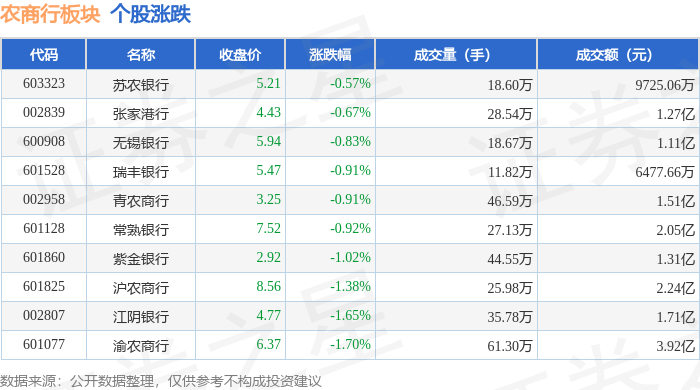
农商行板块9月15日跌1.26%,渝农商行领跌,主力资金净流入7545.27万元
Zheng Xing Xing Ye Ri Bao· 2025-09-15 08:43
Core Viewpoint - The rural commercial bank sector experienced a decline of 1.26% on September 15, with Yunnan Rural Commercial Bank leading the drop. The Shanghai Composite Index closed at 3860.5, down 0.26%, while the Shenzhen Component Index rose by 0.63% to 13005.77 [1]. Group 1: Market Performance - The closing prices and changes for various rural commercial banks showed negative trends, with Yunnan Rural Commercial Bank down 1.70% to 6.37, and Jiangyin Bank down 1.65% to 4.77 [1]. - The trading volume for the rural commercial bank sector was significant, with total transaction amounts reaching hundreds of millions, such as Zhangjiagang Bank at 1.27 billion and Jiangyin Bank at 1.71 billion [1]. Group 2: Capital Flow - The rural commercial bank sector saw a net inflow of 75.45 million from main funds, while retail investors experienced a net outflow of 71.17 million [1]. - Specific banks like Yunnan Rural Commercial Bank had a main fund net inflow of 57.00 million, but retail investors withdrew 16.05 million [2].


“贷”动科创 “权”释未来
Xin Hua Ri Bao· 2025-09-14 21:15
Core Viewpoint - The implementation of the "loan + equity option" model by Jiangsu rural commercial banks is enhancing financial support for technology-driven enterprises, facilitating their growth and innovation [1][2][8]. Group 1: Policy and Financial Innovations - The "loan + equity option" model is a breakthrough for Jiangsu rural commercial banks, allowing them to provide comprehensive financial support throughout the lifecycle of technology enterprises [1][2]. - As of the end of August, nine rural commercial banks in Jiangsu have signed 17 "loan + equity option" agreements, with seven banks completing 13 standardized filings at the Jiangsu Equity Exchange Center, accounting for 65% of the total filings during the same period [1][2]. Group 2: Case Studies of Successful Implementation - Suzhou Rural Commercial Bank executed the first "loan + equity option" agreement in Jiangsu, providing a credit loan of 4 million yuan to a company under the Chinese Academy of Sciences, along with an equity option to purchase 2 million yuan worth of shares [3]. - Reed (Suzhou) Electronic Technology Co., Ltd. utilized the "loan + equity option" model to secure 500,000 yuan in equity rights, which facilitated their external financing and share buyback, allowing the bank to exit the investment [3][4]. - Leming Pharmaceutical (Suzhou) Co., Ltd. received 200,000 yuan in "talent loans" and secured an equity option for 500,000 yuan, which helped them bridge the funding gap during their product development phase [5][6]. Group 3: Broader Industry Impact - The "loan + equity option" model is not only aiding individual companies but also driving innovation in the financial services sector, allowing banks to transition from mere fund providers to comprehensive service providers for enterprises [9][10]. - Jiangsu rural commercial banks are actively building networks with venture capital (VC), private equity (PE), and other financial institutions to enhance their service offerings and project selection capabilities [10][11].

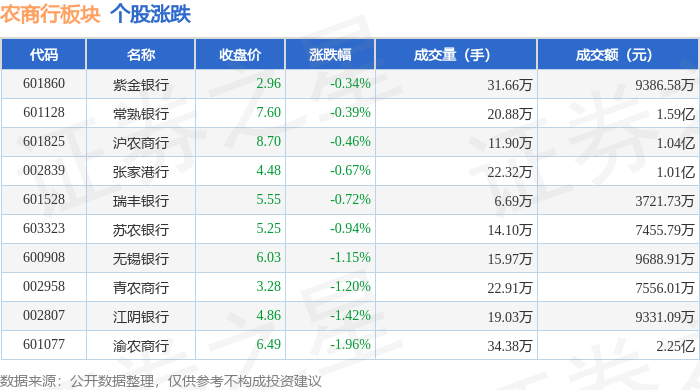
农商行板块9月12日跌1.2%,渝农商行领跌,主力资金净流出1.18亿元
Zheng Xing Xing Ye Ri Bao· 2025-09-12 08:38
Core Points - The rural commercial bank sector experienced a decline of 1.2% on September 12, with Yunnan Rural Commercial Bank leading the drop [1] - The Shanghai Composite Index closed at 3883.69, up 0.22%, while the Shenzhen Component Index closed at 12996.38, up 0.13% [1] Stock Performance - The closing prices and changes for key rural commercial banks are as follows: - Zijin Bank: 2.96, -0.34% - Changshu Bank: 7.60, -0.39% - Shanghai Rural Commercial Bank: 8.70, -0.46% - Zhangjiagang Bank: 4.48, -0.67% - Ruifeng Bank: 5.55, -0.72% - Sunong Bank: 5.25, -0.94% - Wuxi Bank: 6.03, -1.15% - Qingnong Bank: 3.28, -1.20% - Jiangyin Bank: 4.86, -1.42% - Yunnan Rural Commercial Bank: 6.49, -1.96% [1] Capital Flow - The rural commercial bank sector saw a net outflow of 118 million yuan from main funds, while retail investors contributed a net inflow of 108 million yuan [1] - Detailed capital flow for individual banks shows: - Ruifeng Bank: Main funds -189.46 thousand, Retail funds +66.01 thousand - Shanghai Rural Commercial Bank: Main funds -543.89 thousand, Retail funds +117.60 thousand - Zijin Bank: Main funds -740.49 thousand, Retail funds +762.08 thousand - Wuxi Bank: Main funds -831.59 thousand, Retail funds +881.56 thousand - Zhangjiagang Bank: Main funds -1087.07 thousand, Retail funds +1526.36 thousand - Qingnong Bank: Main funds -1198.02 thousand, Retail funds +899.30 thousand - Sunong Bank: Main funds -1200.33 thousand, Retail funds +764.96 thousand - Jiangyin Bank: Main funds -1627.70 thousand, Retail funds +850.10 thousand - Changshu Bank: Main funds -1722.64 thousand, Retail funds +2455.71 thousand - Yunnan Rural Commercial Bank: Main funds -2678.88 thousand, Retail funds +2524.52 thousand [2]

息差下滑趋势出现分化 零售不良走高再引关注
Jin Rong Shi Bao· 2025-09-11 03:21
Core Viewpoint - The performance of A-share listed rural commercial banks in the first half of 2025 shows overall profit growth despite a declining net interest margin, with asset quality improving amidst increasing uncertainties [1][9]. Group 1: Financial Performance - All 10 A-share listed rural commercial banks reported year-on-year growth in net profit for the first half of 2025, despite a general decline in net interest margins [1]. - Jiangyin Rural Commercial Bank led the growth with a revenue of 2.401 billion yuan and a net profit of 846 million yuan, representing increases of 10.45% and 16.63% respectively [2]. - Changshu Rural Commercial Bank achieved revenue and net profit growth rates of 10.1% and 13.51%, maintaining a relatively high net interest margin of 2.58% [2]. Group 2: Net Interest Margin Trends - The net interest margin for several banks has shown a slowing decline, with some banks like Ruifeng Rural Commercial Bank experiencing a minimal drop of only 0.08 percentage points [4]. - Chongqing Rural Commercial Bank had the smallest decline in net interest margin, reducing by just 0.03 percentage points, while still achieving a 5.98% increase in interest income [4]. - However, banks like Zhangjiagang and Suzhou Rural Commercial Banks faced larger declines in net interest margins, with drops of 0.19 and 0.16 percentage points respectively [5]. Group 3: Asset Quality Improvement - The non-performing loan (NPL) ratio for rural commercial banks improved overall, with the average NPL ratio at 2.77%, a decrease of 0.03 percentage points from the end of 2024 [9]. - Qingdao Rural Commercial Bank showed the most significant improvement, with its NPL ratio decreasing by 0.04 percentage points to 1.75% [10]. - Despite improvements, challenges remain in retail loan quality, with some banks experiencing rising NPL ratios in specific sectors [11]. Group 4: Strategic Adjustments - Banks are adjusting their business structures and pricing strategies to mitigate the impact of declining net interest margins, with Chongqing Rural Commercial Bank effectively managing interest costs [6][7]. - The focus on enhancing non-interest income has been a key strategy, with banks like Changshu Rural Commercial Bank integrating financial and non-financial services to strengthen their competitive edge [7]. - Digital tools and data analytics are being utilized by banks to enhance customer targeting and service delivery, particularly in small and micro-business financing [12][13].


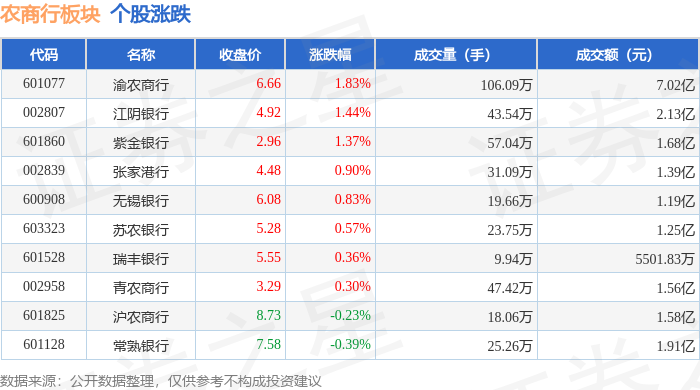
农商行板块9月10日涨0.58%,渝农商行领涨,主力资金净流出3471.47万元
Zheng Xing Xing Ye Ri Bao· 2025-09-10 08:37
Core Insights - The agricultural commercial bank sector experienced a rise of 0.58% on September 10, with Yunnan Agricultural Commercial Bank leading the gains [1] - The Shanghai Composite Index closed at 3812.22, up 0.13%, while the Shenzhen Component Index closed at 12557.68, up 0.38% [1] Stock Performance - Yunnan Agricultural Commercial Bank (601077) closed at 6.66, with an increase of 1.83% and a trading volume of 1.061 million shares, amounting to 702 million yuan [1] - Jiangyin Bank (002807) closed at 4.92, up 1.44%, with a trading volume of 435,400 shares and a turnover of 213 million yuan [1] - Zijin Bank (601860) closed at 2.96, up 1.37%, with a trading volume of 570,400 shares and a turnover of 168 million yuan [1] - Other notable performances include Zhangjiagang Bank (002839) at 4.48 (+0.90%), and Wuxi Bank (600908) at 6.08 (+0.83%) [1] Capital Flow - The agricultural commercial bank sector saw a net outflow of 34.71 million yuan from institutional investors, while retail investors contributed a net inflow of 51.18 million yuan [1] - The detailed capital flow for individual stocks indicates that Changshu Bank (601128) had a net inflow of 20.62 million yuan from institutional investors, while it faced a net outflow of 15.01 million yuan from retail investors [2] - Yunnan Agricultural Commercial Bank (601077) experienced a significant net outflow of 42.29 million yuan from institutional investors, despite a retail net inflow of 36.90 million yuan [2]
常熟银行:9月17日将召开2025年半年度业绩说明会
Zheng Quan Ri Bao Wang· 2025-09-09 13:14
Core Viewpoint - Changshu Bank (601128) announced that its 2025 semi-annual performance briefing will be held on September 17, 2025 [1] Company Summary - The announcement regarding the performance briefing indicates the company's commitment to transparency and communication with stakeholders [1]
常熟银行(601128) - 江苏常熟农村商业银行股份有限公司关于召开2025年半年度业绩说明会的公告
2025-09-09 07:45
证券代码:601128 证券简称:常熟银行 公告编号:2025-045 江苏常熟农村商业银行股份有限公司 关于召开 2025 年半年度业绩说明会的公告 江苏常熟农村商业银行股份有限公司(以下简称"本行")董事会及全体董 事保证本公告内容不存在任何虚假记载、误导性陈述或者重大遗漏,并对其内容 的真实性、准确性和完整性承担个别及连带责任。 重要内容提示: 会议召开时间:2025 年 09 月 17 日(星期三)下午 14:00-15:00 会议召开地点:上海证券交易所上证路演中心(网址: https://roadshow.sseinfo.com/) 会议召开方式:上证路演中心网络互动 投资者可于 2025 年 09 月 10 日(星期三)至 09 月 16 日(星期二)16:00 前登录上证路演中心网站首页点击"提问预征集"栏目或通过本行投资者关系邮 箱:601128@csrcbank.com 进行提问。本行将在 2025 年半年度业绩说明会(以 下简称"业绩说明会")上对投资者普遍关注的问题进行回答。 本行已于 2025 年 08 月 08 日在上海证券交易所网站(www.sse.com.cn)披 露 2025 ...
常熟银行:关于“常银转债”2025年付息事宜的公告
Zheng Quan Ri Bao· 2025-09-08 13:39
Group 1 - The core point of the announcement is that Changshu Bank will pay interest on its 6 billion yuan convertible bonds issued on September 15, 2022, from September 15, 2024, to September 14, 2025 [2] - The bond interest payment record date is set for September 12, 2025, with the interest payment date being September 15, 2025 [2]
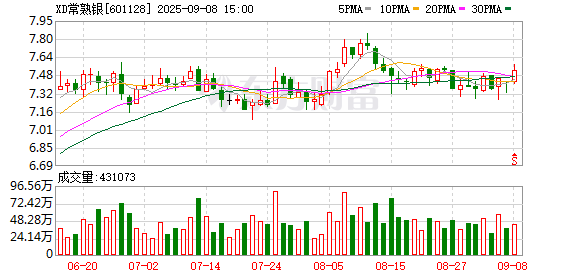
净息差排行榜出炉!常熟银行遥遥领先,上海银行、厦门银行垫底|探寻中报②
Xin Lang Cai Jing· 2025-09-08 12:04
Core Insights - In the first half of 2025, Changshu Bank achieved the highest net interest margin (NIM) among 42 A-share listed banks at 2.58%, being the only bank with a NIM exceeding 2% [1] - The bottom three banks in terms of NIM were Zijin Bank (1.18%), Shanghai Bank (1.15%), and Xiamen Bank (1.08%), indicating a significant decline in their interest margins [1] - Xiamen Bank attributed its NIM decline to factors such as falling market interest rates and the average loan interest rate decrease due to concentrated repricing at the beginning of the year [1] - Only two banks, Xi'an Bank and Minsheng Bank, reported positive growth in NIM, with Xi'an Bank leading at +0.49 percentage points [1] Financial Performance - Xi'an Bank reported a net interest income of 3.898 billion yuan, a year-on-year increase of 59.92%, with interest income rising by 14.25% to 8.752 billion yuan and interest expenses decreasing by 7.07% to 4.854 billion yuan [2] - Guizhou Bank and Zijin Bank experienced the largest declines in NIM, ranking at the bottom of the 42 A-share listed banks [2]