
BOB(601169)

Search documents
上海房贷新政,多家银行公告
Guan Cha Zhe Wang· 2025-08-30 00:14
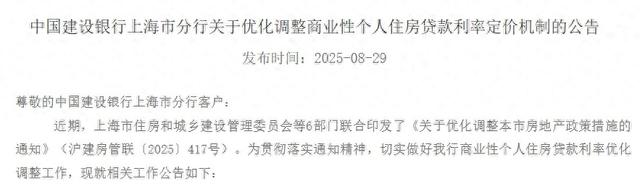
Group 1 - The core viewpoint of the news is the recent adjustments in housing loan policies by several banks in Shanghai following the city's new real estate policy announcement on August 25 [1] - Major banks including China Construction Bank, Bank of Communications, Industrial and Commercial Bank of China, Bank of China, China Merchants Bank, Agricultural Bank of China, Ping An Bank, China Everbright Bank, Beijing Bank, and Jiangsu Bank have released announcements regarding the optimization of commercial personal housing loan interest rate pricing mechanisms [1][2] - The new policies indicate that there will no longer be a distinction between first and second home loan interest rates, with rates determined based on the Shanghai market interest rate pricing self-discipline mechanism and other factors [2] Group 2 - Some existing housing loan rates may also be adjusted for eligible borrowers, with specific rules for adjustments based on the average interest rates of newly issued loans [2] - According to the People's Bank of China, the weighted average interest rate for newly issued commercial personal housing loans in the second quarter of 2025 is 3.09% [2] - Starting September 1, borrowers can check their eligibility for interest rate reductions through the banks' mobile banking channels, and applications can be made online without additional fees [3]




北京银行首席信息官明立松任职资格获批
Bei Jing Shang Bao· 2025-08-29 14:58
北京商报讯(记者宋亦桐)8月29日,北京金融监管局发布《关于明立松北京银行(601169)股份有限公 司首席信息官任职资格的批复》,核准明立松北京银行股份有限公司首席信息官的任职资格。 ...

联想集团与北京银行签署战略合作协议
Xin Lang Cai Jing· 2025-08-29 13:29
Core Insights - Lenovo Group signed a strategic cooperation agreement with Bank of Beijing on August 29, focusing on joint development of enterprise-level products and services [1] - The collaboration aims to create personalized solutions tailored to the needs of both companies' clients [1] - The partnership will also explore long-term ecological cooperation with individual consumers [1]

上海多家银行房贷细则落地,新增二套房利率最低3.09%
2 1 Shi Ji Jing Ji Bao Dao· 2025-08-29 13:27
Core Viewpoint - Shanghai's housing market has introduced new mortgage interest rate pricing mechanisms, eliminating the distinction between first and second home loans, aiming to optimize the real estate policy and stimulate market activity [2][3]. Group 1: New Mortgage Policies - Multiple banks in Shanghai have released announcements regarding the optimization of commercial personal housing loan interest rate pricing mechanisms, aligning with the recent government notification [2]. - The new policy states that the specific interest rate for each customer's commercial personal housing loan will be determined based on the Shanghai market interest rate pricing self-discipline mechanism, along with the bank's operational status and customer risk profile [2][4]. Group 2: Existing Loan Adjustments - For existing loans, banks will continue to follow the previous year's guidelines, allowing adjustments for certain second home loans that exceed the average interest rate of newly issued loans by more than 30 basis points [3]. - The weighted average interest rate for newly issued commercial personal housing loans in China was reported at 3.09% for Q2 2025, a decrease of 2 basis points from Q1, indicating potential for lower rates for second home loans in Shanghai [3][4]. Group 3: Regulatory Framework - The central bank's adjustments include four main points, notably the removal of the distinction between first and second home loan interest rates and the emphasis on banks to adhere to market conditions and government regulations [3][4]. - Banks are required to ensure compliance with the new policies, providing adequate communication and support to borrowers regarding their rights and the implications of the new interest rate structures [4].



北京银行探索“人+AI”协同工作新模式
Zheng Quan Ri Bao Wang· 2025-08-29 13:14
Core Viewpoint - Beijing Bank is focusing on becoming an "AI-driven commercial bank" and is exploring a new collaborative work model of "human + AI" [1] Group 1: AI Strategy - The bank has adopted "All in AI" as a strategic consensus across the organization [1] - It is building an integrated computing power foundation and developing two operational platforms: "large models" and "small models" [1] - The bank has established a "1213" AI technology architecture, which includes over 100 AI capabilities and more than 300 AI application scenarios [1] Group 2: Innovation and Development - Beijing Bank is actively introducing industry-leading general large models and developing financial vertical models tailored to its business characteristics [1] - The AIB AI innovation platform is being utilized to construct "AI + finance" full-scenario capabilities [1]
上海多家银行房贷细则落地,新增二套房利率最低3.09%
21世纪经济报道· 2025-08-29 12:42
Core Viewpoint - The article discusses the recent adjustments to the housing loan interest rate pricing mechanism in Shanghai, which aims to optimize the real estate policy and enhance market stability [2][4]. Group 1: New Housing Loan Policies - The new pricing mechanism for commercial personal housing loans no longer distinguishes between first and second homes, allowing for a more unified approach to interest rates [3][4]. - The specific interest rate for each customer's loan will be determined based on the Shanghai market interest rate pricing self-discipline mechanism, along with the bank's operational conditions and customer risk profiles [3][4]. Group 2: Existing Housing Loan Adjustments - Existing housing loans will continue to follow the guidelines established in October of the previous year, allowing for adjustments in the interest rates of certain second-home loans based on market conditions [3][4]. - If the interest rate increase for existing loans exceeds 30 basis points above the average rate of newly issued loans, borrowers can apply for a rate adjustment [3][4]. Group 3: Market Context and Implications - As of July, the weighted average interest rate for newly issued commercial personal housing loans in China was 3.09%, a slight decrease from the previous quarter, while the 5-year LPR was 3.5% [3]. - For second-home owners in Shanghai, applying for a loan after September 1 could result in a minimum interest rate of 3.09%, aligning with first-home rates, while existing loans at 3.45% could potentially be reduced to 3.36% [3].

北京银行上半年实现归母净利150.53亿元,零售资金量突破1.30万亿元
Bei Jing Shang Bao· 2025-08-29 12:29
北京商报讯(记者宋亦桐)8月29日,北京银行(601169)发布2025年上半年主要经营情况,截至报告期 末,北京银行资产总额达4.75万亿元,较上年末增长12.53%;负债总额达4.36万亿元,较上年末增长 12.94%。报告期内,北京银行实现营业收入362.18亿元,同比增长1.02%;实现归属于母公司股东的净 利润150.53亿元,同比增长1.12%。 零售转型不断深化,零售资金量突破1.30万亿元,较年初增长7.28%;零售客户数达3149.57万户,较年 初增长77.81万户;第三代社保卡新增57.8万张,新增发卡量市场份额排名第一。金融市场统筹平衡,托 管规模2.76万亿元,较年初增长21.66%;货币市场交易总量居境内市场第一梯队;绿色债券投资余额 293.56亿元,较年初增长41.23%。 2025年上半年,北京银行业务强化支撑,公司贷款(含贴现)1.65万亿元,较年初增长11.29%,其中科技 金融、绿色金融、普惠金融、制造业贷款等领域贷款均实现快速增长,分别较上年末增长19.31%、 21.84%、17.27%、14.26%;公司存款(含保证金)1.85万亿元,较年初增长8.51%;公司存 ...
北京银行:科技金融贷款三年增长131%,打造“专精特新第一行”
Zheng Quan Shi Bao Wang· 2025-08-29 12:21
Core Insights - Beijing Bank reported a significant increase in its technology finance loan balance, reaching 434.608 billion yuan as of June 30, 2025, which represents a 19.31% increase from the beginning of the year and a 131% increase compared to June 30, 2022 [1] Group 1: Financial Performance - The total credit funds provided to over 55,000 technology-based small and micro enterprises exceeded 1.3 trillion yuan [1] - The bank serves 82% of the companies listed on the Beijing Stock Exchange's Growth Enterprise Market, 74% on the Sci-Tech Innovation Board, and 75% on the New Third Board's innovative tier [1] Group 2: Targeted Services - Beijing Bank has provided services to over 26,000 specialized and innovative enterprises, with a loan balance of 121 billion yuan for these companies [1] - The bank supports 74% of the national-level specialized and innovative "little giant" enterprises and 55% of specialized and innovative small and medium-sized enterprises in the Beijing area [1]
北京银行(601169) - 北京银行股份有限公司关于会计政策变更的公告
2025-08-29 12:14
证券代码:601169 证券简称:北京银行 公告编号:2025-046 北京银行股份有限公司关于会计政策变更的公告 本行董事会及全体董事保证本公告内容不存在任何虚假记载、误导性陈述或者重大遗 漏,并对其内容的真实性、准确性和完整性承担个别及连带责任。 重要内容提示: 本次会计政策变更是本行根据财政部相关文件要求进行的变 更,符合相关规定和本行实际情况,对本行财务状况和经营成果不产 生重大影响。 一、本次会计政策变更概述 财政部于 2020 年修订了《企业会计准则第 25 号—保险合同》(以 下简称"新保险合同准则"),要求境内外同时上市的企业以及在境外 上市并采用国际财务报告准则或企业会计准则编制财务报表的企业, 自 2023 年 1 月 1 日执行;其他执行企业会计准则的企业自 2026 年 1 月 1 日执行。同时,允许企业提前执行。 按照财政部关于准则实施的时间要求和公司经营发展需要,本行 于 2025 年 1 月 1 日提前适用新保险合同准则,同时,追溯调整了自 2024 年 1 月 1 日起比较期间数据,并按照相关衔接规定进行了财务 报表披露。 本次会计政策变更是本行根据财政部相关文件进行的变更,符 ...
北京银行(601169) - 北京银行股份有限公司与ING BANK N.V.关联交易事项的公告
2025-08-29 12:14
证券代码:601169 证券简称:北京银行 公告编号:2025-047 北京银行股份有限公司 与 ING BANK N.V.关联交易事项的公告 本公司董事会及全体董事保证本公告内容不存在任何虚假记载、误导性陈述或者重大遗 漏,并对其内容的真实性、准确性和完整性承担个别及连带责任。 (二)关联方基本情况 ING BANK N.V.成立于 1991 年 1 月 1 日,是一家全球性金融机 构,为荷兰国际集团全资子公司,注册资本 170.67 亿欧元,主营业 重要内容提示: 一、关联交易概述 北京银行总行信用审批委员会 2025 年 7 月 15 日审议通过 ING BANK N.V.的授信方案,拟同意授予 ING BANK N.V.同业机构综合授 信额度10亿美元,包含等值10亿元人民币承诺性同业融资授信额度。 业务品种包括拆放同业、债券逆回购、债券借贷、债券投资、外汇即 期、外汇远期、外汇掉期、外汇期权-买、利率掉期、同业存单、信 用违约掉期-买方、信用违约掉期-卖方、总收益互换-支付方、总收益 互换-接收方、信用联结票据-买方、信用联结票据-卖方、存放同业- 同业部、备用信用证担保项下融资、出口信用证贴现、福 ...