XIANMEN BANK(601187)

Search documents
固收深度报告20250927:从42家上市银行半年报解读银行债券投资“攻守道”




Soochow Securities· 2025-09-27 14:32
1. Report Industry Investment Rating No information about the report industry investment rating is provided in the given content. 2. Core Viewpoints of the Report - External environment factors such as interest rate fluctuations, bond supply - demand, and policy orientation jointly impact bond investment returns. In H1 2025, the bond investment of 42 listed banks showed certain characteristics in scale, structure, and profit and loss, but there are still challenges in maintaining stable returns in the future [1]. - The overall bond investment scale of 42 listed banks expanded steadily in H1 2025. There were differences in the investment structure among different types of banks, with state - owned banks and city commercial banks having stable growth in the bond allocation portfolio, while joint - stock banks and rural commercial banks increased their efforts in the bond trading portfolio. The bond investment portfolio generally presented a pattern of "stable foundation and flexible gain" [1]. - The coupon income of 42 listed banks was generally stable in H1 2025 but showed a slight year - on - year decline. The fair value change loss was significant, and the investment income increased. However, the bond investment of the banking industry still faces pressure to maintain stable returns [1]. 3. Summary According to the Table of Contents 3.1 42 Listed Banks' Bond Investment Volume - **Overall Bond Investment Scale: Steady Expansion**: In H1 2025, the total scale of the three types of bond - type financial assets of 42 listed banks showed a steady expansion trend. The growth of debt investment - type financial assets measured at amortized cost was relatively slow, while the growth of trading financial assets measured at fair value and included in current profits and losses was relatively large, indicating that banks increased the proportion of trading positions [9]. - **Differentiated Bond Investment Distribution Structures among Different Bank Types**: In H1 2025, state - owned banks and city commercial banks showed stable growth in the bond allocation portfolio, which may be related to their participation in the primary - market issuance of important national and regional bond varieties. Joint - stock banks and rural commercial banks slightly weakened their bond allocation power but significantly increased their efforts in the bond trading portfolio, showing a differentiated feature of "stable allocation by large banks and prominent trading flexibility by small and medium - sized banks" [13]. - **Bond Investment Allocation Tilted towards Government - Related Bonds**: In H1 2025, commercial banks increased their allocation of government - related bonds, with an average month - on - month increase of about 10% for state - owned banks, joint - stock banks, and city commercial banks, and a slightly smaller increase for rural commercial banks. The allocation of financial bonds and other bonds was differentiated. All banks held a relatively large scale of government - related bonds, followed by financial bonds and credit - related bonds [18]. - **Correlation between Financial Asset Types and Bond Variety Structures**: The banking industry maintained a stable growth of interest - rate bonds in the bond allocation portfolio and increased the allocation of credit bonds, while the allocation of financial bonds was relatively weak. In the bond trading portfolio, interest - rate bonds and financial bonds were the core varieties, with a more significant increase than credit bonds, showing a "stable foundation and flexible gain" pattern [22]. 3.2 42 Listed Banks' Bond Investment Profit and Loss - **Coupon Income: Generally Stable and Still the Main Source of Income**: In H1 2025, the total coupon income of 42 listed banks decreased slightly year - on - year. Although the scale of held - to - maturity bonds increased, the decline in the coupon rate of newly issued bonds led to a decrease in coupon income. In the future, coupon income is still expected to be the main source of bond investment income for commercial banks [26]. - **Fair Value Change Loss: Losses in the Trading Level**: In H1 2025, the total fair value change loss of 42 listed banks decreased significantly year - on - year, indicating that it was difficult to obtain capital gains through short - term trading in the volatile bond market, and there were floating losses in bond trading [28]. - **Investment Income: Growth in All Bank Types**: In H1 2025, the actual investment income of 42 listed banks in the bond field increased significantly year - on - year. Although the book value appreciation of bond - type trading financial assets and other debt investment - type financial assets was not as good as that of the previous year, banks could still increase their investment income by selling floating - profit old bonds and waiting for the maturity of high - coupon bonds [31]. 3.3 Attribution and Summary - **External Environment Driving Factors: Interest Rate Fluctuations, Bond Supply - Demand, and Policy Orientation Jointly Impact Bond Investment Returns**: In H1 2025, the "more adjustments and fewer opportunities" bond market environment led to a general decline in the prices of existing bonds, resulting in a significant year - on - year decline in the fair value change loss of listed banks' bond investment. The supply of national bonds, local government bonds, and policy - based financial bonds increased, but the coupon rate of newly issued bonds decreased, leading to a decline in coupon income. Regulatory policies indirectly affected bond investment performance [35]. - **Banking Industry's Bond Investment Pressure and Future Outlook** - Overall Income Shows a Positive Trend but There Are Still Hidden Concerns: In H1 2025, the actual bond investment income of 42 listed banks increased slightly year - on - year, but the coupon income faced downward pressure in the interest - rate downward cycle, and it was more difficult to obtain spread income through band trading. Since H2 2025, the "stock - strong and bond - weak" pattern has emerged, and the loss caused by fair value change will be more obvious [3]. - Different Bank Types Show Differentiated Performance, and State - owned Banks' Pressure Is Relatively Controllable: State - owned banks can maintain a certain profit - making ability in the low - interest - rate volatile bond market due to their advantages in bond allocation and trading portfolios. Joint - stock banks, city commercial banks, and rural commercial banks are more vulnerable, and they may increase their capital allocation in the equity market, commodity market, and related structured fixed - income products in the future [3].
厦门银行股份有限公司 第九届监事会第十七次会议决议公告
Zhong Guo Zheng Quan Bao - Zhong Zheng Wang· 2025-09-27 00:45
证券代码:601187 证券简称:厦门银行 公告编号:2025-039 厦门银行股份有限公司 第九届监事会第十七次会议决议公告 厦门银行股份有限公司(以下简称"公司")第九届监事会第十七次会议通知于2025年9月18日以电子邮 件方式发出,会议于2025年9月26日以书面传签方式召开。本次会议应出席的监事6人,亲自出席会议的 监事6人。本次会议的召集、召开程序符合《中华人民共和国公司法》等法律法规和《厦门银行股份有 限公司章程》的有关规定。 与会监事对议案进行了审议,形成如下决议: 一、审议并通过《厦门银行股份有限公司关于2025年下半年预期信用损失模型(参数)更新方案的议 案》 表决结果:以6票赞成,0票反对,0票弃权获得通过。 二、审议并通过《关于制定〈厦门银行股份有限公司市场风险管理基本办法〉的议案》 表决结果:以6票赞成,0票反对,0票弃权获得通过。 三、审议并通过《厦门银行股份有限公司关于2024年度薪酬管理情况报告的议案》 表决结果:以6票赞成,0票反对,0票弃权获得通过。 厦门银行股份有限公司监事会 2025年9月26日 厦门银行股份有限公司监事会及全体监事保证本公告内容不存在任何虚假记载、误导 ...
厦门银行(601187) - 厦门银行股份有限公司第九届监事会第十七次会议决议公告
2025-09-26 10:15
证券代码:601187 证券简称:厦门银行 公告编号:2025-039 厦门银行股份有限公司监事会及全体监事保证本公告内容不存在任何虚 假记载、误导性陈述或者重大遗漏,并对其内容的真实性、准确性和完整性承 担法律责任。 厦门银行股份有限公司(以下简称"公司")第九届监事会第十七次会议通 知于 2025 年 9 月 18 日以电子邮件方式发出,会议于 2025 年 9 月 26 日以书面传 签方式召开。本次会议应出席的监事 6 人,亲自出席会议的监事 6 人。本次会议 的召集、召开程序符合《中华人民共和国公司法》等法律法规和《厦门银行股份 有限公司章程》的有关规定。 与会监事对议案进行了审议,形成如下决议: 一、审议并通过《厦门银行股份有限公司关于 2025 年下半年预期信用损失 模型(参数)更新方案的议案》 表决结果:以 6 票赞成,0 票反对,0 票弃权获得通过。 二、审议并通过《关于制定<厦门银行股份有限公司市场风险管理基本办法> 的议案》 表决结果:以 6 票赞成,0 票反对,0 票弃权获得通过。 厦门银行股份有限公司 第九届监事会第十七次会议决议公告 表决结果:以 6 票赞成,0 票反对,0 票弃权获 ...
城商行板块9月25日跌0.94%,重庆银行领跌,主力资金净流出2.78亿元
Zheng Xing Xing Ye Ri Bao· 2025-09-25 08:37
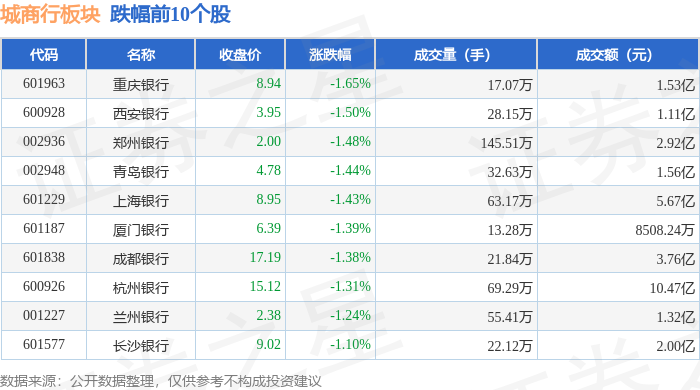
Market Performance - The city commercial bank sector declined by 0.94% on September 25, with Chongqing Bank leading the decline [1] - The Shanghai Composite Index closed at 3853.3, down 0.01%, while the Shenzhen Component Index closed at 13445.9, up 0.67% [1] Individual Stock Performance - Chongqing Bank closed at 8.94, down 1.65% with a trading volume of 170,700 shares and a transaction value of 153 million [1] - Other notable declines include Xi'an Bank down 1.50% to 3.95, Zhengzhou Bank down 1.48% to 2.00, and Qingdao Bank down 1.44% to 4.78 [1] - Shanghai Bank and Xiamen Bank also saw declines of 1.43% and 1.39%, respectively [1] Capital Flow Analysis - The city commercial bank sector experienced a net outflow of 278 million from institutional investors, while retail investors saw a net inflow of 152 million [1] - The table indicates that Suzhou Bank had a significant net outflow from institutional investors of 48.08 million, while Qilu Bank had a net inflow of 25.86 million [2] - Chongqing Bank specifically had a net outflow of 5.68 million from institutional investors but a net inflow of 10.91 million from retail investors [2]



小红日报|标普红利ETF(562060)9月24日龙虎榜
Xin Lang Ji Jin· 2025-09-25 01:05
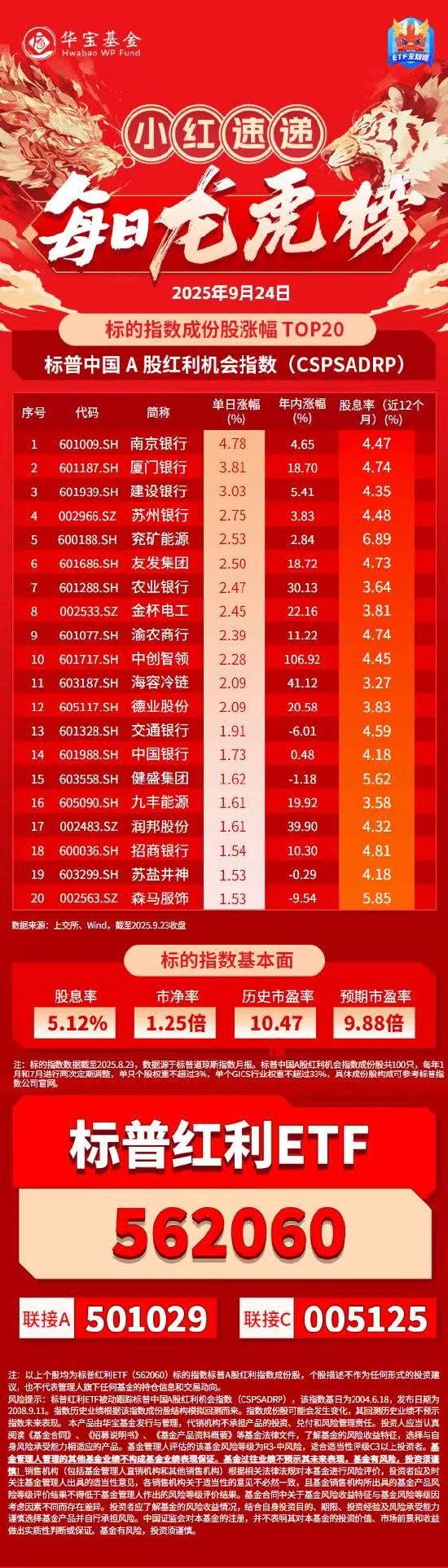
Group 1 - The article highlights the top 20 stocks in the S&P China A-Share Dividend Opportunity Index, showcasing their performance in terms of daily increase, year-to-date increase, and dividend yield [1] - Nanjing Bank (601009.SH) leads with a daily increase of 4.78% and a year-to-date increase of 4.65%, with a dividend yield of 4.47% [1] - Xiamen Bank (601187.SH) shows a significant year-to-date increase of 18.70%, with a daily increase of 3.81% and a dividend yield of 4.74% [1] Group 2 - Agricultural Bank of China (601288.SH) has a remarkable year-to-date increase of 30.13%, with a daily increase of 2.47% and a dividend yield of 3.64% [1] - China Merchants Bank (600036.SH) reports a daily increase of 1.54% and a year-to-date increase of 10.30%, with a dividend yield of 4.81% [1] - The article also notes the formation of a MACD golden cross signal, indicating a positive trend for certain stocks [3]




银行股“9·24行情”这一年:总市值涨了3万多亿
Di Yi Cai Jing· 2025-09-24 15:01
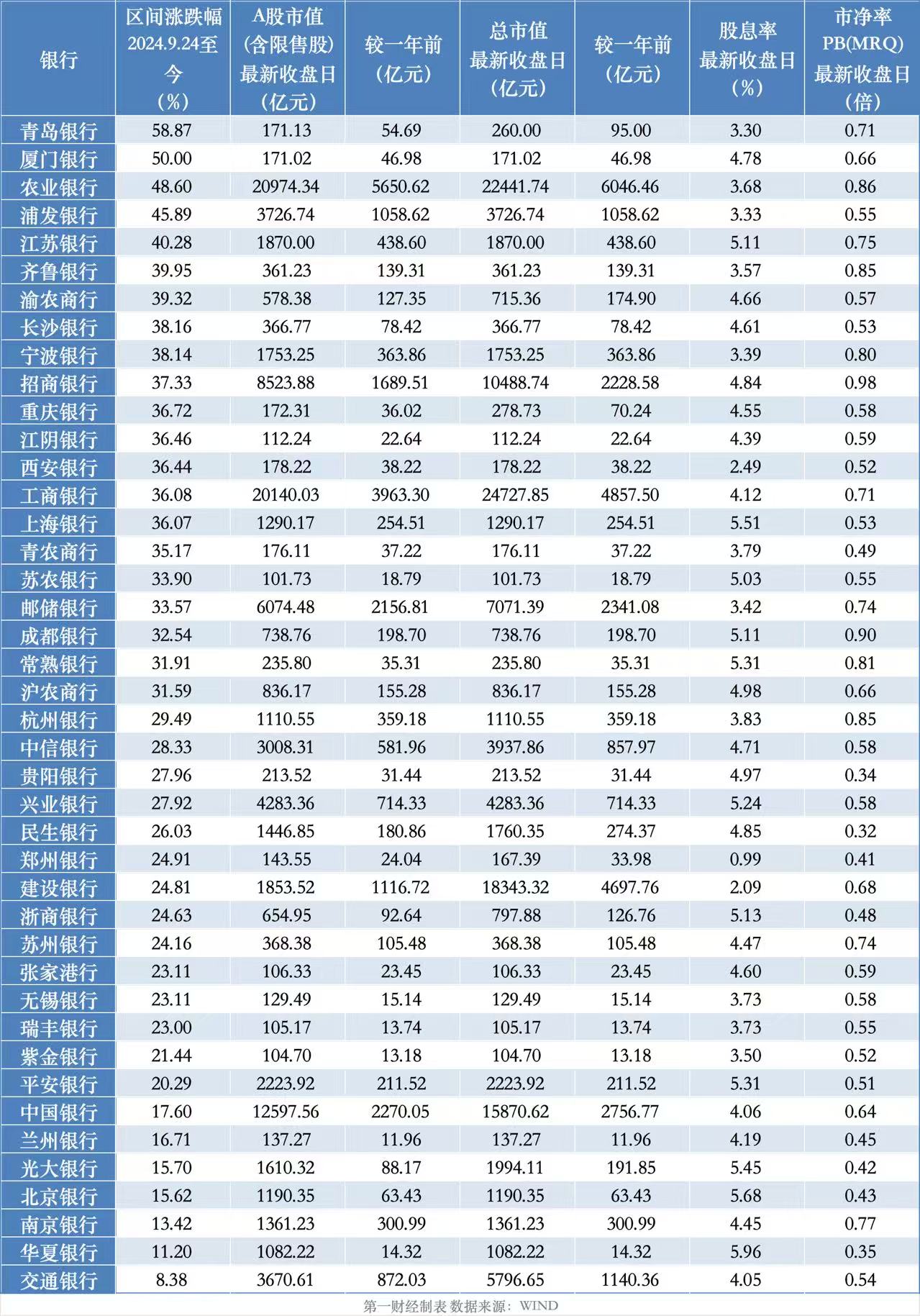
Core Viewpoint - The banking sector has been one of the best-performing segments in the A-share market since the "9.24" rally began in 2024, with the China Securities Banking Index showing a cumulative increase of approximately 24% over the past year [2][3]. Market Performance - As of September 24, 2024, the total A-share market capitalization of 42 listed banks reached approximately 10.6 trillion yuan, an increase of 2.37 trillion yuan from 8.23 trillion yuan a year ago [4]. - The total market capitalization for these banks is about 13.9 trillion yuan, up over 3 trillion yuan from 10.83 trillion yuan a year ago [4]. - The banking sector experienced a significant rally, with the index reaching a high of 8570.76 points, representing a more than 43% increase since last year [2]. Individual Bank Performance - All 42 A-share listed banks reported positive stock price changes over the past year, with the highest increase nearing 59% and the lowest at around 8% [3]. - Notable performers include Qingdao Bank (58.87%), Xiamen Bank (50%), and Agricultural Bank of China (48.6%) [3]. - The median increase for state-owned banks was approximately 29%, with Agricultural Bank, Industrial and Commercial Bank, and Postal Savings Bank leading the gains [3]. Market Capitalization Changes - The top five banks by A-share market capitalization as of the latest close are Agricultural Bank (2.1 trillion yuan), Industrial and Commercial Bank (2.01 trillion yuan), China Bank (1.26 trillion yuan), China Merchants Bank (852.39 billion yuan), and Postal Savings Bank (607.45 billion yuan) [4]. - The Agricultural Bank and Industrial and Commercial Bank saw significant increases in A-share market capitalization, with growth of approximately 565.1 billion yuan and 396.3 billion yuan, respectively [4][5]. Recent Trends and Adjustments - Since July, the banking sector has entered a phase of adjustment, with the China Securities Banking Index declining nearly 13% from its peak [6]. - Over half of the banks have experienced a decline of more than 10% since July 10, with some banks like Everbright Bank and Beijing Bank seeing declines exceeding 20% [6]. - The market sentiment has shifted, leading to increased discussions about whether bank stocks have risen too much and if the rally is over [7]. Valuation Metrics - The median dividend yield for bank stocks is around 4.5%, which has decreased by over 1 percentage point from a year ago but remains competitive compared to other asset yields [7]. - The price-to-book (PB) ratio for the 42 listed banks is approximately 0.58, showing a slight increase from 0.5 a year ago, indicating that the market is still grappling with the issue of banks trading below book value [7].



厦门市高效落地防汛救灾再贷款专项额度
Yang Shi Wang· 2025-09-24 13:48
Core Viewpoint - Xiamen has faced multiple strong typhoons since July, leading to localized flooding and impacting various businesses. The local government has taken swift action to coordinate financial support for disaster recovery and reconstruction efforts [1] Group 1: Government Response - The Xiamen municipal government has organized efforts to enhance collaboration between government and banks to facilitate financial support for disaster recovery [1] - A special loan quota of 3.177 billion yuan has been allocated to encourage local banks to increase credit support for affected businesses, particularly small and micro enterprises, individual businesses, and agricultural sectors [1] Group 2: Financial Institutions' Actions - Local banks in Xiamen have quickly responded to the government's initiatives, forming a collective effort to alleviate financial difficulties faced by businesses [1] - Xiamen Bank has actively utilized the re-lending facility to increase loan disbursements, providing low-cost financing support to affected enterprises [1]
银行股在“9·24行情”这一年:涨幅最低8%最高59%,总市值涨了3万多亿
Di Yi Cai Jing· 2025-09-24 13:24
Core Insights - Since the launch of the "9·24" market rally in 2024, bank stocks have been one of the best-performing sectors in the A-share market, with the China Securities Bank Index showing a cumulative increase of approximately 24% over the past year [1] - The market capitalization of the banking sector has surpassed 10 trillion yuan for the first time, with Agricultural Bank of China briefly overtaking Industrial and Commercial Bank of China in market value before the latter regained its position [1][3] - Since July, bank stocks have entered a phase of volatility and correction, with the index declining nearly 13% from its peak, while the Shanghai Composite Index rose over 10% during the same period [1] Market Performance - All 42 A-share listed banks have seen positive stock price movements over the past year, with the highest increase nearing 59% and the lowest around 8% [2] - Specifically, 36 banks have increased by over 20%, 23 by over 30%, and 5 by over 40% [2] - The top three performers include Qingdao Bank (58.87%), Xiamen Bank (50%), and Agricultural Bank of China (48.6%) [2] Market Capitalization - As of September 24, the total A-share market capitalization of the 42 listed banks is approximately 10.6 trillion yuan, an increase of 2.37 trillion yuan from 8.23 trillion yuan a year ago [3] - The total market capitalization, including H-shares, is about 13.9 trillion yuan, up by over 3 trillion yuan from 10.83 trillion yuan a year ago [3] - The top five banks by A-share market capitalization are Agricultural Bank of China (2.1 trillion yuan), Industrial and Commercial Bank of China (2.01 trillion yuan), and China Bank (1.26 trillion yuan) [3] Value Growth - The largest increases in A-share market capitalization have been seen in Agricultural Bank of China and Industrial and Commercial Bank of China, with increases of approximately 565.1 billion yuan and 396.3 billion yuan, respectively [3][4] - Eight banks have seen their A-share market capitalization increase by over 100 billion yuan since last September, with the top four being state-owned banks [3] Recent Trends - Since July, bank stocks have experienced a correction, with over half of the banks seeing declines of more than 10% [5] - Notably, only two banks, Agricultural Bank of China and Postal Savings Bank of China, have remained in the green during this period [5] - The median dividend yield for bank stocks is currently around 4.5%, which has decreased by over 1 percentage point from a year ago but still offers a significant advantage over other asset yields [5]

城商行板块9月24日涨1.64%,齐鲁银行领涨,主力资金净流出6917.64万元
Zheng Xing Xing Ye Ri Bao· 2025-09-24 08:46
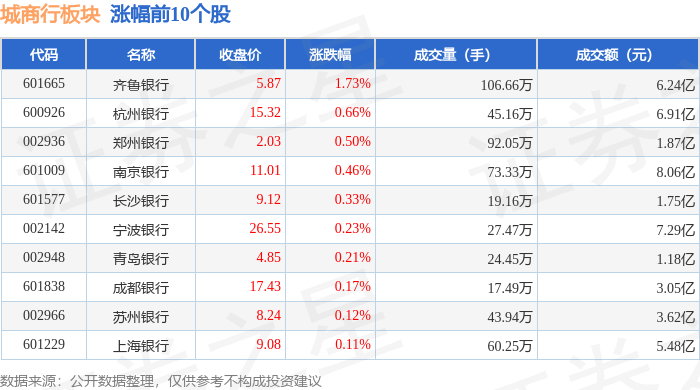
Market Performance - The city commercial bank sector increased by 1.64% on September 24, with Qilu Bank leading the gains [1] - The Shanghai Composite Index closed at 3853.64, up 0.83%, while the Shenzhen Component Index closed at 13356.14, up 1.8% [1] Individual Stock Performance - Qilu Bank closed at 5.87, with a rise of 1.73% and a trading volume of 1.0666 million shares, amounting to a transaction value of 624 million yuan [1] - Hangzhou Bank closed at 15.32, up 0.66%, with a trading volume of 451,600 shares and a transaction value of 691 million yuan [1] - Zhengzhou Bank closed at 2.03, up 0.50%, with a trading volume of 920,500 shares and a transaction value of 18.7 million yuan [1] - Nanjing Bank closed at 11.01, up 0.46%, with a trading volume of 1.7333 million shares and a transaction value of 806 million yuan [1] - Other banks such as Changsha Bank, Ningbo Bank, and Qingdao Bank also showed slight increases in their stock prices [1] Capital Flow Analysis - The city commercial bank sector experienced a net outflow of 69.1764 million yuan from institutional investors, while retail investors saw a net inflow of 55.8208 million yuan [2] - The overall capital flow indicates a mixed sentiment, with institutional investors withdrawing funds while retail investors continued to invest [2] Detailed Capital Flow for Selected Banks - Ningbo Bank had a net inflow of 74.388 million yuan from institutional investors, but a net outflow of 51.098 million yuan from speculative funds [3] - Shanghai Bank saw a net inflow of 17.1761 million yuan from institutional investors, while retail investors had a net outflow of 30.1701 million yuan [3] - Chengdu Bank experienced a net inflow of 16.3117 million yuan from institutional investors, with a net outflow from retail investors [3]

盘中跳水,尾盘拉升!A股突发大洗盘!原因找到了!
天天基金网· 2025-09-23 08:05
Market Overview - The market experienced a significant drop during the day but managed to recover towards the end, with the ChiNext index initially down by 2% but closing in the green [3][5]. - As of September 23, the A-share market showed mixed results, with the Shanghai Composite Index down by 0.18%, the Shenzhen Component down by 0.29%, and the ChiNext index up by 0.21% [5]. Market Dynamics - Despite the late recovery of the three major indices, the majority of individual stocks declined, with 1,108 stocks rising and 4,266 stocks falling [6]. - The total trading volume reached 25,184.71 billion, indicating a significant level of market activity [7]. Sector Performance - Semiconductor stocks showed strength in the afternoon, with Changchuan Technology hitting the daily limit up of 20% and Demingli achieving a three-day consecutive rise [8]. - The shipping sector performed strongly throughout the day, with Nanjing Port and Ningbo Maritime both hitting the daily limit up [10]. - Banking stocks collectively rebounded, with Nanjing Bank and Xiamen Bank rising over 3% [11]. Declines in Specific Sectors - The tourism sector faced a collective adjustment, with Yunnan Tourism and Tibet Tourism hitting the daily limit down [13]. Reasons for Market Drop - Analysts suggest that the market had risen too quickly and needed a correction, with the A-share market not having experienced a significant pullback since April [15]. - Key issues identified include: 1. Insufficient cost-performance ratio, with short-term indicators at high levels and a lack of confirmed effective adjustment phases [15]. 2. Market expectations have largely been met, leading to a return to a more volatile market environment [15]. 3. The structural mainline for A-share indices remains unclear, indicating a potential shift to a new mainline and catalyst waiting period [15]. Investor Sentiment - Pre-holiday, there has been a noticeable shift towards risk aversion among investors, with some opting to secure profits [16].