A股市场调整

Search documents
资金撤退后再回流,这轮A股调整拐点到了吗?【周观A股】
和讯· 2026-03-28 08:34
Market Overview - The A-share market indices experienced a significant narrowing of declines this week, indicating a shift in market sentiment from panic to recovery, with a gradual rebalancing of capital styles [2][3][7] - Despite continued net outflows of main funds, a marginal improvement trend has begun to emerge, suggesting the market is in a critical window of "weak recovery + rebalancing" [2][3] Index Performance - Major A-share indices continued their adjustment but showed a notable reduction in declines compared to the previous week, transitioning from a rapid drop phase to a weak oscillation recovery phase [3][7] - Small-cap stocks experienced a technical rebound after emotional clearance, while previously resilient growth sectors, represented by the ChiNext, turned into the leading decliners, highlighting significant style rotation [3][7] Sector Rotation - The market is dominated by a "defensive + price increase" theme, with materials, utilities, and healthcare sectors rising approximately 2.5%, reflecting a preference for assets with "resource attributes + stable cash flow" [10][3] - Conversely, sectors such as information technology, finance, and certain consumer segments faced pressure, indicating that high valuation and high beta assets are still undergoing valuation digestion [10][3] Trading Volume - A-shares exhibited a "volume contraction" characteristic this week, with weekly trading volume decreasing from 11.06 trillion yuan to 10.56 trillion yuan, indicating a continued decline in trading enthusiasm [23][25] - Daily trading amounts fell from approximately 2.45 trillion yuan at the beginning of the week to 1.86 trillion yuan by Friday, with the market turnover rate dropping from 4.98% to 3.66% [23][25] Fund Flow - Main funds exhibited a "first out, then in" pattern, with a net outflow of 795 billion yuan on Monday due to external geopolitical shocks, followed by a net inflow of 150 billion yuan on Wednesday, marking a key turning point for the week [32][36] - By Friday, main funds continued to flow in with a net inflow of 82.58 billion yuan, indicating a shift from broad withdrawal to structural positioning [32][36] Market Sentiment - The market displayed a typical "V-shaped recovery" this week, with the number of stocks hitting the daily limit down reaching 145 on Monday, but quickly rebounding with a significant number of stocks hitting the limit up in subsequent days [41][46] - Margin financing balances have shown a clear downward trend, reflecting a cautious shift in sentiment, although a slight recovery was observed in the latter part of the week [42][46] Upcoming Focus - Attention will be on policy, macro data, and external disturbances, as the upcoming quarter is a crucial window for assessing economic recovery [50][51] - The market will also face the unlocking of restricted shares for 26 companies next week, which may exert pressure on stock prices [51][53]


李大霄:市场无需恐慌 当前调整实则是对4000点的夯实过程
凤凰网财经· 2026-03-23 06:01
Core Viewpoint - The recent adjustment in the A-share market is primarily driven by external factors, particularly the escalation of the US-Iran conflict, which has led to a surge in international oil prices and disruptions in the Strait of Hormuz, causing global financial market turbulence [1][2]. Market Adjustment Reasons - The adjustment is seen as a process to solidify the 4000-point level, with the 3000-point mark having established a solid support level over 17 years, making a retest of this level highly unlikely [3][4]. - The market's previous bullish sentiment contributed to a delayed reaction to risks, culminating in the recent significant market adjustment [1]. Technical Analysis - The A-share market structure is characterized by a double bottom and triple top formation, with the current adjustment being a normal retracement phase [2]. - Key historical points include the formation of a significant bottom at 2635 points on February 5, 2024, and a triple top around 4197 points on March 3, 2026, which is considered a "false high" [2]. Future Market Outlook - The market is expected to experience a rebound due to stabilizing forces, but this should be viewed as a rebound rather than a reversal, as the market continues to seek new support levels [2]. - The low points are gradually rising, with projections indicating that the 2026 market low will be higher than the 2025 low [2]. Investment Strategy - Investors are advised to differentiate between strong and weak stocks, as significant ETF funds (700 billion to 1 trillion) expected to be liquidated in early 2026 will provide crucial support for quality stocks [5]. - Early research and positioning in quality stocks are recommended to capitalize on potential market opportunities [5].

4000点失守背后:资金撤退、情绪转向,A股在发生什么?【周观A股】
和讯· 2026-03-21 06:56
Market Overview - The A-share market experienced a significant pullback this week, with major indices declining. The Shanghai Composite Index fell by 3.38% to close at 3957.05, breaching the 4000-point mark [1][5] - Market sentiment has notably cooled, with a clear risk aversion trend as funds continue to flow out [2][4] Index Performance - The performance of indices showed a marked divergence, with large-cap blue chips like the Shanghai 50 Index declining by 2.47%, while mid and small-cap indices such as the CSI 500, CSI 1000, and CSI 2000 saw declines exceeding 5% [1][5] - The overall market is under pressure, reflecting a significant drop in risk appetite [1][2] Sector Analysis - In the context of a broad market decline, defensive sectors such as finance and consumer staples demonstrated strong resilience. The banking sector achieved a positive return of approximately 0.3%, making it the only sector to gain this week [9][30] - Conversely, the materials sector led the decline with a drop of over 10.44%, indicating a shift away from previous commodity-driven trading strategies [9][30] Individual Stock Performance - The electricity sector emerged as a structural highlight, with notable gains in specific stocks. For instance, Huadian Liao Energy surged by 61.34% [16] - The top decliners were concentrated in cyclical sectors, reflecting a trend of "high volatility, high elasticity stocks being prioritized for liquidation" [1][30] Trading Volume and Activity - Total trading volume decreased from 12.49 trillion yuan to 11.06 trillion yuan, a decline of 11.5%, indicating a drop in overall market trading enthusiasm [19][21] - Daily trading amounts fell from approximately 2.33 trillion yuan at the beginning of the week to around 2.06 trillion yuan midweek, despite a slight recovery on Friday [19][21] Fund Flow - Main funds saw a cumulative net outflow of 180.61 billion yuan this week, with significant outflows exceeding 600 billion yuan on multiple days [29][30] - The outflow trend was particularly pronounced in cyclical and technology sectors, while core assets in "computing power chains and new energy leaders" attracted some inflows, indicating a flight to certainty in a risk-averse environment [30][35] Market Sentiment - Market sentiment shifted from a previously active state to a more cautious approach, with the number of stocks hitting the daily limit down rising significantly [37][40] - Margin trading balances showed a slight decline, reflecting investors' tendencies to reduce leverage and risk exposure [42] Upcoming Focus - Attention will be on policy stabilization, changes in fund flows, and external disturbances, particularly regarding international oil price fluctuations and the upcoming release of locked shares [46][47]

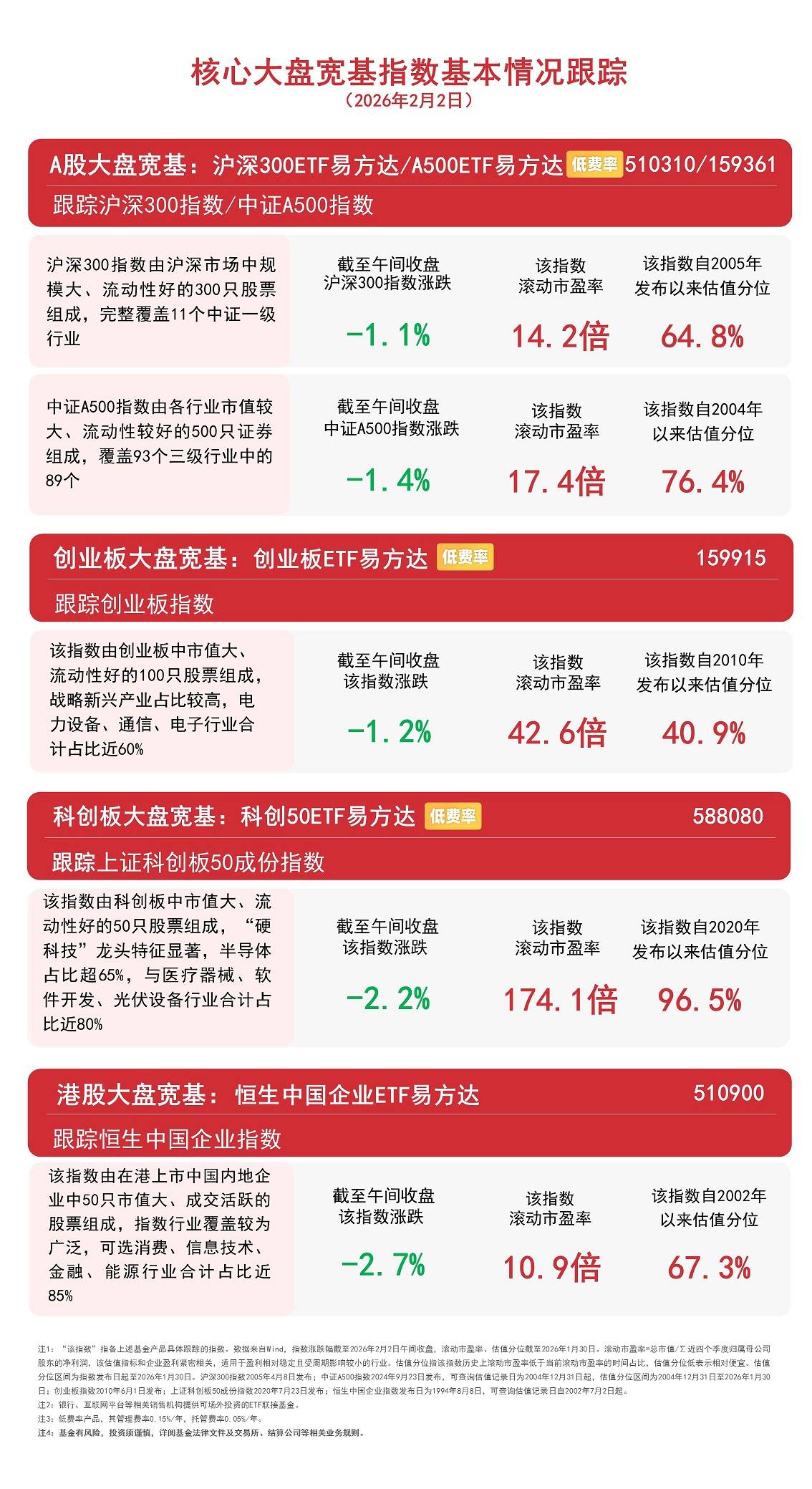
市场集体调整,关注A500ETF易方达(159361)、沪深300ETF易方达(510310)等产品投资机会
Sou Hu Cai Jing· 2026-02-02 05:07
Market Overview - A-shares experienced a collective pullback with the Shanghai Composite Index down by 1.32% in the morning session [1] - The Hong Kong stock market saw a significant decline, with the Hang Seng China Enterprises Index dropping by 2.7% [1][3] Index Performance - The CSI 300 Index fell by 1.1%, with a rolling P/E ratio of 14.2 times, placing it in the 64.8th percentile since its inception in 2005 [2] - The CSI A500 Index decreased by 1.4%, with a rolling P/E ratio of 17.4 times, ranking in the 76.4th percentile since 2004 [2] - The ChiNext Index dropped by 1.2%, with a rolling P/E ratio of 42.6 times, which is in the 40.9th percentile since its launch in 2010 [2] - The STAR Market 50 Index declined by 2.2%, with a rolling P/E ratio of 174.1 times, placing it in the 96.5th percentile since 2020 [2] Sector Performance - Active sectors included liquor, internet, cultural media, and banking, while sectors such as precious metals, non-ferrous metals, petrochemicals, coal, and steel saw the largest declines [1]
调整结束?最多3天,A股会迎来救赎了
Sou Hu Cai Jing· 2026-01-19 16:31
Group 1 - The market is experiencing volatility, with significant sell-offs leading to sharp declines, indicating a potential strategy to allow new buyers to enter before a rally [1][3] - The current adjustment phase is expected to continue until a complete exchange of shares occurs, with a focus on understanding who is buying and selling during this period [3] - The market is likely to shift back towards blue-chip stocks, as institutions and foreign investors are expected to take on some of the shares held by major players like Huijin and insurance funds [3][5] Group 2 - A recovery in the A-share market is anticipated, with expectations of a return to normal trading patterns by the end of the week, followed by a potential rally leading into the Lunar New Year [5] - The recent trading volume in major indices like the CSI 300 and SSE 50 suggests that while there is significant activity, it has not yet translated into price movements, indicating a strategic accumulation of shares [5] - The market is expected to favor sectors such as securities, liquor, pharmaceuticals, home appliances, food, coal, electricity, telecommunications, and oil, as these blue-chip stocks are still seen as undervalued [5]

A股市场探底回升 整体调整格局未改
Xin Lang Cai Jing· 2025-12-21 16:36
Group 1 - The A-share market experienced a "first decline then rise" trend last week, with the Shanghai Composite Index closing at 3890.45 points, reflecting a slight increase of 0.03% [1] - The Shenzhen Component Index and the ChiNext Index saw declines of 0.89% and 2.26%, respectively, indicating a mixed performance across different indices [1] - The market is at a critical juncture, with upward pressure near recent resistance levels and downward support levels being tested [1] Group 2 - The core driver of market adjustments is internal rather than external factors, with the recovery strength of the domestic economy and the effectiveness of policies being key concerns [2] - Institutional rebalancing towards the end of the year may lead to selling pressure, contributing to ongoing market disturbances [2] - Structural characteristics of the market are becoming more pronounced, with opportunities in the consumer sector driven by policy support, although these rebounds may be limited in duration [2] Group 3 - The A-share market is expected to undergo a pressure test, with the ability to break through 3900 points being crucial for the strength of the rebound [3] - The stability of the ChiNext Index is essential for maintaining market confidence [3] - Investors are advised to prepare for different scenarios, either increasing holdings in technology and manufacturing if there is a volume-driven rise or shifting focus to high-dividend and defensive sectors if there is a pullback [3]
A股短期调整可能是回踩,接下来关键是“等待与准备”
British Securities· 2025-12-17 02:10
Market Overview - The A-share market continues to experience downward pressure, influenced by negative sentiment from external markets, including declines in Japanese and Hong Kong stocks [1][8] - Consumer stocks showed some resilience, with real estate stocks experiencing temporary gains, but overall market sentiment remains weak, leading to limited rebound strength [1][5] Key Factors Affecting the Market - The decline in the A-share market is attributed to several factors: the widespread drop in technology stocks globally, rising expectations of interest rate hikes by the Bank of Japan, and structural contradictions within the domestic market [1][8] - The market is facing a lack of clear leading sectors, with frequent rotation of hotspots and insufficient profit-making opportunities [1][8] - As the year-end approaches, institutional investors may engage in tactical rebalancing to lock in profits, contributing to market volatility [1][8] - There is a notable lack of willingness from new capital to enter the market, with trading volumes remaining low at around 1.7 trillion yuan [1][8] Policy Support and Market Outlook - Despite the current market adjustments, there is no need for excessive concern as core supporting factors remain unchanged: the central bank has indicated a flexible approach to maintaining liquidity through tools like reserve requirement ratio cuts and interest rate reductions [2][9] - The National Development and Reform Commission is implementing various measures to stabilize investment, which serves as an important support for the market [2][9] - The upcoming focus is on "waiting and preparing," particularly in anticipation of the Bank of Japan's interest rate decisions, which may signal market stabilization [2][10] Investment Strategy Recommendations - Investors are advised to review their portfolio structures and optimize allocation towards sectors with strong policy support and clear growth prospects [2][10] - Maintaining liquidity is crucial for potential buying opportunities as the market approaches the New Year and spring season [2][10] - It is recommended to focus on sectors such as technology growth (semiconductors, AI themes, robotics), cyclical industries (solar energy, batteries, chemicals), and dividend stocks (banks, utilities) while avoiding high-valuation stocks lacking earnings support [2][10]
A股收评 | 指数走势分化 两重影响曝光!海南本地股逆势反弹
智通财经网· 2025-12-10 07:19
Market Overview - The market showed mixed performance with over 2800 stocks declining, and total trading volume reaching 1.8 trillion, a decrease of 125.45 billion from the previous day [1] - The Shanghai Composite Index fell by 0.23%, while the Shenzhen Component Index rose by 0.29%, and the ChiNext Index decreased by 0.02% [1] Market Adjustment Reasons - Global liquidity concerns were highlighted as the 10-year Japanese government bond yield surpassed 1.96%, with the Bank of Japan signaling potential interest rate hikes, which may lead to market volatility [2] - Policy expectations were also a factor, as the November CPI showed a strong year-on-year increase of 0.7%, the highest since March 2024, driven mainly by rising food prices [2] Sector Performance - The retail sector continued its strong performance, with notable stocks like Dongbai Group achieving four consecutive trading limits, and others like Yonghui Supermarket and Huijia Times hitting the daily limit [5] - The Hainan sector saw a rebound, with stocks like Hainan Ruize and Luoniushan reaching their daily limits, driven by the upcoming full island closure operation of Hainan Free Trade Port [6] - The precious metals sector rose, led by Xiaocheng Technology, with silver prices increasing significantly, up nearly 110% year-to-date [7] Individual Stock Highlights - Moore Threads saw a surge in its stock price, surpassing its initial listing high of 688 yuan, with a total market capitalization exceeding 320 billion [3] Institutional Perspectives - Zhongyin Securities anticipates that the market will continue to rise, supported by funds and policies, with a potential early start to the spring market rally [9] - Xinda Securities suggests that December may serve as a window for positioning in the cross-year market, although the timing for a rally may not be immediate due to current valuation concerns [10] - CITIC Securities notes that market fluctuations and structural opportunities will be the norm until unexpected changes in domestic demand occur, emphasizing the potential undervaluation in resource and traditional manufacturing sectors [11]
宏观金融数据日报-20251203
Guo Mao Qi Huo· 2025-12-03 04:37
Report Summary 1. Report Industry Investment Rating - Not mentioned in the report. 2. Core View of the Report - After several days of recovery and rebound, the market sentiment has become cautious, leading to a significant contraction in A-share trading volume and an adjustment in stock index fluctuations. The upcoming Politburo meeting and the Central Economic Work Conference in mid - to late December will provide guidance for next year's policy focus and market capital allocation. The current market adjustment offers opportunities for the stock index to rise further next year, and traders can consider gradually establishing long positions during the adjustment phase and leveraging the discount structure of stock index futures to increase the probability of long - term investment success [6]. 3. Summary by Relevant Content Market Interest Rate Data - DR001 closed at 1.30, down 0.87bp; DR007 closed at 1.44, down 1.71bp; GC001 closed at 1.41, down 5.50bp; GC007 closed at 1.49, down 0.50bp; SHBOR 3M closed at 1.58, unchanged; LPR 5 - year remained at 3.50, unchanged; 1 - year treasury bond closed at 1.36, up 1.40bp; 5 - year treasury bond closed at 1.56, up 0.20bp; 10 - year treasury bond closed at 1.83, up 0.30bp; 10 - year US treasury bond remained at 4.10 [3]. Central Bank Operations - The central bank conducted 156.3 billion yuan of 7 - day reverse repurchase operations yesterday at an operating rate of 1.40%, with a bid volume, winning bid volume all at 156.3 billion yuan. With 302.1 billion yuan of reverse repurchase maturing on the same day, the net withdrawal for the day was 145.8 billion yuan. This week, 1.5118 trillion yuan of reverse repurchase will mature in the central bank's open market, and 1 trillion yuan of 91 - day repurchase will mature on Friday [3][4]. Stock Index and Futures Data - The CSI 300 closed at 4554, down 0.48%; the SSE 50 closed at 2978, down 0.51%; the CSI 500 closed at 7040, down 0.87%; the CSI 1000 closed at 7313, down 1.00%. The trading volume of the two - stock markets was 1.5934 trillion yuan, a contraction of 280.5 billion yuan from the previous day. Most industry sectors declined, with pharmaceutical commerce, shipbuilding, railway and highway, and packaging materials sectors leading the gains, while energy metals, precious metals, biological products, small metals, motors, education, and non - metal materials sectors leading the losses. In terms of futures, IF contracts showed corresponding price and volume changes [5]. Futures Premium and Discount Situation - IF's current - month contract had a premium of 8.74%, next - month contract 6.51%, current - quarter contract 4.25%, and next - quarter contract 4.33%; IH's current - month contract had a premium of 5.09%, next - month contract 3.61%, current - quarter contract 1.66%, and next - quarter contract 1.67%; IC's current - month contract had a premium of 17.72%, next - month contract 13.01%, current - quarter contract 11.06%, and next - quarter contract 11.40%; IM's current - month contract had a premium of 21.60%, next - month contract 16.39%, current - quarter contract 14.10%, and next - quarter contract 13.65% [7].
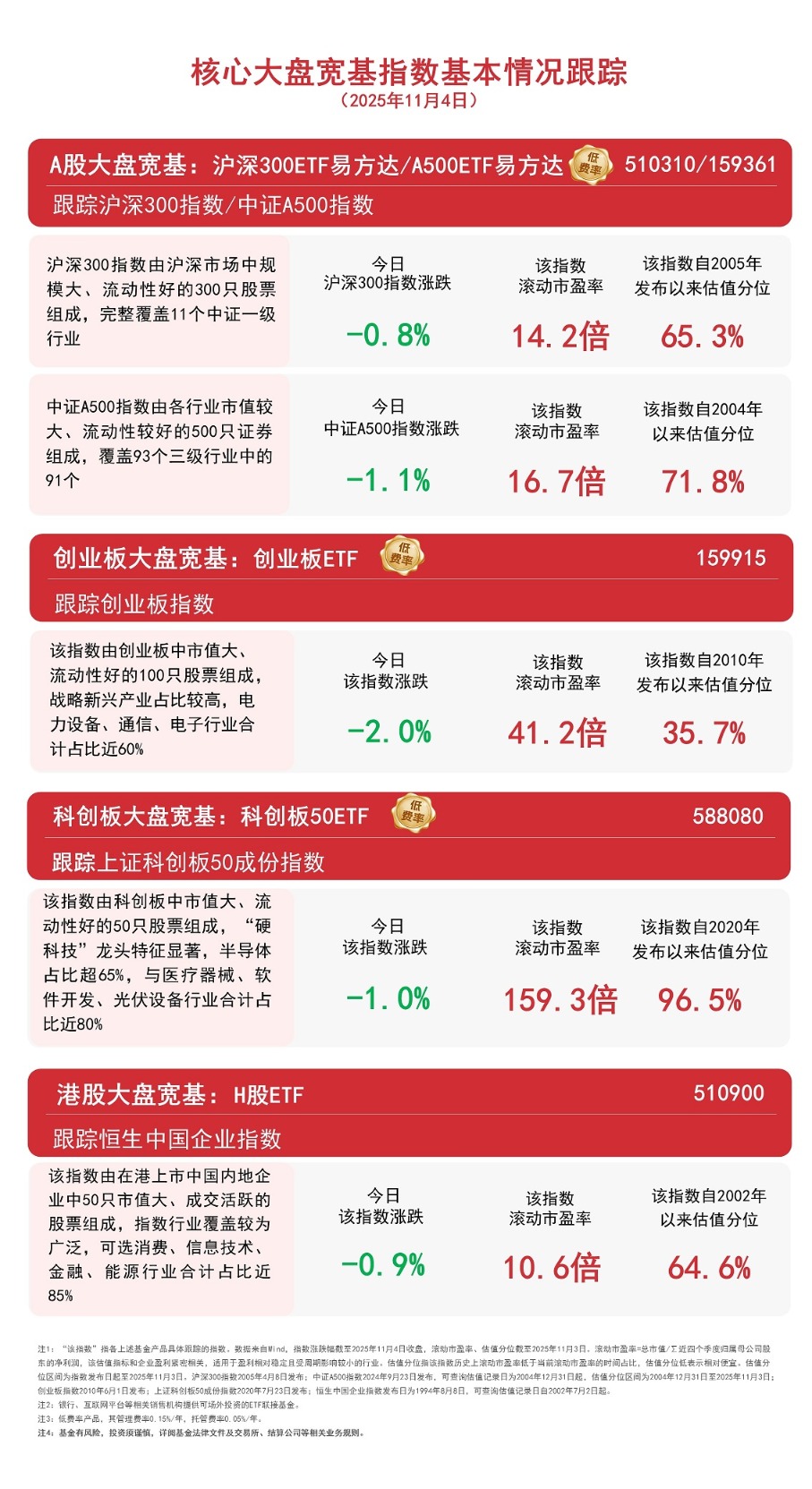
市场缩量调整,关注A500ETF易方达(159361)、沪深300ETF易方达(510310)等产品后续走势
Mei Ri Jing Ji Xin Wen· 2025-11-04 10:23
Market Overview - The A-share market experienced a collective pullback, with total market turnover exceeding 1.9 trillion yuan, a decrease of 194.5 billion yuan compared to the previous day [1] - The major indices closed lower: the CSI A500 index fell by 1.1%, the CSI 300 index decreased by 0.8%, the ChiNext index dropped by 2.0%, and the STAR Market 50 index declined by 1.0% [1] Sector Performance - Sectors that saw gains included: Fujian, banking, ice and snow industry, power grid equipment, film and television, and paper manufacturing [1] - Sectors that experienced declines included: non-ferrous metals, PEEK materials, weight loss drugs, wind power equipment, robotics, and battery sectors [1] Hong Kong Market - The Hong Kong market also faced adjustments, with significant declines in sectors such as pharmaceuticals, automobiles, and robotics [1]