
XIANMEN BANK(601187)

Search documents
厦门银行:选举王建平为第九届董事会职工董事
Ge Long Hui· 2026-02-12 09:53
Core Viewpoint - Xiamen Bank (601187.SH) announced the election of Mr. Wang Jianping as the employee director of the ninth board of directors during the 14th meeting of the sixth employee representative assembly and the 13th meeting of the trade union members assembly, scheduled for February 12, 2026 [1] Summary by Categories - **Board Election** - Mr. Wang Jianping has been elected as the employee director of the ninth board of directors [1] - **Meeting Details** - The meeting will take place on February 12, 2026, and will include both the employee representative assembly and the trade union members assembly [1] - **Regulatory Approval** - The appointment of Mr. Wang Jianping will take effect upon approval from regulatory authorities, with the term lasting until the ninth board of directors concludes its term [1]
银行股集体下跌,重庆银行跌超2%
Ge Long Hui· 2026-02-12 02:37
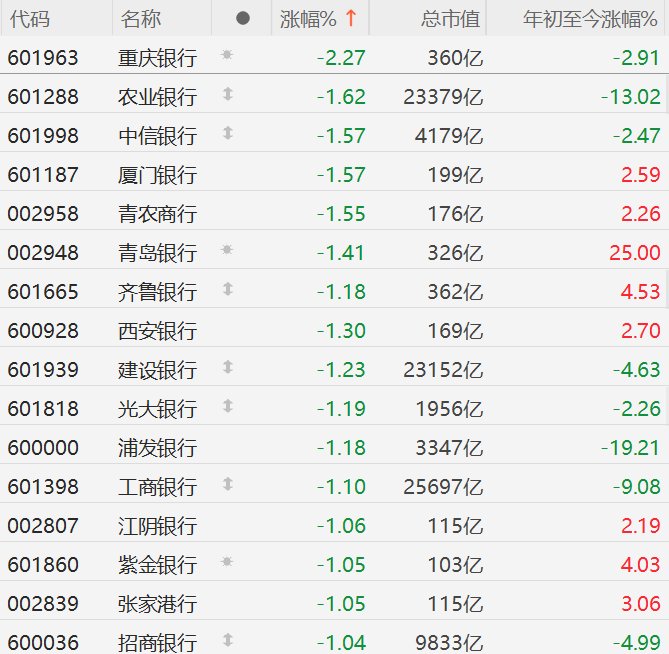
Core Viewpoint - The A-share market for banks experienced a collective decline, with several banks showing significant drops in their stock prices on February 12 [1] Group 1: Stock Performance - Chongqing Bank saw a decline of 2.27%, with a total market value of 36 billion [2] - Agricultural Bank dropped by 1.62%, with a market capitalization of 2,337.9 billion [2] - CITIC Bank decreased by 1.57%, with a market value of 417.9 billion [2] - Xiamen Bank fell by 1.57%, with a market capitalization of 19.9 billion [2] - Qingnong Commercial Bank declined by 1.55%, with a market value of 17.6 billion [2] - Qingdao Bank decreased by 1.41%, with a market capitalization of 32.6 billion [2] - Qilu Bank fell by 1.18%, with a market value of 36.2 billion [2] - Xi'an Bank dropped by 1.30%, with a market capitalization of 16.9 billion [2] - China Construction Bank decreased by 1.23%, with a market value of 23,152 billion [2] - Everbright Bank fell by 1.19%, with a market capitalization of 195.6 billion [2] - Pudong Development Bank decreased by 1.18%, with a market value of 334.7 billion [2] - Industrial and Commercial Bank dropped by 1.10%, with a market capitalization of 25,697 billion [2] - Jiangyin Bank fell by 1.06%, with a market value of 11.5 billion [2] - Zijin Bank decreased by 1.05%, with a market capitalization of 10.3 billion [2] - Zhangjiagang Bank fell by 1.05%, with a market value of 11.5 billion [2] - China Merchants Bank decreased by 1.04%, with a market capitalization of 983.3 billion [2] Group 2: Year-to-Date Performance - Chongqing Bank has a year-to-date decline of 2.91% [2] - Agricultural Bank has seen a year-to-date drop of 13.02% [2] - CITIC Bank's year-to-date decline is 2.47% [2] - Xiamen Bank has a year-to-date increase of 2.59% [2] - Qingnong Commercial Bank's year-to-date increase is 2.26% [2] - Qingdao Bank has a significant year-to-date increase of 25.00% [2] - Qilu Bank has a year-to-date increase of 4.53% [2] - Xi'an Bank's year-to-date increase is 2.70% [2] - China Construction Bank has a year-to-date decline of 4.63% [2] - Everbright Bank's year-to-date decline is 2.26% [2] - Pudong Development Bank has a significant year-to-date decline of 19.21% [2] - Industrial and Commercial Bank has a year-to-date decline of 9.08% [2] - Jiangyin Bank has a year-to-date increase of 2.19% [2] - Zijin Bank's year-to-date increase is 4.03% [2] - Zhangjiagang Bank has a year-to-date increase of 3.06% [2] - China Merchants Bank has a year-to-date decline of 4.99% [2]






A股银行股集体下跌,重庆银行跌超2%
Ge Long Hui A P P· 2026-02-12 02:25
Group 1 - The A-share market saw a collective decline in bank stocks, with Chongqing Bank dropping over 2% and several other banks, including Agricultural Bank, CITIC Bank, and Xiamen Bank, falling more than 1% [1] - Chongqing Bank's stock decreased by 2.27%, with a total market capitalization of 36 billion and a year-to-date decline of 2.91% [2] - Agricultural Bank's stock fell by 1.62%, with a market cap of 2,337.9 billion and a year-to-date decline of 13.02% [2] Group 2 - CITIC Bank's stock decreased by 1.57%, with a market capitalization of 417.9 billion and a year-to-date decline of 2.47% [2] - Xiamen Bank's stock also fell by 1.57%, with a market cap of 19.9 billion and a year-to-date increase of 2.59% [2] - Qingnong Commercial Bank's stock dropped by 1.55%, with a market cap of 17.6 billion and a year-to-date increase of 2.26% [2] Group 3 - Other banks such as Qilu Bank, Xi'an Bank, and China Construction Bank experienced declines of 1.18% to 1.30%, with respective market caps of 36.2 billion, 16.9 billion, and 23,152 billion [2] - The stock of Industrial and Commercial Bank fell by 1.10%, with a market cap of 25,697 billion and a year-to-date decline of 9.08% [2] - China Merchants Bank's stock decreased by 1.04%, with a market cap of 98.33 billion and a year-to-date decline of 4.99% [2]
节奏明显加快 多家银行火速跟进 “降息”!
Zhong Guo Ji Jin Bao· 2026-02-11 06:34
Core Viewpoint - The recent trend of interest rate cuts on deposits has accelerated, with various banks, including state-owned and regional banks, quickly following suit to lower their deposit rates, indicating a significant shift in the banking sector's approach to managing interest rates and net interest margins [1][4]. Group 1: Interest Rate Adjustments - Changsha Bank announced a reduction in its deposit rates effective August 1, with cuts ranging from 10 to 20 basis points for various terms [2]. - Other banks, such as Xiamen Bank and Jiangsu Bank, also adjusted their deposit rates, aligning with the reductions made by major state-owned banks [2]. - In Guangxi, Longsheng Rural Commercial Bank lowered its deposit rates, with the one-year term dropping to 1.55%, a reduction of 20 basis points [2]. Group 2: Speed of Rate Cuts - The current round of interest rate cuts began on July 25, with major state-owned banks leading the way, followed by 18 joint-stock banks within four days [4]. - The rapid pace of these adjustments is notable compared to previous cycles, where larger banks typically initiated changes, and smaller banks followed later [4]. - Analysts suggest that the quick response from smaller banks may be due to increased pressure on net interest margins and the market's adaptation to previous rate cuts [4]. Group 3: Future Outlook - Experts predict that deposit rates may continue to decline throughout the year, with potential further cuts expected in the fourth quarter or early next year [5]. - The chief economist at Minsheng Bank noted that the recent rate cuts could lead to a shift of deposits towards wealth management products, as the market for such products has been recovering rapidly [6].

上市银行2025年年报: 业绩增速有望稳中向好,资产质量持续优化
2026-02-10 03:24
Summary of Conference Call on Banking Sector Outlook Industry Overview - The conference focused on the banking sector, specifically discussing the performance and outlook of 11 listed banks in China for the year 2025 and beyond [1][6]. Key Points and Arguments 1. Overall Performance of Banks - The performance of the 11 banks exceeded expectations, indicating a robust resilience in the banking sector [1][6]. - The net interest margin (NIM) showed signs of stabilization, with a narrowing year-on-year decline contributing significantly to interest income and revenue growth [1][2]. 2. Sensitivity of Interest Income - Interest income is highly sensitive to changes in NIM; a decrease of 10 basis points (BP) in NIM could reduce net interest income growth by 7 percentage points, while a 5 BP decrease would result in a 3.5 percentage point reduction [2]. 3. Fee Income Recovery - There has been a recovery in fee income due to improved capital market conditions and asset allocation by residents, leading to a continuous improvement in bank fees [2][4]. 4. Potential for Old Bond Gains - The banks hold significant unrealized gains on old bonds, which presents a substantial opportunity for realization [3]. 5. Positive Outlook for 2026 - The overall judgment is that the situation in 2026 will be better than in 2025, driven by stable basis points, improving fees, and gains from old bonds [3]. 6. Investment Perspective - The investment strategy focuses on absolute returns, targeting a return on equity (ROE) of around 13% and a price-to-book (PB) ratio of 0.67 times, indicating a reasonable pricing range [3][4]. - The recommendation is to select stocks based on high growth and high dividend yield, particularly in regions like Jiangsu, Nanjing, and Qilu [4][5]. 7. Performance of Specific Banks - Notable banks such as China Merchants Bank and Industrial Bank showed positive revenue growth, with some banks transitioning from negative to positive growth [6][7]. - City commercial banks like Nanjing Bank and Qingdao Bank reported double-digit revenue growth, indicating strong performance [7][10]. 8. Asset Quality and Non-Performing Loans (NPLs) - The asset quality remains stable, with many banks reporting a decrease in NPL ratios. For instance, Qingdao Bank's NPL ratio dropped significantly [10][11]. - The overall trend suggests a gradual improvement in asset quality, with expectations for continued stability in 2026 [11][12]. 9. Credit Growth and Demand - Credit growth is expected to remain strong, particularly in major provinces like Sichuan and Jiangsu, which reported credit growth rates above 8% [12][13]. - The demand for corporate loans remains robust, while retail loan demand is weaker [12]. 10. Future Risks and Projections - There are concerns regarding the potential exposure of retail loans, particularly in mortgage and consumer credit segments, but the overall increase in NPLs is expected to be limited [16][17]. - Projections for 2025 indicate a slight increase in NPL ratios for retail loans, but overall asset quality is expected to remain stable [17][18]. 11. Revenue Growth Expectations - The banking sector is projected to achieve a revenue growth rate of approximately 1.2% year-on-year, with city commercial banks leading in net profit growth [19][20]. 12. Stock Selection Strategy - The stock selection strategy emphasizes high ROE and high dividend yield, with recommendations for both Hong Kong and A-share listed banks [20][21]. Additional Important Insights - The conference highlighted the importance of wealth management in driving fee income, with expectations for continued positive contributions to revenue [19]. - The overall sentiment is optimistic regarding the banking sector's ability to navigate challenges and capitalize on growth opportunities in the coming years [22].




A股银行股普涨,青农商行、齐鲁银行涨超2%
Ge Long Hui· 2026-02-09 06:33
Group 1 - The A-share market saw a general rise in bank stocks, with Qingnong Commercial Bank and Qilu Bank increasing by over 2% [1] - Xiamen Bank, Zhangjiagang Bank, Zijin Bank, and Minsheng Bank all experienced gains of over 1% [1]




银行股迎结构性行情:大行回调、小行领跑
第一财经· 2026-02-08 14:41
Core Viewpoint - The A-share banking sector has shown resilience and strength since early February 2026, driven by both fundamental improvements and capital inflows, with expectations for revenue and profit growth to gradually recover throughout the year [3][7]. Group 1: Market Performance - The banking sector has outperformed the broader market, with 42 A-share bank stocks rising collectively on February 5, 2026, particularly small and medium-sized banks like Xiamen Bank, which hit the daily limit, and Chongqing Bank, which rose over 5% [3][4]. - Over the past year, regional banks represented by city commercial banks have outperformed the industry average, with Xiamen Bank's stock rising 40.36%, Qingdao Bank 35.29%, and Ningbo Bank 32.91%, significantly surpassing the 22.36% increase of the CSI 300 index [6][4]. - In contrast, large state-owned banks have faced downward pressure, with notable declines such as Shanghai Pudong Development Bank down 18.65% and Agricultural Bank of China down 13.15% [6][4]. Group 2: Fundamental and Capital Factors - The core factors supporting the rise in bank stocks are improvements in fundamentals, with 11 A-share banks reporting stable revenue and profit recovery for 2025, particularly city commercial banks like Qingdao Bank and Qilu Bank, which saw net profit growth exceeding 10% [7][8]. - Xiamen Bank reported a revenue of 5.856 billion yuan, a year-on-year increase of 1.69%, and a net profit of 2.75 billion yuan, up 1.64%, with a loan growth of 18.39% [8][9]. - The banking sector has seen a net inflow of approximately 2.249 billion yuan in the past week, with a low average price-to-earnings ratio of 6.1 times and a price-to-book ratio of about 0.52 times, making it attractive to long-term investors [10][9]. Group 3: Future Outlook - The current market dynamics suggest a shift in the logic behind bank stock investments, moving from defensive assets to actively managed positions, particularly for city commercial banks with strong regional advantages [12][11]. - Analysts believe that the banking sector is entering a new growth cycle in 2026, with expectations for net interest income to turn positive and continued inflows from long-term funds due to high dividend yields [13][12]. - However, not all banks are expected to benefit equally, as differences in regional economic foundations, asset structures, and management capabilities are becoming more pronounced in market valuations [13][12].

银行股迎结构性行情:大行回调、小行领跑
Di Yi Cai Jing· 2026-02-08 12:07
Group 1 - The core viewpoint of the articles indicates that the recent strength in A-share bank stocks is driven by a combination of fundamental improvements and capital inflows, with a notable performance from regional banks [1][4][9] - The banking sector has shown resilience with expectations of revenue and net profit growth gradually recovering in 2026, supported by a stable net interest margin and improved asset quality [1][4][9] - The performance of city commercial banks has outpaced that of larger banks, with significant stock price increases observed in banks like Xiamen Bank and Qingdao Bank, which have shown year-on-year gains of 40.36% and 35.29% respectively [2][3][4] Group 2 - The recent data shows that the banking sector has attracted approximately 22.49 billion yuan in net capital inflows, particularly into smaller banks, indicating a shift in investor preference towards stable cash flows and lower valuations [7][9] - The average price-to-earnings ratio for the banking sector is currently at 6.1 times, with a price-to-book ratio of about 0.52 times, suggesting that valuations are at historical lows and making the sector attractive for long-term investors [7][9] - Analysts believe that the banking sector is entering a new growth cycle in 2026, with expectations of a recovery in earnings and a potential increase in loan growth, which could further enhance the attractiveness of bank stocks [8][9]
开年险资调研忙 新质生产力受关注
Zhong Guo Zheng Quan Bao· 2026-02-06 03:50
Core Insights - Insurance capital management is increasingly focused on deep research of individual stocks and industries, with significant interest in A-share listed companies as indicated by over 300 companies being researched since the beginning of 2026 [1][2] Group 1: Research Trends - A total of 96 insurance companies and 32 insurance asset management companies have participated in the research of A-share listed companies since the beginning of 2026 [2] - Key players such as Taiping Pension, Changjiang Pension, and China Life Pension have conducted over 30 research sessions each within a month [2] - Regional banks and sectors like electronic components, semiconductor materials, and devices are receiving heightened attention from insurance capital [2] Group 2: Investment Strategies - Insurance capital views company research as a crucial part of investment strategy, often focusing on high-quality stocks with long-term growth potential [3] - The demand for high dividend stocks is driven by the need for stable cash flow in a low-interest-rate environment, with banks being a primary focus for insurance capital [4] - Insurance capital is increasingly adopting a dividend strategy, favoring high dividend stocks to stabilize returns amid pressure on fixed-income yields [4] Group 3: Focus on New Productive Forces - Insurance capital is aligning with long-term investments in new productive forces, particularly in technology innovation and emerging strategic industries [5] - There is a focus on investing in sectors with real technological barriers and clear business models that can deliver performance [5] Group 4: Investment Paths - For mature technology leaders, insurance capital is likely to invest directly for excess returns, while for emerging tech sectors, indirect investments through ETFs or industry funds are preferred to manage risks [6] - The insurance capital sector is particularly interested in AI-driven technology and high-end manufacturing, with a strategy to invest in companies with clear business models and strong competitive advantages [6]




大金融、大消费板块联袂逆势上涨
Mei Ri Shang Bao· 2026-02-05 22:56
Market Overview - The A-share market showed weakness, with the Shanghai Composite Index falling over 1% during the day and closing down 0.64% at 4075.92 points, while the Shenzhen Component Index and ChiNext Index dropped 1.44% and 1.55% respectively, with total trading volume around 2.19 trillion yuan, a decrease of over 300 billion yuan from the previous day [1] Financial Sector Performance - The financial sector, particularly banks and brokerages, performed actively in the afternoon, with notable gains in stocks such as Xiamen Bank, Chongqing Bank, and Shanghai Bank [2] - Institutions expect recent fiscal and monetary policies to support banks' performance, with a stable recovery in earnings projected for 2025 [2] - 中邮证券 forecasts that the insurance sector will see over 2 trillion yuan in new market funds by 2026, increasing demand for high-dividend assets [2] Brokerage Sector Insights - The brokerage sector also strengthened, with companies like Huayin Securities hitting the daily limit [3] - Major brokerages reported positive earnings for 2025, with CITIC Securities achieving revenue of 748.3 billion yuan and net profit of 300.51 billion yuan, both showing significant year-on-year growth [3] - Investment institutions believe that the brokerage sector will benefit from China's economic development and capital market reforms, enhancing its long-term investment value [3] Consumer Sector Trends - The consumer sector saw a collective rise, with retail, food and beverage, and tourism sectors performing well, highlighted by stocks like Maoye Commercial and Sanjiang Shopping hitting the daily limit [4] - The Ministry of Finance and other authorities announced a "zero tariff" policy for imported goods purchased by residents in Hainan Free Trade Port, which is expected to boost consumer spending [4] Food and Beverage Industry Analysis - The food and beverage industry is currently at a historical low in valuation, with potential investment opportunities emerging as market conditions improve [5] - The sector is expected to benefit from the application of AI technology, enhancing efficiency in retail operations, with the smart retail market projected to grow to approximately 64.5 billion yuan by 2030, at a compound annual growth rate of 22% [6]


