Bank Of Shanghai(601229)

Search documents
优先股隐退永续债上位!银行业资本补充进入密集冲刺期,年利息至少省3%
Xin Lang Cai Jing· 2026-01-04 05:31
Core Viewpoint - The Chinese banking industry is undergoing a significant transformation, with banks redeeming high-cost preferred shares and issuing perpetual bonds as a more cost-effective financing alternative, driven by declining social financing costs and regulatory changes [2][4][11]. Group 1: Redemption of Preferred Shares - By the end of 2025, a total of 9 banks announced the redemption of preferred shares, amounting to 111.8 billion RMB in domestic preferred shares and 5.72 billion USD in foreign preferred shares [4]. - In December 2025 alone, five banks, including Changsha Bank and Beijing Bank, redeemed a total of 45.8 billion RMB in preferred shares [3]. - The redemption of preferred shares is facilitated by their lack of maturity dates but includes redemption clauses, allowing banks to manage capital flexibly [4]. Group 2: Issuance of Perpetual Bonds - As of December 31, 2025, Chinese commercial banks issued 69 perpetual bonds, raising a total of 821.8 billion RMB, marking a historical high in both issuance quantity and scale [5]. - The interest rates for newly issued perpetual bonds generally ranged from 2.0% to 2.9%, the lowest in nearly three years, with a significant issuance peak occurring in the second half of 2025 [5][6]. - The issuance of perpetual bonds is seen as a response to the urgent need for capital replenishment, especially among small and medium-sized banks facing declining capital adequacy ratios [2][6]. Group 3: Cost Savings and Financial Efficiency - By replacing preferred shares with perpetual bonds, banks can save at least 3% annually on interest expenses, significantly reducing their financing costs [8][10]. - For instance, the interest rate on newly issued perpetual bonds is substantially lower than that of previously issued preferred shares, with examples showing potential annual savings of 12.8 million RMB for banks like Industrial Bank [10]. - The transition from preferred shares to perpetual bonds is viewed as a strategic move to optimize capital structure and reduce interest payment burdens, aligning with regulatory requirements [8][10]. Group 4: Regulatory Environment and Market Dynamics - The shift towards perpetual bonds is influenced by regulatory changes that favor capital instruments with loss absorption capabilities, making traditional preferred shares less attractive [11]. - The approval process for issuing perpetual bonds is simpler and faster compared to preferred shares, which require dual regulatory approvals, thus enhancing their appeal to banks [11]. - The current low-interest-rate environment is expected to persist, allowing banks to lock in low financing costs for the next 5 to 10 years, effectively mitigating the pressure from narrowing net interest margins [10].







实测8家银行收益展示:多数未展示年化持仓收益率
2 1 Shi Ji Jing Ji Bao Dao· 2026-01-04 04:02
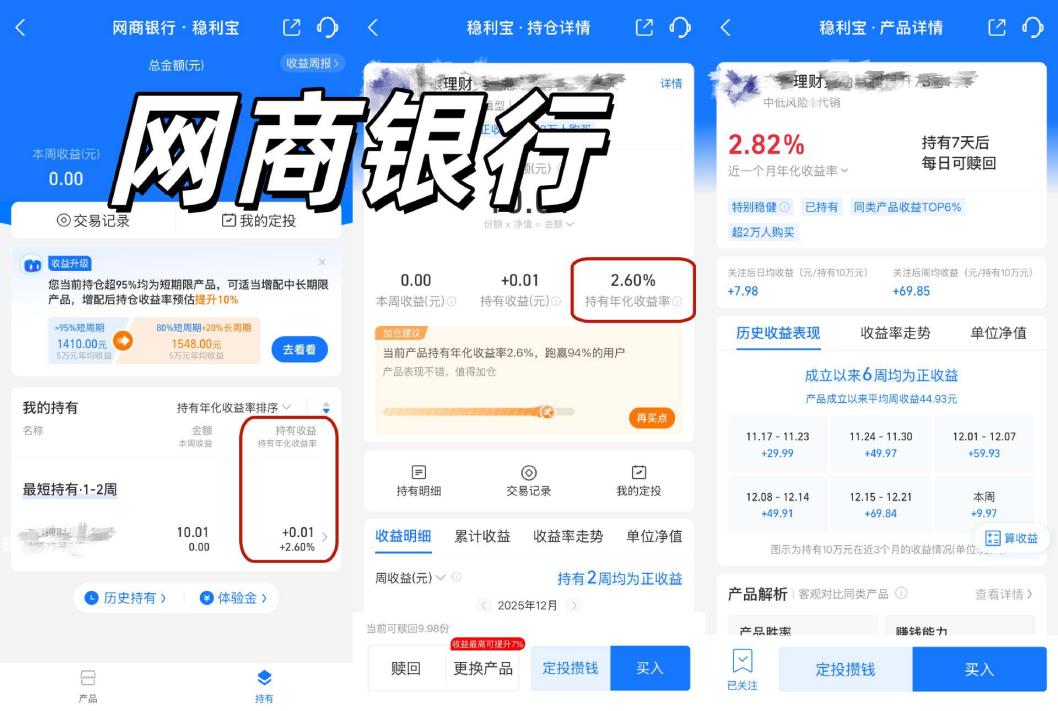
21世资管研究院研究员 杨梦雪 你知道自己购买的理财产品实际收益率,以及实际收益率与理财产品页面所展示的收益率有多少差距吗? 不少银行理财投资者向《21世纪经济报道》反映称,冲着页面展示的高达5%甚至7%的收益率数据买进去,结果发现实际获得的收益并不高,但也不知道是 怎么回事、具体差异有多少。 "当时看到页面展示的收益率还可以就买了,后面也没在意过。我大概能知道我的收益率到不了页面展示的那么高,但实际到底差多少,我不会算也就没关 注过了。"某投资者对记者表示。 《21世纪经济报道》曾多次报道银行理财行业中部分理财公司存在的"打榜"现象,即,通过估值魔法以及其他方式包装出收益数据很高的新产品用于吸引客 户和资金,待"使命"完成便沦为庸常的老产品,前期被高收益数据吸引而来的投资者实际享受不到产品所展示的诱人业绩。 该现象背后,主要成因固然是银行理财产品管理层面的把戏,但是,一些渠道在客户持仓产品业绩展示上是一本糊涂账,导致投资者很难了解到真实情况, 这某种程度上也是推手之一。 银行理财是最具普惠性的财富管理工具,其绝大部分的客户都是个人投资者,产品展示功能和客户服务尤其重要。据银行业理财登记托管中心数据,理财市 ...




近30笔千万级罚单!2025年银行业罚单大盘点
证券时报· 2026-01-03 05:27
Core Viewpoint - In 2025, the Chinese banking industry is undergoing significant regulatory scrutiny characterized by "strict regulation, strong accountability, and zero tolerance," leading to a notable increase in both the quantity and severity of penalties imposed on banks [1]. Group 1: Regulatory Environment - The number of penalties exceeding 10 million yuan in the banking sector reached nearly 30, affecting various types of institutions including state-owned banks, policy banks, joint-stock banks, city commercial banks, private banks, and bank-affiliated wealth management subsidiaries [2]. - Regulatory focus has expanded beyond traditional areas like credit management to include corporate governance, related party transactions, anti-money laundering, data security, and wealth management business oversight [2][4]. Group 2: Major Penalties - Major state-owned banks such as Bank of China, Industrial and Commercial Bank of China, and Agricultural Bank of China received substantial fines, with Bank of China facing a fine of 97.9 million yuan for issues related to corporate governance and asset quality management [4]. - In December 2025, China Communications Bank was fined 68.07 million yuan for violating multiple regulations, including account management and anti-money laundering obligations [4][5]. Group 3: Compliance and Risk Management - The penalties highlight a trend of inadequate compliance and risk management across various banking operations, including loan management, interbank transactions, and wealth management [7][10]. - The regulatory environment has intensified scrutiny on compliance with anti-money laundering regulations, with significant fines imposed for failures in customer identity verification and transaction reporting [8][9]. Group 4: Emerging Business Areas - New banking business models, such as wealth management subsidiaries and direct banks, are also facing strict regulatory penalties, indicating that the regulatory environment is not limited to traditional banking practices [13]. - For instance, Jiaoyun Wealth Management was fined 17.5 million yuan for non-compliance in product information disclosure and post-investment management [13]. Group 5: Double Penalty System - The implementation of a "double penalty system" has become prevalent, where not only institutions are fined but also individual responsible parties face penalties, enhancing accountability within financial institutions [15]. - This system links the career prospects of involved personnel directly to the compliance performance of their institutions, thereby increasing regulatory pressure [15]. Group 6: Future Outlook - The ongoing trend of strict regulation and accountability is expected to continue, prompting banks to improve their internal governance structures and compliance management systems [16]. - The adjustments in business processes and increased technological investments are anticipated to have a profound impact on the operational models and competitive landscape of the banking industry [16].



重拳出击!近30笔千万级罚单!2025年银行业罚单大盘点
券商中国· 2026-01-03 03:33
Core Viewpoint - In 2025, the Chinese banking industry is undergoing significant regulatory scrutiny characterized by "strict regulation, strong accountability, and zero tolerance," leading to a notable increase in both the quantity and amount of penalties imposed on various banking institutions [1]. Regulatory Penalties Overview - The number of penalties exceeding ten million yuan has reached nearly 30, affecting a wide range of institutions including state-owned banks, policy banks, joint-stock banks, city commercial banks, private banks, and bank-affiliated wealth management subsidiaries [1]. - Penalties are not limited to traditional areas like credit management but also extend to corporate governance, related party transactions, anti-money laundering, data security, and wealth management [2]. Corporate Governance and Compliance - Major state-owned banks such as Bank of China, Industrial and Commercial Bank of China, and Agricultural Bank of China have received substantial fines for issues related to corporate governance and business management [3]. - The largest penalty of the year was imposed on Bank of China, amounting to 97.9 million yuan for various management issues [3]. - Regulatory focus has shifted to deeper issues such as the effectiveness of board responsibilities and the integrity of internal control processes [3]. Compliance and Anti-Money Laundering - There has been an intensified crackdown on compliance, particularly in the anti-money laundering sector, with significant fines imposed on banks for failing to adhere to basic financial management regulations [4]. - For instance, China Merchants Bank was fined 68.07 million yuan for violating 11 regulations related to account management and anti-money laundering [4]. Business Management Issues - The primary reasons for penalties in the banking sector include: - Inadequate management across various business areas such as loans, interbank transactions, and wealth management [6]. - Non-compliance with anti-money laundering responsibilities, including failure to identify customers and report suspicious transactions [7]. - Violations in foreign exchange and investment operations, including illegal currency transactions and improper investment disclosures [8]. - Insufficient implementation of regulatory requirements, leading to non-compliance in data reporting and employee management [9]. Emerging Business Areas - New banking business models, including wealth management subsidiaries and direct banks, have also faced penalties, indicating strict regulatory oversight in these emerging sectors [11]. - For example, a wealth management subsidiary was fined 17.5 million yuan for non-compliance in product information disclosure and post-investment management [12]. Double Penalty System - The implementation of a "double penalty system" has become a significant aspect of regulatory actions, where both institutions and responsible individuals face penalties [13]. - This system aims to link the career prospects of involved personnel directly to the compliance performance of their institutions, thereby enhancing accountability [14]. Summary of Penalties - A detailed overview of penalties reveals that various banks have faced significant fines for a range of compliance failures, with amounts often exceeding ten million yuan [15][16].

城商行板块12月31日跌0.33%,厦门银行领跌,主力资金净流入2.01亿元
Zheng Xing Xing Ye Ri Bao· 2025-12-31 09:07
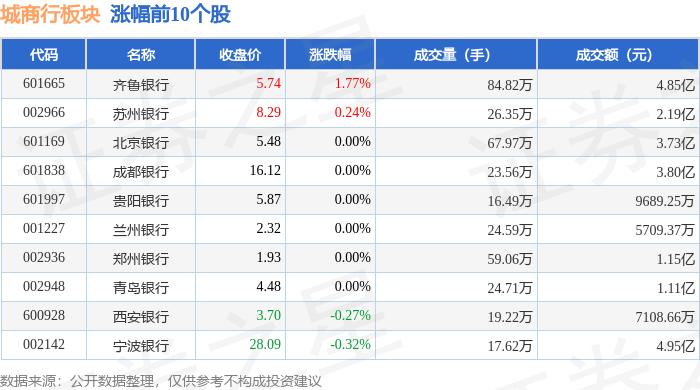
Market Overview - The city commercial bank sector experienced a decline of 0.33% on December 31, with Xiamen Bank leading the drop [1] - The Shanghai Composite Index closed at 3968.84, up 0.09%, while the Shenzhen Component Index closed at 13525.02, down 0.58% [1] Individual Bank Performance - Qilu Bank closed at 5.74, up 1.77% with a trading volume of 848,200 shares and a transaction value of 485 million [1] - Suzhou Bank closed at 8.29, up 0.24% with a trading volume of 263,500 shares and a transaction value of 219 million [1] - Xiamen Bank closed at 7.34, down 1.08% with a trading volume of 133,200 shares and a transaction value of 97.8 million [2] - Nanjing Bank closed at 11.43, down 0.78% with a trading volume of 235,600 shares and a transaction value of 270 million [2] Capital Flow Analysis - The city commercial bank sector saw a net inflow of 201 million from institutional investors, while retail investors experienced a net outflow of 9.56 million [2] - The capital flow for individual banks shows that Shanghai Bank had a net inflow of 48.9 million from institutional investors, while Hangzhou Bank had a net outflow of 50.55 million [3] - Suzhou Bank recorded a net inflow of 30.66 million from institutional investors, while retail investors had a net outflow of 27.1 million [3]
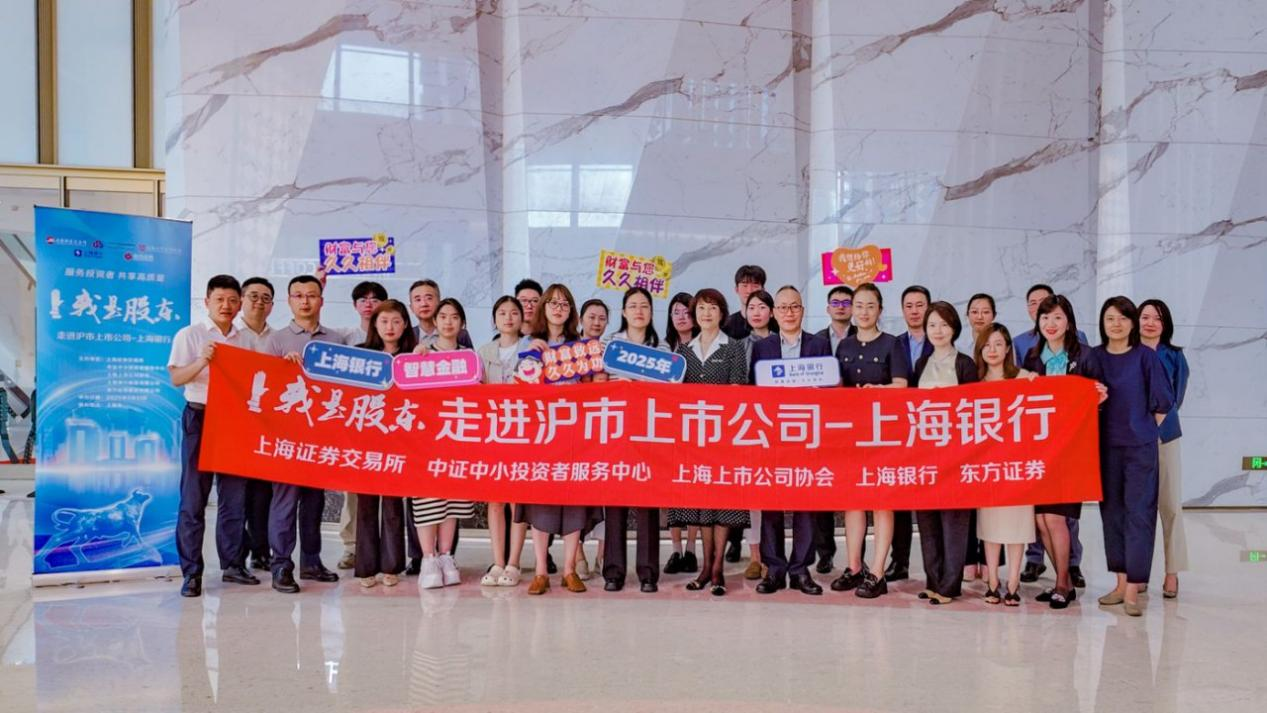
东方证券联合上交所开展“我是股东”走进沪市上市公司上海银行活动
Jin Rong Jie· 2025-12-30 09:08
Group 1 - The event "I am a Shareholder" was organized by Dongfang Securities in collaboration with Shanghai Stock Exchange and other institutions to enhance communication between listed companies and investors [1][3] - Shanghai Bank's Secretary of the Board, Li Xiaohong, shared insights on the bank's development history, main business, market positioning, and future strategy to provide investors with a comprehensive understanding of the bank's operations and industry status [3][6] - Investors had the opportunity to engage directly with Shanghai Bank's management, asking questions about strategic planning, business features, and dividend policies, which were addressed by Li Xiaohong and department heads [3][7] Group 2 - The event included a visit to Shanghai Bank's Puxi branch, showcasing its historical significance and modern design, emphasizing the bank's commitment to customer service and community engagement [6] - Dongfang Securities plans to continue strengthening investor protection and education, aiming to enhance investors' awareness and rights, contributing to the high-quality development of the capital market [7] - Participants expressed high appreciation for the event, highlighting its role in facilitating direct communication with the company and reinforcing the commitment to protecting investor rights and supporting the real economy [7]

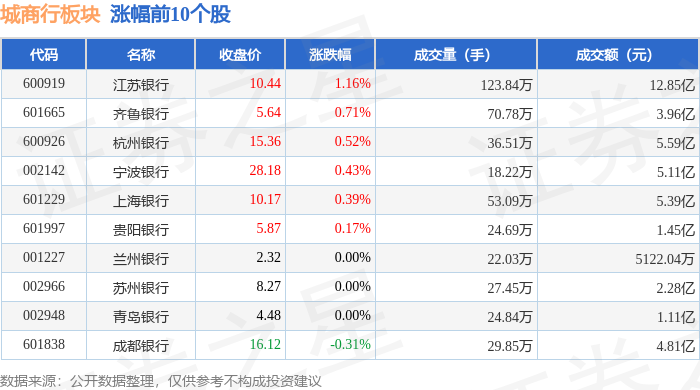
城商行板块12月30日涨0.13%,江苏银行领涨,主力资金净流入1.91亿元
Zheng Xing Xing Ye Ri Bao· 2025-12-30 09:08
Market Performance - The city commercial bank sector increased by 0.13% compared to the previous trading day, with Jiangsu Bank leading the gains [1] - The Shanghai Composite Index closed at 3965.12, down 0.0%, while the Shenzhen Component Index closed at 13604.07, up 0.49% [1] Individual Stock Performance - Jiangsu Bank closed at 10.44, up 1.16% with a trading volume of 1.2384 million shares [1] - Qilu Bank closed at 5.64, up 0.71% with a trading volume of 707,800 shares [1] - Hangzhou Bank closed at 15.36, up 0.52% with a trading volume of 365,100 shares [1] - Ningbo Bank closed at 28.18, up 0.43% with a trading volume of 182,200 shares [1] - Shanghai Bank closed at 10.17, up 0.39% with a trading volume of 530,900 shares [1] - Guiyang Bank closed at 5.87, up 0.17% with a trading volume of 246,900 shares [1] - Chengdu Bank closed at 16.12, down 0.31% with a trading volume of 298,500 shares [2] Capital Flow - The city commercial bank sector saw a net inflow of 191 million yuan from institutional investors, while retail investors experienced a net outflow of 7.0084 million yuan [2] - The main capital inflow and outflow for individual banks are detailed, with Hangzhou Bank receiving a net inflow of 128 million yuan from institutional investors [3] - Jiangsu Bank had a net inflow of 111 million yuan from institutional investors but a net outflow of 124 million yuan from speculative funds [3]



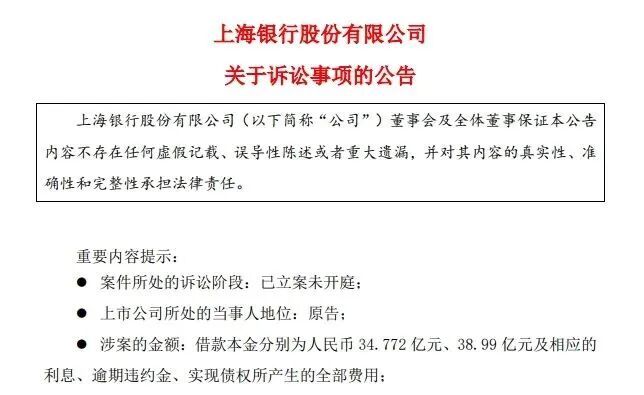
上海银行股份有限公司关于诉讼事项进展的公告
Zhong Guo Zheng Quan Bao - Zhong Zheng Wang· 2025-12-30 08:08
Core Viewpoint - The company is involved in a legal dispute concerning financial loan agreements, with the court ruling in favor of the company, requiring repayment from the defendants, but the outcome will not significantly impact the company's current or future profits [2][3][4][9]. Group 1: Lawsuit Details - The company’s Shenzhen branch is the plaintiff in two financial loan contract disputes against Shenzhen Shenye Logistics Group Co., Ltd. and others, with the total loan amounts of RMB 34.772 billion and RMB 38.99 billion, including interest and penalties [2][3]. - The Guangdong High People's Court has accepted the cases, with specific case numbers assigned [3]. Group 2: Court Ruling - The court ruled that Shenye Logistics must repay RMB 34.772 billion and RMB 38.99 billion along with corresponding interest and overdue penalties within ten days of the ruling [4][5]. - The court also ordered Shenye Logistics to pay legal fees of RMB 200,000 for each case [5]. - The company holds mortgage rights over properties provided by Shenye Logistics and Baoneng Real Estate, allowing priority in repayment from the sale of these properties [5][6]. Group 3: Liability and Responsibilities - Baoneng Investment is jointly liable for the repayment of RMB 34.772 billion and associated costs, with the right to seek reimbursement from Shenye Logistics after fulfilling its obligations [6][7]. - Baoneng Holdings, Yao Zhenhua, and Baoneng Investment are also jointly responsible for the repayment of RMB 38.99 billion and related costs, with similar rights to seek reimbursement [7]. Group 4: Financial Impact - The lawsuit's progress is not expected to have a significant impact on the company's current or future profits [2][9].
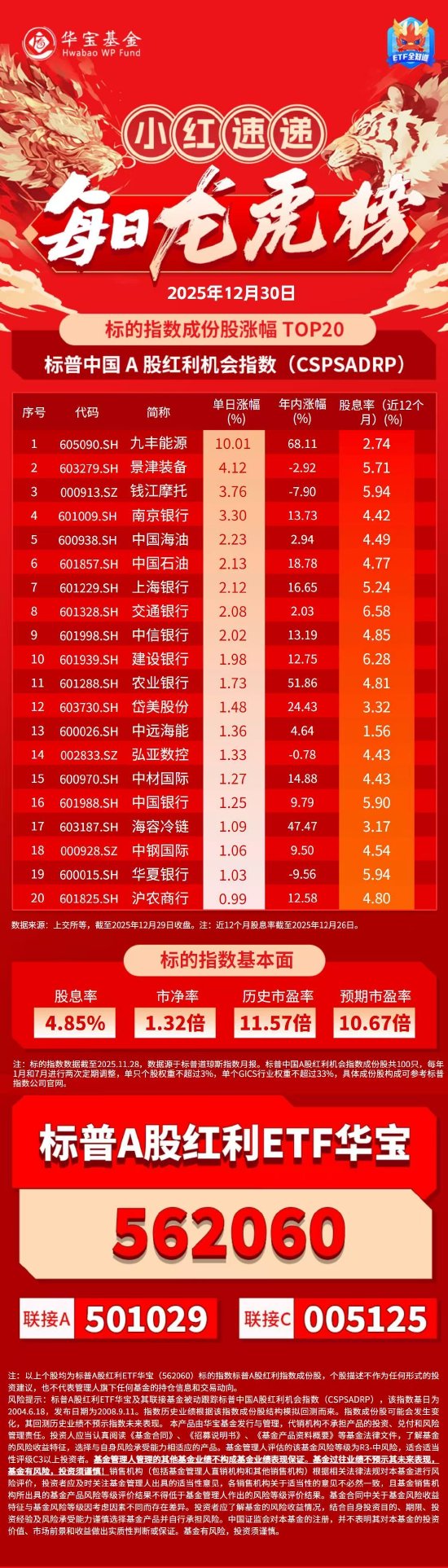
小红日报|银行石油板块携手抗震,标普A股红利ETF华宝(562060)标的指数收跌0.3%
Xin Lang Cai Jing· 2025-12-30 01:34
Group 1 - The article highlights the top 20 stocks in the S&P China A-Share Dividend Opportunity Index (CSPSADRP) based on their daily and year-to-date performance as of December 30, 2025 [1][5] - The top performer is Jiufeng Energy (605090.SH) with a daily increase of 10.01% and a year-to-date increase of 68.11%, along with a dividend yield of 2.74% [1][5] - Other notable stocks include Jiangsu Jingjin Environmental Protection (603279.SH) with a daily increase of 4.12% and a year-to-date decrease of 2.92%, and Qianjiang Motorcycle (000913.SZ) with a daily increase of 3.76% and a year-to-date decrease of 7.90% [1][5] Group 2 - The list includes several banks, with Agricultural Bank of China (601288.SH) showing a significant year-to-date increase of 51.86% and a daily increase of 1.73% [1][5] - China Petroleum (601857.SH) and Shanghai Bank (601229.SH) also performed well, with year-to-date increases of 18.78% and 16.65% respectively [1][5] - The data is sourced from the Shanghai Stock Exchange and reflects the closing prices as of December 29, 2025, with dividend yields calculated up to December 26, 2025 [1][5]





“宝能系”被追债!法院最新判决:总计超73亿元,10天内还清
Mei Ri Jing Ji Xin Wen· 2025-12-29 22:52
Core Viewpoint - Shanghai Bank's Shenzhen branch has received a court ruling requiring Shenzhen Shenye Logistics Group Co., Ltd. to repay significant loans totaling approximately 73.76 billion yuan, along with interest and penalties, marking a critical development in a long-standing debt recovery case [1][3][4]. Group 1: Loan Details - The Shenzhen branch provided loans of 15 billion yuan and 23 billion yuan to Shenye Logistics in September and October 2018, respectively, with due dates in September and October 2021 [3]. - An additional loan of 40 billion yuan was issued in December 2018, due by June 2022, bringing the total outstanding amount to 73.76 billion yuan as of the lawsuit date [3][4]. - The loans were secured by real estate collateral from both Shenye Logistics and Baoneng Real Estate, along with other guarantees [3]. Group 2: Legal Proceedings - The court ruling mandates Shenye Logistics to repay the principal amounts of 34.772 billion yuan and 38.99 billion yuan, along with accrued interest and overdue penalties, within ten days of the ruling's legal effect [1][4]. - The case has been ongoing for over a year since the lawsuit was filed in September 2021, with the loans classified as non-performing by Shanghai Bank at the end of 2021 [4]. Group 3: Company Background - Shanghai Bank was established on January 30, 1996, and was listed on the Shanghai Stock Exchange on November 16, 2016 [4]. - As of September 2025, the bank's total assets were approximately 3.31 trillion yuan, with customer loans around 1.44 trillion yuan and a non-performing loan ratio of 1.18% [4]. - The Baoneng Group, involved in the case, is facing liquidity issues and has been involved in multiple debt and litigation cases, with some assets undergoing disposal [7].