Bank Of Shanghai(601229)

Search documents
机构扎堆调研上市银行信贷投放、净息差等为“最关注”
Zheng Quan Ri Bao· 2026-02-02 16:43
Group 1 - In January, 11 A-share listed banks were surveyed by 373 institutions, with a total of 49 survey instances, focusing on credit issuance, net interest margin, asset quality trends, and bond investment strategies during the peak marketing season [1] - The surveyed banks include Nanjing Bank, Ningbo Bank, Shanghai Bank, Hangzhou Bank, Suzhou Bank, Qingdao Bank, Qilu Bank, Xiamen Bank, Hu Nong Bank, Qing Nong Bank, and Zijin Bank, with six banks experiencing stock price increases, led by Qingdao Bank with over 16% growth [2] - Nanjing Bank was the most favored by institutions, receiving 76 surveys, while Shanghai Bank received 75 surveys, indicating strong interest in their credit issuance during the marketing peak [2] Group 2 - The focus of the credit issuance during the peak marketing season is on corporate credit, with banks reporting better performance compared to the same period in 2025, emphasizing manufacturing, infrastructure, and green transformation projects [2][3] - Shanghai Bank anticipates a continued decline in the Loan Prime Rate (LPR) in 2026, which may lead to a slight decrease in net interest margin due to competitive market factors [4] - Qilu Bank aims to stabilize its net interest margin by optimizing asset management and expanding low-cost deposits while managing liabilities effectively [4] Group 3 - The overall pressure on net interest margin for listed banks is expected to ease in 2026, with a narrowing decline anticipated, supported by improvements in funding costs [5] - Shanghai Bank predicts that bond yields will continue to fluctuate within a range in 2026, with low likelihood of a trend reversal [5] - Hu Nong Bank plans to focus on bond investments primarily for allocation, while also employing advanced technologies for trading and risk management [6]




4652只个股收绿,原因找到了!
Guo Ji Jin Rong Bao· 2026-02-02 13:26
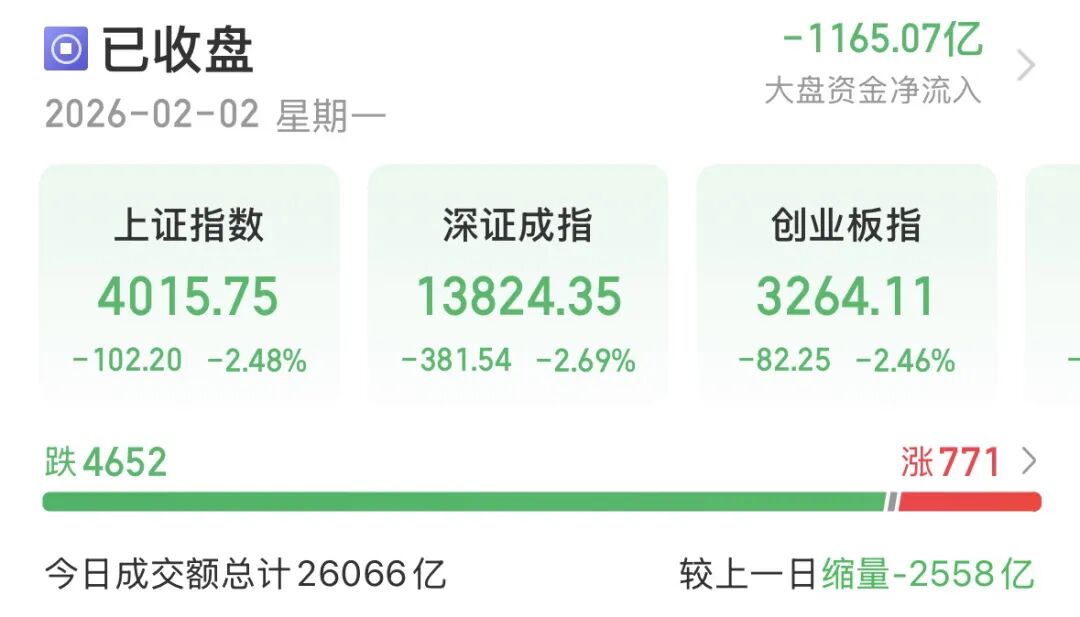
Market Overview - A-shares experienced a significant decline on February 2, with the Shanghai Composite Index and ChiNext Index both dropping over 2% [2][4] - The market showed a broad-based decline, with 4,652 stocks closing lower, particularly in resource sectors such as metals, coal, oil, and chemicals [4][9] - The trading volume decreased significantly, with daily turnover dropping by 255.8 billion to 2.61 trillion [5] Sector Performance - Resource stocks were heavily impacted, with declines exceeding 5% in sectors like non-ferrous metals, steel, basic chemicals, coal, and oil [8][9] - The food and beverage sector, particularly liquor stocks, showed resilience, with several companies like Jinhuijiu and Youyou Food hitting the daily limit [6][7] - Banking stocks also performed relatively well, with several banks showing slight gains despite the overall market downturn [8] Market Sentiment and Factors - The decline was attributed to a combination of external market disturbances, profit-taking, and heightened risk aversion ahead of the holiday [3][11] - Analysts suggest that the market may need 3 to 5 trading days to stabilize, with a focus on whether the Shanghai Composite can hold above the 4,000-point mark [3][15] - The current market environment is characterized as a healthy technical correction rather than a trend reversal, with no signs of panic selling or liquidity crisis [12][14] Investment Strategy - Investors are advised to avoid high-volatility sectors in the short term and to wait for clear signs of market stabilization before gradually increasing positions in quality sectors [3][16] - There is a recommendation to focus on defensive sectors such as electric grid equipment and high-dividend blue chips, while avoiding emotional selling [15][17] - The market is expected to recover quickly post-holiday, supported by liquidity replenishment and policy expectations from the upcoming Two Sessions [15][17]




上海银行(601229):治理变革引路,科技金融兴行
Changjiang Securities· 2026-02-02 13:22
Investment Rating - The report assigns a rating of "Buy" for Shanghai Bank [12] Core Insights - The new management team under Chairman Gu Jianzhong has clarified strategic priorities and initiated significant organizational changes, which have garnered market attention regarding the bank's growth potential [3][6] - The bank is expected to enhance organizational efficiency, accelerate credit issuance, and stabilize net interest margins, leading to improved profitability and performance growth [3][10] Summary by Relevant Sections Governance and Organizational Changes - The new management has implemented a major organizational restructuring aimed at reducing management layers and improving efficiency, particularly in the Shanghai region [6][25] - The bank plans to increase the allocation of professional talent, especially frontline employees, to support key growth areas such as technology finance and wealth management [6][27] Strategic Focus - The corporate banking segment will focus on technology finance, leveraging Shanghai's position as an international innovation center [7][33] - The retail segment is enhancing wealth management services, with a significant portion of assets under management (AUM) coming from pension clients, indicating strong future potential for financial products and insurance [7][39] Credit and Profitability Outlook - Credit growth is expected to accelerate starting in 2026, with a focus on corporate loans, particularly in key projects and state-owned enterprises [8][46] - The bank's net interest margin is projected to stabilize around 1.15%, with interest income growth expected to accelerate in 2026 [8][53] Asset Quality and Risk Management - The bank has been actively managing asset quality, with a decline in non-performing loan ratios since their peak in 2022, and is expected to continue improving risk indicators [9][44] - The focus on corporate real estate loans is expected to mitigate risks, with significant provisions already made for historical non-performing loans [9][44] Investment Recommendations - The governance changes are seen as a core investment logic, with strong capital positions and a commitment to increasing dividend payouts, suggesting a favorable risk-reward profile [10][12] - The bank's projected price-to-book (PB) ratios for 2025-2027 are 0.54x, 0.51x, and 0.47x, with expected dividend yields of 5.5%, 5.8%, and 6.1% respectively [10]
城商行板块2月2日跌0.3%,齐鲁银行领跌,主力资金净流入1792.74万元
Zheng Xing Xing Ye Ri Bao· 2026-02-02 09:15
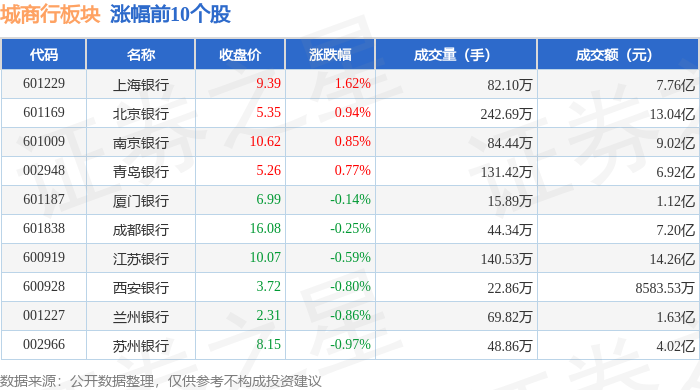
Market Overview - On February 2, the city commercial bank sector declined by 0.3% compared to the previous trading day, with Qilu Bank leading the decline [1] - The Shanghai Composite Index closed at 4015.75, down 2.48%, while the Shenzhen Component Index closed at 13824.35, down 2.69% [1] Individual Bank Performance - Shanghai Bank (601229) closed at 66.6, up 1.62% with a trading volume of 821,000 shares and a transaction value of 776 million [1] - Beijing Bank (601169) closed at 5.35, up 0.94% with a trading volume of 2.4269 million shares and a transaction value of 1.304 billion [1] - Nanjing Bank (6001009) closed at 10.62, up 0.85% with a trading volume of 844,400 shares and a transaction value of 902 million [1] - Qilu Bank (601665) closed at 5.73, down 1.55% with a trading volume of 715,600 shares and a transaction value of 415 million [2] - Hangzhou Bank (600926) closed at 15.92, down 1.49% with a trading volume of 521,800 shares and a transaction value of 840 million [2] Capital Flow Analysis - The city commercial bank sector saw a net inflow of 17.93 million from institutional investors, while retail investors experienced a net outflow of 157.95 million [2] - Major banks like Shanghai Bank and Jiangsu Bank had significant net inflows from institutional investors, with Shanghai Bank receiving 71.52 million, accounting for 9.22% of its total [3] - Conversely, retail investors showed a notable outflow from several banks, including Beijing Bank, which saw a retail net outflow of 64.17 million, representing 4.92% [3]



各银行在售高收益纯固收产品一览!合资理财子产品首次上榜
2 1 Shi Ji Jing Ji Bao Dao· 2026-02-02 09:13
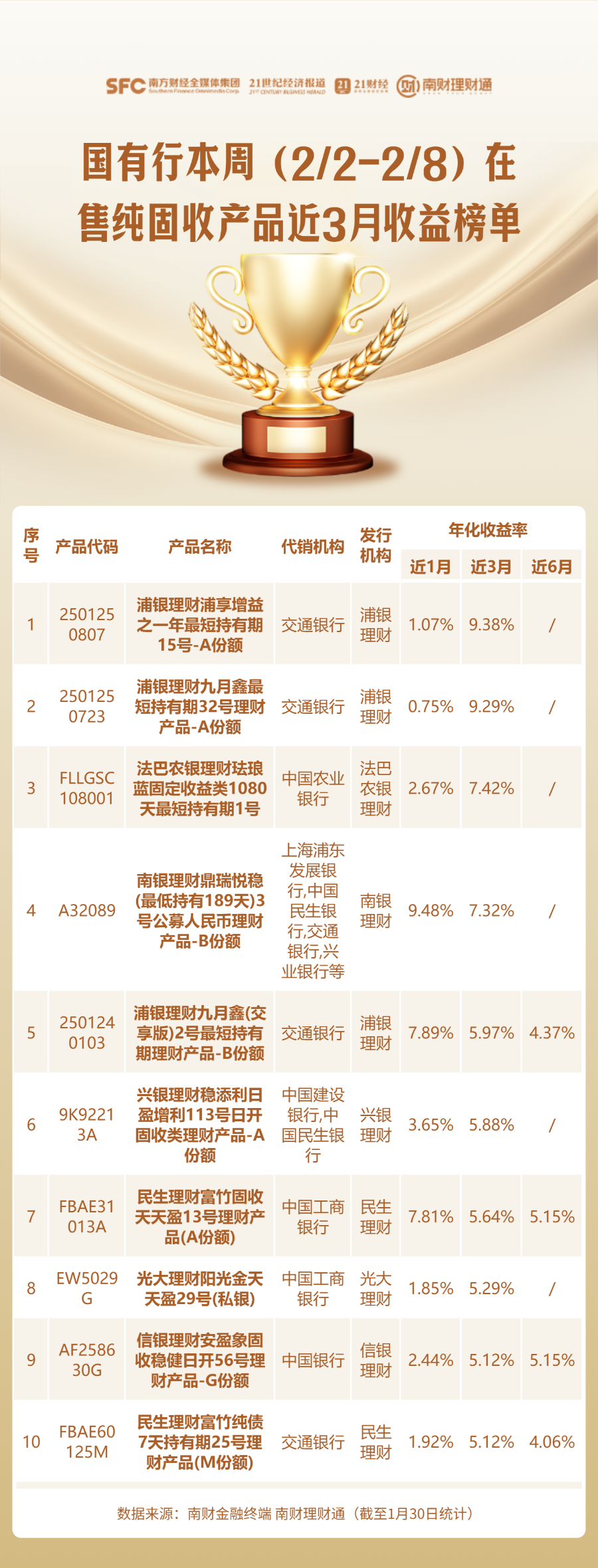
Core Insights - The report focuses on the performance of pure fixed-income products issued by wealth management companies, highlighting the best-performing products available for sale through various distribution channels [1][4] Group 1: Product Performance - The ranking of products is based on their annualized returns over the past month, three months, and six months, with a particular emphasis on the three-month annualized yield to reflect their performance amid recent market fluctuations [1] - A total of 28 distribution institutions are involved, including major banks such as Industrial and Commercial Bank of China, Bank of China, Agricultural Bank of China, and others [1] Group 2: Product Availability - The list of products is categorized as "available for sale," but actual availability may vary due to factors such as sold-out quotas or differences in product listings shown to different customers by banks [1] - Investors are advised to refer to the actual displays on the distribution bank's app for the most accurate information regarding product availability [1] Group 3: Data Source - The data presented in the report is sourced from the Nanfang Financial Terminal and Nanfang Wealth Management, with statistics as of January 30 [3][5]






资金大幅流出后银行为何逆势回升?机构点出 4.4% 高分红率+信贷开门红
Mei Ri Jing Ji Xin Wen· 2026-02-02 07:20
Core Viewpoint - The banking sector experienced significant capital outflows in January 2026, with a notable recovery in stock prices despite the outflows, indicating a potential increase in long-term institutional investor interest [1]. Group 1: Market Performance - As of February 2, 2026, the China Securities Banking Index (399986) rose by 0.15%, with notable increases in individual bank stocks such as CITIC Bank (up 2.64%), Shanghai Bank (up 1.62%), and Huaxia Bank (up 1.42%) [1]. - The Bank ETF Huaxia (515020) increased by 0.18%, with the latest price at 1.65 yuan [1]. Group 2: Capital Flows - In January 2026, there was a substantial net outflow of passive funds from the banking sector, totaling 9,102 billion yuan for the month and 3,773 billion yuan for the week of January 26 to 30 [1]. - CITIC Securities estimated that the net outflow of funds from bank stocks was approximately 1,051 billion yuan in January and 485 billion yuan for the last week of January [1]. Group 3: Future Outlook - Despite the significant capital outflows, the banking index saw a 1% rebound, suggesting a strong willingness for long-term institutional investment [1]. - The banking sector is expected to benefit from a positive operating environment in the first quarter of 2026, with stable net interest margins and asset quality, leading to a recovery in revenue and profit growth [1]. - The current dividend yield of 4.4% in the sector is considered to be in a high cost-performance range, enhancing the attractiveness of core equity assets [1].
银行股逆势上涨,中信银行涨超3%
Ge Long Hui· 2026-02-02 03:57
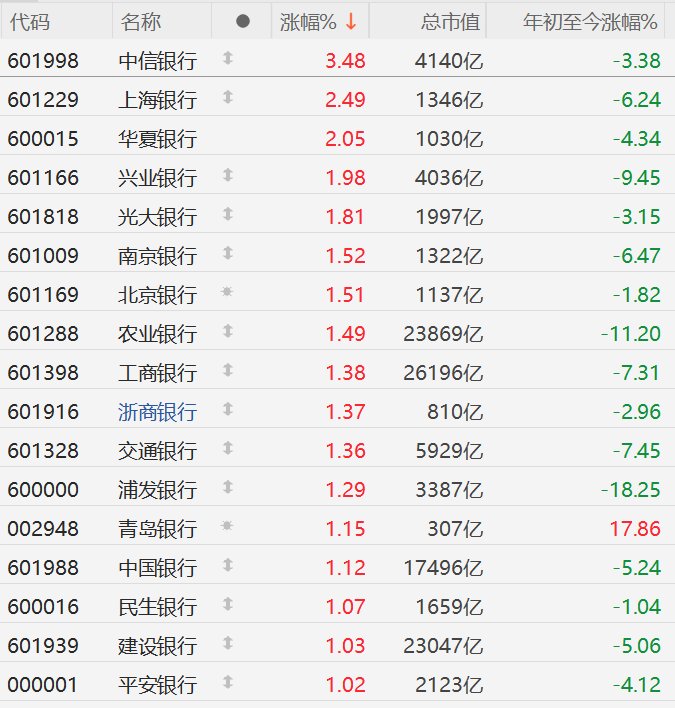
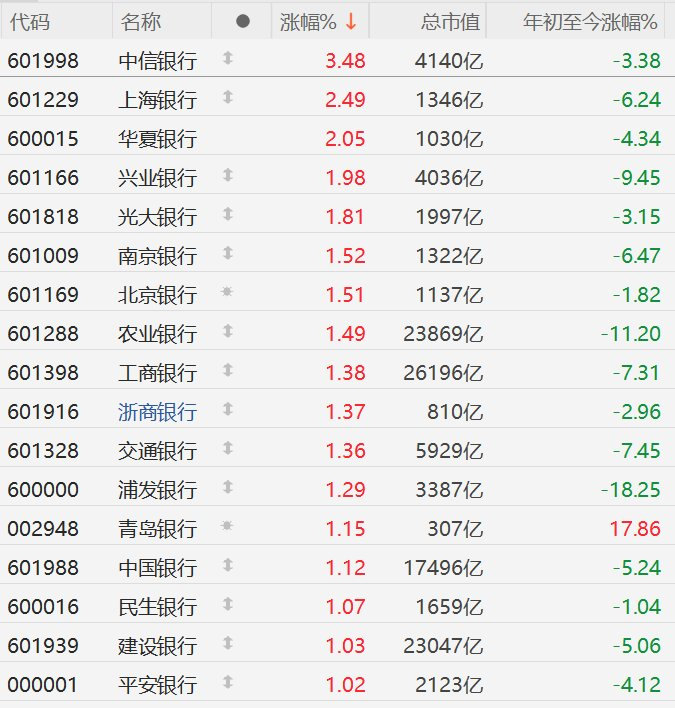
Core Viewpoint - The A-share market's banking sector experienced a counter-trend increase, with several banks showing significant gains despite overall market conditions [1]. Group 1: Stock Performance - CITIC Bank saw an increase of 3.48%, with a total market capitalization of 414 billion [2] - Shanghai Bank increased by 2.49%, with a market cap of 134.6 billion [2] - Huaxia Bank rose by 2.05%, with a market cap of 103 billion [2] - Other banks such as Industrial Bank, Everbright Bank, and Nanjing Bank also reported gains exceeding 1% [1][2] - Agricultural Bank, Industrial and Commercial Bank, and China Merchants Bank had market caps of 2386.9 billion, 2619.6 billion, and 2304.7 billion respectively, with slight increases [2] Group 2: Year-to-Date Performance - Year-to-date performance shows that most banks have negative returns, with CITIC Bank down 3.38% and Shanghai Bank down 6.24% [2] - Notably, Qingdao Bank has a positive year-to-date return of 17.86%, indicating strong performance relative to its peers [2] - Other banks like Agricultural Bank and Industrial Bank have year-to-date declines of 11.20% and 7.31% respectively [2]
A股银行股逆势上涨,中信银行涨超3%
Ge Long Hui A P P· 2026-02-02 03:54
Core Viewpoint - The A-share market has seen a rise in bank stocks, with several banks experiencing significant gains despite overall market trends [1] Group 1: Stock Performance - CITIC Bank increased by 3.48%, with a total market capitalization of 414 billion [2] - Shanghai Bank rose by 2.49%, with a market cap of 134.6 billion [2] - Huaxia Bank saw a gain of 2.05%, with a market value of 103 billion [2] - Industrial Bank increased by 1.98%, with a market cap of 403.6 billion [2] - Everbright Bank rose by 1.81%, with a total market capitalization of 199.7 billion [2] - Nanjing Bank increased by 1.52%, with a market cap of 132.2 billion [2] - Beijing Bank saw a rise of 1.51%, with a market value of 113.7 billion [2] - Agricultural Bank increased by 1.49%, with a market cap of 23,869 billion [2] - Industrial and Commercial Bank rose by 1.38%, with a market value of 26,196 billion [2] - Zhejiang Bank increased by 1.37%, with a market cap of 81 billion [2] - Bank of Communications rose by 1.36%, with a market value of 592.9 billion [2] - Shanghai Pudong Development Bank increased by 1.29%, with a market cap of 338.7 billion [2] - Qingdao Bank saw a rise of 1.15%, with a market value of 30.7 billion [2] - Bank of China increased by 1.12%, with a market cap of 17,496 billion [2] - Minsheng Bank rose by 1.07%, with a market value of 165.9 billion [2] - China Construction Bank increased by 1.03%, with a market cap of 23,047 billion [2] - Ping An Bank rose by 1.02%, with a market value of 212.3 billion [2] Group 2: Year-to-Date Performance - CITIC Bank has a year-to-date decline of 3.38% [2] - Shanghai Bank has decreased by 6.24% year-to-date [2] - Huaxia Bank has a year-to-date decline of 4.34% [2] - Industrial Bank has decreased by 9.45% year-to-date [2] - Everbright Bank has a year-to-date decline of 3.15% [2] - Nanjing Bank has decreased by 6.47% year-to-date [2] - Beijing Bank has a year-to-date decline of 1.82% [2] - Agricultural Bank has decreased by 11.20% year-to-date [2] - Industrial and Commercial Bank has a year-to-date decline of 7.31% [2] - Zhejiang Bank has decreased by 2.96% year-to-date [2] - Bank of Communications has a year-to-date decline of 7.45% [2] - Shanghai Pudong Development Bank has decreased by 18.25% year-to-date [2] - Qingdao Bank has increased by 17.86% year-to-date [2] - Bank of China has a year-to-date decline of 5.24% [2] - Minsheng Bank has decreased by 1.04% year-to-date [2] - China Construction Bank has a year-to-date decline of 5.06% [2] - Ping An Bank has decreased by 4.12% year-to-date [2]
银行周报(2026/1/26-2026/1/30):战略投资者拟扩围,利好银行长期资本补充
GUOTAI HAITONG SECURITIES· 2026-02-01 02:45
股 票 研 究 股票研究 /[Table_Date] 2026.02.01 战略投资者拟扩围,利好银行长期资本补充 [Table_Industry] 商业银行 本报告导读: 证监会拟扩大可参与定增的战略投资者类型,并明确最低持股比例要求,利好上市 银行长期资本补充、金融机构合作深化,以及银行理财多元资产投资转型。 投资要点: [Table_Report] 相关报告 商业银行《银行快报陆续披露,25A 业绩稳健增 长》2026.01.25 商业银行《全年增量 3.34 万亿元,公募基金配置 占比提升 2.1pct 至 5.1%》2026.01.25 商业银行《国有大行投放力度较大,不良压力或 企稳》2026.01.23 商业银行《主动基金环比持平,被动基金增持》 2026.01.23 商业银行《利息净收入增速转正,业绩延续改善 趋势》2026.01.19 证 券 研 究 报 告 请务必阅读正文之后的免责条款部分 行 银行周报(2026/1/26-2026/1/30) | [姓名table_Authors] | 电话 | 邮箱 | 登记编号 | | --- | --- | --- | --- | | 马婷婷(分析 ...


机构调研策略周报(2026.01.26-2026.01.30):电子、机械设备等行业热度持续-20260130
Yuan Da Xin Xi· 2026-01-30 11:35
Group 1: Popular Industry Research - The most researched industries from January 26 to January 30, 2026, are electronics, machinery, basic chemicals, and pharmaceutical biology, with electronics and machinery receiving the highest attention in the past five days [10][12] - Over the past 30 days (December 31, 2025, to January 30, 2026), the most researched industries are machinery, electronics, pharmaceutical biology, and basic chemicals, with machinery and computers having the most research institutions [13][14] Group 2: Popular Company Research - In the past five days, the companies with the most research occurrences and more than 10 institutional ratings are Jiemai Technology, Ice Wheel Environment, and Zhou Dazheng [17][19] - Over the past 30 days, the companies with the most research occurrences and more than 10 institutional ratings include Daikin Heavy Industry, Jiangsu Bank, and Naipu Mining Machinery [22][23] Group 3: Key Company Research Summary 1. **Shanghai Bank** - The focus of the research is on strategic planning and shareholder returns, with a new five-year development plan approved, emphasizing technology finance with a loan balance exceeding 187.05 billion [26] - The asset quality remains stable, with credit focus on key regions and retail ecosystems, and a commitment to maintain cash dividends of no less than 30% annually from 2025 to 2027 [26][27] 2. **Liugong** - The research highlights significant growth in core business, with domestic demand for earth-moving machinery rebounding and overseas sales of electric loaders doubling [29] - The company expects a profit increase of 15% to 25% for the year, despite short-term impairment impacts, and is advancing its overseas manufacturing layout [29][30] 3. **Jiemai Technology** - The focus is on the domestic substitution of electronic film materials and capacity expansion, with high-end release films achieving stable supply and certification from major domestic and international clients [31] - The Tianjin base is expected to start trial production in the first quarter of 2026, enhancing supply chain resilience [31][32]