Bank Of Shanghai(601229)

Search documents
收评:深成指、创指双双涨超1% 涨价题材股集体爆发
Xin Lang Cai Jing· 2026-02-25 07:40
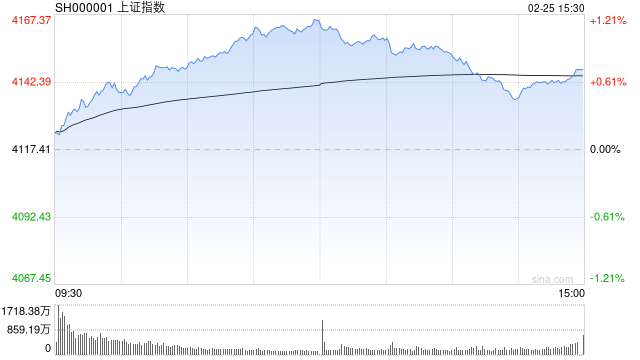
Core Viewpoint - The article discusses the upward trend in the stock market driven by cyclical price increases and the spread of AI, suggesting a potential for market fluctuations to rise ahead of the Two Sessions [1]. Market Performance - The three major stock indices collectively rose, with the Shanghai Composite Index closing at 4147.23 points, up 0.72%, the Shenzhen Component at 14475.87 points, up 1.29%, and the ChiNext Index at 3354.82 points, up 1.41% [3][13]. - Over 3700 stocks increased in value, indicating a predominance of gains in the market [3][13]. Sector Highlights - **Rare Earth Permanent Magnet Sector**: Stocks such as Baotou Steel and China Aluminum International saw significant gains, with prices for various rare earth products increasing post-holiday. For instance, the average price of praseodymium and neodymium oxide rose by 4.16 million yuan/ton [5][14]. - **Real Estate Sector**: Companies like I Love My Home and Hualian Holdings experienced stock price surges, supported by promotional activities from nearly 50 real estate firms in Guangzhou, offering over 140 properties with discounts [6][15]. Consumer Trends - **Restaurant Industry**: Goldman Sachs forecasts a 4.2% year-on-year growth in mainland China's restaurant sales, up from 3.2% last year. The report notes a stabilization in consumer demand and price increases due to rising operational and raw material costs [9][18]. - **Takeout Orders**: The increase in takeout orders is expected to impact profitability negatively, but ongoing high levels of subsidies and product variety expansion are anticipated to support same-store sales growth [9][18]. Institutional Insights - Zhongyuan Securities indicates that the inflow of funds into the market is expected to provide a solid foundation for upward market movements, with a likely scenario of wide fluctuations and structural differentiation in indices [10][19]. - Dongguan Securities highlights a general rise in global assets during the Spring Festival, with AI and resource products becoming market focal points, suggesting a high probability of index increases post-holiday [10][19].






银行股马年开局遇冷,机构调研透露几大隐忧
Di Yi Cai Jing· 2026-02-24 12:01
银行股马年首个交易日跌多涨少 2月24日,A股市场实现开门红,截至收盘,沪指涨0.87%报4117.41点,深证成指涨1.36%,创业板指涨 0.99%。当天,沪深两市合计成交约2.2万亿元,较上一个交易日放量近2200亿元。 调研热情不及往年。 马年第一个交易日A股迎来开门红,银行股在市场火热情绪中继续被"冷落",成为当天为数不多的飘绿 板块之一。 从消息面来看,当天最新LPR(贷款市场报价利率)出炉,1年期及5年期两个期限品种均连续9个月"按 兵不动"。央行节前披露的金融数据显示,尽管社融实现"开门红",但信贷投放在1月罕见出现同比少 增。在此背景下,市场一方面更多关注信贷质量,另一方面也更加关注春节后开工节奏。 从机构对银行的调研情况来看,相较于往年同期,今年以来调研热情也有所回落,分化依然明显。第一 财经梳理发现,机构调研过程中的关注点主要集中在信贷投放尤其对公信贷景气度、息差压力下的负债 量价趋势和中收拓展能力,以及盈利压力下的资本补充计划等。 从板块表现来看,市场热点快速轮动,全市场超4000只个股上涨、百余只个股涨停。截至收盘,31个申 万一级行业中,仅传媒、计算机、商贸零售等7个板块飘绿。其中 ...




再融资结构性松绑,银行业盈利改善
HTSC· 2026-02-24 05:10
Investment Rating - The report maintains an "Overweight" rating for the securities and banking sectors [9]. Core Insights - The report highlights the structural relaxation of refinancing policies, which is expected to improve profitability in the banking sector. The central bank's Q4 monetary policy report emphasizes the implementation of personal credit repair measures, supporting micro-entities [1][28]. - The report identifies investment opportunities in the order of securities > insurance > banking, with a focus on the potential for marginal improvements in the brokerage business due to the recent refinancing policy adjustments [12][24]. Summary by Sections Securities Sector - The optimization of refinancing measures announced by the exchanges is expected to lead to marginal improvements in the brokerage business, with leading firms likely to solidify their advantages through professional capabilities. The Chinese brokerage index performed better than the Hang Seng index during the holiday period, increasing by 0.20% [2][13]. - Recommended stocks include leading brokerages such as CITIC Securities, Guotai Junan, and GF Securities, as well as quality regional firms like Guoyuan Securities [3][12]. Insurance Sector - The report notes a mixed performance in the insurance sector, with property insurance companies showing gains while life insurance companies mostly declined. China Property & Casualty Insurance rose by 5%, while China Taiping fell by 4% [24][25]. - Investors are advised to focus on quality leaders in the insurance sector, with a preference for defensive stocks like China Ping An and China Life Insurance for conservative investors [24][25]. Banking Sector - The banking sector is experiencing a recovery in performance, with Q4 profits improving and net interest margins stabilizing. The report indicates a year-on-year increase in social financing, primarily due to the pre-positioning of government bonds and a rebound in off-balance-sheet financing [28][37]. - Recommended stocks include quality regional banks such as Nanjing Bank and Chengdu Bank, which are expected to perform well due to their strong fundamentals [3][28].





中国人民银行、金融监管总局 发布我国系统重要性银行名单
Jin Rong Shi Bao· 2026-02-24 01:28
Core Viewpoint - The People's Bank of China and the National Financial Regulatory Administration have conducted the 2025 assessment of systemically important banks, identifying 21 domestic banks categorized into five groups based on their systemic importance scores [1] Group 1: Assessment of Systemically Important Banks - A total of 21 domestic systemically important banks have been recognized, including 6 state-owned commercial banks, 10 joint-stock commercial banks, and 5 city commercial banks [1] - The banks are divided into five groups based on their systemic importance scores, with the first group consisting of 11 banks, the second group having 4 banks, the third group with 2 banks, the fourth group containing 4 banks, and the fifth group having no banks [1] Group 2: Breakdown of Bank Groups - The first group includes: China Minsheng Bank, China Everbright Bank, Ping An Bank, Huaxia Bank, Ningbo Bank, Jiangsu Bank, Beijing Bank, Nanjing Bank, Guangfa Bank, Zheshang Bank, and Shanghai Bank [1] - The second group consists of: Industrial Bank, China CITIC Bank, Shanghai Pudong Development Bank, and China Postal Savings Bank [1] - The third group includes: Bank of Communications and China Merchants Bank [1] - The fourth group comprises: Industrial and Commercial Bank of China, Bank of China, China Construction Bank, and Agricultural Bank of China [1] - The fifth group currently has no banks included [1] Group 3: Future Regulatory Actions - The People's Bank of China and the National Financial Regulatory Administration will implement additional regulatory measures for systemically important banks according to the "Regulations on Additional Supervision of Systemically Important Banks (Trial)" [1] - The aim is to enhance the synergy between macro-prudential management and micro-prudential supervision, ensuring the safe and sound operation of systemically important banks [1] - This initiative is intended to better support the high-quality development of the real economy [1]


银行业周度追踪2026年第6周:商业银行四季度利润增速回升-20260224
Changjiang Securities· 2026-02-23 23:30
Investment Rating - The industry investment rating is "Positive" and maintained [11] Core Insights - The banking index fell by 1.3% this week, underperforming the CSI 300 and ChiNext indices by 1.6% and 2.5% respectively, indicating a short-term style switch in the market [6][19] - H-shares of banks led the gains, while most A-shares declined, with notable performances from Huaxia Bank and Shanghai Bank due to improved earnings and strong expectations for convertible bond conversions [6][19] - The price-to-book (PB) ratio and return on equity (ROE) of bank stocks remain undervalued, with a continued recommendation for high-quality city commercial banks in Zhejiang, Jiangsu, and Shandong provinces, including Hangzhou Bank, Ningbo Bank, Jiangsu Bank, Nanjing Bank, Qingdao Bank, Qilu Bank, and Suzhou Bank [6][19] - The report also suggests focusing on low-valuation, high-dividend, and convertible bond opportunities, particularly in Industrial Bank [6][19] Summary by Sections Market Performance - The banking sector's trading activity has decreased, with turnover rates falling, although the transaction volume share for state-owned and rural commercial banks has rebounded [8][39] - The average dividend yield for the six major state-owned banks in A-shares is 4.28%, with a spread of 249 basis points over the 10-year government bond yield, while H-shares yield 5.21% [7][29] Profit Growth and Net Interest Margin - The overall asset growth rate for commercial banks reached 9.0% year-on-year by the end of Q4 2025, with major state-owned banks seeing a growth rate of 10.8% [9][44] - The net profit growth for commercial banks was 2.3% year-on-year, indicating a positive trend, particularly among city and rural commercial banks [9][44] - The net interest margin for 2025 is projected at 1.42%, with a marginal stabilization observed, and a further narrowing of the decline expected in 2026 [9][46] Asset Quality - The non-performing loan (NPL) ratios across various banks are stable or improving, attributed to increased write-off efforts, while the provision coverage ratio continues to decline [10][49] - Capital adequacy ratios remain stable, with attention on the potential impact of the second round of fiscal injections for state-owned banks and refinancing for smaller banks in 2026 [10][49]


银行周报:25Q4银行监管指标:25年银行净利润增速回正-20260223
GUOTAI HAITONG SECURITIES· 2026-02-23 14:55
Investment Rating - The report assigns an "Overweight" rating for the banking sector [4]. Core Insights - The banking sector's net profit growth has turned positive, with a year-on-year increase of 2.33% in Q4 2025, showing an improvement compared to the previous quarters [4][10]. - The net interest margin has stabilized at 1.42%, with expectations of a narrowing decline in 2026 due to the re-pricing of high-cost long-term deposits and a slowdown in the reduction of new loan rates [4][10]. - The non-performing loan (NPL) ratio decreased to 1.50%, indicating a positive trend in asset quality [4][10]. - The capital adequacy ratio improved slightly to 15.5%, reflecting a marginal increase in capital levels [4][10]. Summary by Sections 1. Key Regulatory Indicators for Q4 2025 - Total assets of commercial banks grew by 9.0% year-on-year, with large banks showing a growth rate of 10.8% [7]. - The average capital return rate was 7.78%, and the average asset return rate was 0.60% [10]. 2. Industry and Company Dynamics - The report highlights the ongoing implementation of a moderately loose monetary policy by the central bank, aimed at stabilizing economic growth and ensuring adequate liquidity [10]. - The banking sector's focus for 2026 includes identifying banks with potential for performance growth, particularly recommending Ningbo Bank, China Merchants Bank, and Nanjing Bank [4][10]. 3. Weekly Data Tracking - The report includes weekly tracking of stock performance, with notable fluctuations in bank stock prices, indicating market volatility [18].


1月以来机构扎堆调研优质股曝光 大金重工获318家机构调研居首
Mei Ri Jing Ji Xin Wen· 2026-02-22 04:57
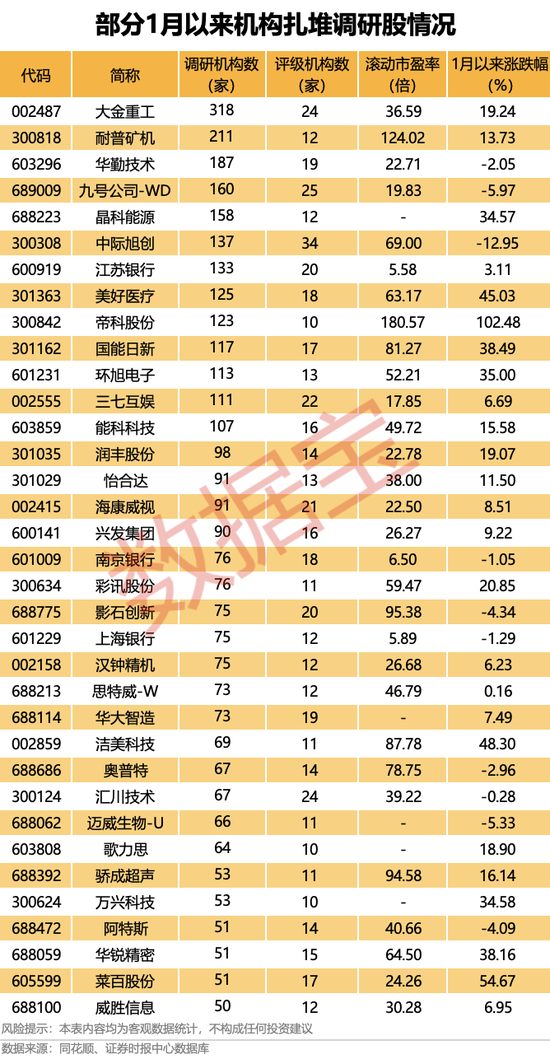
每经AI快讯,据证券时报·数据宝统计,1月以来,调研机构数在50家及以上且评级机构数在10家及以上 的公司,合计有35家。其中,大金重工获得318家机构调研居首。从评级机构数来看,中际旭创获34家 机构评级居首。江苏银行、上海银行、南京银行3只银行股进入榜单,其中江苏银行有多达133家机构调 研。数据显示,上榜个股今年以来平均涨幅超过16%,远超大盘同期表现。其中,帝科股份、菜百股 份、洁美科技、美好医疗等个股均涨超40%。 ...


机构扎堆调研的优质股曝光!
Xin Lang Cai Jing· 2026-02-22 04:21
节后行情怎么走?机构扎堆调研情况或提供一些线索。 随着春节假期进入尾声,市场即将重新开市,投资者关注度逐渐升温,机构资金的动向尤为引人瞩目。 其中,大金重工获得318家机构调研居首。公司在近期的调研中表示,英国AR7拍卖了8.4GW的海风项 目,超出前期市场预计数量,项目规模和补贴金额均创历史新高,固定式和漂浮式项目的执行电价相较 上一轮均实现同比上升,补贴年限也从15年延长至20年,提高了开发商的参与热情。另外,AR8预计在 今年也将拍出一定体量的项目量。本轮AR7中标的业主是公司已合作的重要客户,公司对本年市场订单 的获取很有信心。 从评级机构数来看,中际旭创获34家机构评级居首。国泰海通证券认为,公司业绩符合预期。从行业情 况看,1.6T有望在2026年快速上量,2027年需求有望进一步大幅提升。公司为云数据中心客户提供 400G、800G和1.6T等高速光模块,赢得了海内外客户的广泛认可,并保持了市场份额的持续成长,有 望大幅受益。 江苏银行、上海银行、南京银行3只银行股进入榜单,其中江苏银行有多达133家机构调研。 在众多的市场参与主体中,机构投资者凭借其专业的研究能力和信息优势,往往能率先布局具备 ...

【养老金融】首笔!上海银行成功落地全市首笔养老场景“民间投资”担保业务,为“社区食堂”注入金融活力
Xin Lang Cai Jing· 2026-02-14 14:36
Core Viewpoint - Shanghai Bank has successfully implemented the first "private investment" guarantee business in the elderly care sector in Shanghai, aimed at enhancing financial support for民生服务 and promoting the development of the private economy [1][2]. Group 1: Business Implementation - The "private investment" financing plan was tailored for Yuanyuan Catering, a company specializing in community elderly meal services, which operates over 40 self-managed community canteens and serves more than 30 cooperative meal points [1][2]. - The financing solution addresses the company's operational needs for stable working capital, including food procurement and employee salaries, with approval and disbursement completed in just 2 working days [1][2]. Group 2: Policy Support and Collaboration - The Municipal Financing Guarantee Fund Management Center provided comprehensive professional guidance during the implementation, offering differentiated policy support such as expanding financing areas and increasing credit limits [3]. - Shanghai Bank established a special working group to study policy details and align with fiscal interest subsidies, focusing on accurately meeting the financing needs of small and micro enterprises [3]. Group 3: Future Plans - Shanghai Bank plans to deepen cooperation with government and guarantee institutions, optimizing products like personal business loans and fixed asset loans under the "private investment" guarantee policy [2][3]. - The bank aims to expand the coverage of inclusive finance, focusing on key areas such as green, digital, and health elderly care, to support high-quality development of the real economy and private sector [2][3].
1月信贷社融点评:温和开门红
ZHESHANG SECURITIES· 2026-02-14 05:23
Investment Rating - The industry investment rating is "Positive" (maintained) [4] Core Insights - The report highlights a "strong deposit, weak loan" characteristic in the opening month of the year [4] - In January 2026, new social financing increased by 7.2 trillion yuan, a year-on-year increase of 166.2 billion yuan, with a balance growth of 8.2% [4][5] - New RMB loans in January 2026 amounted to 4.7 trillion yuan, a year-on-year decrease of 420 billion yuan, with a balance growth of 6.1% [4][5] - The report indicates that consumer demand has shown some recovery, particularly in short-term loans, but overall consumer credit demand may remain pessimistic throughout the year [1][2] Summary by Sections Credit Overview - Entity credit remained stable, with a significant reduction in bill financing [1] - Retail loans saw an increase of 456.5 billion yuan in January, with short-term loans contributing 109.7 billion yuan [1] - Corporate loans totaled 4.5 trillion yuan, a year-on-year decrease of 330 billion yuan, influenced by a substitution effect between short-term loans and bill financing [2] Social Financing - Government bonds contributed significantly to social financing, with new issuance of 976.4 billion yuan in January, a year-on-year increase of 283.1 billion yuan [5] - The report notes a trend of "deposit migration," with non-bank deposits reaching 36 trillion yuan, accounting for 10.7% of total deposits [5] Investment Recommendations - The report recommends a "New Momentum Portfolio" including banks like Nanjing Bank, Shanghai Bank, and others, highlighting their potential for value recovery [3][5] - It emphasizes the importance of high-dividend bank stocks in the current environment, suggesting that banks with new growth drivers may achieve greater value restoration [5]