
Bank Of Shanghai(601229)

Search documents
21专访|上海银行胡德斌:“本体论”破局大模型应用关键梗阻
2 1 Shi Ji Jing Ji Bao Dao· 2026-01-08 09:57
Core Insights - The banking industry is undergoing a significant digital transformation, entering a phase characterized by data-driven decision-making and intelligent operations, moving beyond initial online service enhancements [3][10] - Shanghai Bank has successfully completed its "Zhixin Project," marking a major advancement in its digital infrastructure with a fully autonomous core system [2][10] - The bank emphasizes the importance of integrating technology with business operations to enhance agility and responsiveness in the market [4][11] Digital Transformation Progress - The digital transformation in the banking sector has reached a "deep water zone" and "critical period," with a shift from basic online services to a focus on data asset management and AI capabilities [3][10] - Leading institutions have moved into a new cycle of value creation, while many smaller banks face challenges such as outdated systems and a lack of skilled personnel [3][4] Organizational Structure and Mechanisms - Successful digital transformation requires a restructuring of production relationships, emphasizing strategic leadership and integration of technology with business [4][5] - Shanghai Bank has adopted a "strong middle platform empowerment and agile tribe combat" principle to facilitate this transformation [4][5] Evaluation and Decision-Making - The bank has established a three-dimensional evaluation system focusing on value, experience, and efficiency to assess digital initiatives [5] - Strategic alignment of technology budgets with business goals is crucial, with a focus on measurable outcomes [5] Challenges in Digitalization - The banking sector faces systemic challenges, including a shortage of talent skilled in both finance and technology, and issues related to data ownership and privacy [6][10] - There is a call for collaborative efforts between regulators and the industry to address these challenges and promote digital transformation [6] Attitude Towards AI and Large Models - Shanghai Bank views AI, particularly large models, as a core strategic element for future competitiveness, moving beyond cost reduction to value creation [7][10] - The bank is cautious in its tactical application of AI, ensuring that critical areas maintain strict oversight to mitigate risks [7][9] Future Directions in Digitalization - Future breakthroughs in the banking sector are expected in areas such as AI-native financial products, real-time risk management, and enhanced collaboration with industry sectors [12] - The bank aims to leverage technology to create a sustainable and innovative digital ecosystem while addressing security and compliance challenges [12]

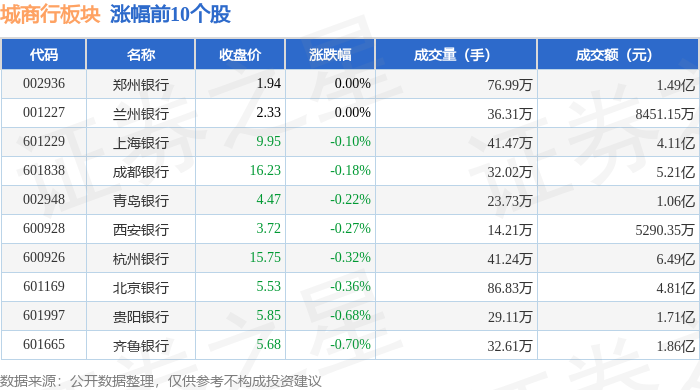
城商行板块1月8日跌0.89%,重庆银行领跌,主力资金净流入673.97万元
Zheng Xing Xing Ye Ri Bao· 2026-01-08 08:56
Market Overview - The city commercial bank sector experienced a decline of 0.89% on January 8, with Chongqing Bank leading the drop [1] - The Shanghai Composite Index closed at 4082.98, down 0.07%, while the Shenzhen Component Index closed at 13959.48, down 0.51% [1] Individual Stock Performance - Zhengzhou Bank closed at 1.94 with no change, while Lanzhou Bank also remained unchanged at 2.33 [1] - Shanghai Bank closed at 9.95, down 0.10%, and Chengdu Bank closed at 16.23, down 0.18% [1] - Chongqing Bank saw a significant decline of 2.70%, closing at 10.45, with a trading volume of 99,000 shares [2] Trading Volume and Turnover - The trading volume for Zhengzhou Bank was 769,900 shares with a turnover of 149 million yuan, while Lanzhou Bank had a trading volume of 363,100 shares and a turnover of 84.51 million yuan [1] - The highest turnover was recorded for Nanjing Bank at 1.342 billion yuan with a trading volume of 1,217,000 shares [2] Capital Flow Analysis - The city commercial bank sector saw a net inflow of 6.7397 million yuan from institutional investors, while retail investors experienced a net outflow of 70.5351 million yuan [2] - Chengdu Bank had a net inflow of 87.0825 million yuan from institutional investors, but a net outflow of 46.0321 million yuan from retail investors [3] Summary of Capital Flows - Institutional investors showed a positive net flow for several banks, including Hangzhou Bank with 77.8301 million yuan and Qingdao Bank with 8.4480 million yuan [3] - Conversely, Chongqing Bank had a negative net flow of 535,600 yuan from institutional investors, indicating a lack of confidence [3]

小红日报 | 红利板块小幅回调,标普A股红利ETF华宝(562060)标的指数收跌0.6%
Xin Lang Cai Jing· 2026-01-08 01:14
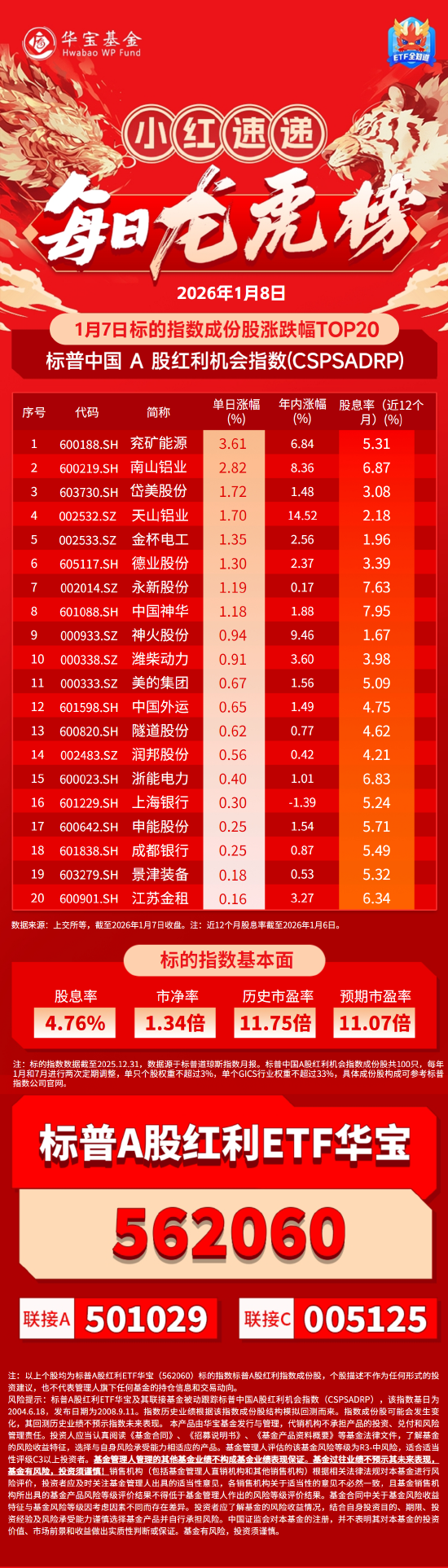
Group 1 - The article presents the top 20 stocks in the S&P China A-Share Dividend Opportunity Index (CSPSADRP) based on their daily and year-to-date performance as of January 7, 2026 [1][5] - The top performer is Tuke Mining (600188.SH) with a daily increase of 3.61% and a year-to-date increase of 6.84%, along with a dividend yield of 5.31% [1][5] - Nanshan Aluminum (600219.SH) ranks second with a daily increase of 2.82% and a year-to-date increase of 8.36%, offering a dividend yield of 6.87% [1][5] Group 2 - Other notable stocks include Daimay Co. (603730.SH) with a daily increase of 1.72% and a year-to-date increase of 1.48%, and Tianshan Aluminum (002532.SZ) with a daily increase of 1.70% and a year-to-date increase of 14.52% [1][5] - The list also features companies like Midea Group (000333.SZ) and China Shenhua (601088.SH), which have year-to-date increases of 1.56% and 1.88%, respectively, with dividend yields of 5.09% and 7.95% [1][5] - The data is sourced from the Shanghai Stock Exchange and reflects the closing prices as of January 7, 2026, with dividend yields calculated up to January 6, 2026 [1][5]





按揭、信用卡、消费贷与经营贷深度:深度银行四大零售资产的风险分析框架
ZHONGTAI SECURITIES· 2026-01-07 11:17
Investment Rating - The report maintains an "Overweight" rating for the banking sector [2] Core Insights - The four categories of retail loans (mortgages, credit cards, consumer loans, and business loans) collectively constitute household liabilities, each with distinct collateral types, duration structures, and policy influences. The report aims to establish a risk framework for these retail assets and assess their impact on banking operations in the future [2][4] - Under stress testing, the non-performing loan (NPL) ratios for mortgages, credit cards, and consumer loans are projected to increase by 11, 12, and 20 basis points respectively in 2026, while the growth in non-performing amounts remains manageable. The overall quality of corporate assets is expected to continue improving, indicating a stable banking sector [2][4] - Retail asset risks are deemed controllable, with policies expected to maintain stability in the near term [2] Summary by Sections Retail Asset Analysis Framework: Collateral Types + Duration Structure + Policy Impact - The overall NPL ratio for retail loans of listed banks is estimated at 1.27% in the first half of 2025, slightly above the corporate NPL ratio of 1.26%, but the increase in NPL ratios is stabilizing. The composition of existing NPLs is 63% corporate and 37% retail, with business loans and mortgages showing higher proportions of both existing and newly added NPLs [2][12] - The report establishes a risk analysis framework for retail assets, highlighting the differences in collateral types, duration structures, and policy impacts among the four categories of retail loans [2][4] Consumer Loans: "High-Risk" Assets - The relationship between consumer loans and consumption trends is closely aligned, with notable deviations occurring during strict property purchase restrictions and regulatory cycles for online loans. The market structure for consumer credit (excluding credit cards and mortgages) shows that listed banks hold over 51.5% of the market, while non-listed banks account for 17% and other players for 31% [2][4] - The risk logic for consumer credit indicates that risk pricing is primarily determined by interest rates, which can be categorized into four tiers based on risk levels. The report estimates that 4.4% of consumer loans fall into the "high-risk" category, with commercial banks' high-risk consumer loans representing only 0.6% of their total consumer loans [2][4] Mortgage Loans: Risk Sources and International Comparisons - The primary sources of mortgage risk include negative cash flow and high loan-to-value (LTV) ratios, with 1.2% of respondents reporting monthly incomes below their mortgage payments. The report anticipates that the current high LTV portion, which constitutes 2.9% of total mortgage balances, will not necessarily lead to increased NPLs [2][4] - International comparisons indicate that mortgage NPL ratios in most countries remain below 2%, suggesting that the risks in the domestic market are manageable [2][4] Business Loans: High-Risk Assets - The report estimates that approximately 2 trillion yuan of high-risk business loans were outstanding at the end of 2021, with nearly one-third of these high-risk assets already exposed. The peak of risk exposure is expected in 2024 and the first half of 2025, with NPL ratios projected to rise by 18 basis points to 1.96% under stress testing conditions [2][4] Credit Cards: Early NPL Exposure - Credit cards have historically shown early exposure to NPLs, with the NPL ratio at 2.44% in the first half of 2025. The report notes that the net increase in credit card NPLs has significantly decreased, indicating that credit cards are not currently a major pressure point for banks [2][4] Investment Recommendations - The report suggests two main investment lines for bank stocks: focusing on regional banks with strong certainty and advantages, particularly in areas like Jiangsu, Shanghai, Chengdu, Shandong, and Fujian, and recommending large banks with high dividend yields such as Agricultural Bank, Construction Bank, and Industrial and Commercial Bank [2][4]





城商行板块1月7日涨0%,杭州银行领涨,主力资金净流出1.7亿元
Zheng Xing Xing Ye Ri Bao· 2026-01-07 08:58
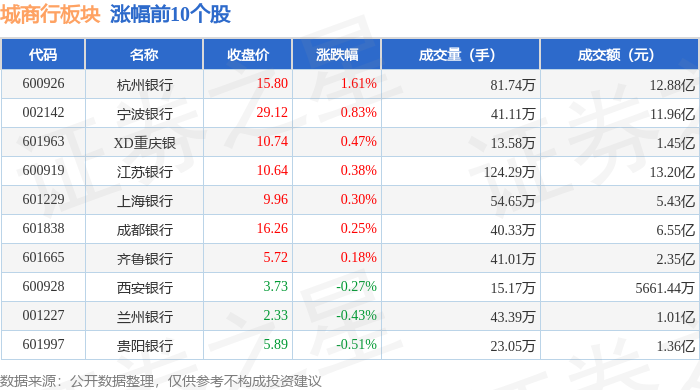
Market Performance - The city commercial bank sector experienced a slight increase of 0.0% on January 7, with Hangzhou Bank leading the gains [1] - The Shanghai Composite Index closed at 4085.77, up 0.05%, while the Shenzhen Component Index closed at 14030.56, up 0.06% [1] Individual Stock Performance - Hangzhou Bank (600926) closed at 15.80, with a rise of 1.61% and a trading volume of 817,400 shares [1] - Ningbo Bank (002142) closed at 29.12, up 0.83%, with a trading volume of 411,100 shares [1] - Other notable performances include Jiangsu Bank (601963) at 10.64 (+0.38%) and Shanghai Bank (601229) at 9.96 (+0.30%) [1] Capital Flow Analysis - The city commercial bank sector saw a net outflow of 170 million yuan from institutional investors, while retail investors contributed a net inflow of 188 million yuan [2] - The overall capital flow indicates a mixed sentiment, with institutional investors withdrawing funds while retail investors increased their positions [2] Detailed Capital Flow by Bank - Jiangsu Bank had a net inflow of 123 million yuan from institutional investors, while retail investors saw a net outflow of 27 million yuan [3] - Hangzhou Bank experienced a net inflow of 84 million yuan from institutional investors, but retail investors had a significant outflow of 132 million yuan [3] - Chengdu Bank recorded a net inflow of 55 million yuan from institutional investors, with retail investors also experiencing a net outflow [3]


上海银行:公司遵循监管导向,聚焦主责主业
Zheng Quan Ri Bao Zhi Sheng· 2026-01-06 11:41
(编辑 丛可心) 证券日报网讯 1月6日,上海银行在互动平台回答投资者提问时表示,公司遵循监管导向,聚焦主责主 业,不断提升核心竞争力和内在价值,着力深化高质量发展,同时把握资本市场机遇,积极加强与股 东、投资者和资本市场的交流,促进投资价值传递。 ...
城农商行2025年收罚单超千张、罚没金额8.75亿元,信贷与反洗钱成违规“重灾区”
Xin Lang Cai Jing· 2026-01-06 11:17
Core Viewpoint - In 2025, a total of 6,521 fines were issued to 1,097 banking institutions in China, with a total penalty amount of 2.641 billion yuan, indicating a continued trend of stricter regulatory oversight in the financial sector [2][12]. Group 1: Penalty Statistics - Agricultural commercial banks received the highest number of fines, totaling 738, with Shenzhen Rural Commercial Bank receiving the largest fine among them [2][12]. - City commercial banks were issued 276 fines, with Shanghai Bank leading in the amount of fines [2][12]. - The total number of fines for both agricultural and city commercial banks accounted for 15.55% of the total fines, amounting to 875 million yuan [2][12]. Group 2: Reasons for Penalties - The top three reasons for penalties included violations in credit business (1,209 fines), inadequate internal control systems (752 fines), and violations of anti-money laundering regulations (697 fines) [2][12]. - Other reasons for penalties included violations in payment settlement, data reporting and governance, and inadequate employee behavior management [2][12]. Group 3: Major Fines in City Commercial Banks - Among 80 city commercial banks, Shanghai Bank, Beijing Bank, and Chongqing Three Gorges Bank had the highest penalty amounts, with fines of 37.31 million yuan, 35.40 million yuan, and 14.49 million yuan respectively [3][13]. - Shanghai Bank was penalized for multiple violations, including account management and anti-money laundering regulations, resulting in a total fine of 28.748 million yuan [4][14]. - Beijing Bank faced penalties for similar violations, with a total fine of 25.2685 million yuan [5][15]. Group 4: Major Fines in Agricultural Commercial Banks - In the agricultural commercial bank sector, Shenzhen Rural Commercial Bank, Chongqing Rural Commercial Bank, and Beijing Rural Commercial Bank received the largest fines, amounting to 12.84 million yuan, 11.65 million yuan, and 10.87 million yuan respectively [6][16]. - Shenzhen Rural Commercial Bank was fined for failing to comply with customer identity verification regulations and other violations, leading to a fine of 12.844 million yuan [7][17]. - Other banks, such as Foshan Rural Commercial Bank, also faced significant penalties for various violations, with fines reaching up to 8.8 million yuan [8][18]. Group 5: Regulatory Implications - The increasing number of fines highlights the need for city and agricultural commercial banks to strengthen internal management and compliance awareness to avoid future violations [9][19]. - Regulatory authorities are demonstrating a firm commitment to enhancing financial safety through stringent oversight [9][19].
上海银行(601229) - 上海银行关于可转债转股结果暨股份变动公告
2026-01-05 10:47
上海银行股份有限公司 关于可转债转股结果暨股份变动公告 上海银行股份有限公司(以下简称"公司")董事会及全体董事保证本公告 内容不存在任何虚假记载、误导性陈述或者重大遗漏,并对其内容的真实性、准 确性和完整性承担法律责任。 证券代码:601229 证券简称:上海银行 公告编号:临 2026-001 可转债代码:113042 可转债简称:上银转债 经中国证券监督管理委员会《关于核准上海银行股份有限公司公开发行可转 换公司债券的批复》(证监许可〔2020〕3172 号)核准,公司于 2021 年 1 月 25 日公开发行了 20,000 万张可转换公司债券(以下简称"可转债"),每张面值 人民币 100 元,按面值发行,发行总额人民币 200 亿元,期限 6 年。 经上海证券交易所自律监管决定书〔2021〕52 号文同意,公司人民币 200 亿元可转债于 2021 年 2 月 10 日起在上海证券交易所挂牌交易,债券简称"上银 转债",债券代码"113042"。 根据有关规定和《上海银行股份有限公司公开发行 A 股可转换公司债券募集 说明书》的约定,上银转债自 2021 年 7 月 29 日起可转换为公司 A 股 ...
城商行板块1月5日涨0.26%,杭州银行领涨,主力资金净流入3.8亿元
Zheng Xing Xing Ye Ri Bao· 2026-01-05 09:09
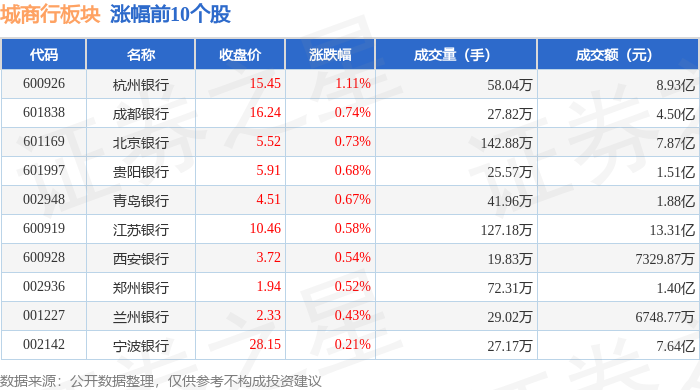
Market Overview - The city commercial bank sector increased by 0.26% on January 5, with Hangzhou Bank leading the gains [1] - The Shanghai Composite Index closed at 4023.42, up by 1.38%, while the Shenzhen Component Index closed at 13828.63, up by 2.24% [1] Individual Bank Performance - Hangzhou Bank (600926) closed at 15.45, with a rise of 1.11% and a trading volume of 580,400 shares, amounting to a transaction value of 893 million yuan [1] - Chengdu Bank (601838) closed at 16.24, up by 0.74%, with a trading volume of 278,200 shares and a transaction value of 450 million yuan [1] - Beijing Bank (601169) closed at 5.52, increasing by 0.73%, with a trading volume of 1,428,800 shares and a transaction value of 787 million yuan [1] - Guizhou Bank (601997) closed at 5.91, up by 0.68%, with a trading volume of 255,700 shares and a transaction value of 151 million yuan [1] - Qindao Bank (002948) closed at 4.51, increasing by 0.67%, with a trading volume of 419,600 shares and a transaction value of 188 million yuan [1] - Jiangsu Bank (616009) closed at 10.46, up by 0.58%, with a trading volume of 1,271,800 shares and a transaction value of 1.331 billion yuan [1] - Xian Bank (600928) closed at 3.72, increasing by 0.54%, with a trading volume of 198,300 shares and a transaction value of 73.3 million yuan [1] - Zhengzhou Bank (002936) closed at 1.94, up by 0.52%, with a trading volume of 723,100 shares and a transaction value of 140 million yuan [1] - Lanzhou Bank (001227) closed at 2.33, increasing by 0.43%, with a trading volume of 290,200 shares and a transaction value of 67.5 million yuan [1] - Ningbo Bank (002142) closed at 28.15, up by 0.21%, with a trading volume of 271,700 shares and a transaction value of 764 million yuan [1] Capital Flow Analysis - The city commercial bank sector saw a net inflow of 380 million yuan from main funds, while retail funds experienced a net outflow of 134 million yuan [2] - The main funds' net inflow and outflow for individual banks include: - Jiangsu Bank (600919) had a net inflow of 10.4 million yuan, with a 7.78% share of main funds [3] - Shanghai Bank (601229) had a net inflow of 87.04 million yuan, with a 13.64% share of main funds [3] - Hangzhou Bank (600926) had a net inflow of 79.04 million yuan, with an 8.86% share of main funds [3] - Nanjing Bank (600000) had a net inflow of 67.86 million yuan, with a 9.68% share of main funds [3] - Ningbo Bank (002142) had a net inflow of 58.14 million yuan, with a 7.61% share of main funds [3] - Qilu Bank (601665) had a net inflow of 57.72 million yuan, with a 14.60% share of main funds [3] - Qingdao Bank (002948) had a net inflow of 22.18 million yuan, with an 11.82% share of main funds [3] - Suzhou Bank (002966) had a net inflow of 6.29 million yuan, with a 2.71% share of main funds [3] - Xiamen Bank (601187) had a net inflow of 520,450 yuan, with a 5.25% share of main funds [3] - Xian Bank (600928) had a net inflow of 287,550 yuan, with a 3.92% share of main funds [3]

#8家银行APP仅1家展示持有收益率#上热搜 网友:冲着高收益率买理财,结果实际收益差一大截
Xin Lang Cai Jing· 2026-01-05 05:28
1月5日金融一线消息,#8家银行APP仅1家展示持有收益率#这一话题冲上热搜,引起网友热议。 1月5日金融一线消息,#8家银行APP仅1家展示持有收益率#这一话题冲上热搜,引起网友热议。 据媒体报道,近日,有记者实测了8家主要银行APP,了解其在客户持仓业绩展示上的具体情况。包括 工商银行、建设银行、招商银行、兴业银行、民生银行、微众银行、网商银行、上海银行。 实测发现,目前手机银行App的产品页面展示的一般为不同时间维度下的年化收益率,如成立以来、近 一年、近一月、近三月等。"哪个高展示哪个",也一度是行业最为常见的营销手段。 8家受测银行APP中,仅一家银行在持仓业绩展示中体现持有年化收益率这一数据,理财客户能够更为 直观地通过这一数据对比自己持仓产品详情页展示的过往收益与自己购买后的持仓收益。 对此,有网友表示:冲着高收益率买理财,结果实际收益差一大截。 还有网友表示:收益率藏着不少猫腻,普通投资者太难甄别了。 责任编辑:李琳琳 据媒体报道,近日,有记者实测了8家主要银行APP,了解其在客户持仓业绩展示上的具体情况。包括 工商银行、建设银行、招商银行、兴业银行、民生银行、微众银行、网商银行、上海银行。 ...


