Bank Of Shanghai(601229)

Search documents
A股低开高走,三大股指收涨:黄金股再度上涨,两市成交近2.9万亿元
Xin Lang Cai Jing· 2026-01-27 07:32
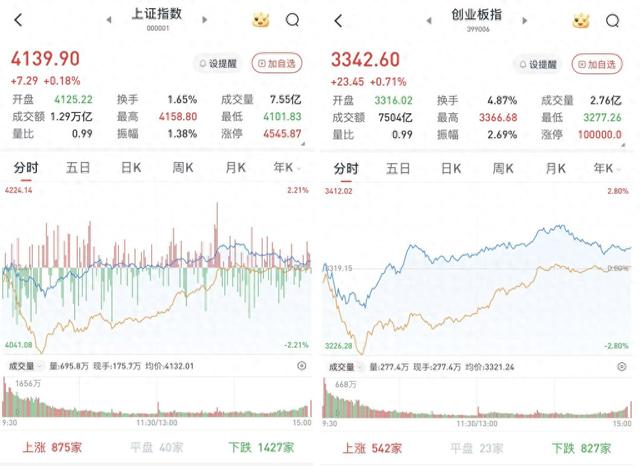
Market Overview - The three major A-share indices opened lower on January 27, with the Shanghai Composite Index closing at 4139.9 points, up 0.18% [2] - The ChiNext Index rose by 0.71% to 3342.6 points, while the Sci-Tech 50 Index increased by 1.51% to 1555.98 points [2] Trading Activity - A total of 1928 stocks rose, while 3450 stocks fell, with 91 stocks remaining flat [3] - The total trading volume was 28.949 billion yuan, a decrease of 3.533 billion yuan from the previous trading day [3] Sector Performance - Semiconductor stocks saw significant gains, with over 20 stocks hitting the daily limit or rising more than 10% [5] - Gold stocks also performed well, with several stocks reaching the daily limit or increasing by over 10% [5] - Coal and basic metal sectors experienced notable declines, with major coal stocks dropping over 4% [6] Market Sentiment and Predictions - Financial analysts suggest that the A-share market may continue to experience fluctuations in the short term due to increased overseas uncertainties and pressure at previous high levels [7] - The current market is viewed as a short-term adjustment risk, with expectations for continued upward movement in the medium term [7] - Long-term perspectives indicate that the current market trend is still in its mid-stage, with potential for a "slow bull" market to continue [8][9] Investment Recommendations - Analysts recommend focusing on sectors such as technology, particularly AI and robotics, as well as industries benefiting from price increases like chemicals and non-ferrous metals [8][9] - Short-term investment opportunities are suggested in power equipment and photovoltaic sectors, which are supported by market demand and policies [10]





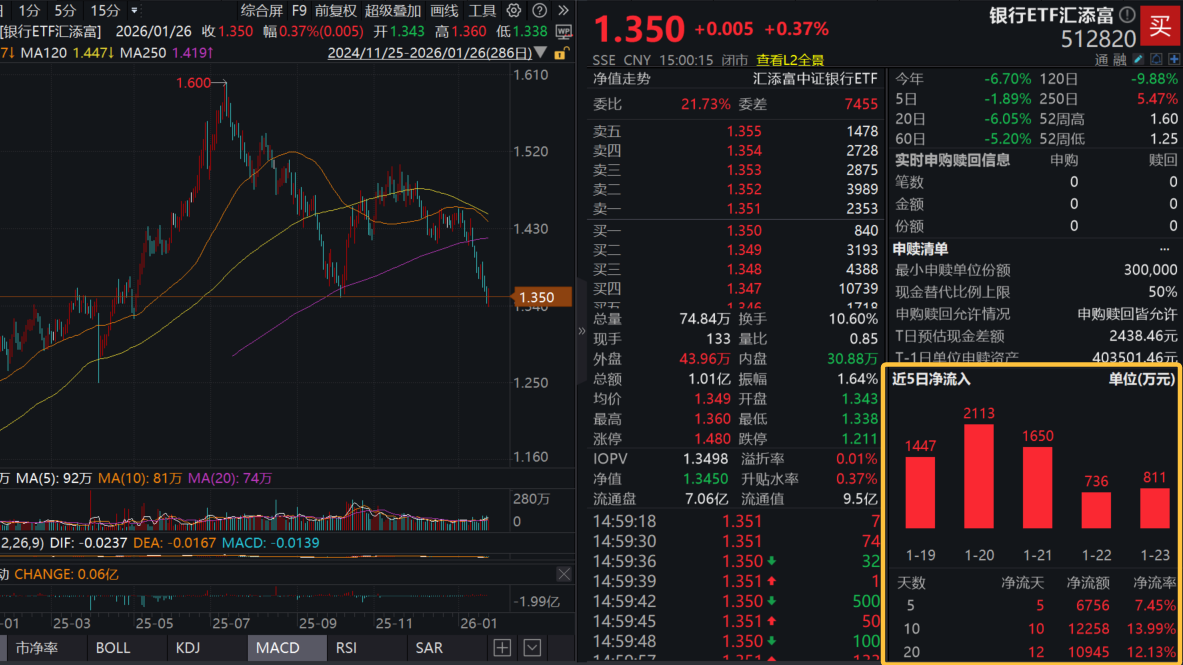
银行股顽强收红!农业银行涨超1%,银行ETF汇添富(512820)连续12日吸金超1.3亿元!板块下探至关键支撑?最新PB至0.65倍
Xin Lang Cai Jing· 2026-01-26 10:06
1月26日,A股市场震荡,顺周期板块强势,截至15:00,银行ETF汇添富(512820)逆势收涨0.37%,终结三连阴,资金持续涌入高股息的银行板块,银行 ETF汇添富(512820)已连续12日吸金超1.3亿元。 | 1分 5分 15分 = | 综合屏 F9 前复权 超级叠加 画线 工具 Q 2 » | 银行ETF汇添 | 1.350 +0.005 +0.37% | 【银行ETF汇添富】2026/01/26 收1.350 幅0.37%(0.005) 开1.343 高1.360 低1.338 四 | 512 | | | | | | | | | | | | | | --- | --- | --- | --- | --- | --- | --- | --- | --- | --- | --- | --- | --- | --- | --- | --- | --- | --- | | 7J MA120 1.447J MA250 1.4191 | 2024/11/25-2026/01/26(286日)▼ | SSE CNY 15:00:15 闭市 查看L2全图 | -1.610 | 交生 | -6.70% 120日 ...



看好交投持续活跃下优质金融股机会
HTSC· 2026-01-26 02:45
Investment Rating - The report maintains an "Overweight" rating for the securities and banking sectors, while also recommending the insurance sector [8]. Core Insights - The market remains active with an average daily trading volume of 28 trillion yuan in A-shares, and the financing balance stabilizing at 2.7 trillion yuan. However, the ETF market has experienced significant volatility, with major outflows from core broad-based ETFs [11][16]. - The sentiment for market bullishness is strong, and the spring rally is expected to continue, particularly in the insurance sector where beta trading opportunities are anticipated [2][26]. - The central bank's governor indicated that there is still room for interest rate cuts, with the latest Loan Prime Rate (LPR) remaining unchanged for eight consecutive months [11][32]. Securities Sector Summary - The report highlights a positive outlook for the securities sector, with several brokerages reporting significant profit growth for 2025. The recommendation includes top brokerages such as CITIC Securities, Guotai Junan, and GF Securities [2][12]. - The average daily trading volume in the A-share market is noted at 28 trillion yuan, with a stable financing balance, indicating a recovery opportunity for the brokerage sector [11][12]. Insurance Sector Summary - The report suggests focusing on quality leading companies in the insurance sector, as the market sentiment remains strong and the spring rally is expected to continue [26][27]. - The insurance sector's fund holdings have increased, with major stocks like Ping An and China Life being highlighted for their significant market presence [27][31]. Banking Sector Summary - The banking sector is characterized by stable performance, with several banks reporting positive earnings forecasts for 2025. The report recommends quality individual stocks such as Nanjing Bank and Chengdu Bank [3][40]. - The central bank's comments on potential interest rate cuts and the expansion of wealth management products indicate a favorable environment for banks [32][33]. - The report notes a decline in bond allocations within bank wealth management products, with an increase in deposits and funds [37][34].



看好金融股战略配置机会
HTSC· 2026-01-26 02:45
Investment Rating - The report maintains an "Overweight" rating for both the banking and securities sectors [6]. Core Insights - The financial sector shows a strategic allocation opportunity, with increased fund positions in banking, securities, and insurance stocks [1][5]. - The banking sector's fund position has slightly increased, indicating a return of risk appetite among investors [2][13]. - The securities sector is experiencing a recovery in fund positions, driven by market activity and performance expectations [3][5]. - The insurance sector has seen a significant increase in fund positions, with major insurance stocks being favored by investors [4][5]. Summary by Sections Banking Sector - As of Q4 2025, the banking sector's fund position increased by 0.04 percentage points to 1.89%, with large banks and joint-stock banks seeing gains, while city commercial banks experienced a decline [2][13]. - The top three heavy-weighted stocks in the banking sector account for 46.0% of the total fund position, indicating a concentration in holdings [13][27]. - The dividend yield for A/H shares in the banking sector is approximately 4.87%/4.88%, making it attractive compared to the 10-year government bond yield of 1.83% [5]. Securities Sector - The securities sector's fund position rose by 0.10 percentage points to 0.72%, although it remains at a historically low level [3][5]. - Major securities firms like CITIC Securities and Guotai Junan have been favored for their performance potential amidst market recovery [5][8]. - The average price-to-book ratio for large and small securities firms is 1.44x and 1.67x, respectively, indicating they are trading at 27% and 42% of their historical averages [5]. Insurance Sector - The insurance sector's fund position increased by 0.94 percentage points to 1.72%, with major stocks like Ping An and China Pacific receiving significant increases in holdings [4][5]. - The insurance index's price-to-book ratio is at 1.53x, which is at the 40th percentile of valuations since 2014, suggesting potential for valuation recovery [4][5]. - Strong sales performance in life insurance is noted, with a focus on high-elasticity stocks as key investment opportunities [4].




金融行业周报(2026、01、25):业绩比较基准新规正式落地,坚定保险中长期向好逻辑-20260125
Western Securities· 2026-01-25 10:30
Investment Rating - The report maintains a positive long-term outlook for the insurance sector, indicating a strong continuity in market performance despite recent fluctuations [2][12][16]. Core Insights - The financial sector experienced a mixed performance this week, with the non-bank financial index down by 1.45%, underperforming the CSI 300 index by 0.83 percentage points. The insurance sector saw a decline of 4.02%, while the brokerage sector decreased by 0.61% [1][10]. - The insurance sector's performance is driven by two main factors: policy support leading to economic recovery and liquidity easing combined with a strong stock market. The report suggests a shift from liquidity-driven growth to a focus on macro policy support and economic recovery expectations [2][13][16]. - The brokerage sector is expected to benefit from new regulations that enhance investment management quality, with a recommendation to focus on larger, undervalued firms and those involved in mergers and acquisitions [3][18]. - The banking sector is facing a slight decline, but there are signs of recovery in profitability for leading banks, with recommendations to focus on banks with high dividend yields and those expected to benefit from market conditions [19][21]. Summary by Sections Insurance Sector - The insurance sector's recent decline is attributed to short-term market sentiment and liquidity changes, but the long-term outlook remains positive due to strong support from both the liability and asset sides [2][12][16]. - Key recommendations include focusing on companies like China Pacific Insurance, China Ping An, China Life (H), and China Taiping, with a specific recommendation for New China Life [4][16]. Brokerage Sector - The brokerage sector's performance is slightly better than the overall market, with a focus on the new guidelines from the regulatory body that aim to improve fund management quality [3][17]. - Recommended firms include Guotai Junan, Huatai Securities, and others, particularly those with strong merger and acquisition prospects [4][18]. Banking Sector - The banking sector has shown a decline but is expected to stabilize, with recommendations to focus on banks with high earnings elasticity and strong dividend yields [19][21]. - Specific banks to watch include Hangzhou Bank, Ningbo Bank, and others, with a focus on those that have previously been undervalued [4][21].




把握优质银行高性价比买点
HTSC· 2026-01-25 07:45
Investment Rating - The report maintains an "Overweight" rating for the banking sector, indicating an expectation that the sector will outperform the benchmark index [1]. Core Insights - The banking index has declined by 8.4% since December, primarily due to concerns over real estate and interest rate cuts, leading to a valuation drop to 0.65x PB, which is at the 65th percentile over the past five years. Some quality stocks are offering a dividend yield close to 6% for 2025 [2][6]. - Despite the market's concerns, the core revenue trends in the banking sector remain positive. Eight banks, including Nanjing and Ningbo, reported improved revenues and profits for 2025, suggesting a favorable outlook for 2026 as net interest margins stabilize and wealth management income contributes positively [7][9]. - The report emphasizes the importance of focusing on high-quality banks with strong fundamentals and earnings elasticity, such as Ningbo, Nanjing, and Chongqing Rural Commercial Bank, as well as those with excellent dividend yield ratios like Shanghai and Chengdu banks [7][9]. Summary by Sections Investment Recommendations - The report highlights specific banks with investment recommendations: - Chengdu Bank (601838 CH): Buy with a target price of 23.25 [5]. - Chongqing Rural Commercial Bank (3618 HK): Buy with a target price of 8.34 [5]. - Nanjing Bank (601009 CH): Buy with a target price of 14.78 [5]. - Shanghai Bank (601229 CH): Buy with a target price of 12.38 [5]. - Ningbo Bank (002142 CH): Buy with a target price of 35.12 [5]. - Chongqing Rural Commercial Bank (601077 CH): Hold with a target price of 8.29 [5]. Market Dynamics - The report notes that the banking sector's credit issuance has been robust at the start of 2026, with a significant portion of new credit issued in January, indicating a shift in lending patterns. The focus remains on sectors like transportation, energy, and manufacturing [9][10]. - The report anticipates a narrowing of the decline in net interest margins for 2026, driven by the optimization of funding costs and stabilization in new loan pricing. The impact of potential interest rate cuts by the central bank is expected to be limited due to the timing of loan repricing [10][21]. Performance Metrics - The report provides performance metrics for various banks, indicating improvements in revenue and profit growth for several institutions. For instance, Nanjing Bank is projected to achieve a net profit of 219 billion yuan in 2025, with a growth rate of 8.5% [26]. - The report also highlights the asset quality of banks, noting that the average non-performing loan ratio for mortgage loans remains below 1%, indicating manageable risk levels [6][9].

25Q4基金对银行持仓点评:主动基金环比持平,被动基金增持
GUOTAI HAITONG SECURITIES· 2026-01-23 11:10
股票研究 /[Table_Date] 2026.01.23 票 研 究 主动基金环比持平,被动基金增持 [Table_Industry] 商业银行 | [姓名table_Authors] | 电话 | 邮箱 | 登记编号 | | --- | --- | --- | --- | | 马婷婷(分析师) | 021-23185608 | matingting@gtht.com | S0880525100001 | | 陈惠琴(分析师) | 021-38676666 | chenhuiqin@gtht.com | S0880525100003 | 本报告导读: 25Q4 主动基金对银行持仓比例环比持平于 1.9%,被动基金持仓比例环比+1.6pct 至 7.0%,其中宁波银行、兴业银行、中国银行、建设银行等获主动基金增配。 25Q4 基金对银行持仓点评 投资要点: [Table_Summary] 2025 年四季度基金重仓持股情况披露(主动基金包括普通股票型、 偏股混合型、灵活配置型,被动基金包括被动指数型、指数增强型): [Table_Report] 相关报告 商业银行《国有大行投放力度较大,不良压力或 企稳》20 ...

城商行板块1月23日跌1.01%,上海银行领跌,主力资金净流入1.48亿元
Zheng Xing Xing Ye Ri Bao· 2026-01-23 09:04
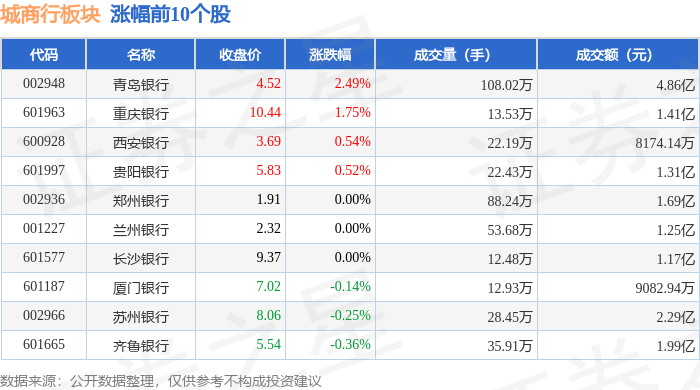
证券之星消息,1月23日城商行板块较上一交易日下跌1.01%,上海银行领跌。当日上证指数报收于 4136.16,上涨0.33%。深证成指报收于14439.66,上涨0.79%。城商行板块个股涨跌见下表: | 代码 | 名称 | 收盘价 | 涨跌幅 | 成交量(手) | 成交额(元) | | --- | --- | --- | --- | --- | --- | | 002948 | 青岛银行 | 4.52 | 2.49% | 108.02万 | 4.86亿 | | 601963 | 重庆银行 | 10.44 | 1.75% | 13.53万 | 1.41亿 | | 600928 | 西安银行 | 3.69 | 0.54% | 22.19万 | 8174.14万 | | 601997 | 豊阳银行 | 5.83 | 0.52% | 22.43万 | 1.31亿 | | 002936 | 郑州银行 | 1.91 | 0.00% | 88.24万 | 1.69亿 | | 001227 | 兰州银行 | 2.32 | 0.00% | 53.68万 | 1.25亿 | | 601577 | 长沙银行 | 9.37 | ...

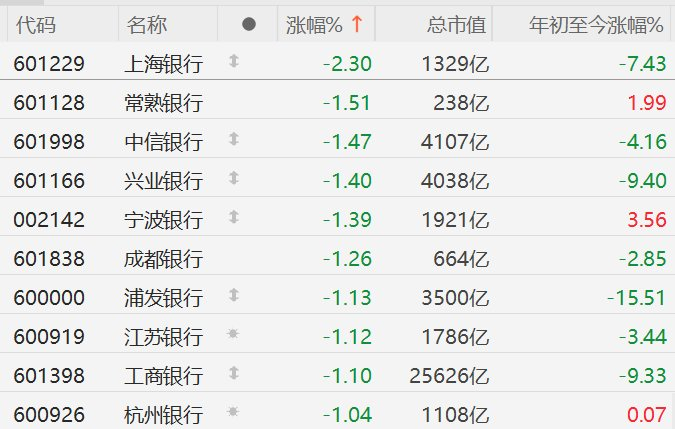
A股银行股普跌
Ge Long Hui A P P· 2026-01-23 07:20
| 代码 | 名称 | | 涨幅%↑ | 总市值 | 年初至今涨幅% | | --- | --- | --- | --- | --- | --- | | 601229 | 上海银行 | 1 | -2.30 | 1329亿 | -7.43 | | 601128 | 常熟銀行 | | -1.51 | 238亿 | 1.99 | | 601998 | 中信銀行 | 1 | -1.47 | 4107亿 | -4.16 | | 601166 | 兴业银行 | 1 | -1.40 | 4038亿 | -9.40 | | 002142 | 宁波银行 | 1 | -1.39 | 1921亿 | 3.56 | | 601838 | 成都银行 | | -1.26 | 664亿 | -2.85 | | 600000 | 浦发银行 | 1 | -1.13 | 3500亿 | -15.51 | | 600919 | 江苏银行 | 兼 | -1.12 | 1786亿 | -3.44 | | 601398 | 工商银行 | 1 | -1.10 | 25626亿 | -9.33 | | 600926 | 杭州银行 | 张 | -1.04 | ...

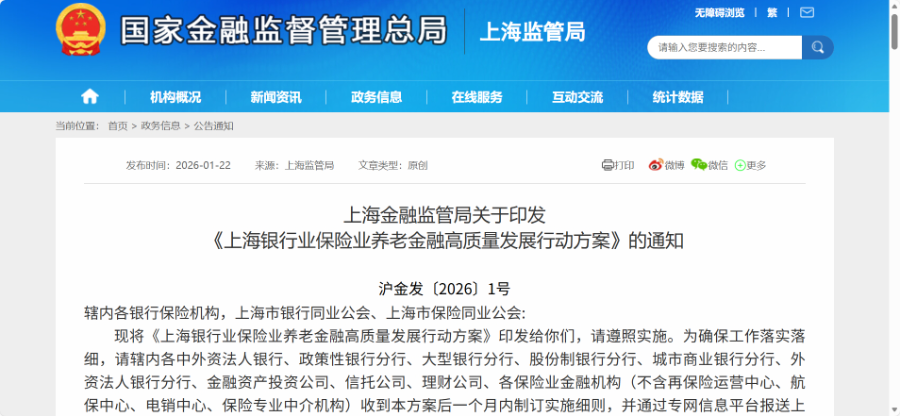
加大企业年金资源投入!上海银行保险业养老金融行动方案出炉
2 1 Shi Ji Jing Ji Bao Dao· 2026-01-22 10:20
Core Viewpoint - The Shanghai Financial Regulatory Bureau has issued the "Action Plan for the High-Quality Development of Pension Finance in the Banking and Insurance Sectors," aiming to establish a comprehensive pension management system and enhance financial services for the elderly population [1][2]. Group 1: Pension System Development - The plan emphasizes the construction of a multi-tiered pension security system, supporting basic pension insurance, enterprise (occupational) annuities, and personal pension accounts [2][3]. - Financial institutions are required to optimize service environments and enhance the safety of pension fund management, while increasing resource allocation for enterprise and occupational annuities [2][3]. Group 2: Financing and Risk Protection for the Elderly Industry - The plan calls for increased financial support for the elderly industry, encouraging banks to innovate credit models and allocate long-term funds effectively [3]. - Insurance institutions are guided to provide stable funding through equity investments and REITs, while trust institutions are encouraged to offer customized services [3]. Group 3: Product Supply and Service Experience - Financial institutions are urged to develop comprehensive pension financial solutions, transitioning from single product offerings to a holistic service ecosystem [3]. - There is a focus on creating a product spectrum that covers all aspects of the elderly's financial lifecycle, including preparation, wealth accumulation, consumption, and risk protection [3]. Group 4: Internal Governance and Regulation - The plan highlights the need for improved internal governance within banking and insurance institutions, promoting the establishment of specialized departments for pension finance [4]. - Regulatory frameworks for pension finance will be refined to ensure compliance and protect the rights of the elderly population [4]. Group 5: Collaborative Mechanisms - A multi-party collaborative mechanism involving government, regulatory bodies, financial institutions, and industry organizations will be established to foster innovation and policy coordination [4]. - The aim is to create a favorable ecosystem for pension finance innovation and enhance Shanghai's role as a leader in this sector [4]. Group 6: Implementation and Future Steps - The Shanghai Financial Regulatory Bureau will guide local banking and insurance institutions to implement the 20 policy measures outlined in the action plan, leveraging financial advantages and technological empowerment [5].