Bank Of Shanghai(601229)

Search documents
大金融、大消费板块联袂逆势上涨
Mei Ri Shang Bao· 2026-02-05 22:56
Market Overview - The A-share market showed weakness, with the Shanghai Composite Index falling over 1% during the day and closing down 0.64% at 4075.92 points, while the Shenzhen Component Index and ChiNext Index dropped 1.44% and 1.55% respectively, with total trading volume around 2.19 trillion yuan, a decrease of over 300 billion yuan from the previous day [1] Financial Sector Performance - The financial sector, particularly banks and brokerages, performed actively in the afternoon, with notable gains in stocks such as Xiamen Bank, Chongqing Bank, and Shanghai Bank [2] - Institutions expect recent fiscal and monetary policies to support banks' performance, with a stable recovery in earnings projected for 2025 [2] - 中邮证券 forecasts that the insurance sector will see over 2 trillion yuan in new market funds by 2026, increasing demand for high-dividend assets [2] Brokerage Sector Insights - The brokerage sector also strengthened, with companies like Huayin Securities hitting the daily limit [3] - Major brokerages reported positive earnings for 2025, with CITIC Securities achieving revenue of 748.3 billion yuan and net profit of 300.51 billion yuan, both showing significant year-on-year growth [3] - Investment institutions believe that the brokerage sector will benefit from China's economic development and capital market reforms, enhancing its long-term investment value [3] Consumer Sector Trends - The consumer sector saw a collective rise, with retail, food and beverage, and tourism sectors performing well, highlighted by stocks like Maoye Commercial and Sanjiang Shopping hitting the daily limit [4] - The Ministry of Finance and other authorities announced a "zero tariff" policy for imported goods purchased by residents in Hainan Free Trade Port, which is expected to boost consumer spending [4] Food and Beverage Industry Analysis - The food and beverage industry is currently at a historical low in valuation, with potential investment opportunities emerging as market conditions improve [5] - The sector is expected to benefit from the application of AI technology, enhancing efficiency in retail operations, with the smart retail market projected to grow to approximately 64.5 billion yuan by 2030, at a compound annual growth rate of 22% [6]




开年险资调研忙 新质生产力受关注
Zhong Guo Zheng Quan Bao· 2026-02-05 22:23
Group 1 - The core viewpoint of the articles highlights the increasing interest of insurance capital in specific sectors and companies, particularly in regional banks and new productivity sectors, as indicated by their extensive research activities [1][2][3] - Since the beginning of 2026, over 300 A-share listed companies have been researched by insurance companies and asset management firms, with significant participation from 96 insurance companies and 32 asset management companies [2] - Key areas of focus for insurance capital include regional banks such as Shanghai Bank and Nanjing Bank, as well as sectors like electronic components, semiconductor materials, and devices [2][3] Group 2 - Insurance capital is increasingly favoring high-dividend stocks as a stable source of cash flow, particularly in a low-interest-rate environment, which drives the demand for equity assets [4] - The strategy of investing in high-dividend stocks is seen as a way to enhance returns and stabilize portfolios, with a focus on long-term holdings and dividend yields [4][5] - The shift towards high-dividend stocks is also a response to new accounting standards that increase profit statement volatility, making these investments more attractive [4] Group 3 - Insurance capital is aligning with the new productivity sector, which relies on technological innovation and strategic emerging industries, requiring long-term and stable capital support [5][6] - Investments are being directed towards technology leaders with clear business models and performance track records, while emerging tech sectors may be approached through industry-themed ETFs or funds to mitigate risks [6] - The focus on AI-driven technology and high-end manufacturing is expected to be central to future technological revolutions, with a commitment to direct investments in companies with strong competitive advantages [6]


风格切换进行时?银行连续走强,厦门银行罕见涨停!机构:历史春节前银行胜率最高
Xin Lang Ji Jin· 2026-02-05 12:36
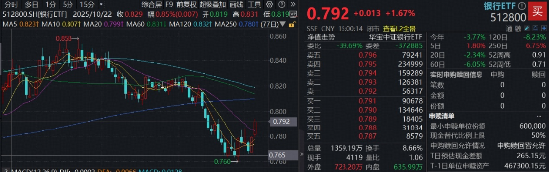
Core Viewpoint - The banking sector continues to show strong performance, with significant gains in individual bank stocks and a notable increase in the banking ETF, indicating a potential market style shift towards large-cap and quality stocks [1][3][5]. Group 1: Market Performance - On February 5, the banking sector saw collective gains, with Xiamen Bank hitting a trading limit and reaching its highest price since June 2021 [1]. - Major banks such as Chongqing Bank and Shanghai Bank also experienced significant increases, with gains of nearly 6% and over 4% respectively [1]. - The largest banking ETF (512800) opened high and further surged, closing up 1.67% with a trading volume of 1.071 billion yuan, reflecting a substantial increase in market activity [1]. Group 2: Fund Flows and Style Shift - There was a rapid influx of main funds into the banking sector, with a net inflow of 5.502 billion yuan, ranking second among all Shenwan first-level industries [3]. - Institutions suggest that the current strength in the banking sector may indicate a style shift in the market, moving from small-cap to large-cap stocks and from thematic to quality investments [3]. - Historical data shows that the banking sector has a high success rate before the Spring Festival, with an 80% win rate for absolute and excess returns over the past decade [3]. Group 3: Financial Performance of Banks - As of the 2025 reporting season, 10 listed banks that have disclosed performance reports achieved positive growth in net profit, with 9 of them reporting both revenue and net profit increases [5]. - Despite a challenging environment characterized by declining interest rates and narrowing interest margins, the banking sector is demonstrating stable growth, providing fundamental support for valuation recovery [5]. - The banking ETF (512800) and its linked funds are effective investment tools tracking the overall performance of the banking sector, with the ETF's latest scale exceeding 12.2 billion yuan and an average daily trading volume of over 800 million yuan since 2025 [5].


尾盘异动!20分钟内,两股直拉涨停!大消费集体爆发
证券时报· 2026-02-05 10:00
A股市场超3700股飘绿,有色板块跌幅居前,白银有色、湖南白银跌停,四川黄金逼近跌停;煤 炭、石油、电力等板块集体走低;光伏产业链股集体下挫,捷佳伟创、迈为股份跌超10%,钧达 股份等跌停;银行板块逆市上扬,厦门银行午后涨停,重庆银行涨近6%;影视股集体走高,幸福 蓝海涨超11%,横店影视、金逸影视涨停;零售板块午后崛起,茂业商业、三江购物尾盘异动, 直线拉升涨停;食品饮料股拉升,海欣食品、安记食品涨停。值得注意的是,民爆光电连续4日 涨停续创历史新高。 A股今日(2月5日)整体疲弱,沪指盘中跌超1%,创业板指一度跌超2%;港股尾盘止跌回升, 恒生指数翻红,恒生科技指数一度涨近1%。 具体来看,两市主要股指盘中弱势下探,沪指一度跌超1%,尾盘跌幅有所收窄。截至收盘,沪指 跌0.64%报4075.92点,深证成指跌1.44%,创业板指跌1.55%,北证50指数跌逾2%,沪深北三市合 计成交约2.19万亿元,较此前一日减少逾3000亿元。 港股方面,百胜中国、东方甄选涨超10%,海底捞涨约4%;紫金矿业跌近5%。 银行板块拉升 银行板块今日逆市拉升,截至收盘,厦门银行涨停,重庆银行涨近6%,上海银行涨逾4%,南京 ...


A股上市银行全线飘红!厦门银行涨停、中小银行领涨
Bei Jing Shang Bao· 2026-02-05 08:40
Core Viewpoint - The A-share banking sector experienced a collective rise, with all 42 stocks showing positive performance, particularly among small and medium-sized banks [1][2] Group 1: Market Performance - The banking sector index rebounded from a low of 6627.36 points on January 29 to close at 6904.39 points, indicating a clear recovery trend [1] - Qingdao Bank led the sector with a 23.88% increase, followed by Ningbo Bank at 15.81%, and several other banks showing gains exceeding 8% [1] Group 2: Factors Driving the Rise - Multiple factors contributed to the rise in bank stocks, including positive earnings forecasts for 2025, stable revenue and net profit growth, and improving asset quality [2] - The banking sector is expected to continue the "early investment, early returns" strategy in 2026, with projected new credit accounting for 62%-65% of the annual total in the first quarter [2] - A shift in market sentiment from growth to value has led to a flow of funds back into undervalued banking stocks, which are seen as defensive investments [2]

银行业绩快报预喜较多,中证银行或筑底企稳
Mei Ri Jing Ji Xin Wen· 2026-02-05 06:56
Core Viewpoint - The banking sector is showing signs of recovery in revenue and profit growth, with several banks reporting high growth rates for 2025, indicating a positive outlook for 2026 driven by policy support and stable net interest margins [1][1][1] Group 1: Market Performance - As of February 5, 2026, the China Securities Banking Index (399986) increased by 1.66%, with notable gains from Xiamen Bank (601187) up 9.99%, Chongqing Bank (601963) up 5.73%, Shanghai Bank (601229) up 4.27%, and Nanjing Bank (601009) up 3.80% [1][1][1] - The Bank ETF Huaxia (515020) rose by 1.63%, with the latest price reported at 1.67 yuan [1][1][1] Group 2: Financial Performance - By the end of January, 10 banks disclosed preliminary performance reports for 2025, showing a recovery in revenue and profit growth [1][1][1] - Qingdao Bank (002948), Nanjing Bank, and Shanghai Pudong Development Bank (600000) maintained high growth rates in net profit and revenue, with annual net profit growth rates of 21.7%, 8.1%, and 10.5% respectively [1][1][1] Group 3: Future Outlook - Dongfang Securities anticipates that the banking sector will return to a fundamental narrative in 2026, supported by policy financial tools and resilient asset expansion [1][1][1] - The sector is still in a deposit repricing cycle, which is expected to stabilize net interest margins, while structural risks are anticipated to receive policy support [1][1][1] - The absolute returns of the banking sector are viewed positively for 2026 [1][1][1] Group 4: ETF Information - The Bank ETF Huaxia (515020) is noted for having the lowest comprehensive fee rate tracking the China Securities Banking Index (399986) [1][1][1] - The linked funds include Class A (008298), Class C (008299), and Class D (024642) [1][1][1]

银行股,全线飘红
第一财经· 2026-02-05 05:41
Core Viewpoint - The banking sector experienced significant gains on February 5, with multiple banks reaching new highs and notable percentage increases in their stock prices [1]. Group 1: Stock Performance - Xiamen Bank's stock price reached 7.93, marking a 9.99% increase, the highest since June 2021 [2]. - Chongqing Bank's stock rose to 11.00, reflecting a 6.80% increase [2]. - Shanghai Bank and Nanjing Bank saw increases of over 4%, with prices at 9.78 and 11.23 respectively [2]. - Other banks such as Yuzhong Rural Commercial Bank and Ningbo Bank also experienced gains, with increases of 3.62% and 3.25% respectively [2].

A股银行股涨幅进一步扩大:厦门银行涨停,重庆银行涨超7%
Ge Long Hui A P P· 2026-02-05 05:35
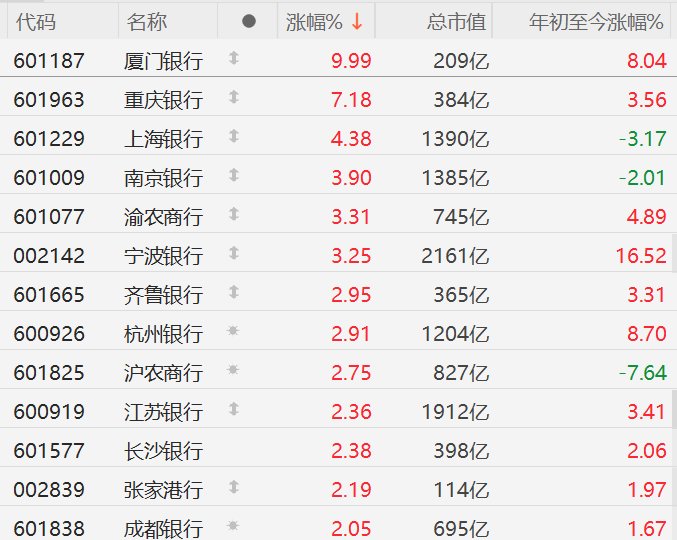
Core Viewpoint - The A-share market has seen significant gains in bank stocks, with notable increases in share prices for several banks, indicating positive market sentiment towards the banking sector [1]. Group 1: Stock Performance - Xiamen Bank experienced a maximum increase of 9.99%, reaching a total market capitalization of 20.9 billion [2]. - Chongqing Bank rose by 7.18%, with a market value of 38.4 billion [2]. - Shanghai Bank's shares increased by 4.38%, bringing its market capitalization to 139 billion [2]. - Nanjing Bank saw a rise of 3.90%, with a total market value of 138.5 billion [2]. - Yunnan Rural Commercial Bank increased by 3.31%, with a market capitalization of 74.5 billion [2]. - Ningbo Bank's shares rose by 3.25%, reaching a market value of 216.1 billion [2]. - Qilu Bank increased by 2.95%, with a market capitalization of 36.5 billion [2]. - Hangzhou Bank's shares rose by 2.91%, bringing its market value to 120.4 billion [2]. - Jiangsu Bank saw an increase of 2.36%, with a total market capitalization of 191.2 billion [2]. - Changsha Bank's shares rose by 2.38%, with a market value of 39.8 billion [2]. - Zhangjiagang Bank increased by 2.19%, reaching a market capitalization of 1.14 billion [2]. - Chengdu Bank's shares rose by 2.05%, with a total market value of 69.5 billion [2]. Group 2: Year-to-Date Performance - Xiamen Bank has a year-to-date increase of 8.04% [2]. - Chongqing Bank's year-to-date performance is up by 3.56% [2]. - Shanghai Bank has seen a year-to-date decline of 3.17% [2]. - Nanjing Bank's year-to-date performance is down by 2.01% [2]. - Yunnan Rural Commercial Bank has a year-to-date increase of 4.89% [2]. - Ningbo Bank has the highest year-to-date increase at 16.52% [2]. - Qilu Bank's year-to-date performance is up by 3.31% [2]. - Hangzhou Bank has a year-to-date increase of 8.70% [2]. - Jiangsu Bank's year-to-date performance is up by 3.41% [2]. - Changsha Bank has a year-to-date increase of 2.06% [2]. - Zhangjiagang Bank's year-to-date performance is up by 1.97% [2]. - Chengdu Bank has a year-to-date increase of 1.67% [2].
银行股集体爆发!厦门银行暴涨6.38%,多家上市银行透露旺季信贷投放表现优于2025年同期
Jin Rong Jie· 2026-02-05 03:57
城商行:城商行依托区域资源深耕地方市场,在地方经济复苏周期中信贷投放节奏更为灵活,叠加中小 金融机构改革红利释放,优质城商行的资产质量将持续优化,区域业务拓展空间进一步打开,估值修复 动力充足。 消息面上,当前银行(核心股)正处年度营销旺季,多家上市银行透露旺季信贷投放表现优于2025年同 期,对公信贷开门红情况整体向好。同时,近期多家中小银行获批增资扩股,青海贵南农村商业银行、 东营银行等机构完成注册资本调整,部分银行同步推进减资优化,业内认为此举将推动银行业整体资本 结构进一步完善,夯实服务实体经济的资本基础。此外,中小金融机构改革化险持续推进,开年以来已 有25家村镇银行平稳退出,行业减量提质步伐加快,经营质量有望稳步提升。 中国人民银行(核心股)近日召开2026年信贷市场工作会议。会议要求,做好2026年信贷市场工作,不 断加强对重大战略、重点领域和薄弱环节的优质金融服务。建设多层次金融服务体系,着力支持扩大内 需、科技创新、中小微企业等重点领域。 相关行业: 早盘银行(核心股)股逆势爆发,截至午间收盘,银行板块上涨1.55%。领涨股厦门银行涨6.38%,重 庆银行涨超4%,宁波银行、上海银行涨超3% ...
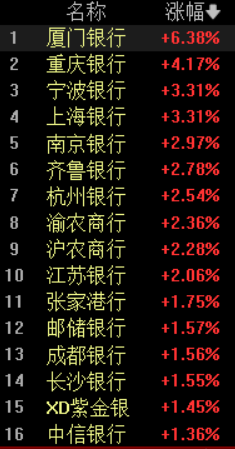
银行股逆势上涨,厦门银行涨超6%,重庆银行涨超4%
Ge Long Hui· 2026-02-05 03:51
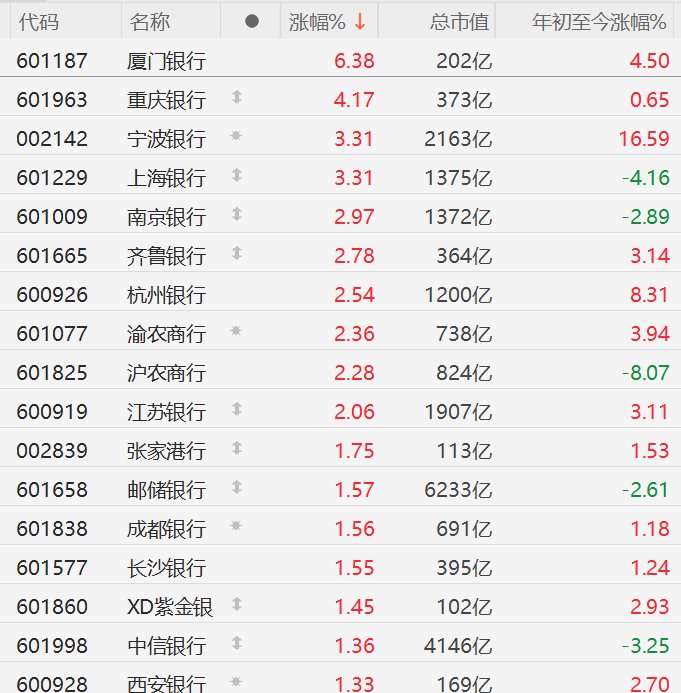
Core Viewpoint - The A-share market for banks showed a contrary upward trend, with several banks experiencing significant gains on February 5, 2023, despite broader market conditions [1]. Group 1: Stock Performance - Xiamen Bank saw an increase of 6.38%, with a total market capitalization of 20.2 billion [2] - Chongqing Bank rose by 4.17%, with a market cap of 37.3 billion [2] - Ningbo Bank increased by 3.31%, with a market value of 216.3 billion [2] - Shanghai Bank also rose by 3.31%, with a market cap of 137.5 billion [2] - Nanjing Bank increased by 2.97%, with a market capitalization of 137.2 billion [2] - Qilu Bank rose by 2.78%, with a market cap of 36.4 billion [2] - Hangzhou Bank increased by 2.54%, with a market value of 120 billion [2] - Yuhuang Agricultural Commercial Bank rose by 2.36%, with a market cap of 73.8 billion [2] - Shanghai Rural Commercial Bank increased by 2.28%, with a market value of 82.4 billion [2] - Jiangsu Bank rose by 2.06%, with a market cap of 190.7 billion [2] Group 2: Year-to-Date Performance - Ningbo Bank has the highest year-to-date increase at 16.59% [2] - Xiamen Bank has a year-to-date increase of 4.50% [2] - Qilu Bank shows a year-to-date increase of 3.14% [2] - Hangzhou Bank has a year-to-date increase of 8.31% [2] - Jiangsu Bank shows a year-to-date increase of 3.11% [2]