
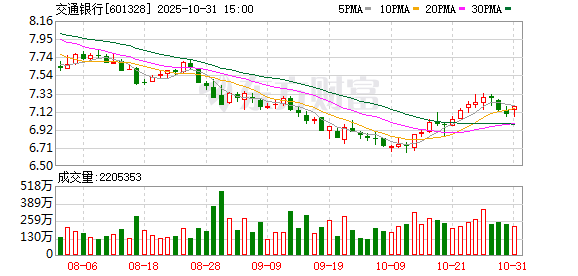
BANK COMM(601328)

Search documents
六大行三季报业绩:工行挣得最多,农行增速最快,建行派息最高
2 1 Shi Ji Jing Ji Bao Dao· 2025-10-31 15:22
Core Insights - The six major state-owned banks in China reported double growth in revenue and net profit for the first three quarters of the year, achieving a total profit of 1.07 trillion yuan [2] - China Bank had the fastest revenue growth, while Industrial and Agricultural Banks led in total net profit and year-on-year growth [2] - The net interest margin showed a downward trend across all banks, indicating a potential challenge in profitability [3] Revenue Summary - The revenue figures for the six banks are as follows: Industrial Bank 640.03 billion yuan, Agricultural Bank 550.88 billion yuan, Construction Bank 573.70 billion yuan, China Bank 491.20 billion yuan, Postal Savings Bank 265.08 billion yuan, and Transportation Bank 199.65 billion yuan, with year-on-year growth rates of 2.17%, 1.97%, 0.82%, 2.69%, 1.82%, and 1.80% respectively [2] Net Profit Summary - The net profit figures for the banks are: Industrial Bank 269.91 billion yuan, Agricultural Bank 220.86 billion yuan, Construction Bank 257.36 billion yuan, China Bank 177.66 billion yuan, Postal Savings Bank 76.56 billion yuan, and Transportation Bank 69.99 billion yuan, with year-on-year growth rates of 0.33%, 3.03%, 0.62%, 1.08%, 0.98%, and 1.90% respectively [2] Asset Quality - The non-performing loan ratios for the banks as of September 30 are: Industrial Bank 1.33%, Agricultural Bank 1.27%, Construction Bank 1.32%, China Bank 1.24%, Postal Savings Bank 0.94%, and Transportation Bank 1.26%, all showing improvement compared to the end of the previous year [3] Dividend Distribution - The proposed dividend distributions per 10 shares are: Industrial Bank 1.414 yuan, Agricultural Bank 1.195 yuan, Construction Bank 1.858 yuan, China Bank 1.094 yuan, Postal Savings Bank 1.230 yuan, and Transportation Bank 1.563 yuan, totaling 204.66 billion yuan, with Construction Bank having the highest payout [3] Market Performance - The stock prices of the four major banks have seen varying degrees of increase this year, with Agricultural Bank up 57.72%, Industrial Bank 18.05%, Construction Bank 10.06%, and China Bank 7.12%, leading to Agricultural Bank ranking second in global bank market capitalization [3] Analyst Outlook - Morgan Stanley's report suggests that profits for major Chinese banks are expected to remain stable, with dividend yields around 6%-7%, indicating that large state-owned banks are considered safe investment choices [4]




聚力价值创造,经营稳中向好——交通银行发布2025年三季度业绩
Sou Hu Cai Jing· 2025-10-31 12:28
Core Viewpoint - The Bank of Communications reported a stable and positive operational performance for the third quarter of 2025, with total assets reaching 15.50 trillion yuan, a year-on-year increase of 4.02% [1] Group 1: Financial Performance - The bank achieved a net operating income of 200.06 billion yuan, a year-on-year growth of 1.86%, with net interest income and net commission income increasing by 1.46% and 0.15% respectively [2] - The net profit attributable to shareholders reached 69.99 billion yuan, reflecting a year-on-year increase of 1.90%, with growth rates for net revenue and net profit improving by 1.14% and 0.29% compared to the first half of the year [2] Group 2: Support for the Real Economy - The bank focused on enhancing financial services for the real economy, with customer loan balances reaching 9.07 trillion yuan, a year-on-year increase of 6.04%, adding 31.2 billion yuan compared to the previous year [3] - The bank's green loan balance grew by 6.72%, while green bond investments surged by 52.35% year-on-year [3] - Inclusive finance loans increased by 18.29%, and loans for the pension industry rose by 41.75% [3] Group 3: Digital Transformation - The bank is accelerating its digital transformation, enhancing digital infrastructure and security, with monthly active users for its mobile banking and payment apps reaching 53.06 million and 25.93 million respectively [5] - The bank has opened 7,039 open banking interfaces, with a total of 10.5 billion calls made [5] Group 4: Risk Management - The bank maintained a non-performing loan ratio of 1.26%, a decrease of 0.05 percentage points from the previous year, while the provision coverage ratio increased to 209.97%, up by 8.03 percentage points [6] - The bank disposed of non-performing loans amounting to 55.74 billion yuan, a year-on-year increase of 28.12% [6]
六大行前三季度赚了多少钱?
Jin Shi Shu Ju· 2025-10-31 11:34
Core Insights - The six major state-owned banks in China reported a total operating income of approximately 2.73 trillion yuan for the first three quarters of 2025, reflecting a year-on-year growth of 1.87% [3] - The net profit attributable to shareholders reached about 1.72 trillion yuan, with a year-on-year increase of 1.22% [3] - All six banks achieved positive year-on-year growth in both revenue and net profit, with significant contributions from the third quarter [4] Revenue and Profit Performance - The revenue growth rates for Bank of China and Industrial and Commercial Bank of China were 2.69% and 2.17%, respectively, while Agricultural Bank of China led in net profit growth at 3.03% [3] - Absolute profit figures for the banks included approximately 269.9 billion yuan for ICBC, 257.4 billion yuan for CCB, and 220.9 billion yuan for ABC [3] Interest Income and Net Interest Margin - Interest income continued to decline, with only the Bank of Communications showing a year-on-year increase of 1.46% in net interest income [6] - The net interest margin for most banks decreased, but the rate of decline has narrowed compared to earlier in the year, with declines ranging from 0.01 to 0.04 percentage points per quarter [6] Asset Growth and Quality - Total assets of the six banks approached 218 trillion yuan, with a growth of approximately 1.85% since mid-year [3] - The non-performing loan ratio improved for five banks compared to the end of last year, while one bank saw a slight increase [7] Market Capitalization - As of October 30, Agricultural Bank of China had a market capitalization of 2.74 trillion yuan, leading among the banks, while ICBC's market cap was 2.59 trillion yuan [8]

交通银行:业务总监(公司与机构业务)唐朔任职资格获批
Bei Jing Shang Bao· 2025-10-31 11:15
Core Points - The announcement from Bank of Communications indicates that Tang Shuo has been approved by the National Financial Regulatory Administration to serve as the bank's business director for corporate and institutional business [1] Summary by Category Company - Bank of Communications has received official approval for Tang Shuo's appointment as the business director for corporate and institutional business [1] Regulatory Approval - The approval was granted by the National Financial Regulatory Administration, confirming Tang Shuo's qualifications for the role [1]
交通银行:关于高管任职资格获监管机构核准的公告
Zheng Quan Ri Bao· 2025-10-31 11:13
Core Points - The announcement from Bank of Communications states that it has received approval from the National Financial Supervision Administration regarding the appointment of Mr. Tang Shuo as the business director for corporate and institutional business [2] Group 1 - Bank of Communications has officially announced the approval of Mr. Tang Shuo's qualifications as the business director for corporate and institutional business [2]
交通银行深耕 “五篇大文章” 赋能首都新质生产力发展
Zhong Guo Jin Rong Xin Xi Wang· 2025-10-31 10:06
Group 1 - The core focus of the Bank of Communications is on advanced manufacturing and enterprises related to new productivity, utilizing technology finance and cultural finance as key strategies [1] - In the technology finance sector, the bank has launched the "Jiaoyin Torch Loan" product in collaboration with the Ministry of Industry and Information Technology, addressing the full lifecycle financing needs of technology enterprises, with its 2.0 version released at the Financial Street Forum [1] - The bank has established a cultural finance center in Beijing, leading related service efforts and launching dedicated cultural finance brands and products at the Financial Street Forum, aiming to reduce financing costs for Beijing enterprises and promote deep integration of the "Five Major Articles" with the real economy [1]
交通银行(03328) - 海外监管公告
2025-10-31 10:02
香港交易及結算所有限公司及香港聯合交易所有限公司對本公告之內容概不負責,對其準確性 或完整性亦不發表任何聲明,並明確表示,概不就因本公告全部或任何部分內容而產生或因倚 賴該等內容而引致之任何損失承擔任何責任。 (於中華人民共和國註冊成立的股份有限公司) (股份代號:03328) 海外監管公告 本公告乃根據香港聯合交易所有限公司證券上市規則第13.10B條而作出。 公司秘書 中國上海 2025年10月31日 於本公告發佈之日,本行董事為任德奇先生、張寶江先生、殷久勇先生、 周萬阜先生、常保升先生*、廖宜建先生*、陳紹宗先生*、穆國新先生*、 艾棟先生*、石磊先生 # 、張向東先生 # 、李曉慧女士 # 、馬駿先生 # 、王天澤先生 # 及 肖偉先生 # 。 * 非執行董事 # 獨立非執行董事 股票代码:601328 股票简称:交通银行 编号:临 2025-070 交通银行股份有限公司 关于高管任职资格获监管机构核准的公告 茲載列交通銀行股份有限公司於上海證券交易所網站刊登的《交通銀行股份有限 公司關於高管任職資格獲監管機構核准的公告》,謹供參閱。 承董事會命 交通銀行股份有限公司 何兆斌 唐朔先生的简历,详见本 ...
交通银行(601328) - 交通银行关于高管任职资格获监管机构核准的公告
2025-10-31 09:13
特此公告 交通银行股份有限公司 关于高管任职资格获监管机构核准的公告 股票代码:601328 股票简称:交通银行 编号:临 2025-070 交通银行股份有限公司(以下简称"交通银行"或"本行")董事会及全体董事保证本 公告内容不存在任何虚假记载、误导性陈述或者重大遗漏,并对其内容的真实性、准确性和 完整性承担法律责任。 本行今日收到《国家金融监督管理总局关于唐朔交通银行业务总监(公司与 机构业务)任职资格的批复》(金复〔2025〕618 号),唐朔先生任本行业务总监 (公司与机构业务)的任职资格获国家金融监督管理总局核准生效。 唐朔先生的简历,详见本行于 2025 年 8 月 29 日在上海证券交易所网站 (www.sse.com.cn)发布的《交通银行股份有限公司第十届董事会第二十四次会 议决议公告》(编号:临 2025-054)。 交通银行股份有限公司董事会 2025 年 10 月 31 日 ...
国有大型银行板块10月31日跌1.01%,邮储银行领跌,主力资金净流出1.16亿元
Zheng Xing Xing Ye Ri Bao· 2025-10-31 08:42
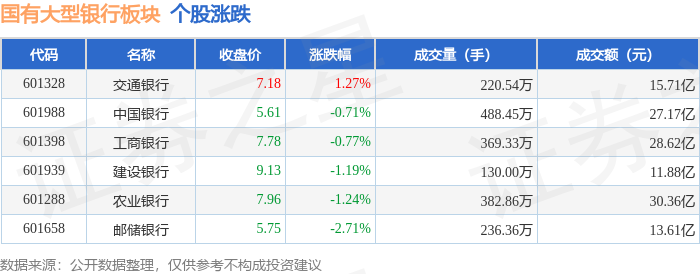
Core Insights - The state-owned large bank sector experienced a decline of 1.01% on October 31, with Postal Savings Bank leading the drop [1] - The Shanghai Composite Index closed at 3954.79, down 0.81%, while the Shenzhen Component Index closed at 13378.21, down 1.14% [1] Bank Performance Summary - **Bank of Communications (601328)**: Closed at 7.18, up 1.27%, with a trading volume of 2.2054 million shares and a transaction value of 1.571 billion [1] - **Bank of China (601988)**: Closed at 5.61, down 0.71%, with a trading volume of 4.8845 million shares and a transaction value of 2.717 billion [1] - **Industrial and Commercial Bank of China (601398)**: Closed at 7.78, down 0.77%, with a trading volume of 3.6933 million shares and a transaction value of 2.862 billion [1] - **China Construction Bank (601939)**: Closed at 9.13, down 1.19%, with a trading volume of 1.3 million shares and a transaction value of 1.188 billion [1] - **Agricultural Bank of China (601288)**: Closed at 7.96, down 1.24%, with a trading volume of 3.8286 million shares and a transaction value of 3.036 billion [1] - **Postal Savings Bank (601658)**: Closed at 5.75, down 2.71%, with a trading volume of 2.3636 million shares and a transaction value of 1.361 billion [1] Capital Flow Analysis - The state-owned large bank sector saw a net outflow of 116 million in main funds, while retail funds experienced a net outflow of 8.1972 million [1] - **Bank of Communications**: Main funds net inflow of 224 million, retail funds net outflow of 63.839 million [2] - **Bank of China**: Main funds net outflow of 760.85 thousand, retail funds net outflow of 1.64165 million [2] - **China Construction Bank**: Main funds net outflow of 310.645 thousand, retail funds net inflow of 2.39997 million [2] - **Industrial and Commercial Bank of China**: Main funds net outflow of 519.931 thousand, retail funds net inflow of 1.39323 million [2] - **Postal Savings Bank**: Main funds net outflow of 893.268 thousand, retail funds net outflow of 1.0489 million [2] - **Agricultural Bank of China**: Main funds net outflow of 1.607 million, retail funds net inflow of 4.46154 million [2]


工行、农行、中行、建行、交行、邮储银行公布!
Jin Rong Shi Bao· 2025-10-31 08:16
Core Insights - The six major state-owned banks in China reported growth in both operating income and net profit for the first three quarters of 2025, with total assets also showing steady growth [1][2][3] Group 1: Bank Performance - Industrial and Commercial Bank of China (ICBC) achieved operating income of 640.03 billion yuan, a year-on-year increase of 2.17%, and net profit of 269.91 billion yuan, up 0.33% [1] - Agricultural Bank of China (ABC) reported operating income of 550.88 billion yuan, a 1.97% increase, and net profit of 220.86 billion yuan, growing by 3.03% [1] - Bank of China (BOC) recorded operating income of 491.20 billion yuan, a 2.69% increase, and net profit of 177.66 billion yuan, up 1.08% [2] - China Construction Bank (CCB) posted operating income of 573.70 billion yuan, a 0.82% increase, and net profit of 257.36 billion yuan, growing by 0.62% [2] - Bank of Communications (BCOM) achieved operating income of 199.64 billion yuan, a 1.80% increase, and net profit of 69.99 billion yuan, up 1.90% [2] - Postal Savings Bank of China (PSBC) reported operating income of 265.08 billion yuan, a 1.82% increase, and net profit of 76.56 billion yuan, growing by 0.98% [3] Group 2: Asset and Loan Quality - ICBC's total assets reached 52.81 trillion yuan, an increase of 399.17 billion yuan or 8.18%, with a non-performing loan (NPL) ratio of 1.33%, down 0.01 percentage points [1] - ABC's total assets were 48.14 trillion yuan, up 489.73 billion yuan or 11.33%, with an NPL ratio of 1.27%, down 0.03 percentage points [1] - BOC's total assets amounted to 37.55 trillion yuan, increasing by 248.89 billion yuan or 7.10%, with an NPL ratio of 1.24%, down 0.01 percentage points [2] - CCB's total assets reached 45.37 trillion yuan, up 479.79 billion yuan or 11.83%, with an NPL ratio of 1.32%, down 0.02 percentage points [2] - BCOM's total assets were 15.50 trillion yuan, increasing by 59.91 billion yuan or 4.02%, with an NPL ratio of 1.26%, down 0.05 percentage points [2] - PSBC's total assets reached 18.61 trillion yuan, up 152.07 billion yuan or 8.90%, with an NPL ratio of 0.94%, up 0.04 percentage points [3] Group 3: Provision Coverage - ICBC's provision coverage ratio stood at 217.21%, an increase of 2.30 percentage points [1] - ABC's provision coverage ratio was 295.08%, down 4.53 percentage points [1] - BOC's provision coverage ratio was 196.60%, down 4.00 percentage points [2] - CCB's provision coverage ratio was 235.05%, up 1.45 percentage points [2] - BCOM's provision coverage ratio was 209.97%, an increase of 8.03 percentage points [2] - PSBC's provision coverage ratio was 240.21%, down 45.94 percentage points [3]