
BANK COMM(601328)

Search documents
金价波动加剧 多家银行调整积存金起投门槛
Zheng Quan Ri Bao Zhi Sheng· 2025-10-29 17:11
Core Insights - The international gold price has been experiencing significant fluctuations at high levels, leading commercial banks to adjust their precious metal business strategies, particularly by optimizing the investment thresholds for gold accumulation products [1][4] - Several banks have raised the minimum investment amounts for gold accumulation products, with the Bank of Communications implementing a floating adjustment mechanism linked to real-time gold prices [2][4] Summary by Category Market Trends - The current high volatility in gold prices has prompted banks to adapt their strategies to enhance service precision and risk management capabilities [1][3] - More financial institutions are expected to follow suit in adjusting their investment thresholds to provide investors with more flexible options that align with market changes [1][3] Bank Adjustments - The Bank of Communications announced that starting from October 27, 2025, its gold accumulation plan will have a minimum investment amount that fluctuates with real-time gold prices, requiring the investment to be at least equal to the current gold price [2] - Other banks, including Industrial and Commercial Bank of China, Bank of China, and Ping An Bank, have also raised their minimum investment amounts for gold accumulation products in October [4] Regulatory Compliance and Risk Management - The floating mechanism linked to real-time gold prices helps avoid frequent manual adjustments and aligns with regulatory requirements, ensuring compliance while managing risks effectively [3] - Banks are also focusing on investor education by issuing risk alerts to enhance awareness and encourage prudent investment behavior [5][6]

智通港股投资日志|10月30日



智通财经网· 2025-10-29 16:03
Group 1 - The article provides a list of companies and their respective activities related to shareholder meetings, new stock activities, performance announcements, and dividend distributions scheduled for October 30, 2025 [1][2][5][7]. - Several companies are mentioned as being in the process of initial public offerings (IPOs), including 旺山旺水-B, 均胜电子, 文远知行-W, and 赛力斯 [6]. - Companies such as 美的集团 and 翰森制药 are noted for their dividend distribution dates, indicating ongoing shareholder returns [7][8]. Group 2 - The article highlights the resumption of trading for companies like 舍图控股, 鸿盛昌资源, and 安能物流, suggesting a return to market activity after previous suspensions [6][7]. - The document lists various companies involved in dividend payouts, which may attract investor interest due to potential income generation [8]. - The presence of multiple companies in the IPO stage indicates a potentially active market environment for new investments [6].
主发起行密集收编,村镇银行“归巢”
Bei Jing Shang Bao· 2025-10-29 13:10
Core Viewpoint - The ongoing "return to the nest" reform of village banks, led by main initiating banks, aims to address risks and optimize the financial layout in rural areas, transitioning from scale expansion to quality improvement in financial services [1][8]. Summary by Sections Village Bank Dissolution and Integration - On October 29, three village banks in Shandong were approved for dissolution, with their assets and operations taken over by Qingdao Rural Commercial Bank [3][5]. - Similarly, six village banks in Sichuan were absorbed by Chengdu Rural Commercial Bank, marking a significant shift in the operational structure of these institutions [3][5]. Background and Purpose of Village Banks - Village banks were established to serve the "three rural issues" and small enterprises, filling gaps in financial services at the grassroots level [8][12]. - However, many have deviated from their original purpose due to weak capital, governance issues, and inadequate risk control, leading to a need for consolidation [8][12]. "Village to Branch" Reform Mechanism - The "village to branch" reform involves the absorption of village banks into their initiating banks, eliminating their independent legal status and consolidating operations [8][12]. - This process can occur through two main pathways: full acquisition of shares by the initiating bank or the integration of multiple village banks into a regional management branch [8][12]. Strategic Benefits of Consolidation - The consolidation allows initiating banks to leverage unified risk management frameworks and capital allocation mechanisms, enhancing the overall risk resilience of the absorbed village banks [6][11]. - It also facilitates the expansion of county-level financial services by utilizing existing customer bases and branch networks [6][11]. Future Outlook and Challenges - The reform is expected to continue, with more village banks likely to be integrated into main banks, as highlighted by recent regulatory approvals [12][13]. - However, there are concerns about potential drawbacks, such as longer decision-making processes and increased product homogeneity, which could hinder the unique advantages of village banks [12][13].





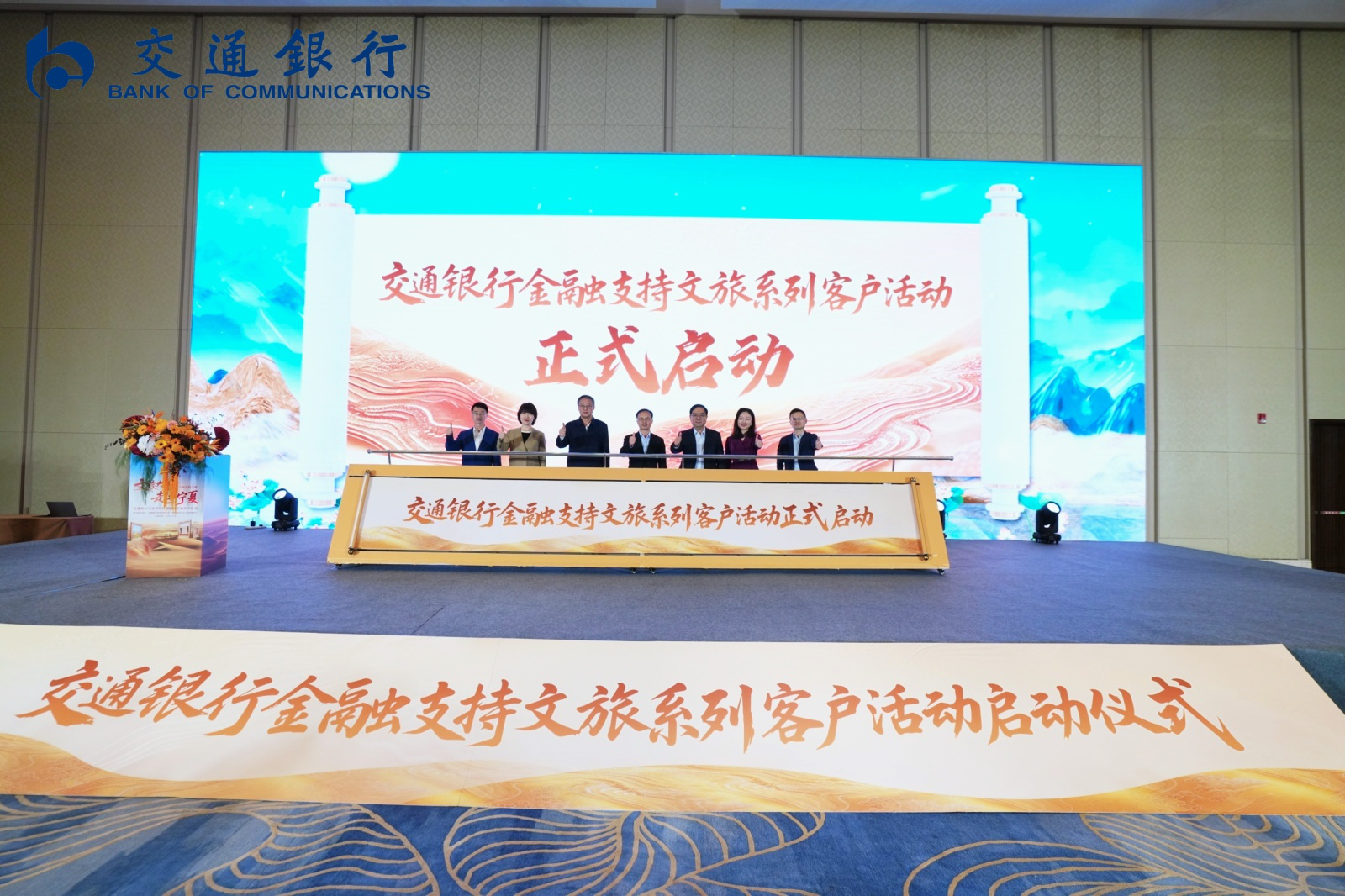
交通银行“金融支持文旅系列客户活动”在宁夏银川正式启动
Zhong Guo Jin Rong Xin Xi Wang· 2025-10-29 11:38
Group 1 - The event "Financial Support for Cultural Tourism Series" initiated by Bank of Communications in Yinchuan, Ningxia, aims to promote cultural tourism and enhance consumer confidence [1][5] - Over 400 guests from various branches of Bank of Communications participated in the special event at the Xixia Tomb Museum, showcasing the rich cultural heritage of the region [3] - The event featured cultural exchanges and lectures on Xixia civilization, highlighting the integration of traditional culture and financial support for tourism development [5] Group 2 - The initiative aligns with Ningxia's "Bring Customers to Ningxia Plan," demonstrating a successful exploration of how financial institutions can empower cultural tourism [5]
交通银行副行长钱斌:金融与科技融合共振 智赋产业新未来
Zhong Guo Jin Rong Xin Xi Wang· 2025-10-29 10:22
Core Viewpoint - The financial industry should actively seize the new round of technological transformation dividends, leveraging "data elements" and "artificial intelligence" to accelerate digital transformation and foster a new growth point through serving technological innovation [1][2]. Group 1: Financial and Technological Integration - Financial services are increasingly interwoven with technology and industry, creating a powerful force for economic and social development [1]. - Financial resources are being precisely directed to support technological innovation, injecting strong momentum into industrial prosperity [1]. - Technological innovation is effectively driving financial transformation, establishing a new paradigm for economic development [1]. Group 2: Traffic Bank's Digital Transformation Strategy - During the "14th Five-Year Plan" period, Traffic Bank is prioritizing digital transformation as a strategic breakthrough, significantly investing in technology and talent [2]. - The bank has established a specialized organizational structure for technology finance, including a central technology finance center and nearly a hundred technology branches nationwide to meet the financial needs of tech enterprises [2]. - Traffic Bank aims to innovate product and service models by utilizing technological capabilities, allowing more financial resources to concentrate on technological innovation and fostering a collaborative industrial ecosystem [2].
国有大型银行板块10月29日跌1.62%,邮储银行领跌,主力资金净流出2.46亿元
Zheng Xing Xing Ye Ri Bao· 2025-10-29 08:41
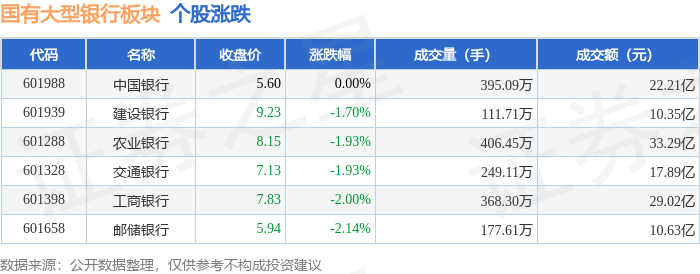
Core Insights - The state-owned large bank sector experienced a decline of 1.62% on October 29, with Postal Savings Bank leading the drop [1] - The Shanghai Composite Index closed at 4016.33, up 0.7%, while the Shenzhen Component Index closed at 13691.38, up 1.95% [1] Bank Performance - China Bank (601988) closed at 5.60 with no change in price - Construction Bank (601939) closed at 9.23, down 1.70% - Agricultural Bank (601288) closed at 8.15, down 1.93% - Transportation Bank (601328) closed at 7.13, down 1.93% - Industrial and Commercial Bank (601398) closed at 7.83, down 2.00% - Postal Savings Bank (601658) closed at 5.94, down 2.14% [1] Capital Flow Analysis - The state-owned large bank sector saw a net outflow of 246 million yuan from main funds, while retail investors had a net inflow of 486 million yuan [1] - The detailed capital flow for individual banks shows: - China Bank: Main funds net inflow of 230 million yuan, retail net outflow of 24.99 million yuan [2] - Postal Savings Bank: Main funds net outflow of 206.81 thousand yuan, retail net inflow of 17.58 million yuan [2] - Industrial and Commercial Bank: Main funds net outflow of 76.53 million yuan, retail net inflow of 158 million yuan [2] - Construction Bank: Main funds net outflow of 84.07 million yuan, retail net inflow of 75.81 million yuan [2] - Transportation Bank: Main funds net outflow of 147 million yuan, retail net inflow of 167 million yuan [2] - Agricultural Bank: Main funds net outflow of 167 million yuan, retail net inflow of 93.32 million yuan [2]



广弘控股:为子公司向交通银行融资提供7200万元担保
Xin Lang Cai Jing· 2025-10-29 08:39
Core Viewpoint - Guanghong Holdings announced that its board and shareholders agreed to provide a guarantee for its subsidiary Nanhai Poultry and its subsidiaries, with a credit financing limit of up to 250 million yuan for one year [1] Group 1: Financing Details - On October 20, 2025, Nanhai Poultry, Nanhai Huang Breeding, and Guanghong Breeding signed comprehensive credit contracts with Bank of Communications, with limits of 20 million yuan, 20 million yuan, and 30 million yuan respectively [1] - On October 28, the company signed a guarantee contract with Bank of Communications to provide joint liability guarantees for the main contract debts of the three subsidiaries, with maximum debt balances of 24 million yuan, 24 million yuan, and 36 million yuan respectively, with a guarantee period until April 23, 2026 [1] Group 2: Current Guarantee Status - As of the announcement date, the company and its subsidiaries have a cumulative external guarantee balance of 1.823 billion yuan, accounting for 57.47% of the most recent audited net assets, with no overdue external guarantees [1]

交通银行“无缝”融入养老场景
Bei Jing Wan Bao· 2025-10-29 06:54
Core Viewpoint - The financial sector plays a crucial role in supporting the development of the elderly care industry and the "silver economy," with Bank of Communications (BoCom) committed to creating a comprehensive financial service system that addresses the challenges of an aging population [1] Systematic Layout - BoCom has established a comprehensive service system covering five areas: elderly industry finance, pension finance, elderly wealth finance, elderly consumption finance, and financial services tailored for the elderly, positioning itself as a leader in the aging finance sector [4] - The bank aims to become a "senior-friendly bank," extending its service chain to meet the diverse needs of elderly clients and introducing innovative products like the "Pension One Account" for better asset management [4] - BoCom integrates resources to provide exclusive benefits for the elderly across seven life scenarios, enhancing their wealth management and consumption vitality through a "finance + ecosystem" model [4] Technological Empowerment - BoCom promotes "technology for the elderly," ensuring that financial services are safe, simple, and seamlessly integrated into the daily lives of older adults [5] - The bank has launched pilot programs for a "digital RMB hard wallet" in communities, allowing elderly users to make payments easily without needing to operate smartphones [5] - Online, BoCom has embedded a "Healthy Aging" service platform in its mobile banking and WeChat mini-programs, facilitating access to essential health and wellness services [6] Addressing Challenges - BoCom recognizes common challenges in the elderly care industry, such as the small scale and financial irregularities of non-profit institutions, and is working to optimize credit evaluation and lending processes for these organizations [7] - The bank is addressing the phenomenon of "hot account openings but cold contributions" in personal pension accounts by enhancing financial literacy and optimizing product offerings to meet diverse risk preferences [7] - To bridge the digital divide, BoCom adopts a "online + offline" strategy, improving its app for elderly users and enhancing service capabilities at physical branches [7] Future Outlook - BoCom is optimistic about the future of "technology + elderly care," planning to leverage financial services to unite various societal forces in reforming and developing elderly care services [8]

交通银行一原副行长退休5年后被查!系我国银行业首位CIO
Nan Fang Du Shi Bao· 2025-10-29 04:44
Core Points - The former Vice President of Bank of Communications, Hou Weidong, is under investigation for serious violations of discipline and law, five years after his retirement [2][3] - Hou Weidong was the first Chief Information Officer (CIO) in China's banking industry and held significant positions in both technology and business operations during his tenure [3][4] Group 1: Background and Career - Hou Weidong worked at the Industrial and Commercial Bank of China before joining Bank of Communications, where he held various roles, including CIO and Vice President [3][4] - He served as Vice President of Bank of Communications for over nine years, during which he also held the position of CIO for six years [3][4] Group 2: Investigation and Institutional Response - The investigation into Hou Weidong was announced by the Central Commission for Discipline Inspection and the National Supervisory Commission, indicating a broader crackdown on corruption within the banking sector [2][9] - Following the announcement, the Bank of Communications' Party Committee expressed its commitment to support the investigation and emphasized the importance of maintaining strict discipline and governance [9] Group 3: Recent Trends in Corruption Cases - Prior to Hou Weidong's case, two other officials from Bank of Communications were also investigated for serious violations of discipline and law in 2023 [10] - The Central Commission for Discipline Inspection has highlighted the emergence of new forms of corruption, including hidden and disguised methods that complicate investigations [10]

交通银行表态:坚决拥护党中央决定
Zhong Guo Ji Jin Bao· 2025-10-29 01:36
Core Points - The Central Commission for Discipline Inspection and the National Supervisory Commission announced an investigation into the former Vice President of Bank of Communications, Hou Weidong, for serious violations of discipline and law [1][2] - The Bank of Communications' Party Committee expressed strong support for the investigation and emphasized the importance of aligning with the central government's anti-corruption efforts [2][3] - The bank aims to enhance its internal governance and maintain a strict approach to discipline and anti-corruption measures [3][4] Group 1 - The investigation into Hou Weidong reflects the central government's commitment to deepening the anti-corruption campaign in the financial sector [1][2] - The Party Committee of the Bank of Communications is committed to learning from this case and ensuring that all employees understand the complexities and challenges of the anti-corruption struggle [2][3] - The bank will implement measures to ensure compliance with political discipline and regulations, emphasizing the role of leadership in maintaining a clean political environment [3] Group 2 - The bank is focused on enhancing its support for national strategies and addressing key areas of financial risk while promoting high-quality development [4] - The Party Committee will work to integrate the latest directives from the 20th Central Committee regarding self-revolution and comprehensive strict governance of the Party [3][4] - The bank aims to strengthen its financial support for the real economy and contribute to national development goals [4]