BANK COMM(601328)

Search documents
交通银行:六赴服贸之约 展示金融创新实践成果
Ren Min Wang· 2025-09-11 00:57
Group 1 - The China International Fair for Trade in Services (CIFTIS) financial services exhibition opened in Beijing, showcasing the Bank of Communications' innovative practices in financial services for the real economy and regional economic development [1] - The Bank of Communications presented various financial products, including "Jiao Yin Torch Loan," which utilizes a big data approval model to address financing challenges for technology-oriented small and micro enterprises [1] - The "Jiao Yin Venture Capital Loan" employs a "loan + external direct investment" model to broaden financing channels for technology companies through partnerships with quality investment institutions in Beijing [1] Group 2 - The bank's "Jiao Yin Park Loan" effectively meets the full-cycle financing needs of park enterprises by integrating various financial services, supporting the growth of technology-oriented companies [1] - The cross-border financial zone "Jiao Lian World, Hui Tong Global" offers comprehensive financial support for enterprises looking to expand internationally and attract foreign investment [1] - The bank focuses on enhancing financial services in key areas such as domestic demand, digital governance, and the silver economy, aligning its capabilities with national needs and public interests [2] Group 3 - The retail business showcased the "cross-province handling" of government services in the Beijing-Tianjin-Hebei region, allowing users to manage over 130 government matters and access various services remotely [2] - The bank has developed a housing rental deposit management and rent supervision system to protect the housing dreams of new citizens through a four-dimensional closed-loop management approach [2] - The silver economy segment integrates various services for the elderly, providing a one-stop resource connection for pension accounts, retirement financial products, and insurance [2] Group 4 - To enhance audience engagement and awareness of digital currency, the bank organized interactive activities featuring hardware wallets and cultural-themed designs [3] - The bank continued popular activities from previous years, such as blind box promotions related to digital currency, offering attendees the chance to win themed merchandise [3] - The exhibition will also host various promotional and educational events, including lectures on fund management and anti-fraud measures [3]
交通银行深圳分行全面推行“贷款明白纸” 助力企业融资透明化
Zheng Quan Shi Bao· 2025-09-10 22:38
Group 1 - The core initiative of the "Loan Clarity Paper" was officially launched by the Bank of Communications Shenzhen Branch in August 2025, aiming to enhance financial transparency and support the optimization of the business environment in Shenzhen [1] - The "Loan Clarity Paper" categorizes all interest and fees incurred during the loan process, presenting a comprehensive total cost to enterprises, thereby safeguarding their right to know and promoting a customer-centric service philosophy [2] - This initiative serves as a decision-making tool for enterprises, allowing them to accurately understand the true cost of loans and choose the most suitable financing options, effectively addressing the issue of high financing costs [3] Group 2 - A recent case highlighted the effectiveness of the "Loan Clarity Paper," where a small enterprise discovered that many costs, such as insurance and mortgage registration fees, were covered by the bank, leading to a successful loan application without hidden fees [3] - The Bank of Communications Shenzhen Branch plans to continue promoting the "Loan Clarity Paper" to help enterprises reduce costs and improve efficiency, thereby injecting continuous financial support into the development of the real economy [3]
“交”融数智 赋能生态 交通银行北京市分行高质量支持服贸会成功举办
Cai Jing Wang· 2025-09-10 13:28
2025年中国国际服务贸易交易会金融服务专题展于9月10日至9月14日在北京首钢园举办。此次展会 以"数智驱动 开放共赢"为主题,全力打造全球金融创新产品和服务展示、重要政策和行业规则发布、 合作伙伴洽谈、前沿金融体验四大平台。 在服务实体经济方面,交通银行北京市分行充分发挥金融科技优势,推动信贷产品创新与服务升级,打 通金融惠企利民的"最后一公里"。面对科技型小微企业融资难融资慢痛点,该行综合运用大数据、隐私 计算、数据沙箱等技术,通过有效整合内外部多维数据源为企业精准画像、事先批量核算预授信额度, 实现主动送"贷"上门,确保金融活水快速精准滴灌至有需求的企业,有效提升金融服务的可得性和满意 度。在贷款提用环节,依托大模型、OCR相结合模式,实现贷款影像资料智能识别和信息比对,缩短 贷款提用环节耗时,切实提升企业融资效率。 在服务人民美好生活方面,交通银行北京市分行聚焦市民"衣食住行"等民生需求,不断丰富数字金融服 务场景、延伸金融服务触角、优化和重塑业务流程,使金融服务"触手可及"。该行深耕汽车金融场景, 将交银车贷产品无缝嵌入汽车厂商购车全流程,为客户提供方便快捷的线上车贷业务,并提供手机银行 +交行贷 ...
交通银行亮相2025年服贸会金融服务专题展
Zheng Quan Ri Bao· 2025-09-10 11:36
Core Viewpoint - The 2025 China International Service Trade Fair Financial Services Exhibition showcases the innovative practices of Bank of Communications in financial services, emphasizing its role in supporting the real economy and regional development [2]. Group 1: Financial Products and Services - Bank of Communications presented various innovative financial products such as "Jiao Yin Torch Loan," "Jiao Yin Venture Capital Loan," "Foreign Trade Quick Loan," and "Carbon Asset Pledge Financing" to demonstrate the synergy between financial services and the real economy [2]. - The "Jiao Yin Torch Loan" targets growing technology-based small and micro enterprises, utilizing a unique big data approval model to address their financing challenges [3]. - The "Jiao Yin Venture Capital Loan" employs a "loan + external direct investment" model to enhance financing channels for technology enterprises through partnerships with quality investment institutions [3]. Group 2: Cross-Border Financial Solutions - The bank established a cross-border financial zone titled "Jiao Lian World, Hui Tong Global," offering comprehensive financial support for enterprises looking to expand internationally or attract foreign investment through solutions like "Foreign Trade Quick Loan" and "E-commerce Pass" [3]. Group 3: Retail and Community Services - The retail business segment highlighted the "cross-province handling" of government services in the Beijing-Tianjin-Hebei region, allowing citizens to manage over 130 government services and access personal social security information seamlessly [3]. - The bank showcased a housing rental deposit management and rent supervision system, aimed at safeguarding the housing dreams of new citizens through a four-dimensional closed-loop management approach [4]. Group 4: Senior Economy and Consumer Services - The bank's senior economy segment focuses on providing a one-stop resource connection for the elderly, integrating pension accounts, retirement financial products, insurance, and trust services [4]. - The retail credit and credit card segment promotes various consumer-friendly products and activities, such as "Hui Min Loan" and "Jiao Yin Car Loan," to stimulate market consumption [4]. Group 5: Digital Currency Engagement - To enhance public engagement and awareness of digital currency, the bank organized interactive activities featuring aesthetically designed hardware wallets and continued popular activities from previous years, such as blind box promotions related to digital RMB [4].

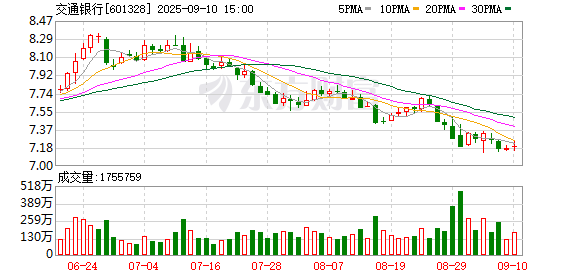
参股基金板块9月10日涨0.02%,亨通股份领涨,主力资金净流出13.48亿元



Sou Hu Cai Jing· 2025-09-10 09:19
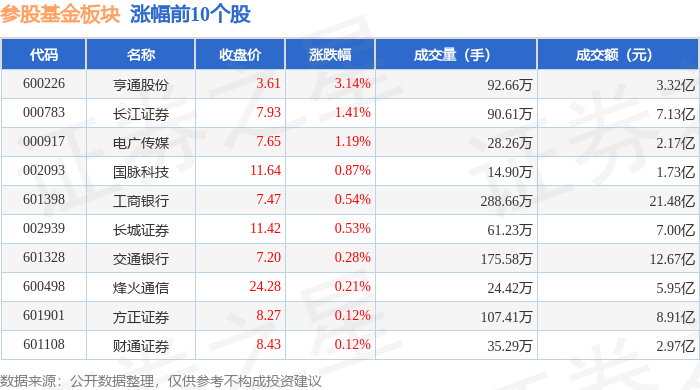
Market Overview - The participating fund sector increased by 0.02% compared to the previous trading day, with Hengtong Optic-Electric leading the gains [1] - The Shanghai Composite Index closed at 3812.22, up 0.13%, while the Shenzhen Component Index closed at 12557.68, up 0.38% [1] Individual Stock Performance - Hengtong Optic-Electric (600226) closed at 3.61, up 3.14%, with a trading volume of 926,600 shares and a turnover of 332 million yuan [1] - Changjiang Securities (000783) closed at 7.93, up 1.41%, with a trading volume of 906,100 shares and a turnover of 713 million yuan [1] - Other notable performers include: - Electric Power Media (000917) at 7.65, up 1.19% [1] - Guomai Technology (002093) at 11.64, up 0.87% [1] - Industrial and Commercial Bank of China (601398) at 7.47, up 0.54% [1] Fund Flow Analysis - The participating fund sector experienced a net outflow of 1.348 billion yuan from institutional investors, while retail investors saw a net inflow of 902 million yuan [2] - Notable net inflows from retail investors include: - Changjiang Securities with a net inflow of 103 million yuan [3] - Industrial and Commercial Bank of China with a net inflow of 95.78 million yuan [3] - Conversely, significant net outflows from institutional investors were observed in: - Junzheng Group (601216) with a net outflow of 440 million yuan [2] - Guolian Minsheng (601456) with a net outflow of 27.5 million yuan [2]
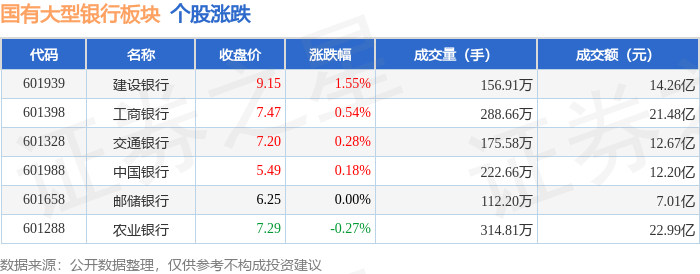
国有大型银行板块9月10日涨0.14%,建设银行领涨,主力资金净流入3.98亿元
Zheng Xing Xing Ye Ri Bao· 2025-09-10 08:37
证券之星消息,9月10日国有大型银行板块较上一交易日上涨0.14%,建设银行领涨。当日上证指数报收 于3812.22,上涨0.13%。深证成指报收于12557.68,上涨0.38%。国有大型银行板块个股涨跌见下表: | 代码 | 名称 | 主力净流入(元) | 主力净占比 游资净流入 (元) | | 游资净占比 散户净流入 (元) | | 散户净占比 | | --- | --- | --- | --- | --- | --- | --- | --- | | 601939 建设银行 | | 2.23亿 | 15.65% | -1.12亿 | -7.84% | -1.11亿 | -7.81% | | 601398 工商银行 | | 9577.89万 | 4.46% | -1.45 Z- | -6.77% | 4970.63万 | 2.31% | | 601988 中国银行 | | 8223.48万 | 6.74% | -7048.54万 | -5.78% | --1174.94万 | -0.96% | | 601328 交通银行 | | 5221.46万 | 4.12% | 869.38万 | 0.69% | - ...


交通银行厦门分行亮相2025中国(厦门)国际警安法务科技展 暨“出海”法商服务展 金融赋能企业“出海”扬帆
Jin Rong Shi Bao· 2025-09-10 02:19
此次参展是交通银行厦门分行深化金融服务、助力企业"出海"的又一重要举措。未来,该行将依托 交通银行总行全球化服务网络与专业能力,持续整合金融资源,为企业提供"出海"全链条金融支持,助 力企业在国际市场稳健发展,为厦门经济贡献金融力量。 (数据来源:交通银行厦门分行) 第二十五届中国国际投资贸易洽谈会举办期间,2025中国(厦门)国际警安法务科技展暨"出海"法 商服务展于9月8日在厦门国际会展中心拉开帷幕。本次展会由厦门市人民政府、中安协主办,紧扣企 业"出海"这一核心需求,致力于打破"出海"全链条服务壁垒,联动多方优质资源。 作为助力企业海外发展的金融力量,交通银行厦门分行携专属"出海"金融解决方案精彩亮相,集中 展示了企业"出海"的金融解决方案,涵盖跨境结算、海外投融资、汇率避险等内容。现场通过一对一咨 询等形式,为企业解答"出海"中的资金流转、风险对冲等实际问题,助力企业在国际市场的探索中,提 前做好资金规划与风险防控。 展会现场,交通银行总行国际业务专家以《直击企业"出海"》为主题,带来了一场精彩的分享。宣 讲围绕交通银行完善的跨境金融服务体系、灵活多样的离在岸融资方案等核心内容,同时结合跨境融资 具体 ...
交通银行河南省分行:以“极智”体验赋能企业全球化布局
Zheng Quan Ri Bao Zhi Sheng· 2025-09-08 16:38
Core Insights - The article highlights the increasing pace of Chinese enterprises "going global" and the growing need for efficient, convenient, and secure cross-border financial services to support their international operations [1][2] Group 1: Company Overview - The company mentioned is a state-owned enterprise engaged in the supply chain business of coal, agricultural products, and precious metals, facing strict internal approval processes and high payment efficiency requirements [1] - The collaboration with the Bank of Communications' Henan branch has led to significant improvements in the company's cross-border remittance efficiency, saving considerable financial costs annually [2] Group 2: Financial Services Provided - The Bank of Communications has developed a comprehensive cross-border financial service system, including features like "Easy汇" for multi-channel support, batch remittance, real-time image transmission, and automatic routing selection, enhancing the security of customer funds [1] - The implementation of the CIPS standard sender and receiver has improved the efficiency of cross-border payments, addressing the company's pain points and ensuring smooth overseas operations [1] Group 3: Future Collaboration and Strategy - Since the partnership began, the company has completed cross-border remittances totaling $180 million, with plans for further collaboration in international letters of credit and derivative business [2] - The Bank of Communications aims to continue focusing on customer needs, enhancing financial technology innovation, and expanding cross-border financial product offerings, particularly in cross-border RMB services [2]
国有大型银行板块9月8日跌0.56%,交通银行领跌,主力资金净流出11.57亿元
Zheng Xing Xing Ye Ri Bao· 2025-09-08 08:53
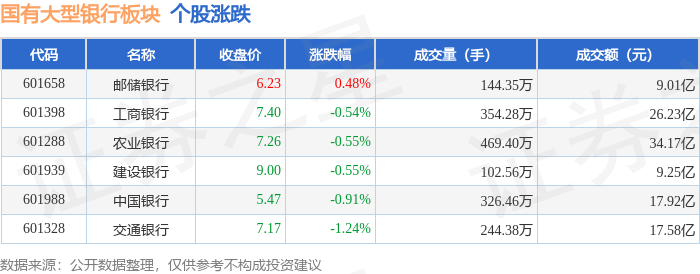
Core Insights - The state-owned large bank sector experienced a decline of 0.56% on September 8, with Bank of Communications leading the drop [1] - The Shanghai Composite Index closed at 3826.84, up 0.38%, while the Shenzhen Component Index closed at 12666.84, up 0.61% [1] Bank Performance Summary - Postal Savings Bank: Closed at 6.23, up 0.48%, with a trading volume of 1.44 million shares and a turnover of 900 million yuan [1] - Industrial and Commercial Bank: Closed at 7.40, down 0.54%, with a trading volume of 3.54 million shares and a turnover of 2.623 billion yuan [1] - Agricultural Bank: Closed at 7.26, down 0.55%, with a trading volume of 4.694 million shares and a turnover of 3.417 billion yuan [1] - China Construction Bank: Closed at 9.00, down 0.55%, with a trading volume of 1.026 million shares and a turnover of 925 million yuan [1] - Bank of China: Closed at 5.47, down 0.91%, with a trading volume of 3.264 million shares and a turnover of 1.792 billion yuan [1] - Bank of Communications: Closed at 7.17, down 1.24%, with a trading volume of 2.444 million shares and a turnover of 1.758 billion yuan [1] Fund Flow Analysis - The state-owned large bank sector saw a net outflow of 1.157 billion yuan from institutional investors, while retail investors had a net inflow of 660 million yuan [1] - The detailed fund flow for individual banks shows varying levels of net inflow and outflow among institutional, retail, and speculative investors [2]
交通银行独立非执行董事被港交所罚款41.6万港元 德勤项目审计存在多项缺失
Xi Niu Cai Jing· 2025-09-08 04:01
Core Viewpoint - The Hong Kong Accounting and Financial Reporting Council has reprimanded Wang Tianze, an independent non-executive director of Bank of Communications, and imposed a fine of HKD 416,000 due to audit deficiencies during his tenure at Deloitte [2][3]. Group 1: Regulatory Actions - The Hong Kong Accounting and Financial Reporting Council found multiple deficiencies in the audits conducted by Deloitte and its two project partners for two former Hong Kong listed companies, resulting in fines exceeding HKD 1.9 million [3]. - Wang Tianze was the project partner for the audits of Tianhe Group for the years 2011, 2012, and 2013, where he failed to obtain sufficient appropriate audit evidence and lacked professional skepticism regarding significant misstatement risks related to revenue [3]. Group 2: Company Response - Bank of Communications stated that the regulatory body did not find any intentional, dishonest, or willful misconduct by Wang Tianze, and he has no record of disciplinary action, indicating that this incident will not affect his ability to serve as an independent non-executive director [3]. Group 3: Background Information - Wang Tianze has been serving as an independent director at Bank of Communications since October 2023 and has held various significant positions at Deloitte, including Chief Business Officer and Partner in Risk Consulting [4].