BANK COMM(601328)

Search documents
国有六大行:积极落实个人消费贷贴息政策
Zheng Quan Ri Bao· 2025-09-07 16:09
Core Viewpoint - The implementation of the personal consumption loan interest subsidy policy starting September 1 has prompted several major banks to prepare for its execution, aiming to attract consumers through simplified processes and enhanced customer experience [1][2]. Group 1: Policy Implementation - Major state-owned banks, including ICBC, ABC, BOC, CCB, and PSBC, have released FAQs regarding the personal consumption loan interest subsidy, addressing consumer concerns [1]. - The cumulative interest subsidy cap for each borrower during the policy period is set at 3,000 yuan, with a maximum subsidy of 1,000 yuan for individual loans under 50,000 yuan [1]. Group 2: Automatic Recognition of Transactions - Banks like CCB and TCB have stated that loan funds will be disbursed to the borrower's selected debit card/account, with automatic recognition of transactions including POS payments, QR code payments, and online transactions [2]. - For transactions not automatically recognized, customers can submit proof of consumption for manual review to receive the subsidy [2]. Group 3: Existing Loans and Compliance - Borrowers with personal consumption loans issued before September 1, 2025, can still enjoy the subsidy if they use the funds for consumption during the policy period without needing to refinance [3]. - Banks have emphasized strict compliance measures against fraudulent activities related to loan applications and subsidy claims, with penalties for violations [3]. Group 4: Economic Impact - Analysts from CITIC Securities believe that the interest subsidy will positively impact consumer spending by reducing interest burdens and leveraging fiscal funds to enhance consumption loan leverage [3].






本周聚焦:2025上半年银行确认了多少金融资产处置收益?OCI浮盈有多少?
GOLDEN SUN SECURITIES· 2025-09-07 08:20
Investment Rating - The report maintains an "Increase" rating for the banking sector, indicating a positive outlook for the industry [1]. Core Insights - In the first half of 2025, the contribution of financial asset disposal gains from AC and OCI accounts to revenue reached 5.2%, an increase of 2.9 percentage points compared to 2024 [1][2]. - The investment income growth rate for 42 listed banks was 23.6%, with AC, OCI, and TPL gains showing year-on-year growth rates of 134.7%, 79.0%, and -8.4% respectively [1]. - The report highlights that the increase in disposal gains does not necessarily indicate a significant increase in asset disposal scale, as market conditions and strategies vary among banks [2]. Financial Asset Disposal Gains - The contribution of AC and OCI financial asset disposal gains to revenue was 5.2%, up 2.9 percentage points from 2024, with AC asset disposal gains contributing 2.6% [2]. - Among different types of banks, rural commercial banks had the highest contribution from AC and OCI disposal gains, reaching 11.0%, an increase of 6.2 percentage points from 2024 [2]. - Specific banks such as Jiangyin Bank, Sunong Bank, and Zijin Bank had high disposal gain ratios relative to their revenue, at 28.9%, 26.7%, and 22.7% respectively [2]. OCI Floating Profit Situation - The overall OCI floating profit decreased compared to the end of the previous year, accounting for 12.6% of the estimated profit for 2025 [3]. - Major state-owned banks like CCB and ABC reported significant OCI floating profits, with balances exceeding 30 billion [3]. - The average contribution of OCI floating profits to profits for city and rural commercial banks was notably high, with Ningbo Bank's ratio reaching 35% [3][6]. Sector Trends - The banking sector is expected to benefit from expansionary policies aimed at stabilizing the economy, with a focus on real estate and consumer spending [7]. - The report suggests a focus on banks with improving fundamentals, such as Ningbo Bank, and those with dividend strategies like Jiangsu Bank and Chengdu Bank [7]. - Attention is also drawn to banks with potential convertible bond conversion expectations, including Shanghai Bank and Industrial Bank [7].



事关个贷贴息,工行、农行、中行、建行、交行、邮储银行答复
Jin Rong Shi Bao· 2025-09-06 09:08
Core Points - The personal consumption loan interest subsidy policy was officially implemented on September 1, 2023, allowing residents to enjoy interest subsidies on loans used for consumption until August 31, 2026 [1] - Major banks are actively promoting this policy through their mobile banking apps and have established "subsidy zones" for customers [1] Group 1: Implementation Details - The subsidy applies to personal consumption loans from six major state-owned banks, twelve national joint-stock commercial banks, and five other lending institutions, specifically for loans that can be identified as used for consumption [1] - Agricultural Bank of China clarified that loans issued between September 1, 2025, and August 31, 2026, can qualify for the subsidy if used for consumption, and borrowers do not need to refinance existing loans [2] Group 2: Transaction Recognition - Transactions eligible for automatic recognition include POS transactions, QR code payments, online payments, and transfers to corresponding business accounts [3] - For transactions not automatically recognized, customers can upload receipts to the bank's app for manual recognition starting September 6, 2023 [3] Group 3: Service Agreement and Channels - Customers can sign the subsidy service agreement through the mobile banking app upon loan approval, regardless of when the loan was signed [4] - Postal Savings Bank allows customers to process subsidy applications through its app and branches, emphasizing that no third parties will be involved in the process [5] Group 4: Fees and Compliance - China Bank confirmed that no fees will be charged for processing the personal consumption loan subsidy [6] - Industrial and Commercial Bank of China stated that it will strictly adhere to market principles and legal regulations, prohibiting fraudulent activities to obtain subsidies, with serious consequences for violators [8]
多家银行高管发声!下半年息差形势如何应对?
券商中国· 2025-09-06 02:16
Core Viewpoint - The banking industry is facing ongoing pressure on net interest margins, but there are positive signals indicating potential stabilization through proactive asset-liability management and structural optimization [2][3]. Summary by Sections Net Interest Margin Trends - Among 42 A-share listed banks, 38 experienced a decline in net interest margin in the first half of 2025 compared to 2024, with only 3 showing improvement [3]. - Major state-owned banks reported net interest margins as follows: ICBC at 1.30% (down 13 basis points), CCB at 1.40% (down 14 basis points), ABC at 1.32% (down 13 basis points), BOC at 1.26% (down 18 basis points), PSBC at 1.70% (down 21 basis points), and CMB at 1.21% (down 8 basis points) [3]. - The decline in net interest margins is attributed to factors such as the continuous decrease in LPR rates, adjustments in existing mortgage rates, and the Fed's rate cuts, leading to asset yields declining faster than liability costs [3]. Future Outlook for Net Interest Margins - Bank executives anticipate that net interest margins may stabilize in the second half of 2025, despite ongoing downward pressure [5][6]. - ICBC's vice president noted that while net interest margins are expected to decline, the rate of decline is projected to slow down, supported by effective asset-liability management strategies [5]. - Agricultural Bank of China's president indicated that as deposits mature and interest rates adjust, the cost of liabilities is expected to decrease, potentially stabilizing net interest margins [6]. Strategies for Stabilizing Net Interest Margins - Banks are focusing on optimizing their business structures and enhancing pricing strategies to stabilize net interest margins [8]. - Huaxia Bank plans to improve asset quality and manage liabilities more effectively to support net interest margin stability [8]. - China Merchants Bank emphasizes the importance of external factors and plans to enhance asset-liability management to maintain reasonable net interest margins [8]. Proactive Management Initiatives - Banks are adopting a comprehensive approach to improve net interest margins, including optimizing asset-liability structures and enhancing customer engagement [9]. - The focus is on balancing various business lines and improving the efficiency of fund management to mitigate the impact of declining interest rates [9].


稳中提质显韧性 交通银行书写高质量发展答卷
Zhong Guo Jing Ying Bao· 2025-09-05 18:29
Core Viewpoint - The Bank of Communications reported a stable and positive performance in the first half of 2025, with key operating indicators showing growth and improved asset quality, reflecting its commitment to shareholder returns and robust management [2][3][4]. Financial Performance - As of June 30, 2025, the total assets of the group reached 15.44 trillion yuan, an increase of 3.59% compared to the end of the previous year [2][3]. - The bank achieved operating income of 1333.68 billion yuan and a net profit attributable to shareholders of 460.16 billion yuan, representing year-on-year growth of 0.77% and 1.61%, respectively [2][3][4]. - The net interest income was 852.47 billion yuan, with a year-on-year increase of 1.20%, and the net interest margin remained at 1.21% [4]. Asset Quality and Risk Management - The non-performing loan ratio was 1.28%, a decrease of 0.03 percentage points from the end of the previous year, while the provision coverage ratio increased to 209.56%, up by 7.62 percentage points [5]. - The bank disposed of non-performing loans totaling 378.3 billion yuan, a year-on-year increase of 27.9%, with substantial recoveries indicating effective risk management [5]. Strategic Focus Areas - The bank is committed to enhancing its service to the real economy, with a customer loan balance of 9 trillion yuan, reflecting a growth of 5.18% year-on-year [4][7]. - The bank's focus on technology, green finance, inclusive finance, pension finance, and digital finance is evident, with significant growth in loans across these sectors [7][8][9]. Capital Management and Shareholder Returns - The bank successfully raised 120 billion yuan through the issuance of approximately 14.1 billion A-shares, enhancing its core tier one capital and risk resilience [6]. - The bank proposed a cash dividend of 1.563 yuan per 10 shares, totaling 13.811 billion yuan, which represents 30% of the net profit attributable to shareholders for the first half of 2025 [6]. Future Development Plans - The bank aims to align with national development strategies, focusing on enhancing capital efficiency, expanding green finance, and improving digital services [11][12]. - It plans to strengthen its customer base and risk management while maintaining its commitment to serving the real economy and contributing to national economic goals [12].

交通银行(601328):资产质量指标趋势优于同业
Changjiang Securities· 2025-09-05 10:13
Investment Rating - The report maintains a "Buy" rating for the company [2][9]. Core Views - The company reported a revenue growth of +0.8% in the first half of the year, with a net profit growth of +1.6%, ranking among the top two state-owned banks in terms of net profit growth [2][6]. - The non-performing loan (NPL) ratio at the end of the first half was 1.28%, a decrease of 2 basis points from the previous quarter and 3 basis points from the beginning of the year, indicating a significant improvement in asset quality compared to peers [2][6]. - The provision coverage ratio increased by 9 percentage points to 210%, reaching a ten-year high, which supports the stability of net interest margin and profitability [2][6]. Summary by Sections Financial Performance - Revenue growth for the first half was +0.8%, with Q1 showing a decline of -1.0% and Q2 recovering to +2.6%. Net profit growth was +1.6%, with Q1 at +1.5% [2][6]. - The net interest margin decreased by 2 basis points to 1.21% in the first half, with a total decline of 6 basis points expected for the year, the smallest drop among state-owned banks [2][6]. Asset Quality - The NPL ratio at the end of the first half was 1.28%, down 2 basis points from the previous quarter and 3 basis points from the start of the year, showing the most significant decline among state-owned banks [2][6]. - The NPL net generation rate was 0.49%, down 4 basis points from the previous year, indicating a positive trend in asset quality [2][6]. Investment Valuation - The current valuation for the company's A-shares and H-shares is approximately 0.56x and 0.47x price-to-book (PB) ratio, respectively, indicating that the stock is significantly undervalued [2][6]. - The company ranks among the top five banks in terms of A-share index weight, with a low institutional allocation ratio, supporting the recommendation to maintain a "Buy" rating [2][6].
上市银行1H25业绩总结:营收利润边际改善,看好板块配置价值有限
Dongxing Securities· 2025-09-05 09:38
Investment Rating - The report maintains a positive outlook on the banking sector's allocation value, suggesting continued investment interest in the sector [4][10]. Core Viewpoints - The performance of listed banks in the first half of 2025 shows a marginal improvement in revenue and profit margins, with year-on-year growth of 1.0% in revenue and 0.8% in net profit attributable to shareholders [4][5]. - The recovery in the bond market during the second quarter has alleviated some of the pressures on bond investment returns, contributing to the overall performance improvement [4][5]. - The report anticipates that the banking sector's revenue and net profit growth will remain around 1% year-on-year for 2025, despite ongoing pressures on the banking fundamentals [4][10]. Summary by Sections Performance Overview - In the first half of 2025, listed banks experienced a year-on-year revenue growth of 1.0% and a net profit growth of 0.8%, with quarter-on-quarter improvements of 2.8 percentage points and 2 percentage points respectively [4][5]. - The growth in interest-earning assets was 9.7% year-on-year, with a stable credit growth of 8% and a significant increase in financial investments by 14.9% [4][11]. - The net interest margin for the first half of 2025 was 1.33%, showing a year-on-year decline of 13 basis points, which is less than the decline seen in the same period last year [4][5]. Non-Interest Income - Non-interest income showed a positive trend, with a year-on-year increase of 10.8% in other non-interest income and a 3.1% increase in fee income [4][5][10]. - The report highlights that the recovery in the capital market has contributed to the improvement in non-interest income [4][10]. Asset Quality - The report notes that while the non-performing loan ratio remains stable, there is an increase in the generation rate of overdue and non-performing loans, particularly in retail banking [4][10]. - The provision coverage ratio remained stable, with an increase in provisioning efforts during the first half of 2025 [4][10]. Future Outlook - The banking sector is expected to face continued pressure in 2025, but signs of a potential turning point are emerging, with improved net interest margins and non-interest income [4][10]. - The report suggests that the demand for bank stocks will increase from long-term funds, driven by favorable policies encouraging investment in the banking sector [4][10].

交通银行亮相第十五届智慧城市与智能经济博览会-银行-金融界
Jin Rong Jie· 2025-09-05 09:16
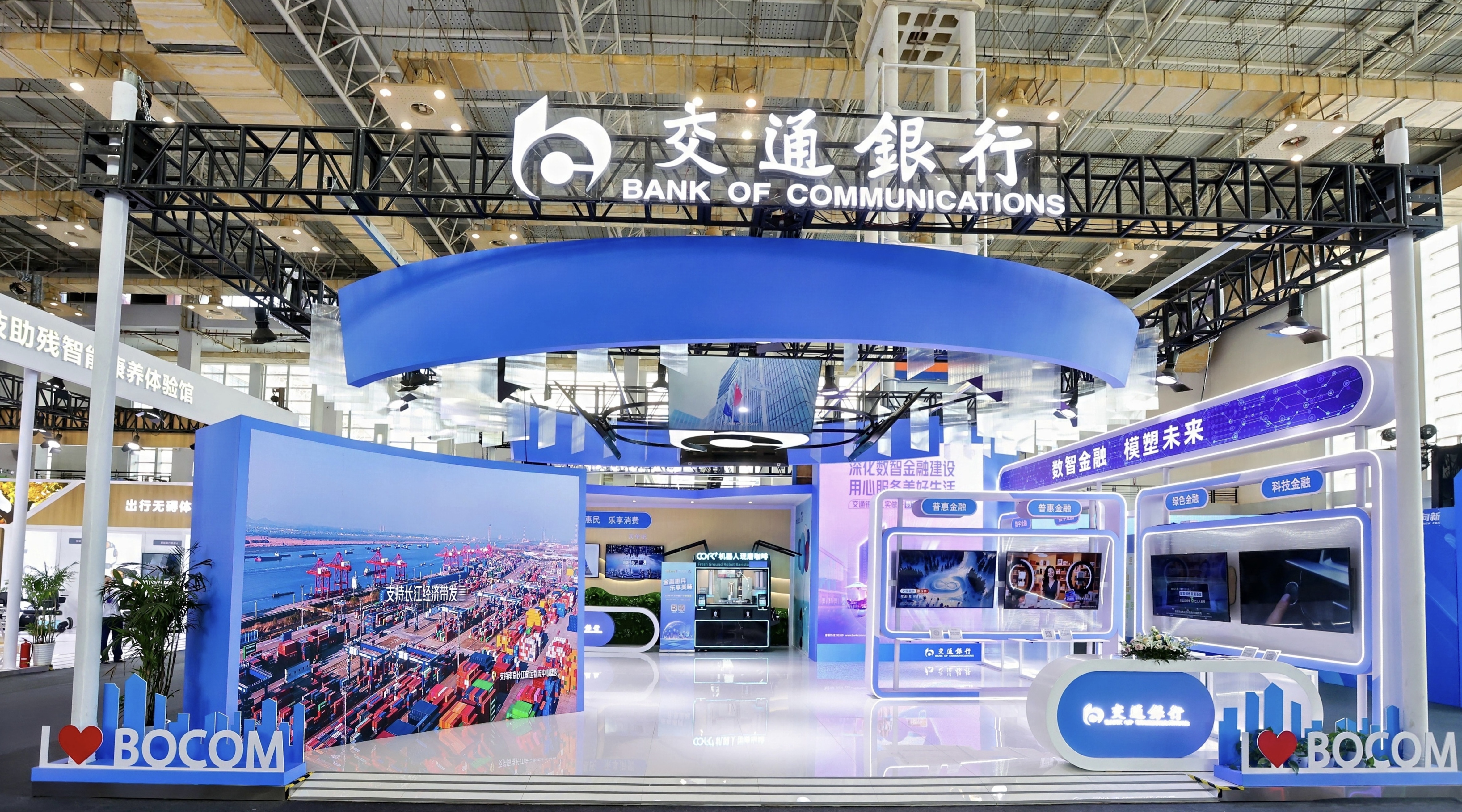
Core Viewpoint - The 15th Smart City and Intelligent Economy Expo showcases the latest achievements of the Bank of Communications in utilizing artificial intelligence and digitalization to enhance financial services and support the real economy [1] Group 1: Technological Innovations - The Bank of Communications' exhibition features cutting-edge technologies such as AI models and blockchain applications in finance, highlighting innovations in financial services [4] - The "Five Major Articles" section demonstrates how the bank leverages digitalization to empower regional economic development through proactive credit services and data-driven solutions [4] Group 2: Regional Economic Services - The bank has developed the "Shipping Butler" blockchain ecosystem to facilitate maritime trade by integrating customs, insurance, logistics, and tax data, enhancing service for clients in the shipping industry [5] - The "Ke Chuang Zhi Yi Loan" product targets technology-based small and micro enterprises, offering online, credit-based financing solutions that consider diverse factors beyond traditional collateral [5] - A new housing loan product, "Jin Hui Rental Loan," has been launched to assist new citizens and young people with rental housing needs in Ningbo [5] Group 3: Digital Currency Experience - The digital consumption experience area educates visitors about digital RMB, featuring engaging activities like "1 cent for ice cream" to promote understanding of digital currency and financial technology [5][6] - The expo includes a "Technology for the Disabled" experience center, where attendees can participate in charitable activities supporting social welfare initiatives [6]
15.53亿元资金今日流出银行股
Zheng Quan Shi Bao Wang· 2025-09-05 09:07
Market Overview - The Shanghai Composite Index rose by 1.24% on September 5, with 30 industries experiencing gains, led by the power equipment and communication sectors, which increased by 7.19% and 5.49% respectively [1] - The banking sector was the biggest loser of the day, declining by 0.99% [1] Capital Flow Analysis - The net inflow of capital in the two markets was 44.53 billion yuan, with 20 industries seeing net inflows. The power equipment sector topped the list with a net inflow of 21.02 billion yuan, followed by the electronics sector with a net inflow of 10.78 billion yuan and a daily increase of 4.35% [1] - Conversely, 11 industries experienced net outflows, with the retail sector leading at 1.595 billion yuan, followed closely by the banking sector with a net outflow of 1.553 billion yuan [1] Banking Sector Performance - The banking sector had 42 stocks, of which only 2 rose while 37 fell. The net inflow of capital for the sector was 155.3 million yuan, with 10 stocks experiencing net inflows, including Everbright Bank, which saw a net inflow of 36.19 million yuan [2] - Major banks with significant net outflows included China Merchants Bank, Agricultural Bank of China, and Bank of Communications, with outflows of 374 million yuan, 280 million yuan, and 162 million yuan respectively [2] Individual Bank Performance - The following banks had notable performances in terms of capital flow: - China Merchants Bank: -0.67% change with a net outflow of 373.73 million yuan [2] - Agricultural Bank of China: -2.93% change with a net outflow of 279.51 million yuan [2] - Bank of Communications: -0.95% change with a net outflow of 161.95 million yuan [2] - Other banks with significant net outflows included China Construction Bank, Minsheng Bank, and Industrial and Commercial Bank of China, all showing negative changes and outflows [2][3]


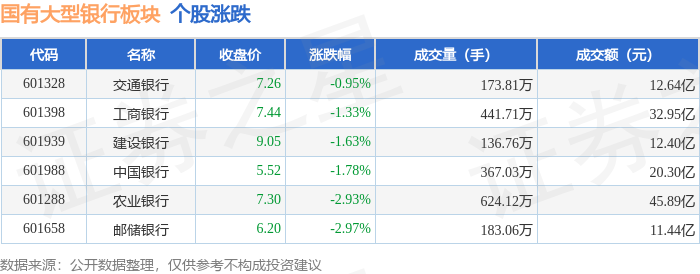
国有大型银行板块9月5日跌2.12%,邮储银行领跌,主力资金净流出6.32亿元
Zheng Xing Xing Ye Ri Bao· 2025-09-05 08:56
Core Viewpoint - The state-owned large banks sector experienced a decline of 2.12% on September 5, with Postal Savings Bank leading the drop, while the overall market indices showed an increase [1] Group 1: Market Performance - The Shanghai Composite Index closed at 3812.51, up 1.24% - The Shenzhen Component Index closed at 12590.56, up 3.89% [1] Group 2: Individual Bank Performance - Postal Savings Bank (601658) closed at 6.20, down 2.97% with a trading volume of 183.06 million and a turnover of 1.144 billion - Agricultural Bank of China (601288) closed at 7.30, down 2.93% with a trading volume of 624.12 million and a turnover of 4.589 billion - Industrial and Commercial Bank of China (601398) closed at 7.44, down 1.33% with a trading volume of 441.71 million and a turnover of 3.295 billion - China Construction Bank (601939) closed at 9.05, down 1.63% with a trading volume of 136.76 million and a turnover of 1.240 billion - Bank of China (601988) closed at 5.52, down 1.78% with a trading volume of 367.03 million and a turnover of 2.030 billion - Bank of Communications (601328) closed at 7.26, down 0.95% with a trading volume of 173.81 million and a turnover of 1.264 billion [1] Group 3: Fund Flow Analysis - The state-owned large banks sector saw a net outflow of 632 million from main funds, while retail funds experienced a net inflow of 71.03 million - The sector attracted a net inflow of 561 million from speculative funds [1][2] Group 4: Detailed Fund Flow for Individual Banks - Postal Savings Bank: Main funds net outflow of 32.03 million, speculative funds net inflow of 35.16 million, retail funds net outflow of 3.13 million - Industrial and Commercial Bank: Main funds net outflow of 54.24 million, speculative funds net inflow of 27.76 million, retail funds net inflow of 26.48 million - Bank of China: Main funds net outflow of 54.66 million, speculative funds net inflow of 101 million, retail funds net outflow of 46.28 million - China Construction Bank: Main funds net outflow of 95.08 million, speculative funds net inflow of 58.67 million, retail funds net inflow of 36.41 million - Bank of Communications: Main funds net outflow of 149 million, speculative funds net inflow of 116 million, retail funds net inflow of 33.23 million - Agricultural Bank: Main funds net outflow of 247 million, speculative funds net inflow of 223 million, retail funds net inflow of 24.33 million [2]