ICBC(601398)

Search documents
工行、农行、中行、建行、交行等,齐出手
中国基金报· 2025-11-28 14:35
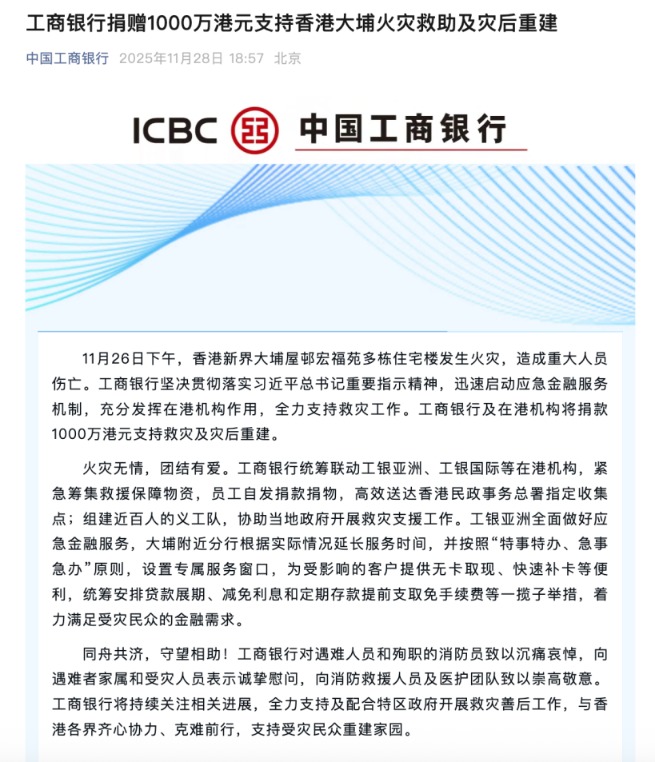
Core Viewpoint - Multiple banks in Hong Kong are actively supporting rescue and reconstruction efforts following a significant fire incident in Tai Po, New Territories, which resulted in major casualties [1] Group 1: Donations and Support Actions - Industrial and Commercial Bank of China (ICBC) donated 10 million HKD and organized a volunteer team to assist local government in rescue efforts [3] - Agricultural Bank of China (ABC) also donated 10 million HKD, focusing on supporting fire rescue and post-disaster recovery [6] - Bank of China (BOC) announced a donation of 20 million HKD and established a special account for public donations [11] - China Construction Bank (CCB) pledged 10 million HKD for emergency relief and recovery efforts, while also facilitating cross-border donations [15] - Bank of Communications (BoCom) plans to donate 10 million HKD and set up emergency service stations in affected areas [18] - Shanghai Bank and Minsheng Bank collectively donated over 50 million HKD, with Shanghai Bank contributing 10 million HKD and Minsheng Bank 5 million HKD [24] Group 2: Financial Services and Customer Support - ICBC is providing emergency financial services, including extended service hours and special service windows for affected customers [3] - ABC is coordinating with public welfare organizations for targeted donations and has initiated a volunteer team for disaster support [6] - BOC is expediting the reissuance of bank cards for affected customers and waiving related fees [12] - CCB is offering flexible identity verification and free reissuance of bank cards for customers unable to provide identification [15] - BoCom has set up priority service channels and is providing emergency cash support for affected customers [19]



工行、农行、中行、建行、交行等,齐出手
Zhong Guo Ji Jin Bao· 2025-11-28 14:26
Core Viewpoint - Multiple banks are taking urgent actions to support the rescue and reconstruction efforts following a significant fire incident in Hong Kong's Tai Po district, which resulted in major casualties and damage [1]. Group 1: Bank Contributions - Industrial and Commercial Bank of China (ICBC) has pledged HKD 10 million for disaster relief and reconstruction efforts, coordinating with its Hong Kong branches to provide emergency financial services and support [3]. - Agricultural Bank of China (ABC) is also donating HKD 10 million to assist in fire rescue and post-disaster recovery, while organizing volunteer teams to support affected families [6][7]. - Bank of China (BOC) has committed HKD 20 million, establishing a special donation account for public contributions and offering various financial support measures for affected customers [11][12]. - China Construction Bank (CCB) announced a donation of HKD 10 million and is providing flexible identity verification and fee waivers for affected customers [15][16]. - Bank of Communications plans to donate HKD 10 million and has set up emergency service stations to assist affected residents [19][20]. - Other banks, including Shanghai Bank and Minsheng Bank, collectively donated over HKD 50 million, with HSBC and Hang Seng Bank contributing HKD 30 million [25][26].
工行晋升全球系统重要性银行第三组,为中资银行首家
2 1 Shi Ji Jing Ji Bao Dao· 2025-11-28 13:18
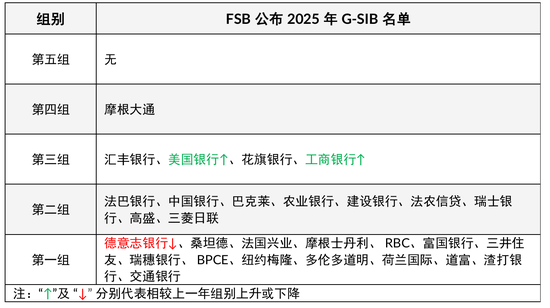
Core Insights - The Financial Stability Board (FSB) announced the 2025 Global Systemically Important Banks (G-SIB) list, with five Chinese commercial banks included, marking a significant recognition of their importance in the global financial system [1][2] Group Summaries Group Adjustments - Industrial and Commercial Bank of China (ICBC) has moved from the second group to the third group, becoming the first Chinese bank to enter the G-SIB third group, which indicates an increase in its global significance [1][2] - The additional capital requirement for ICBC will increase from 1.5% to 2.0% due to this group adjustment [1] Other Chinese Banks - The other four Chinese banks maintain their group positions: Bank of China, Agricultural Bank of China, and China Construction Bank remain in the second group, while Bank of Communications stays in the first group [1][2] G-SIB Evaluation Framework - The G-SIB evaluation framework, established post-2007 financial crisis, aims to enhance capital requirements for large banks to mitigate systemic risks [2][3] - The additional capital requirements for each group range from 1% for the first group to 3.5% for the fifth group, with higher groups facing stricter regulatory demands [3] Rating Changes and Factors - Fitch Ratings noted that the scoring changes for Chinese G-SIBs this year were driven by multiple factors rather than just size, with ICBC and Bank of China seeing significant score increases of 33 and 32 points, respectively [3] - Currency fluctuations positively impacted the scores of Chinese banks this year, although this effect may reverse in 2026 due to recent currency changes [3] Basel Committee Adjustments - The Basel Committee is considering changing the G-SIB identification framework from year-end static data to average values over the year, with a preference for quarterly averages among feedback [4] - If quarterly averages are adopted, the impact on most banks' final scores may be limited, but institutions near group thresholds could still experience changes [4] Capital Adequacy of ICBC - Standard & Poor's Global Ratings indicated that ICBC is capable of meeting the higher capital requirements, with a total loss-absorbing capacity capital ratio of 21.52% as of September 30, 2025, exceeding the minimum requirement for the third group [4] - ICBC's conservative growth strategy is expected to support capital retention and manage capital buffer pressures, with projected asset growth remaining controlled in the coming years [4]
六大行集体"下架"5年期大额存单?部分银行2022年后就已鲜少发售
Zheng Quan Shi Bao· 2025-11-28 13:07
Core Viewpoint - The absence of 5-year large denomination certificates of deposit (CDs) from major state-owned banks reflects a trend in the banking sector towards shorter-term products and more precise liability management in a low interest rate environment [1][2][3] Group 1: Current Market Situation - Major banks including Industrial and Commercial Bank of China, Agricultural Bank of China, Bank of China, China Construction Bank, Bank of Communications, and Postal Savings Bank currently do not offer 5-year large denomination CDs [1] - Bank of China has issued at least 37 batches of personal large denomination CDs from 2016 to 2025, but since 2023, 5-year CDs are only available to specific clients rather than all personal customers [1] - Agricultural Bank of China has not issued 5-year large denomination CDs since 2022, focusing instead on products with terms of 3 years or less [2] Group 2: Interest Rate Dynamics - Some banks are experiencing a phenomenon where the interest rate for 5-year fixed deposits is lower than that for 3-year fixed deposits, indicating a "negative spread" [2] - As of the third quarter of this year, the net interest margin for commercial banks was 1.42%, showing a year-on-year decrease of 11 basis points, despite some banks stabilizing their margins [2] Group 3: Strategic Adjustments - Banks are adopting more refined strategies for liability management, including shortening deposit terms and offering differentiated deposit strategies targeting specific customer segments, particularly the elderly [3] - The elderly demographic, which accounts for over 70% of savings deposits, is being targeted with higher interest rates and lower minimum deposit thresholds, optimizing the banks' liability structure and reducing liquidity management pressure [3] - This approach not only enhances the banks' ability to attract stable long-term funds but also aligns with social responsibility by providing tailored services to older customers, thereby building brand trust and achieving a balance between commercial and social value [3]



工行晋升全球系统重要性银行第三组 为中资银行首家
2 1 Shi Ji Jing Ji Bao Dao· 2025-11-28 13:00
Core Viewpoint - The Financial Stability Board (FSB) announced the 2025 Global Systemically Important Banks (G-SIB) list, with the Industrial and Commercial Bank of China (ICBC) moving from the second group to the third group, marking it as the first Chinese bank to enter the G-SIB third group, indicating an increased significance of Chinese banks in the global financial system [1] Group 1: G-SIB Classification and Capital Requirements - ICBC's additional capital requirement will increase from 1.5% to 2.0% following its group adjustment, while the other four Chinese banks maintain their current group standings [1] - The G-SIB evaluation framework, established post-2007 financial crisis, aims to enhance capital requirements for large banks to mitigate systemic risks [1] Group 2: Scoring Changes and Influencing Factors - The scoring changes for Chinese G-SIBs this year show that scale is no longer the primary driver for score increases, with ICBC and China Bank seeing significant score increases of 33 and 32 points respectively due to multiple sub-factors [2] - Currency fluctuations have positively impacted the scores of Chinese institutions this year, contrasting with historical trends where such factors typically alleviated score increases; however, future currency volatility may suppress scores [2] Group 3: Basel Committee Adjustments and Future Outlook - The Basel Committee is considering changing the G-SIB identification framework from year-end static data to average values over the year, with a preference for quarterly averages among feedback [3] - Standard & Poor's Ratings indicated that ICBC is capable of meeting the higher capital requirements, with a total loss-absorbing capacity capital ratio of 21.52% as of September 30, 2025, exceeding the minimum requirement for the third group [3] - ICBC's conservative growth strategy is expected to support capital retention and manage capital buffer pressures, with projected asset growth remaining controlled and loan growth likely in single digits over the next two years [3]
2025年全球系统重要性银行名单出炉!五大国有行入榜,工行组别上升
Guo Ji Jin Rong Bao· 2025-11-28 12:45
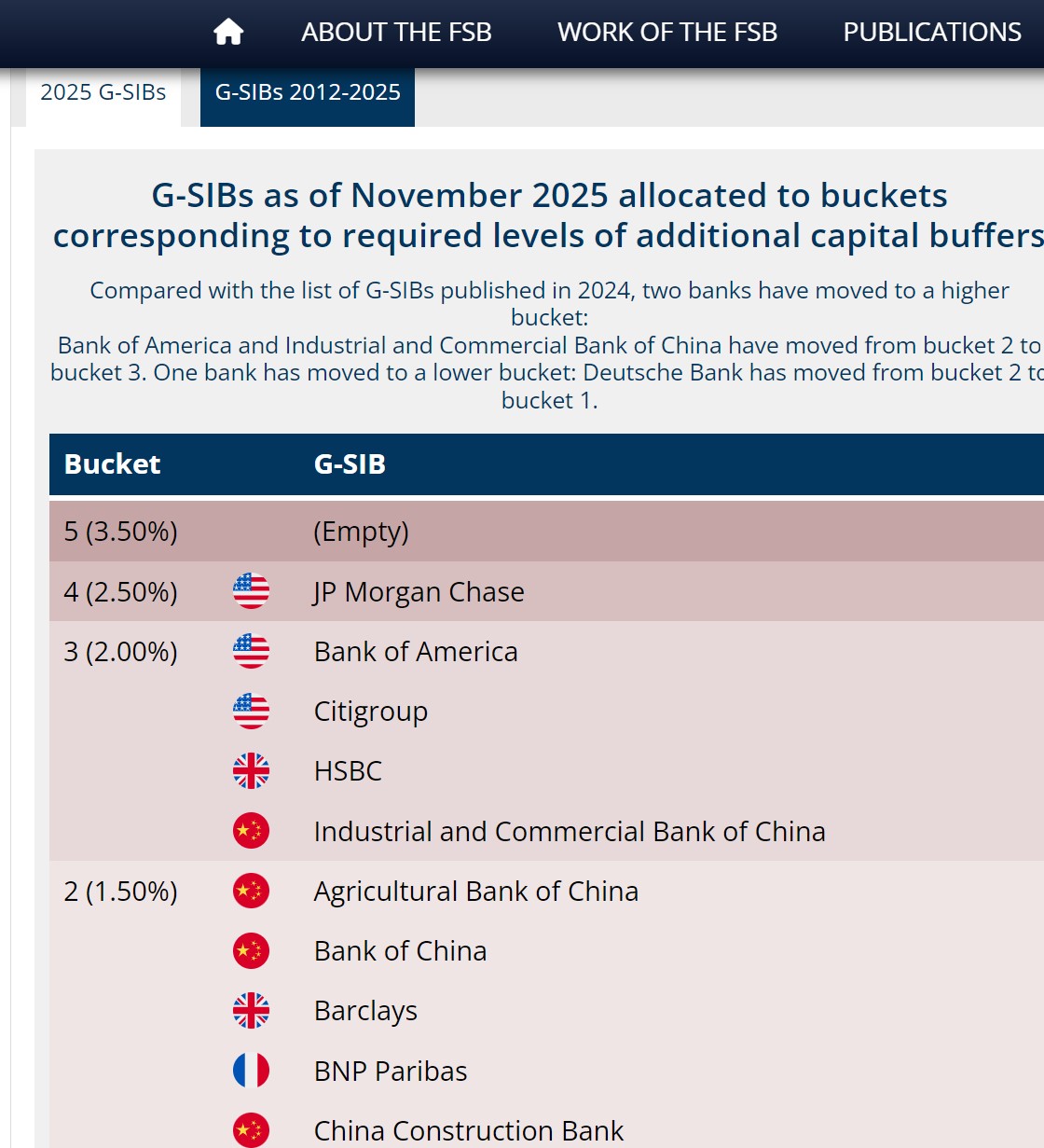
Core Points - The Financial Stability Board (FSB) released the 2025 list of Global Systemically Important Banks (G-SIBs) on November 27, 2023, with five major state-owned banks from China consistently included in the list [1] - Industrial and Commercial Bank of China (ICBC) has moved from the second group to the third group, while Agricultural Bank of China, Bank of China, and China Construction Bank remain in the second group, and Bank of Communications stays in the first group [1] Group 1: G-SIBs Classification and Requirements - The G-SIBs rating is based on five dimensions: size, interconnectedness, substitutability, financial institution infrastructure, complexity, and cross-border activities [4] - The 2025 list includes 29 G-SIBs, with the same institutions as in 2024 but with adjusted rankings reflecting changes in banks' core business activities [4] - An increase in group ranking leads to higher loss absorption requirements, effective from January 1, 2027 [4][5] Group 2: Capital Requirements and TLAC - Following the group elevation, ICBC's additional capital requirement will rise from 1.5% to 2.0% [5] - The total loss-absorbing capacity (TLAC) requirements for G-SIBs are aligned with international standards, with external TLAC risk-weighted ratios set to be no less than 16% from January 1, 2025, and 18% from January 1, 2028 [6] - TLAC bonds issued by the five major state-owned banks reached a total of 540 billion yuan, with 30 bonds issued as of November 28, 2025 [7]
2025年全球系统重要性银行名单出炉!五大国有行入榜 工行组别上升
Guo Ji Jin Rong Bao· 2025-11-28 12:44
Core Points - The Financial Stability Board (FSB) released the 2025 list of Global Systemically Important Banks (G-SIBs) on November 27, 2023, with five major state-owned banks from China consistently included in the list [1] - Industrial and Commercial Bank of China (ICBC) has moved from the second group to the third group, while Agricultural Bank of China, Bank of China, and China Construction Bank remain in the second group, and Bank of Communications stays in the first group [1][2] Group 1: G-SIBs Classification and Capital Requirements - The G-SIBs classification is based on five dimensions: size, interconnectedness, substitutability, financial institution infrastructure, complexity, and cross-border activities [2] - The 2025 list includes 29 G-SIBs, with the same institutions as in 2024 but with adjusted rankings reflecting changes in banks' core business activities [2] - ICBC's additional capital requirement will increase from 1.5% to 2.0% due to its group elevation, effective from January 1, 2027 [2][3] Group 2: Factors Influencing G-SIBs Scores - The increase in scores for ICBC and Bank of China by 33 and 32 points, respectively, is attributed to multiple sub-factors rather than size being the primary driver [3] - Chinese G-SIBs continue to outperform global peers in terms of size and interconnectedness metrics [3] - Currency fluctuations have positively impacted the scores of Chinese G-SIBs, contrasting with historical trends where currency factors typically alleviated score increases [3] Group 3: TLAC Requirements and Bond Issuance - G-SIBs must meet different capital requirements based on their group classification and adhere to Total Loss-Absorbing Capacity (TLAC) requirements [4] - TLAC is designed to ensure that G-SIBs can absorb losses and maintain critical functions during resolution [4] - As of November 28, 2025, the five major state-owned banks have issued a total of 30 TLAC bonds amounting to 540 billion yuan [5] - The issuance of TLAC bonds from 2024 to 2025 is expected to be lower than anticipated, with a projected net supply of around 300 billion yuan in 2026 [5]
延长服务时间、提供延迟还款宽限期!银行业驰援香港大埔火灾救助
Bei Jing Shang Bao· 2025-11-28 12:05
Group 1 - The major fire incident at Hong Kong's Tai Po Wang Fuk Court has led to significant casualties and has drawn attention from various sectors of society [1] - The banking industry has quickly activated emergency mechanisms, providing donations, material support, and financial service green channels to establish a "financial lifeline" for disaster relief [1] - Agricultural Bank of China, along with its local institutions, will donate HKD 10 million to support fire rescue and post-disaster reconstruction efforts [1] - Industrial and Commercial Bank of China (ICBC) and its local institutions will also contribute HKD 10 million for disaster relief and reconstruction [1] - China Construction Bank is donating HKD 10 million for emergency rescue, transitional housing, and post-disaster recovery, while also opening a green channel for cross-border donations [1] - Minsheng Bank's Hong Kong branch will donate HKD 5 million to the "Tai Po Wang Fuk Court Relief Fund" established by the Hong Kong government for emergency assistance [1] - Bank of China Hong Kong will contribute HKD 20 million and establish a dedicated account for public donations [1] Group 2 - China Construction Bank (CCB) Asia has initiated three emergency measures for affected residents, including flexible identity verification for withdrawals and waiving early withdrawal fees for fixed deposits [2] - CCB Asia has also launched a fundraising campaign, raising HKD 2 million for emergency relief and community rebuilding efforts [2] - ICBC Asia's Tai Po branch has extended service hours and set up dedicated service windows for affected customers, offering various conveniences such as cardless cash withdrawals and expedited card replacements [2] - Bank of Communications (Hong Kong) has established emergency service stations and extended branch hours, providing fee-free withdrawals and flexible loan arrangements for affected customers [2]


工商银行(01398) - 董事会决议公告
2025-11-28 12:05
(於中華人民共和國註冊成立的股份有限公司) 股份代號:1398 董事會決議公告 中國工商銀行股份有限公司(「本行」)董事會於2025年11月28日採用書面傳簽方式召開 會議。會議的召開符合法律法規、《中國工商銀行股份有限公司章程》以及《中國工商銀 行股份有限公司董事會議事規則》的規定。 會議審議通過了《關於香港大埔火災事件專項捐贈事項的議案》。 香港交易及結算所有限公司及香港聯合交易所有限公司對本公告之內容概不負責,對其準確性或完整性亦不發表 任何聲明,並明確表示,概不就因本公告全部或任何部份內容而產生或因倚賴該等內容而引致之任何損失承擔任 何責任。 中國工商銀行股份有限公司 INDUSTRIAL AND COMMERCIAL BANK OF CHINA LIMITED 中國工商銀行股份有限公司 董事會 中國,北京 2025年11月28日 於本公告刊發日期,董事會成員包括執行董事廖林先生、劉珺先生、段紅濤先生和王景武先生;非執行董事曹利 群女士、董陽先生和鐘蔓桃女士;獨立非執行董事陳德霖先生、赫伯特•沃特先生、莫里•洪恩先生、陳關亭先生和 李偉平先生。 議案表決情況:有效表決票12票,同意12票,反對0票,棄 ...
2025年全球系统重要性银行名单公布,我国5家银行入选
Zhong Guo Jing Ying Bao· 2025-11-28 11:54
Core Viewpoint - The Financial Stability Board (FSB) has released the updated list of Global Systemically Important Banks (G-SIBs) for 2025, which includes five banks from China, maintaining the same number as in 2024 but with adjustments in classification groups [1] Group 1: Inclusion of Chinese Banks - Five Chinese banks have been included in the 2025 G-SIBs list: Industrial and Commercial Bank of China, Agricultural Bank of China, Bank of China, China Construction Bank, and Bank of Communications [1] - The classification groups for these banks have been adjusted, with Bank of Communications in Group 1 (additional capital requirement of 1%), Agricultural Bank of China, Bank of China, and China Construction Bank in Group 2 (additional capital requirement of 1.5%), and Industrial and Commercial Bank of China in Group 3 (additional capital requirement of 2.0%) [1]