
ICBC(601398)

Search documents
避险情绪升温,百亿银行ETF华宝(512800)向上突破,营收净利双增,工商银行涨超2%
Sou Hu Cai Jing· 2026-03-30 11:25
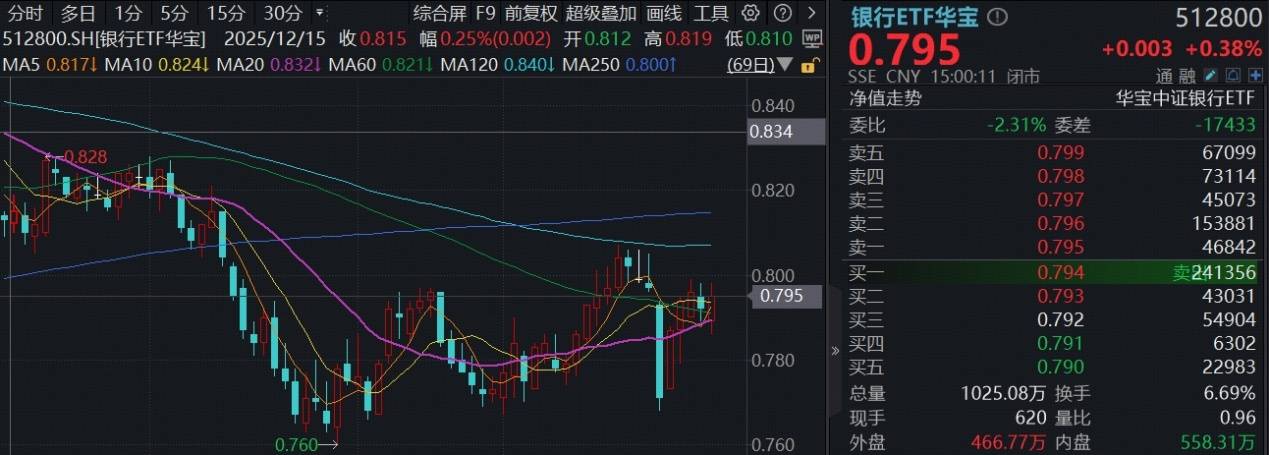
Core Viewpoint - The banking sector shows resilience amid geopolitical tensions, with a focus on high-dividend defensive assets attracting investor interest [3] Group 1: Market Performance - On March 30, the Shanghai Composite Index rose by 0.24% after initially dropping over 1%, while the ChiNext and Shenzhen Composite Indices fell [1] - The banking sector demonstrated defensive characteristics, with most individual stocks closing higher; Xiamen Bank led with a nearly 4% increase, and major banks like ICBC and Bank of China also saw gains [1] Group 2: Banking Sector Insights - Major state-owned banks, including ICBC, CCB, BOC, and PSBC, reported annual results showing steady asset growth and increases in both revenue and net profit [3] - Despite challenges such as narrowing net interest margins, bank management expressed optimism about stabilizing margins, which received positive market feedback [3] - According to CITIC Securities, the disclosed bank performance aligns with expectations, and future disclosures are likely to show minimal deviations from forecasts [3] Group 3: Investment Opportunities - With rising risk aversion, the banking sector is expected to benefit from increased allocation due to its defensive characteristics and potential for fundamental improvements [3] - The banking ETF (512800) has a significant scale of over 12 billion, making it the largest and most liquid among A-share banking ETFs, with an average daily trading volume exceeding 800 million since 2025 [4]



宇宙行的“双轴”叙事
华尔街见闻· 2026-03-30 08:16
Core Viewpoint - The financial report of the Industrial and Commercial Bank of China (ICBC) serves as a precise reflection of China's macroeconomic dynamics, highlighting its dual role in supporting both the real economy and consumer spending [1][2]. Group 1: Asset and Profitability Performance - ICBC has achieved a net profit of 370.77 billion yuan in 2025, marking a year-on-year increase of 1.0%, while operating income exceeded 800 billion yuan, growing by 1.9% [2]. - The total assets of ICBC reached 53.48 trillion yuan, representing a 9.5% increase from the previous year [2]. - The bank's non-performing loan ratio decreased by 3 basis points, with capital adequacy and provision coverage ratios remaining at high levels, demonstrating strong resilience [3]. Group 2: Strategic Focus on Supply and Demand - ICBC's strategy emphasizes a dual approach of strengthening the supply side while nurturing the demand side, which has translated into operational resilience against cyclical fluctuations [2][3]. - The bank's corporate loans reached 18.84 trillion yuan by the end of 2025, with an increase of 1.36 trillion yuan from the previous year, reflecting its deep integration into the industrial chain [3]. Group 3: Sector-Specific Investments - In the industrial sector, ICBC's manufacturing loans amounted to 5.24 trillion yuan, with a growth rate of 19.4%, positioning it as a leader in the industry [5]. - The bank has expanded its cross-border financial services, with the number of overseas RMB clearing banks increasing to 12 and cross-border RMB business volume surpassing 10 trillion yuan [6]. - ICBC's technology loans reached 6 trillion yuan, supported by innovative risk pricing models and a focus on high-quality sectors [7]. Group 4: Retail Banking and Consumer Support - By the end of 2025, ICBC's domestic branches increased RMB loans by 2.17 trillion yuan, with personal consumption loans growing by 18.5% and personal operating loans by 15% [8]. - The bank has actively implemented policies to stimulate domestic demand, including significant investments in personal auto finance and consumer loan interest subsidies [9]. - ICBC has established over 9,300 specialized financial outlets for elderly services and launched various pension investment solutions to cater to the aging population [9][10]. Group 5: Risk Management and Future Outlook - ICBC is enhancing its risk management capabilities through intelligent risk control measures, ensuring high-quality development and safety [10]. - The bank's dual focus on industrial and consumer sectors positions it well to navigate economic fluctuations and sustain growth during the 14th Five-Year Plan period [11][12]. - Looking ahead, ICBC aims to continue providing robust support for China's high-quality economic development through efficient capital allocation [13].
大行评级丨花旗:工商银行估值仍具吸引力,H股目标价7.95港元
Ge Long Hui· 2026-03-30 08:05
Core Viewpoint - Citigroup's report indicates that Industrial and Commercial Bank of China (ICBC) experienced a slight year-on-year profit growth of 0.7% to 368.6 billion yuan, with pre-provision profit increasing by 1.9% to 554.5 billion yuan, slightly below expectations [1] Group 1: Financial Performance - In Q4, pre-provision profit grew by 3% year-on-year, benefiting from an improved cost-to-income ratio [1] - Net profit in Q4 increased by 1.9% year-on-year, a slowdown from 3.3% in Q3, primarily due to rising credit costs, partially offset by a decrease in tax rates [1] Group 2: Future Projections - Citigroup anticipates that ICBC will receive a capital injection of approximately 100 billion yuan, which is expected to dilute earnings per share by about 3% to 4%, lower than Agricultural Bank of China [1] - Considering potential dilution, ICBC's H-shares are currently valued at a projected price-to-book ratio of 0.52 times for 2026, with an estimated dividend yield of 5.2%, indicating attractive valuation [1] Group 3: Ratings and Target Price - Citigroup has set a target price of 7.95 HKD for ICBC's H-shares and maintains a "Buy" rating [1]
大行评级丨瑞银:工商银行去年第四季及全年业绩稳健,评级“买入”
Ge Long Hui· 2026-03-30 07:37
Group 1 - The core viewpoint of the report indicates that the Industrial and Commercial Bank of China (ICBC) demonstrated stable performance in the fourth quarter and for the entire year, aligning with industry expectations and the bank's own forecasts [1] - In Q4, the net interest margin expanded by 2 basis points quarter-on-quarter, and core earnings growth turned positive [1] - The bank's net profit attributable to shareholders increased by 0.7% year-on-year to 368.6 billion yuan, slightly exceeding market expectations [1] Group 2 - Management anticipates a continued moderate decline in loan yield this year, but at a significantly slower pace, with new loan yields stabilizing in the first two months of the year [1] - Assuming no further interest rate cuts, the net interest margin is expected to exhibit an L-shaped trend, with net interest income likely to recover to positive growth this year [1] - The bank has set a target price of HKD 7.79 for ICBC's H-shares, maintaining a "Buy" rating [1]
花旗:给予工商银行目标价7.95港元与“买入”评级 Q4业绩略逊于预期
Zhi Tong Cai Jing· 2026-03-30 07:03
Core Viewpoint - Citigroup has issued a report giving Industrial and Commercial Bank of China (ICBC) a target price of HKD 7.95 and a "Buy" rating, anticipating an injection of approximately RMB 100 billion from Central Huijin Investment [1] Group 1: Financial Performance - The company's net profit for the last year increased by 0.7% year-on-year to RMB 368.6 billion [1] - The pre-provision profit grew by 1.9% year-on-year to RMB 554.5 billion, slightly below Citigroup's expectations [1] - In Q4, the pre-provision profit rose by 3% year-on-year, benefiting from an improved cost-to-income ratio [1] Group 2: Future Projections - The anticipated dilution from the capital injection is expected to reduce earnings per share by approximately 3% to 4%, which is lower than that of Agricultural Bank of China [1] - After considering potential dilution, ICBC's H-shares are projected to correspond to a price-to-book ratio of 0.52 times for 2026, with a forecasted dividend yield of 5.2%, indicating attractive valuation [1] Group 3: Quarterly Performance - In Q4, the net profit increased by 1.9% year-on-year, a slowdown compared to Q3's growth of 3.3%, primarily due to rising credit costs, partially offset by a decrease in tax rates [1]
花旗:给予工商银行(01398)目标价7.95港元与“买入”评级 Q4业绩略逊于预期
智通财经网· 2026-03-30 06:55
Core Viewpoint - Citigroup has issued a report giving Industrial and Commercial Bank of China (ICBC) a target price of HKD 7.95 and a "Buy" rating, anticipating a capital injection of approximately RMB 100 billion from Central Huijin Investment [1] Financial Performance - The company's net profit for the last year increased by 0.7% year-on-year to RMB 368.6 billion, while the pre-provision profit rose by 1.9% to RMB 554.5 billion, slightly below Citigroup's expectations [1] - In the fourth quarter, the pre-provision profit grew by 3% year-on-year, benefiting from an improved cost-to-income ratio [1] - The net profit in the fourth quarter increased by 1.9% year-on-year, a slowdown compared to 3.3% in the third quarter, primarily due to rising credit costs, partially offset by a decrease in tax rates [1] Valuation Metrics - After considering potential dilution from the capital injection, ICBC's H-shares are trading at a forecasted price-to-book ratio of 0.52 times for 2026, with an expected dividend yield of 5.2%, indicating attractive valuation [1]
A股银行股逆势上涨,工商银行涨超2%
Ge Long Hui· 2026-03-30 06:08
Group 1 - A-shares of bank stocks are rising against the trend, with Xiamen Bank increasing nearly 4% [1] - Industrial and Commercial Bank of China (ICBC) has risen over 2% [1] - Other banks such as Bank of China, Chongqing Bank, Bank of Communications, China Construction Bank, and Shanghai Bank have all increased by more than 1% [1]
银行投资观察20260329:石油冲击对流动性的影响再解析
GF SECURITIES· 2026-03-29 14:48
Core Insights - The report emphasizes the impact of oil price shocks on liquidity, suggesting that the ability to transmit cost shocks downstream will be stronger than previous oil price impacts, with expectations of nominal price increases in Q2 2026 [19][20][21] - It highlights that while medium-term demand remains optimistic, caution is advised regarding the contraction of broad liquidity in Q2 2026, particularly due to cross-border liquidity constraints and rising long-term interest rates affecting investment returns [19][21] Section Summaries 1. Current Observation - The banking sector overall declined by 0.8% during the observation period from March 23 to March 27, 2026, underperforming the Wind All A index, which fell by 0.7% [17] - State-owned banks, joint-stock banks, city commercial banks, and rural commercial banks experienced declines of -1.29%, -0.42%, -0.85%, and -0.47% respectively [17] - In contrast, H-shares of banks outperformed, with the Hang Seng Index down 1.2% while H-share banks gained 0.5% [17] 2. Investment Recommendations - The report suggests that the market's concerns regarding the demand side of the Chinese economy and cost transmission are overly pessimistic, given the supportive fiscal policies and stabilization in the real estate cycle [19] - It recommends caution regarding the contraction of liquidity in Q2 2026, emphasizing the importance of cross-border liquidity as a key variable for supporting Chinese asset liquidity [19][20] 3. Sector Performance - The banking sector's average price for convertible bonds fell by 0.67%, underperforming the convertible bond index by 1.95 percentage points [18] - The report notes that the profitability growth expectations for 2025 remain largely unchanged for seven banks, indicating stability in earnings forecasts [18] 4. Individual Stock Performance - Among A-share banks, Ping An Bank and Shanghai Rural Commercial Bank saw increases of 2.32% and 1.25% respectively, while Chongqing Bank experienced a decline of 6.55% [17] - In H-shares, Chongqing Rural Commercial Bank and Bank of China rose by 4.68% and 3.40%, while Bohai Bank and Jiangxi Bank fell by 3.45% and 1.49% respectively [17] 5. Valuation and Financial Analysis - As of March 27, 2026, the banking sector's latest price-to-earnings ratio (TTM) is 6.84X, and the price-to-book ratio is 0.67X, indicating that valuations are at historical average levels [45] - The report provides detailed financial metrics for key banks, including expected earnings per share and return on equity for 2026 and 2027, supporting the investment recommendations [9]

银行“火拼”消费贷、经营贷
第一财经· 2026-03-29 14:43
Core Viewpoint - The article highlights the rising trend of non-performing loan (NPL) ratios in personal loans across major banks, attributing this to macroeconomic changes and the ongoing adjustment in the real estate sector, while emphasizing the importance of risk management in consumer and business loans [3][10]. Group 1: Personal Loan Quality Trends - As of March 27, 2026, major banks like ICBC, CCB, and others have reported an increase in personal loan NPL ratios, with many attributing this to external macroeconomic factors [3][10]. - The personal loan NPL ratio for state-owned banks has approached 1.6%, with ICBC and CCB both reporting NPL ratios of 1.58%, marking an increase from the previous year [10][11]. - The shift in consumer demand due to the real estate market's downturn has led to a contraction in housing loans, while consumer and business loans have become focal points for banks [6][10]. Group 2: Loan Composition and Performance - By the end of 2025, CCB and ICBC's personal loan balances exceeded 9 trillion yuan, with CCB leading in housing, consumer, and credit card loans, while ICBC led in business loans by over 600 billion yuan [6][8]. - The consumer loan and business loan segments have seen significant growth, with CCB reporting nearly 30% growth in both areas, contrasting with the decline in housing loans [6][10]. - Credit card business has faced challenges, with all eight banks reporting a decline in credit card balances, particularly ICBC and Postal Savings Bank, which saw declines exceeding 10% [7][10]. Group 3: Risk Management and Future Outlook - CCB's management has emphasized the importance of optimizing credit risk management mechanisms in response to rising risks in the retail sector, indicating a focus on risk control moving forward [11][12]. - ICBC's leadership has acknowledged the short-term rise in personal loan NPL ratios but remains optimistic about long-term stability, citing strong economic fundamentals and the potential for improved asset quality through policy support [11][12]. - The article notes that while consumer and business loans are growing rapidly, the associated risks are also increasing, necessitating careful monitoring and management [10][13].


银行资负跟踪20260329:大行转贴净买入有限
GF SECURITIES· 2026-03-29 13:08
Investment Rating - The industry investment rating is "Buy" [3] Core Insights - The report indicates that large banks have limited net buying activity, with a monthly cumulative net purchase of 46.8 billion yuan as of March 26, which is a decrease of approximately 200 billion yuan month-on-month but an increase of about 50 billion yuan year-on-year. It is expected that credit issuance may slightly decline compared to March 2025, but the initial performance remains strong [7][20] - The central bank's operations included a net injection of 281.9 billion yuan through various monetary policy tools, with a focus on maintaining liquidity stability as the quarter-end approaches [16] - The report highlights that the liquidity environment is expected to tighten in April due to tax payments and annual settlement pressures, with potential increases in funding rates towards the end of the month [16][17] Summary by Sections Section 1: March Credit Performance - The data shows that the funding environment remains stable as the quarter-end approaches, with large banks gradually reducing their lending from 4.37 trillion yuan to 3.78 trillion yuan [16] - The report emphasizes the importance of monitoring the upcoming PMI data and bank annual reports for insights into future liquidity trends [23] Section 2: Central Bank Dynamics and Market Rates - The central bank conducted 4.742 trillion yuan in 7-day reverse repos, with a net injection of 281.9 billion yuan after accounting for maturing operations [16] - Market rates for various instruments, including treasury bonds and NCDs, have shown slight fluctuations, with the 1-year treasury yield at 1.25% and the average NCD issuance rate at 1.52% [17][18] Section 3: Bank Financing Tracking - The total outstanding amount of interbank certificates of deposit (NCDs) is 18.19 trillion yuan, with a weighted average issuance rate of 1.65% [21] - The report notes that there were no new issuances of commercial bank bonds during the period, and the total outstanding amount of commercial bank bonds is 3.32 trillion yuan [22]
