Workflow
BOCIC(601696)
icon
Search documents
研报掘金丨中银证券:安井食品主业营收稳健,维持“买入”评级
Ge Long Hui· 2025-11-06 09:06
Core Viewpoint - The report from Zhongyin Securities indicates that Anyi Foods' net profit attributable to shareholders for the first three quarters of 2025 is 950 million yuan, reflecting a year-on-year decrease of 9.3% [1] Financial Performance - In Q3 2025, the company's revenue and net profit attributable to shareholders were 377 million yuan and 27 million yuan, respectively, showing year-on-year increases of 6.6% and 11.8% [1] - The main business revenue of the company remained stable in Q3, with new channel performance contributing positively [1]
华虹公司股价涨5.08%,中银证券旗下1只基金重仓,持有3.52万股浮盈赚取21.65万元
Xin Lang Cai Jing· 2025-11-06 03:38
Core Viewpoint - Huahong Semiconductor Company experienced a 5.08% increase in stock price, reaching 127.12 CNY per share, with a trading volume of 2.703 billion CNY and a turnover rate of 5.40%, resulting in a total market capitalization of 220.611 billion CNY [1] Company Overview - Huahong Semiconductor, established on January 21, 2005, and listed on August 7, 2023, is primarily engaged in specialty process wafer foundry services in China [1] - The company offers a diverse range of wafer foundry and supporting services, including embedded/standalone non-volatile memory, power devices, analog and power management, logic, and RF [1] - The revenue composition of the company is as follows: integrated circuit wafer foundry 94.60%, other services 4.78%, and rental income 0.62% [1] Fund Holdings - Huahong Company is a significant holding in one fund managed by Bank of China Securities, specifically the BOC Securities Advantage Manufacturing Stock A (011269), which held 35,200 shares, accounting for 4.4% of the fund's net value [2] - The fund has achieved a year-to-date return of 50.01%, ranking 519 out of 4,216 in its category, and a one-year return of 38.49%, ranking 794 out of 3,909 [2] Fund Manager Information - The fund manager of BOC Securities Advantage Manufacturing Stock A is Zhang Lixin, who has been in the position for 2 years and 319 days, managing a total fund size of 148 million CNY [3] - During Zhang's tenure, the best fund return was 4.4%, while the worst return was -5.35% [3]
海光信息股价涨5%,中银证券旗下1只基金重仓,持有5.5万股浮盈赚取61.11万元
Xin Lang Cai Jing· 2025-11-06 02:36
Group 1 - The core point of the news is that Haiguang Information has seen a 5% increase in stock price, reaching 233.11 CNY per share, with a trading volume of 4.73 billion CNY and a market capitalization of 541.83 billion CNY [1] - Haiguang Information Technology Co., Ltd. was established on October 24, 2014, and went public on August 12, 2022. The company specializes in the research, design, and sales of high-end processors used in servers and workstations, with 99.73% of its revenue coming from high-end processors [1] Group 2 - According to data from the top ten heavy stocks of funds, a fund under Bank of China Securities has heavily invested in Haiguang Information, increasing its holdings by 5,000 shares in the third quarter, bringing the total to 55,000 shares, which accounts for 3.27% of the fund's net value [2] - The Bank of China Securities Technology Innovation Mixed Fund (LOF) has achieved a return of 61.14% this year, ranking 444 out of 8149 in its category, and a return of 48.28% over the past year, ranking 675 out of 8053 [2] Group 3 - The fund manager of the Bank of China Securities Technology Innovation Mixed Fund (LOF) is Lin Bocheng, who has been in the position for 7 years and 240 days, with a total asset scale of 1.186 billion CNY [3] - During Lin Bocheng's tenure, the best fund return was 110.75%, while the worst return was -48.35% [3]
基金分红:中银证券安澈债券基金11月10日分红
Sou Hu Cai Jing· 2025-11-06 01:40
Core Viewpoint - The announcement details the fourth dividend distribution for the Zhongyin Securities Anche Bond Fund in 2025, highlighting the distribution plan and key dates for investors [1]. Summary by Sections Dividend Distribution Details - The dividend distribution is the fourth for the year 2025, with a distribution base date set for October 10, 2025 [1]. - The specific dividend distribution plan includes: - Zhongyin Securities Anche Qian Bond A (Code: 018718) with a net asset value of 1.01 yuan and a distribution of 0.07 yuan per 10 shares - Zhongyin Securities Anhui Xin Bond C (Code: 018719) with a net asset value of 1.02 yuan and a distribution of 0.07 yuan per 10 shares [1]. Key Dates - The equity registration date for the dividend is November 7, 2025, and the cash dividend payment date is November 10, 2025 [1]. - For investors opting for reinvestment of dividends, the net asset value for conversion will be determined on November 7, 2025, with shares credited to their accounts on November 10, 2025 [1]. - Investors can start processing inquiries and redemptions for the reinvested shares from November 11, 2025 [1]. Tax and Fees - The fund's dividend distribution is exempt from income tax as per relevant laws and regulations [1]. - There are no fees for the dividend distribution, and investors choosing the reinvestment option will not incur subscription fees for the converted shares [1].
A股低开高走显韧性 机构称市场仍处于上行通道
Market Overview - On November 5, the A-share market opened lower but closed higher, with all three major indices rising, particularly the ChiNext Index which increased by over 1% [1][2] - The total trading volume in the A-share market was 1.89 trillion yuan, marking a decrease of 441 billion yuan from the previous trading day [2] - The market has seen a continuous decline in trading volume, dropping from 2.46 trillion yuan on October 30 to 1.89 trillion yuan on November 5, with two consecutive days below 2 trillion yuan [2] Sector Performance - Active sectors included ultra-high voltage, photovoltaic inverters, lithium battery anodes, virtual power plants, and energy storage [1][2] - The electric equipment sector experienced a surge, with stocks like Double Star Electric and Arctech Solar hitting the 20% limit up [3] - Among the Shenwan first-level industries, electric equipment, coal, and retail sectors saw the highest gains, increasing by 3.40%, 1.39%, and 1.22% respectively [2] Fund Flow Analysis - On November 5, the net outflow of main funds in the Shanghai and Shenzhen markets significantly decreased to 134.15 billion yuan, compared to over 570 billion yuan on November 4 [4] - A total of 1,935 stocks saw net inflows, while 3,219 stocks experienced net outflows [4] - The electric equipment sector attracted significant net inflows, with Sunshine Power receiving over 15 billion yuan and CATL over 10 billion yuan [5] Market Sentiment and Future Outlook - Analysts suggest that the market is currently in a slow upward channel, with structural opportunities likely to dominate the market in November [6][7] - The technology sector is experiencing a high-level consolidation, while cyclical stocks may present short-term rotation opportunities due to macro policy expectations [6] - The market is expected to continue its high-level consolidation, with a focus on sectors with high performance and valuation alignment, particularly in AI computing, semiconductors, and renewable energy [7]
骄成超声股价涨5.5%,中银证券旗下1只基金重仓,持有2.64万股浮盈赚取14.8万元
Xin Lang Cai Jing· 2025-11-05 06:56
Core Viewpoint - The stock of Shanghai Jiao Cheng Ultrasonic Technology Co., Ltd. has increased by 5.5%, reaching 107.55 CNY per share, with a total market capitalization of 12.447 billion CNY [1] Company Overview - Shanghai Jiao Cheng Ultrasonic Technology Co., Ltd. was established on February 13, 2007, and went public on September 27, 2022 [1] - The company specializes in the research, design, production, and sales of ultrasonic welding and cutting equipment and accessories, as well as providing automation solutions for the new energy battery manufacturing sector [1] Revenue Composition - The revenue breakdown of the company's main business is as follows: - Accessories: 31.42% - Ultrasonic equipment for new energy batteries: 25.86% - Services and others: 18.51% - Ultrasonic equipment for wire harness connectors: 13.92% - Ultrasonic equipment for semiconductors: 8.03% - Ultrasonic equipment for non-metal materials: 2.09% - Others (supplementary): 0.18% [1] Fund Holdings - A fund under Bank of China Securities holds a significant position in Jiao Cheng Ultrasonic, with 26,400 shares, accounting for 4.46% of the fund's net value, making it the eighth largest holding [2] - The fund, Bank of China New Energy Mixed A (005571), has a total scale of 35.507 million CNY and has achieved a year-to-date return of 42.84% [2] Fund Manager Performance - The fund manager, Zhang Lixin, has been in position for 2 years and 318 days, with the fund's total assets amounting to 14.8 million CNY [3] - During Zhang's tenure, the best fund return was 4.4%, while the worst was -5.35% [3]
欣旺达股价涨5.06%,中银证券旗下1只基金重仓,持有6.21万股浮盈赚取10.62万元
Xin Lang Cai Jing· 2025-11-05 05:52
Group 1 - The core point of the news is that XINWANDA's stock price increased by 5.06% to 35.52 CNY per share, with a trading volume of 2.849 billion CNY and a turnover rate of 4.81%, resulting in a total market capitalization of 65.622 billion CNY [1] - XINWANDA is primarily engaged in the research, design, production, and sales of lithium-ion battery modules, with revenue composition as follows: consumer batteries 51.47%, electric vehicle batteries 28.18%, others 16.63%, and energy storage systems 3.72% [1] Group 2 - According to data, a fund under Bank of China Securities holds a significant position in XINWANDA, with the Bank of China CSI 500 ETF (515190) holding 62,100 shares, accounting for 0.54% of the fund's net value, ranking as the eighth largest holding [2] - The Bank of China CSI 500 ETF (515190) has a current scale of 390 million CNY and has achieved a year-to-date return of 27.07%, ranking 1931 out of 4216 in its category [2] Group 3 - The fund managers of the Bank of China CSI 500 ETF (515190) are Liu Xianzheng and Zhang Yimin, with Liu having a tenure of 7 years and 282 days and Zhang having a tenure of 5 years and 53 days [3] - Liu's best fund return during his tenure is 118.04%, while Zhang's best return is 22.43% [3]
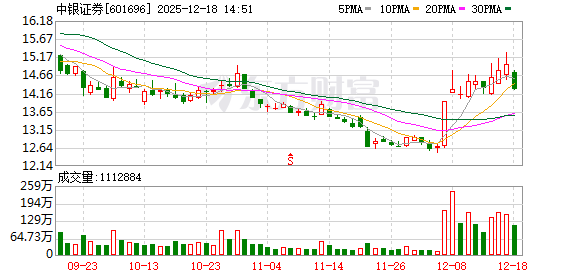
股票行情快报:中银证券(601696)11月4日主力资金净卖出2794.60万元
Sou Hu Cai Jing· 2025-11-04 11:54
Core Viewpoint - As of November 4, 2025, Zhongyin Securities (601696) closed at 13.82 yuan, experiencing a decline of 0.36% with a trading volume of 307,400 hands and a transaction value of 423 million yuan [1] Fund Flow Analysis - On November 4, 2025, the net outflow of main funds was 27.946 million yuan, accounting for 6.6% of the total transaction value, while retail investors saw a net inflow of 23.0833 million yuan, representing 5.45% of the total transaction value [1] - Over the past five days, the stock has shown significant fluctuations in fund flows, with the largest net outflow recorded on November 3, 2025, at 156 million yuan, which constituted 27.33% of the total transaction value [2] Company Financial Performance - For the first three quarters of 2025, Zhongyin Securities reported a main revenue of 2.438 billion yuan, a year-on-year increase of 26.95%, and a net profit attributable to shareholders of 854 million yuan, up 29.28% year-on-year [3] - The third quarter of 2025 alone saw a main revenue of 933 million yuan, reflecting a 38.33% year-on-year increase, and a net profit of 289 million yuan, which is a 22.37% increase year-on-year [3] - The company's debt ratio stands at 79.44%, with investment income reported at 276 million yuan [3] Industry Comparison - Zhongyin Securities has a total market value of 38.392 billion yuan, which is significantly lower than the industry average of 75.743 billion yuan, placing it 31st in the industry ranking [3] - The company's net profit margin is 35.03%, which is below the industry average of 43.22%, ranking it 27th in the industry [3] - The price-to-earnings ratio (P/E) for Zhongyin Securities is 33.71, slightly above the industry average of 32.92, ranking it 67th [3]
通胀、外贸与房地产视角:在A股转入“慢牛”、房价未显著回升的情景下,长期收益率可能维持震荡
1. Report Industry Investment Rating - Not mentioned in the provided content 2. Core Views of the Report - In the scenario where the A - share market turns into a "slow - bull" and housing prices do not rebound significantly, long - term bond yields are likely to remain in a volatile pattern, and the low - interest - rate state will basically stay the same [5][84][85]. - In the long run, China is probably in the "bear - steepening" phase of the yield curve as it emerges from the low - interest - rate state, but the speed of "bear - steepening" is uncertain. Long - term yields are expected to rise ahead of short - term yields, and short - term yields will tend to be stable before long - term yields continue to rise [5][84]. - The relationship between China's long - term yields and the real estate cycle has strengthened in recent years. The new 500 billion yuan policy - based financial instruments and the newly issued 500 billion yuan local government debt may ensure that the social financing growth rate at the end of this year is roughly similar to that at the end of the third quarter, without a significant increase [5][84]. - The central bank's decision to resume Treasury bond trading reflects its intention to maintain yield stability, and the bond market's volatile pattern may become more obvious. The base - money injection effect of Treasury bond trading may replace reserve requirement ratio cuts [5][84]. 3. Summaries According to Related Catalogs 3.1 Low - Interest - Rate Period: Japan's Experience - The root cause of low interest rates is generally relatively low financing demand, and low interest rates and low asset values (except for fixed - income assets) are often two sides of the same coin. Japan entered a low - interest - rate era after the asset bubble burst in the 1990s [13]. - From 1990 - 1998, Japan's interest rates declined rapidly. The Bank of Japan cut interest rates 9 times from 1991 - 1995, and the 10 - year Japanese government bond yield dropped from about 8% in 1990 to below 1% in September 1998 [13]. - After 1998, Japanese bond yields entered a new low - level range. Japan's economy remained in a low - inflation state until the post - pandemic period when inflation increased, leading to a turning point in its long - term loose monetary policy [13]. - When the main inflation indicators (such as CPI growth) fluctuate around 0, short - term interest rates like the 1 - year Treasury bond yield may hit the bottom. Japan's CPI mainly fluctuated around 0 from the late 1990s to 2021, and the bond market did not react significantly to tax - induced inflation [16]. - During the low - interest - rate period, Japanese residents' risk appetite was low, and their cash and deposit scales grew rapidly. Japanese financial institutions' risk appetite weakened from the late 1990s to the first decade of the 21st century, with bonds replacing loans to some extent. The Japanese stock market rebounded first, but long - term yields did not rise until both housing and stock prices increased recently [19][21]. - Japan's real estate bubble burst in the 1990s, and housing prices remained low. The household leverage ratio stagnated and then declined in 2000, but increased again after 2020, followed by a real - estate market rebound [23][25]. - The relationship between asset prices and long - term interest rates may be based on the "balance - sheet effect." The bursting of the stock and housing bubbles in Japan led to a decline in long - term interest rates, while their subsequent rebounds may have repaired the household balance sheets [25]. 3.2 China's Bond Market and Inflation - China's recent inflation shows CPI remaining flat and PPI declining, similar to Japan's inflation trend since the early 1990s. Core CPI has stabilized, but food prices have offset core inflation, keeping CPI slightly down year - on - year [28][29]. - Food price growth has been restricted due to slow - growing catering consumption, which may be persistent. Short - term attention should be paid to the impact of climate and pests on the supply of edible agricultural products [30][31]. - PPI has been flat month - on - month and stable year - on - year. Since October 2022, it has declined year - on - year for 36 months, which may be affected by real - estate and export prices. Future PPI trends may affect CPI [35][37]. 3.3 China's Bond Market and Foreign Trade Environment - Since the trade friction this year, China's export volume has not been significantly affected. Exports to the US have declined, but those to the EU have increased, and those to Japan have been stable. Exports to ASEAN have offset the decline in exports to the US, EU, and Japan [41]. - The US's import tariff increase since April has negatively affected its foreign trade. The trade deficit as a percentage of GDP decreased from over 6% in Q1 to 3.5% in Q2, which is related to tariffs and the cooling of the US employment market [43]. - The main risk in the US employment market may come from the real - estate market. Production - type employment in the US private non - farm sector has not recovered to the pre - "subprime mortgage crisis" level, and service - type employment is a lagging variable, while production - type employment may be a leading variable [47]. - The US has recently experienced local credit risk exposure, and mortgage delinquency rates have increased. The impact of US credit risk exposure on trade policies and import demand needs to be analyzed in different scenarios [52][59]. - Although China's overall export volume is growing, the export price index declined year - on - year from July to September. Maintaining an appropriate level of exports to the US is significant for domestic inflation [58]. 3.4 China's Bond Market and Real Estate Market - The relationship between China's long - term yields and the real - estate cycle has strengthened in recent years, with household loan growth as the main transmission mechanism. Since 2021, the slowdown in household loan growth has affected long - term yields [61]. - China's household loan - to - GDP ratio has stabilized recently, similar to Japan's situation during the real - estate price trough. The sales area of commercial residential buildings is still bottom - fishing, and it will take time for the real - estate market to fully rebound [63][64]. 3.5 China's Bond Market and Incremental Policy Tools - Infrastructure investment affects long - term yields from the perspective of capital demand. In recent quarters, the sum of infrastructure and real - estate investment has declined [66]. - The newly established 500 billion yuan policy - based financial instruments and the newly issued 500 billion yuan local government debt are expected to ensure that the social financing growth rate at the end of this year is roughly similar to that at the end of the third quarter, without a significant increase [68][73]. 3.6 China's Bond Market and Monetary Policy: Implications of Resuming Treasury Bond Trading - The central bank's decision to resume Treasury bond trading reflects its intention to maintain yield stability. The price - discovery function of Treasury bond trading is more important than its liquidity - adjustment function [75]. - The resumption of Treasury bond trading may provide a channel for base - money injection, which may replace reserve requirement ratio cuts. Different scenarios of base - money injection will lead to different M2 growth rates [78][79]. 3.7 Conclusion and Outlook - Based on Japan's experience, China's short - term bond yields are mainly determined by monetary policy, while long - term yields are related to real - estate cycles. China's inflation is affected by core CPI, food prices, real - estate, and export prices [26][83]. - For long - term yields, three scenarios are possible: A - share turns "slow - bull" but housing prices do not rebound, long - term yields will fluctuate; A - share rises rapidly and housing prices rebound, long - term yields will rise; A - share has a turning point, long - term yields will fall again. The first scenario is the benchmark scenario [84][85].
睿创微纳股价连续4天下跌累计跌幅5.68%,中银证券旗下1只基金持200股,浮亏损失966元
Xin Lang Cai Jing· 2025-11-04 07:38
Core Viewpoint - Ruichuang Micro-Nano has experienced a decline in stock price, with a cumulative drop of 5.68% over the past four days, indicating potential concerns among investors [1] Company Overview - Ruichuang Micro-Nano Technology Co., Ltd. is located in Yantai, Shandong, China, established on December 11, 2009, and listed on July 22, 2019. The company specializes in the design and manufacturing of application-specific integrated circuits, MEMS sensors, and infrared imaging products [1] - The revenue composition of the company is as follows: infrared thermal imaging and optoelectronic business accounts for 94.48%, microwave radio frequency business 2.94%, and others 2.59% [1] Fund Holdings - According to data, a fund under Bank of China Securities holds Ruichuang Micro-Nano as one of its top ten positions. The fund, Zhongyin Securities CSI 500 ETF Linked A (008258), held 200 shares in the third quarter, unchanged from the previous period, representing 0.01% of the fund's net value [2] - The fund has incurred a floating loss of approximately 66 yuan today and a total floating loss of 966 yuan during the four-day decline [2] Fund Manager Performance - The fund managers of Zhongyin Securities CSI 500 ETF Linked A are Liu Xianzheng and Zhang Yimin. Liu has been in the position for 7 years and 281 days, with a total fund asset size of 794 million yuan, achieving a best return of 118.04% and a worst return of -34.66% during his tenure [3] - Zhang has been managing the fund for 5 years and 52 days, also with a total asset size of 794 million yuan, achieving a best return of 23.44% and a worst return of -40.75% during his tenure [3]