
BOCIC(601696)

Search documents
证券板块1月27日跌1.06%,中银证券领跌,主力资金净流出23.91亿元
Zheng Xing Xing Ye Ri Bao· 2026-01-27 09:06
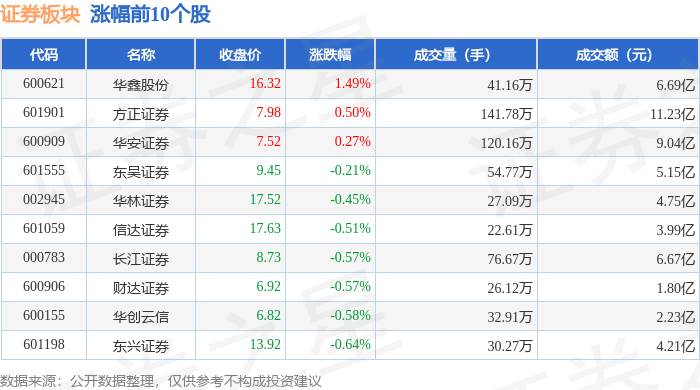
从资金流向上来看,当日证券板块主力资金净流出23.91亿元,游资资金净流入9.79亿元,散户资金净流 入14.12亿元。证券板块个股资金流向见下表: | 代码 | 名称 | 收盘价 | 涨跌幅 | 成交量(手) | 成交额(元) | | --- | --- | --- | --- | --- | --- | | 601696 | 中银证券 | 13.76 | -2.96% | 74.82万 | 10.28亿 | | 601377 | 兴业证券 | 6.93 | -2.26% | 155.38万 | 10.86亿 | | 601108 | 财通证券 | 9.26 | -2.11% | 122.41万 | 11.35 Z | | 600864 | 哈投股份 | 6.56 | -1.80% | 37.05万 | 2.43亿 | | 601688 | 华泰证券 | 22.84 | -1.76% | 86.61万 | 19.92 乙 | | 300059 | 东方财富 | 22.90 | -1.76% | 316.48万 | 72.62亿 | | 000686 | 东北让券 | 9.09 | -1.62% | 50.1 ...





中国中车股价连续5天下跌累计跌幅6.67%,中银证券旗下1只基金持3.4万股,浮亏损失1.56万元
Xin Lang Cai Jing· 2026-01-27 07:20
中银证券鑫瑞6个月持有A(010170)成立日期2020年11月11日,最新规模2634.18万。今年以来收益 0.83%,同类排名8058/9018;近一年收益4.59%,同类排名7515/8192;成立以来收益10.61%。 中银证券鑫瑞6个月持有A(010170)基金经理为。 1月27日,中国中车跌1.53%,截至发稿,报6.44元/股,成交14.51亿元,换手率0.92%,总市值1848.21 亿元。中国中车股价已经连续5天下跌,区间累计跌幅6.67%。 资料显示,中国中车股份有限公司位于北京市海淀区西四环中路16号,成立日期2007年12月28日,上市 日期2008年8月18日,公司主营业务涉及公司主要从事铁路机车、客车、动车组、城轨地铁车辆及重要 零部件的研发、制造、销售、修理和租赁。主营业务收入构成为:铁路装备49.86%,新产业34.01%, 城轨与城市基础设施14.53%,现代服务1.60%。 从基金十大重仓股角度 数据显示,中银证券旗下1只基金重仓中国中车。中银证券鑫瑞6个月持有A(010170)三季度持有股数 3.4万股,与上期相比持股数量不变,占基金净值比例为0.53%,位居第二大重仓 ...

中银证券:房企加大“好房子”项目供给 开盘去化率明显高于以往
Xin Hua Cai Jing· 2026-01-27 07:11
从供给端来看,夏亦丰说,2025年新版《住宅项目规范》颁布实施后,典型城市新项目开盘去化率明显 高于以往。中银证券调查问卷显示,居民对"好房子"的需求在未来新房市场中会更加明显,居住品质高 低、物业配套条件都将成为购房者决策参考。 "现有政策中专项债收储去库存效果最直接,但资金来源可进一步扩大。另外,实际收储过程中,还存 在收益平衡、收储资产有效性等问题,仍需政策进一步支持。从盘活存量来看,资产证券化如ABS、公 募REITs可行性较高,相应地,对资产质量要求也较高。"她说。 新华财经北京1月27日电(记者高婷、余蕊)近日,在中国国际经济交流中心举办"经济每月谈"活动 上,中银证券房地产首席分析师夏亦丰表示,自2025年新版《住宅项目规范》颁布实施后,典型城市新 项目开盘去化率明显高于以往,居民对"好房子"的需求在未来新房市场中会更加明显。 夏亦丰说,从市场成交量来看,二手房成交增量仍有空间,目前年均成交量约在5亿平到6亿平,相对平 稳,预计2026年二手房成交量或将持平或微跌。从新房市场成交价来看,一线城市上海"一枝独秀"、始 终保持上涨,北京、广州也保持了相对的韧性。她还提到,应从新房、二手房两方面综合研 ...
浙商证券原银行首席梁凤洁奔赴买方;中基协:2025年私募基金管理规模22.15万亿元,再创新高 | 券商基金早参
Mei Ri Jing Ji Xin Wen· 2026-01-27 01:23
|2026年1月27日 星期二| NO.1 券商资管公司公募管理规模去年增长显著,千亿元级阵营扩容至5家 近日,随着公募基金2025年四季报披露完毕,各家券商及券商资管公司(以下统称"券商资管")的最新 公募基金管理规模也浮出水面。截至2025年末,共有5家券商资管公司公募基金管理规模在千亿元以 上。其中,东方红资产管理以2162.68亿元的管理规模居于榜首,较2024年末增长30.05%。其次是华泰 证券资管,管理规模为1808.28亿元,较2024年末增长29.15%。中银证券、财通资管的管理规模也排名 居前,分别为1339.33亿元、1197.6亿元,均较2024年末出现小幅下滑,降幅分别为1.88%、7.47%。得 益于并购整合,国泰海通资管管理规模为1110.58亿元,跻身管理规模千亿元行列,较2024年末增长 37.6%。长江资管、山证资管管理规模分别为390.98亿元、370.83亿元,较2024年末增长47.39%、 49.04%。 点评:券商资管公募规模扩容凸显财富管理转型成效,龙头机构凭借品牌效应持续吸纳资金,头部效应 强化。并购整合加速行业洗牌,中小机构需差异化竞争。长期看,资管业务实力 ...


券商资管公司公募管理规模去年增长显著 千亿元级阵营扩容至5家
Zheng Quan Ri Bao· 2026-01-26 16:54
Group 1 - The public fund market has seen rapid growth, with total net asset value reaching 37.49 trillion yuan as of January 26, 2025, a 14.03% increase compared to the same period in 2024 [2] - Five brokerage asset management companies have surpassed 100 billion yuan in public fund management scale by the end of 2025, with Dongfanghong Asset Management leading at 216.27 billion yuan, a 30.05% increase from 2024 [2] - Several smaller brokerage asset management firms have shown significant growth, with Changjiang Asset Management and Shanzheng Asset Management increasing their management scales by 47.39% and 49.04%, respectively [2][3] Group 2 - Different institutions have distinct product structures, with non-monetary market funds dominating the management products of Dongfanghong Asset Management, Zhongyin Securities, and Caitong Asset Management, while Huatai Securities has over 85% of its products in monetary market funds [3] - Brokerages are actively exploring differentiated development paths in the public fund sector, with some increasing their stakes in public fund companies to enhance control and improve business synergy [4] - Companies are focusing on expanding their product lines and enhancing their capabilities in active equity products, with a particular emphasis on technology themes and the STAR Market [4][5]


中长级主题投资系统:基金”的配置闭环,并给出基于热度分层的动态跟踪与风险控
Bank of China Securities· 2026-01-26 06:25
Group 1 - The report constructs a three-dimensional heat evaluation system for theme investment in A-shares, focusing on "volume-price-discussion degree" to achieve a comprehensive output for theme rotation tracking and allocation [1][2] - The framework aims to capture fund behavior, price trends, and market consensus during theme rotation, translating theme signals into tradable targets and allocatable tools, forming a sustainable tracking and decision-making loop [2][5] - The report emphasizes the importance of a quantitative approach to measure market sentiment and trading rhythm through a "volume-price" model, which provides a visual and quantifiable basis for observing theme strength [9][10] Group 2 - The report identifies leading stocks within themes by assessing their market capitalization and liquidity, ensuring that selected stocks can effectively reflect fund preferences and market sentiment [40][41] - The identification logic includes three core features: representing the theme direction, accommodating incremental funds, and demonstrating price leadership during emotional intensification [40][42] - The report outlines a structured scoring and tiering system for stocks based on their performance in volume, price momentum, and discussion degree, facilitating the identification of core leaders in theme investment [43][44] Group 3 - The report highlights the significance of popular themes in providing clear mapping directions, indicating that related industries and sectors often present opportunities for catch-up [2][5] - It discusses the identification of candidate themes by exploring the main themes and their diffusion within the same industry chain or sector, followed by secondary screening based on volume and price patterns [2][5] - The report presents a quantitative process for transforming catch-up opportunities from narrative judgments into trackable outputs, focusing on specific structural patterns such as low-level rises and volume breakthroughs [2][5]
十大券商一周策略:慢牛未改!科技 + 资源品成共识配置,警惕赚钱效应收敛
Jin Rong Jie· 2026-01-25 23:50
Core Viewpoint - The A-share market is characterized by "structural differentiation and simultaneous repair," with various institutions noting that despite ongoing redemption pressure on broad-based ETFs, sectors such as consumer chains, real estate chains, and resource products are entering a repair window [1][2]. Group 1: Market Trends - The broad-based ETF redemption pressure continues to grow, with significant differences in the承接力 (support capacity) among different industries and stocks [2]. - The consumer chain is expected to see an increase in allocation leading up to the Two Sessions, with the real estate chain also likely to experience noticeable recovery during this period [2]. - The spring market is supported by ample liquidity and policy backing, which may sustain the ongoing spring rally, although caution is advised regarding the marginal contraction of profit effects at high levels [1][3]. Group 2: Investment Focus - The consensus among institutions is to focus on technology (AI, semiconductors) and resource products (non-ferrous metals, chemicals) as key investment directions [1][7]. - There is growing attention on cyclical sectors showing signs of bottom reversal, such as power grid equipment and lithium batteries, as well as non-bank sectors [1][3]. - The current market environment is conducive to exploring basic combinations centered around chemicals, non-ferrous metals, new energy, and power equipment, while also considering low allocation in non-bank sectors like securities and insurance [2][4]. Group 3: Performance and Earnings - As the annual report forecast disclosure period peaks, the impact of earnings on market structure is expected to become more pronounced, with a focus on sectors with earnings highlights [4][11]. - The performance of sectors such as AI hardware, batteries, pharmaceuticals, steel, and non-bank financials is anticipated to improve, given their relatively low price increases [4][12]. - The market is likely to experience a rotation among sectors, with a focus on high-growth areas and those benefiting from price increases [12][14]. Group 4: Future Outlook - The market is expected to continue its slow bull trend, with the potential for a correction after reaching a phase high between 4200 and 4300 points [6][10]. - The spring market is seen as an extension of the structural bull market, with a likelihood of a consolidation phase following the current rally [3][5]. - The focus for 2026 includes a clearer dual mainline of asset allocation towards physical assets and Chinese assets, with thematic investments becoming essential [9][10].



【十大券商一周策略】春季行情仍在途,注意总体赚钱效应已逼近高位
券商中国· 2026-01-25 14:11
Group 1 - The core viewpoint of the article emphasizes the ongoing recovery of market confidence, with potential for sector and stock recovery, particularly in consumer and real estate chains before the Two Sessions [2] - The article highlights the significant outflow of funds from broad-based ETFs, with a notable impact on sectors and stocks that are underweight by institutions [2] - It suggests that sectors with strong fundamentals and logical narratives, particularly those not heavily weighted in broad-based indices, are likely to see recovery [2] Group 2 - The spring market is characterized by a transition towards a more stable phase, with the potential for a perfect spring market driven by increased profitability [3] - The article notes that the overall profitability effect is nearing a high point, indicating that the market may face limitations in time and space for further growth [3] - It anticipates a correction phase following the spring market, where the focus will shift to clearer industrial trends and performance digestion [3] Group 3 - The article discusses the supportive role of abundant liquidity in driving the current spring market, stemming from various factors including insurance capital and foreign fund inflows [4] - It emphasizes the importance of focusing on fundamental performance as companies begin to disclose annual reports, with particular attention to sectors like AI hardware, batteries, and pharmaceuticals [5] Group 4 - The article identifies the current market phase as a structural bull market, transitioning from the second consolidation phase to the third upward phase [6] - It suggests that the market may face a correction after reaching a temporary high between 4200 and 4300 points, with a focus on the support levels and core sectors [6] Group 5 - The article advocates for a dual focus on technology and resource sectors, highlighting the importance of macroeconomic conditions and liquidity in shaping investment strategies [7] - It identifies key sectors such as semiconductors, AI, and new energy as central to current market trends, with a positive outlook for resource industries [7] Group 6 - The article suggests that the market's optimism is necessary, particularly in light of the recent volatility and the need to consider the relationship between market optimism and regulatory cooling [8] - It emphasizes the importance of focusing on physical assets and Chinese assets in investment strategies, with a recommendation for sectors like equipment exports and consumer recovery [9] Group 7 - The article indicates that the current market is entering a phase of high volatility and differentiation, with expectations for policy-driven demand expansion [10] - It highlights the potential for the non-ferrous metals sector to benefit from both industrial trends and financial attributes, particularly in light of geopolitical factors [11] Group 8 - The article notes that the A-share market is returning to a slow bull trend, with an increasing importance of sector rotation and fundamental performance [12] - It emphasizes the need to focus on structural investment opportunities, particularly in technology innovation and manufacturing sectors [12] Group 9 - The article suggests that the current market may be entering the latter half of the spring market, with a focus on sectors with strong performance and clear industrial trends [13] - It highlights the potential for price increases in sectors like basic chemicals and new energy materials, as well as opportunities in export-driven sectors [13] Group 10 - The article maintains that the slow bull trend is likely to continue, with a focus on technology, resource sectors, and industries with high growth potential [14] - It suggests that the current market conditions provide ample opportunities for investment, particularly in sectors with strong earnings forecasts [14]

策略周报:“春躁”行情分化,聚焦金属科技双主线-20260125
Bank of China Securities· 2026-01-25 09:41
Group 1 - The report highlights a "spring excitement" market entering a phase of high volatility and structural differentiation, focusing on the dual main lines of metals and technology (AI applications and commercial aerospace) [2][12] - The non-ferrous metals industry is expected to benefit from both industrial trends and financial attributes in 2026, driven by Fed rate cut expectations and geopolitical tensions, particularly in rare earths and strategic metals [12][21] - The report notes a significant decline in the allocation of active equity funds to Hong Kong stocks, dropping to 15.9% in Q4 2025 from an average of 19.3% in the previous three quarters, indicating a weakening of overall pricing power [22][28] Group 2 - The AI application market is not finished but is expected to become more differentiated and focused, particularly on clear business models and rapid implementation in AI marketing, healthcare, and programming [33][34] - Major companies are accelerating their entry into the AI healthcare sector, which shows strong commercial potential due to its essential consumption characteristics and high payment willingness from both consumers and enterprises [36] - The report indicates that the global satellite launch and low-orbit constellation construction are accelerating, leading to an upward expectation for space photovoltaics, with potential for customized development in the materials sector [12][38]
中银量化大类资产跟踪:贵金属与中小微风格权益持续领涨
Bank of China Securities· 2026-01-25 08:42
- The report does not contain any specific quantitative models or factors for analysis[1][2][3] - The report primarily focuses on market performance, valuation metrics, style indices, and fund flows without detailing quantitative model construction or factor definitions[1][2][3] - No formulas or detailed construction processes for models or factors are provided in the report[1][2][3]