
CHINA TELECOM(601728)

Search documents
经济观察丨“AI+新型工业化”融合提速:场景更多 生态更优
Zhong Guo Xin Wen Wang· 2025-07-31 01:27
Group 1 - The Chinese government is promoting the integration of artificial intelligence (AI) into new industrialization, with a focus on enhancing industrial applications and optimizing the industry ecosystem [1][2] - The 2025 World Artificial Intelligence Conference (2025WAIC) showcased various AI applications in industries such as textiles, photovoltaics, and automotive, demonstrating significant efficiency improvements and quality enhancements [1][2] - AI-driven industrial safety systems have shown a 70% increase in response efficiency and a 50% reduction in manpower for safety management in steel manufacturing [1] Group 2 - Major state-owned enterprises are actively engaging in AI and manufacturing initiatives, with China Mobile establishing an AI innovation research institute and China Telecom launching an integrated AI service platform [2] - The Ministry of Industry and Information Technology of China has outlined key tasks for the second half of the year, emphasizing the deepening of the "AI + manufacturing" initiative [2] - A national AI platform called "Huanxin Community" was launched to promote the maturity of domestic AI technologies and industry ecosystems, aggregating data from 13 industries and opening up 40 high-value AI scenarios [2] Group 3 - KPMG's white paper presented at the 2025WAIC highlights that generative AI is rapidly penetrating various key processes in traditional manufacturing, leading to deeper applications beyond initial pilot projects [3]



政务数据新规即将施行,AI+IT建设有望推动行业新一轮建设周期
Xuan Gu Bao· 2025-07-30 23:26
Group 1 - The "Regulations on Government Data Sharing" will be implemented on August 1, 2025, aiming to enhance the security, order, and efficiency of government data sharing, thereby improving digital governance and public service effectiveness [1] - The regulations fill a legislative gap in China's government data sharing sector and establish a clear management system, addressing the "data island" issue [1] - The regulations are expected to significantly benefit the government data market by optimizing sharing processes and improving data supply efficiency [1] Group 2 - Companies involved in public data authorized operations include China Mobile, China Telecom, China Unicom, Deep Sanda A, Yihualu, Taiji Co., and Guangdian Yuntong [2] - In the financial services sector, companies such as Hengsheng Electronics and Zhongke Ruankai are noted [2] - In the trade and circulation sector, Shanghai Steel Union is mentioned, while in healthcare, companies like Zhongke Jiangnan, Chuangye Huikang, Jiuyuan Yinhai, and Wanda Information are highlighted [2] - In transportation, Shenzhou Holdings and COSCO Shipping Technology are identified [2]


无人机、卫星通信车抢修 密云、怀柔、延庆等地部分基站恢复通信
Xin Jing Bao· 2025-07-30 18:03
Core Viewpoint - The article highlights the response of telecommunications companies in Beijing to severe flooding, detailing their efforts to restore communication services using advanced technologies like drones and satellite communication systems [1][4]. Group 1: Emergency Response and Recovery Efforts - As of July 28, China Telecom deployed 334 personnel, 6 satellite communication vehicles, and 30 emergency repair vehicles to restore communication in affected areas [2]. - China Unicom reported the deployment of over 320 personnel and various emergency equipment, including 10 satellite base station vehicles and 34 satellite phones, with significant restoration of base stations in multiple districts [2][3]. - Beijing Mobile utilized 5 emergency communication vehicles and 2 drones to establish communication in key areas, successfully sending emergency messages and enabling communication for local government command points [2][4]. Group 2: Impact of Severe Weather - The average rainfall in Beijing reached 165.9 mm, with the maximum recorded at 543.4 mm, leading to significant infrastructure damage, including 31 road damages and 1825 disabled base stations [1]. - Communication facilities suffered extensive damage, with 62 fiber optic cables destroyed and 136 villages experiencing power outages [1]. Group 3: Technological Innovations in Communication - The use of drone base stations has been pivotal, providing emergency communication services to several villages and sending nearly 1 million emergency messages [4][5]. - Satellite communication vehicles and portable satellite stations were deployed to ensure connectivity in remote areas, demonstrating the effectiveness of "hard technology" in disaster response [4]. Group 4: Community Support and Services - Telecommunications companies provided temporary services such as free calls and charging stations for disaster-affected individuals, with China Telecom sending out 19.65 million risk warning messages [5]. - Beijing Unicom offered 100G of free data to users in affected areas, while Beijing Mobile provided essential services like drinking water and temporary shelter at key locations [5].

AMAC信息技术指数下跌1.18%,前十大权重包含三六零等
Jin Rong Jie· 2025-07-30 14:23
从AMAC信息技术指数持仓的市场板块来看,深圳证券交易所占比53.49%、上海证券交易所占比 46.51%。 从AMAC信息技术指数持仓样本的行业来看,信息技术占比61.81%、通信服务占比31.42%、工业占比 5.53%、可选消费占比0.62%、金融占比0.54%、房地产占比0.08%。 据了解,中基协基金估值行业分类指数依据《中国上市公司协会上市公司行业统计分类指引》中的门类 划分,编制16个门类指数(不包括制造业);依据制造业门类下的大类划分,编制27个大类指数,共有 43条行业分类指数。该指数以2008年12月31日为基日,以1000.0点为基点。 从指数持仓来看,AMAC信息技术指数十大权重分别为:寒武纪(4.07%)、中国电信(3.32%)、科 大讯飞(3.19%)、中国移动(2.82%)、国电南瑞(2.52%)、中国联通(2.42%)、金山办公 (2.01%)、恒生电子(1.6%)、润和软件(1.21%)、三六零(1.06%)。 金融界7月30日消息,A股三大指数收盘涨跌不一,AMAC信息技术指数 (AMAC信息,H11044)下跌 1.18%,报3319.2点,成交额1699.08亿元。 数 ...


通信服务板块7月30日涨0.27%,南凌科技领涨,主力资金净流出6.77亿元
Zheng Xing Xing Ye Ri Bao· 2025-07-30 08:33
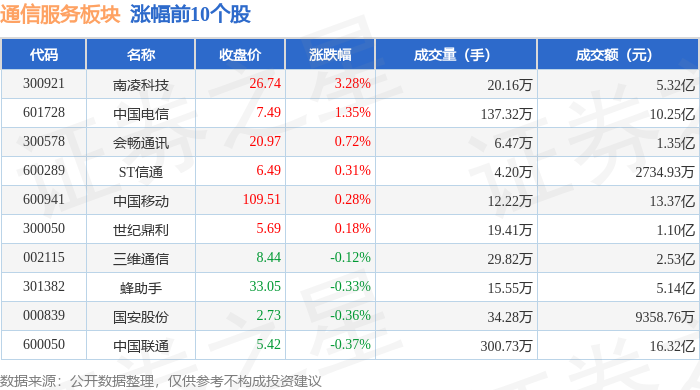
Market Overview - On July 30, the communication services sector rose by 0.27% compared to the previous trading day, with Nanling Technology leading the gains [1] - The Shanghai Composite Index closed at 3615.72, up 0.17%, while the Shenzhen Component Index closed at 11203.03, down 0.77% [1] Stock Performance - Nanling Technology (300921) closed at 26.74, with a gain of 3.28% and a trading volume of 201,600 shares [1] - China Telecom (601728) closed at 7.49, up 1.35%, with a trading volume of 1,373,200 shares and a turnover of 1.025 billion yuan [1] - China Mobile (600941) closed at 109.51, up 0.28%, with a trading volume of 122,200 shares and a turnover of 1.337 billion yuan [1] - The overall performance of the communication services sector showed mixed results, with some stocks experiencing declines [2] Capital Flow - The communication services sector saw a net outflow of 677 million yuan from institutional investors, while retail investors contributed a net inflow of 535 million yuan [2] - Major stocks like China Telecom and China Unicom experienced significant net outflows from institutional investors, indicating a shift in capital dynamics [3] - Nanling Technology had a net inflow of 22.25 million yuan from institutional investors, suggesting continued interest despite broader sector trends [3]


上证 180 基建指数上涨0.22%,前十大权重包含国电电力等
Jin Rong Jie· 2025-07-30 08:07
Core Viewpoint - The A-share market showed mixed performance with the Shanghai 180 Infrastructure Index rising by 0.22% to 1883.26 points, with a trading volume of 29.432 billion yuan [1] Group 1: Index Performance - The Shanghai 180 Infrastructure Index increased by 0.84% over the past month and 1.78% over the last three months, but has decreased by 2.41% year-to-date [2] - The index is based on the Shanghai 180 Index and includes listed companies related to infrastructure, resources, and transportation, reflecting their overall market performance [2] Group 2: Index Composition - The top ten weighted companies in the Shanghai 180 Infrastructure Index are: - Changjiang Electric Power (14.26%) - China State Construction (8.58%) - China Telecom (8.28%) - China Mobile (7.12%) - China Unicom (6.14%) - China Nuclear Power (5.49%) - Three Gorges Energy (4.5%) - China Power Engineering (4.45%) - China Railway (4.28%) - Guodian Power (2.97%) [2] Group 3: Sector Allocation - The index is fully composed of companies listed on the Shanghai Stock Exchange, with sector allocations as follows: - Utilities: 40.30% - Industrials: 36.92% - Communication Services: 22.78% [3] - The index samples are adjusted biannually, with adjustments occurring on the next trading day after the second Friday of June and December [3]


联想集团与中国电信签署战略合作协议
Jing Ji Wang· 2025-07-30 08:04
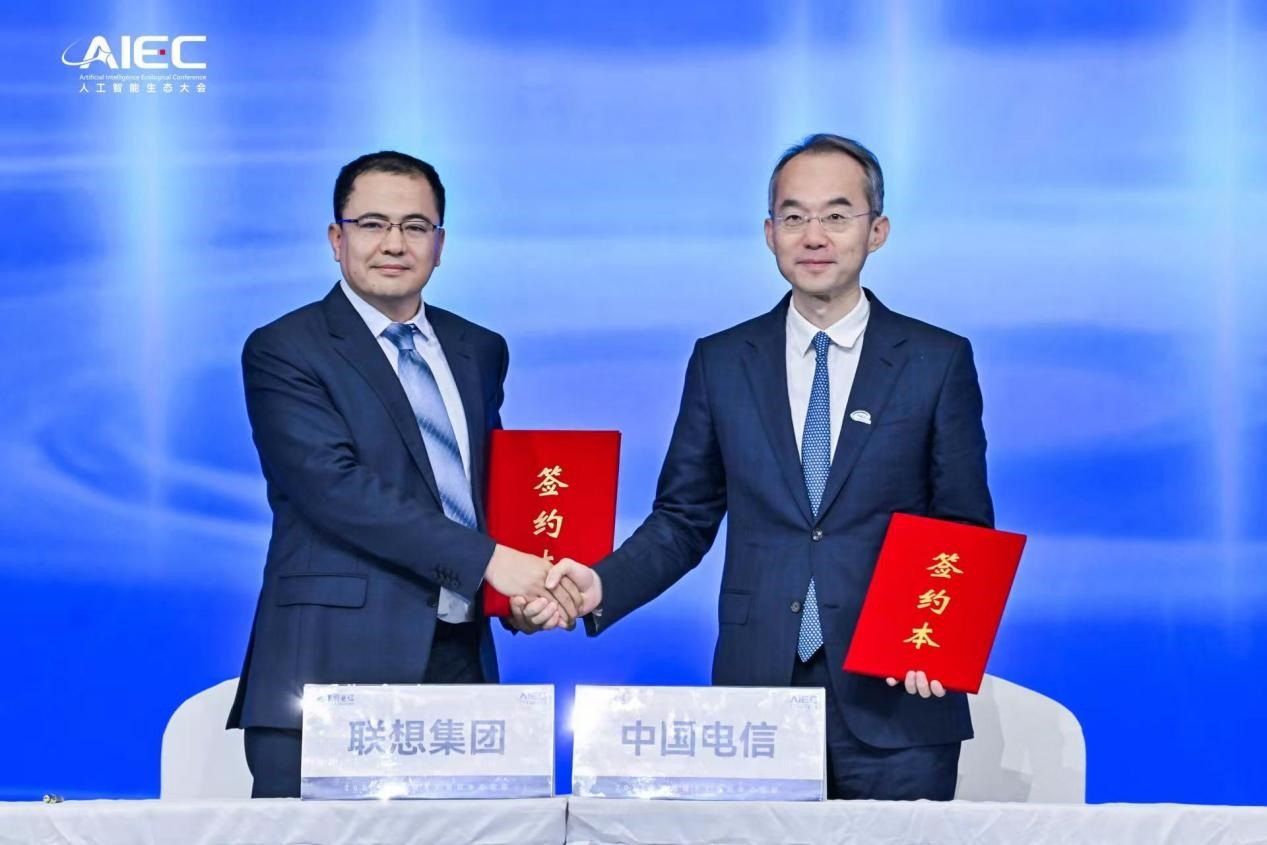
Core Viewpoint - The strategic cooperation agreement between China Telecom and Lenovo marks a significant milestone in their partnership, aiming to enhance collaboration in various fields including AI, cloud services, and industry solutions [1][4][6]. Group 1: Strategic Cooperation Details - Lenovo has been recognized as an important strategic partner of China Telecom, receiving the "Five Comprehensive Business Pioneer Cooperation Award" in 2024 [4]. - The cooperation will focus on areas such as basic communication, comprehensive information services, AI computing, international business, and joint expansion of government and enterprise clients [4][6]. - Both companies will explore collaboration in the Internet of Things (IoT) sector, including AI PCs, smart interactive devices, vehicle networking, and autonomous driving [4][6]. Group 2: Joint Initiatives - The partnership aims to deepen cooperation between Tianyi Cloud and Lenovo's hybrid cloud services, creating vertical industry cloud applications and establishing a close partnership service model [4][5]. - There will be a focus on smart manufacturing, with plans to co-build benchmark projects for smart factories [4][6]. - The companies will collaborate on AI computing and large model development to create intelligent computing solutions [5]. Group 3: Market Expansion and Goals - The agreement includes plans for overseas business cooperation, providing a full-chain intelligent solution for manufacturing enterprises venturing abroad [6]. - Joint efforts will be made to expand government and enterprise industry clients, integrating China Telecom's industry expertise with Lenovo's advanced intelligent systems [6]. - The strategic partnership aims to serve social development, share experiences, and enhance efficiency, contributing to the construction of a digital China and exploring the future of intelligent transformation [6].

东方证券:运营商加大AI终端布局 助力产业打开空间
Zhi Tong Cai Jing· 2025-07-30 07:33
Core Viewpoint - The report from Dongfang Securities highlights the growing focus of telecom operators on AI terminals, particularly in the smart home sector, which is expected to drive growth opportunities in the industry [1][2]. Group 1: Telecom Operators' AI Terminal Development - Leading telecom operators are continuously launching AI terminals such as mobile smart screens, showing impressive product growth [1]. - In March 2025, China Unicom and ZTE jointly released a series of innovative AI smart home terminal products, including smart screens and AI cameras [1]. - In May 2025, China Telecom upgraded its Tianyi AI central screen to serve as a comprehensive AI life assistant, indicating strong competitive advantages in the smart home business [1]. Group 2: Market Growth and Sales Data - The market for mobile smart screens, represented by China Mobile, is experiencing robust growth, with a projected retail volume of 254,000 units in 2024, reflecting a 65% year-on-year increase [2]. - The industry is expected to maintain rapid growth as telecom operators increase their investments in home AI terminals [2]. Group 3: AI Model Investments and Product Offerings - Telecom operators are investing heavily in AI models to enhance the intelligence of their terminals [3]. - China Mobile showcased its JiuTian Basic Model V3.0 at the 2025 World Artificial Intelligence Conference, while China Telecom introduced its self-developed Starry Sky Model system, enhancing the functionality of its terminal products [3]. - Future product promotions and subsidy policies from telecom operators are anticipated to improve the penetration of AI terminals in home settings [3].

中国电信天翼AI发布首款AI眼镜 星辰大模型开启第一视角智能交互新范式
Zheng Quan Ri Bao Zhi Sheng· 2025-07-30 05:41
Core Insights - The 2025 World Artificial Intelligence Conference (WAIC) was recently held in Shanghai, where China Telecom AI Technology (Beijing) Co., Ltd. launched the world's first fully integrated self-developed Star Model-based smart wearable device, "Tianyi AI Smart Glasses" [1] - The product leverages China Telecom's cloud-network integration infrastructure and Star Model technology, creating a new paradigm for first-person intelligent interaction [1] - Tianyi AI Smart Glasses achieve full-stack empowerment of the Star Model in the smart wearable device sector, featuring capabilities such as 0.8-second instant capture and multimodal real-time translation [1] Product Features - The device includes a 12-megapixel ultra-wide-angle lens and seven AI imaging algorithms, enabling 1440P HD vision synchronization [1] - It is equipped with a five-microphone array combined with the Star Voice Model for precise voice wake-up [1] - The glasses offer food recognition capabilities to analyze ingredients, calories, and nutrition, as well as a cultural tourism guide function that connects with multiple museum databases for professional exhibit explanations [1] Strategic Direction - China Telecom AI will continue to utilize the Star Model as an engine to deepen its "Artificial Intelligence +" strategy, promoting the deep integration of AI with various industries [2]
短评:在自贸港建设大局中展现央企作为
Hai Nan Ri Bao· 2025-07-30 01:17
Group 1 - The core viewpoint emphasizes the importance of secure and orderly data flow in the development of global digital trade, which is a key task in the construction of Hainan Free Trade Port [1] - Hainan Telecom, as a leading central enterprise, is taking on the responsibility of accelerating the construction of digital information infrastructure in Hainan Free Trade Port, contributing to the development of an information highway for economic and social growth [1] - The construction of Hainan Free Trade Port provides a collaborative platform for central enterprises, allowing companies like Hainan Telecom to leverage policy and development opportunities while playing a strategic supporting role in the port's construction [1] Group 2 - The digital information infrastructure construction is centered around cloud-network integration, with a focus on achieving a unified approach across the province and island [1] - Hainan Telecom is expanding 5G industry applications and exploring various scenarios such as gaming, data processing, cross-border film and television, live streaming, and data circulation regulation [1] - The establishment of international information parks in Haikou and Sanya, along with the creation of a data product supermarket, showcases Hainan's model for promoting data elements and enhancing the port's influence [1]