
CHINA TELECOM(601728)

Search documents
沐曦股份上市首日竞价高开568% 联想 、中国电信等巨头持股
智通财经网· 2025-12-17 02:08
Core Viewpoint - Muxi Co., Ltd. has successfully listed on the Shanghai Stock Exchange's Sci-Tech Innovation Board, opening with a 568% increase, reaching a stock price of 700 yuan and a total market value of 280 billion yuan, with a single contract profit of nearly 300,000 yuan, while the issue price was 104.66 yuan per share [1] Company Overview - Muxi Co., Ltd. is a leading domestic enterprise in high-performance general-purpose GPU products, becoming the second domestic GPU company to list on the A-share market after Moore Threads [1] - The company focuses on the independent research and development of full-stack high-performance GPU chips and computing platforms, primarily engaged in the R&D, design, and sales of full-stack GPU products for AI training and inference, general computing, and graphics rendering [1] - Muxi has established a unique GPU product system and an independent open software ecosystem, providing high-efficiency and versatile computing power support for cloud computing, and is a significant force in promoting the autonomous and controllable infrastructure for intelligent computing in various industries [1] Investment and Financing - Muxi has completed over 10 rounds of financing, with a strong shareholder base including the founding team, national funds, top VC firms, local state-owned assets, and industrial capital [2] - Key VC investors include Sequoia China and Matrix Partners, with Sequoia holding approximately 4.19% and Matrix holding 5.13% through multiple associated funds [2] - Lenovo Group, as an early strategic investor, holds nearly 1% of Muxi's shares and has collaborated on the "DeepSeek integrated machine," positioning itself in the domestic AI computing core sector [2] Product Development and Market Position - Muxi and Lenovo launched the "DeepSeek domestic AI integrated machine," achieving rapid delivery and significant market penetration across various core industries [3] - Muxi's GPU product matrix includes inference, training, and graphics rendering, with its flagship product, the Xiyun C600, achieving a fully domestic closed loop in design, manufacturing, and testing, competing with international leaders like NVIDIA's A100 [3] - The collaboration between Muxi and Lenovo enhances the usability of domestic GPUs and addresses the final mile in application, leveraging Lenovo's established supply chain and customer resources [3] Industry Outlook - The ongoing investment in AI infrastructure and the increasing importance of autonomous and controllable strategies are expected to drive the expansion of domestic computing power supply, with Muxi and Moore Threads leading the way [4] - This trend presents long-term investment opportunities in the capital market and promotes the development of the upstream and downstream of the industry chain [4]
中国电信发布2026终端技术发展策略
Zhong Guo Chan Ye Jing Ji Xin Xi Wang· 2025-12-17 00:08
Group 1 - China Telecom announced multiple innovative achievements and a 2026 terminal technology development strategy at the "AI + Terminal Technology Standards and Innovation Cooperation Forum" [1] - Key technological breakthroughs in the AI terminal field include trusted interaction between end and network, mapping of perceived information to network performance requirements, and the establishment of an intelligent network capability verification platform [1] - In the eSIM sector, China Telecom is collaborating with the industry to develop eSIM industry standards for terminals and chips, and is conducting joint product R&D and key testing technology breakthroughs [1] Group 2 - China Telecom's Vice General Manager Huang Zhiyong proposed three major initiatives for the future: deepening technological innovation cooperation, expanding application scenarios, and building an open cooperation ecosystem [2] - The company aims to develop new terminal types such as 5G-A smart glasses and embodied intelligence, while promoting cross-layer intelligent communication architecture [2] - China Telecom plans to enhance the eSIM terminal variety, expand satellite communication services, and promote the Tianyi smart terminal products [2]
三芯透明迁移,跨架构大模型推理技术验证完成
Xuan Gu Bao· 2025-12-16 15:17
Core Insights - The article highlights a significant breakthrough in cross-architecture large model inference technology verification, achieved by the China Telecom Research Institute in collaboration with various industry partners [1] - This technology enables seamless operation of the same operator source code across three types of chips: Nvidia, Ascend, and Muxi, addressing the challenge of multi-architecture adaptation [1] - The innovation aims to enhance the usability of domestic computing power, facilitating the transition from "usable" to "user-friendly" and "easy to use," thereby supporting the autonomous and diversified development of computing infrastructure in China [1] Industry Summary - The successful implementation of a heterogeneous large model inference framework based on Triton has compressed the operator adaptation cycle from "weekly" to "daily," achieving performance levels of 90% compared to native operator libraries [1] - This advancement is expected to provide business entities with intuitive and precise chip selection decision support, which is crucial for the commercialization of large models [1] - The article mentions related A-share concept stocks such as Tuosida and Mengwang Technology, indicating potential investment opportunities in this sector [1]
中国电信(728.HK):十五五或有政策鼓励政企应用AI云计算技术 集团有望受惠
Ge Long Hui· 2025-12-16 13:59
Core Viewpoint - The company is experiencing moderate growth in profitability for the third quarter of 2025, with a slight increase in revenue and EBITDA, but a slowdown in growth is noted due to macroeconomic factors [1] Group 1: Financial Performance - For the first three quarters of 2025, the company's revenue increased by 0.6% year-on-year, with service revenue growing by 0.9% [1] - EBITDA rose by 4.2% year-on-year, and profit attributable to shareholders increased by 5.0% [1] - In the third quarter alone, revenue decreased by 0.9% year-on-year, while service revenue grew by 0.5% [1] - EBITDA for the third quarter increased by 2.4% year-on-year, and profit attributable to shareholders rose by 3.6% [1] Group 2: Cloud Business and AI Integration - The company's cloud service, Tianyi Cloud, is in a transitional phase, with revenue growth slowing; it reported revenue of 57.3 billion RMB in the first half of 2025, a year-on-year increase of 3.8% [1] - Management indicated that the global cloud computing industry is undergoing a critical transition, with a significant decline in growth for traditional cloud services, while demand for AI-driven intelligent computing is strong [1] - The company's intelligent revenue, which includes AI and intelligent computing services, grew by 62.3% year-on-year in the first three quarters of 2025 [1] Group 3: Government Policies and Market Outlook - The "14th Five-Year Plan" emphasizes technological self-reliance and innovation, which may lead to government initiatives encouraging the application of AI-related cloud computing technologies [2] - The company has a significant proportion of enterprise clients from government-related units, which tend to be conservative in adopting AI technologies due to security concerns [2] - The outlook for Chinese government bond yields is limited, and the company is considered a high-quality dividend stock, supported by stable traditional services and healthy cash flow [2]
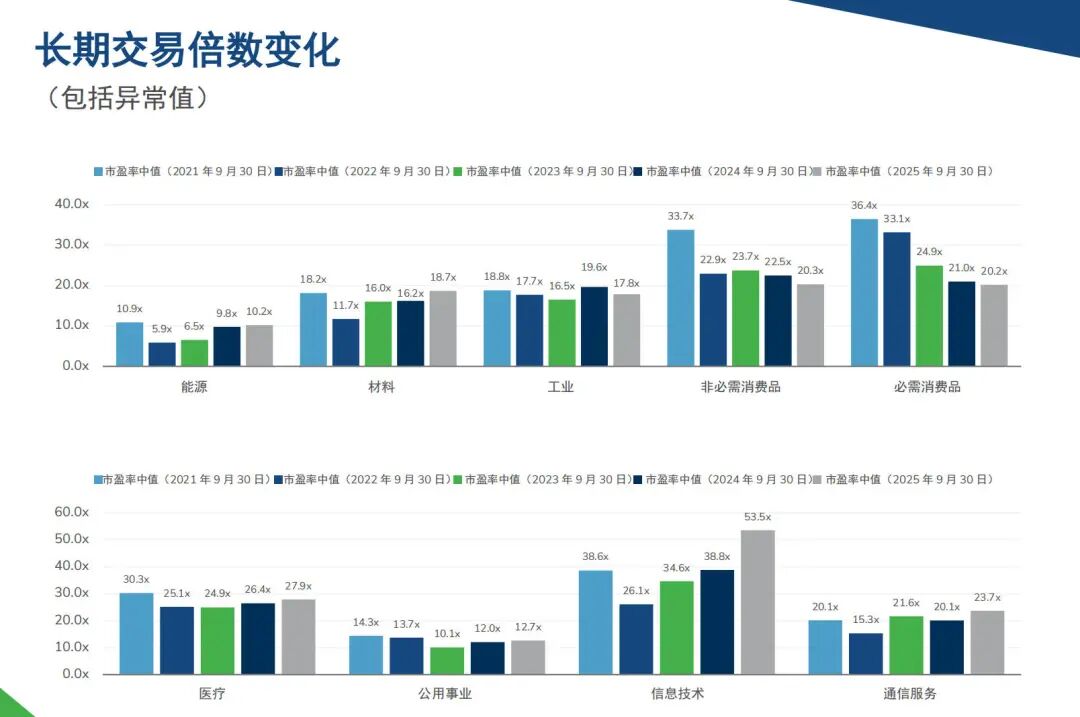
中国通信板块市盈率创五年新高 5G-A成核心驱动力
Xin Lang Cai Jing· 2025-12-16 13:12
Core Insights - The report by Kroll indicates that the price-to-earnings (P/E) ratio of China's communication services sector has risen to 23.7 times as of September 30, 2025, up from 20.1 times in 2024, marking the highest level in nearly five years, driven primarily by the rapid deployment of 5G-A technology [1][4]. Group 1: 5G-A Technology Impact - The 5G-A network is expected to enhance speeds by ten times compared to existing 5G standards, becoming a critical infrastructure for emerging fields such as industrial automation, autonomous driving, and the low-altitude economy [2][5]. - Major operators are heavily investing in upgrades: China Mobile has allocated $1.4 billion to upgrade 400,000 base stations to 5G-A technology, while China Telecom and China Unicom have announced plans to deploy 5G-A technology in over 300 cities by the end of the year [2][5]. Group 2: Market Performance - The MSCI China Communication Services Index has seen a cumulative increase of 96.8% since September 2023, significantly outperforming the broader market [2][5]. - The communication sector has shown particularly strong performance in the first three quarters of 2025, serving as a key driver for the overall index's rise [2][5].




中国电信委任李惠光为独立非执行董事
Zhi Tong Cai Jing· 2025-12-16 12:59
Core Viewpoint - China Telecom has announced the approval of Mr. Li Huiguang as an independent non-executive director, effective from December 16, 2025, until the annual general meeting in 2026 [1] Group 1 - Mr. Li Huiguang will also serve as the chairman and member of the company's remuneration committee, as well as a member of the audit committee and nomination committee [1]
中国电信(00728) - 海外监管公告 - 中国电信股份有限公司董事会议事规则
2025-12-16 12:57
香港交易及結算所有限公司及香港聯合交易所有限公司對本公告的內容概不負責,對其準確性或完整性亦不發表任何聲 明,並明確表示概不對因本公告全部或任何部份內容而產生或因倚賴該等內容而引致的任何損失承擔任何責任。 China Telecom Corporation Limited 中国电信股份有限公司 (於中華人民共和國註冊成立之股份有限公司) (股份編號:728) 海外監管公告 中國電信股份有限公司董事會議事規則 本公告乃根據香港聯合交易所有限公司證券上市規則第 13.10B 條而作出。 兹載列中國電信股份有限公司(「本公司」)在上海證券交易所網站刊登的《中國電信股份有 限公司董事會議事規則》,僅供參考。 承董事會命 中國電信股份有限公司 董事長兼首席執行官 柯瑞文 中國北京,2025 年 12 月 16 日 於本公告刊發之日的本公司董事會包括柯瑞文(董事長兼首席執行官);劉桂清(總裁兼首席 運營官);唐珂、李英輝(財務總監)(皆為執行副總裁);呂永鐘(非執行董事);吳嘉寧、 陳東琪、呂薇、李惠光(皆為獨立非執行董事)。 中国电信股份有限公司董事会议事规则 第一章 总则 董事会会议是董事会议事的主要形式。按规定参加 ...
中国电信(00728) - 海外监管公告 - 中国电信股份有限公司股东会议事规则
2025-12-16 12:54
香港交易及結算所有限公司及香港聯合交易所有限公司對本公告的內容概不負責,對其準確性或完整性亦不發表任何聲 明,並明確表示概不對因本公告全部或任何部份內容而產生或因倚賴該等內容而引致的任何損失承擔任何責任。 China Telecom Corporation Limited 中国电信股份有限公司 (於中華人民共和國註冊成立之股份有限公司) (股份編號:728) 海外監管公告 中國電信股份有限公司股東會議事規則 本公告乃根據香港聯合交易所有限公司證券上市規則第 13.10B 條而作出。 兹載列中國電信股份有限公司(「本公司」)在上海證券交易所網站刊登的《中國電信股份有 限公司股東會議事規則》,僅供參考。 承董事會命 中國電信股份有限公司 董事長兼首席執行官 柯瑞文 中國北京,2025 年 12 月 16 日 於本公告刊發之日的本公司董事會包括柯瑞文(董事長兼首席執行官);劉桂清(總裁兼首席 運營官);唐珂、李英輝(財務總監)(皆為執行副總裁);呂永鐘(非執行董事);吳嘉寧、 陳東琪、呂薇、李惠光(皆為獨立非執行董事)。 第一章 总则 公司应当严格按照法律、行政法规、本规则及《公司章程》的相关规定 召开股东会,保证 ...
中国电信(00728)委任李惠光为独立非执行董事
智通财经网· 2025-12-16 12:48
智通财经APP讯,中国电信(00728)公布,特别股东大会已批准李惠光先生担任公司独立非执行董事,李 惠光先生亦担任公司董事会薪酬委员会主席及委员、审核委员会及提名委员会委员,相关任期自 2025 年 12 月 16 日起至本公司于 2026 年召开的 2025 年年度股东大会止。 ...
中国电信(00728) - 公司章程
2025-12-16 12:45
中國電信股份有限公司 章程 (包括截至2025 年12 月16 日止股東會批准的修訂) – 1 – | 章 | 目 | 標 題 | | 頁 碼 | | --- | --- | --- | --- | --- | | 第一章 | | 總 則 | | 4 | | 第二章 | | 經營宗旨和範圍 | | 7 | | 第三章 | | 股份和註冊資本 | | 9 | | 第四章 | | 減資和購回股份 | | 14 | | 第五章 | | 購買公司股份的財務資助 | | 16 | | 第六章 | | 股票和股東名冊 | | 17 | | 第七章 | | 股東的權利和義務 | | 22 | | 第八章 | | 股東會 | | 29 | | 第九章 | | 董事和董事會 | | 48 | | 第十章 | | 公司董事會秘書 | | 66 | | 第十一章 | | 公司總裁及其他高級管理人員 | | 67 | | 第十二章 | | | 公司董事、高級管理人員的任職資格、義務及責任 | 70 | | 第十三章 | | 財務會計制度與利潤分配 | | 74 | | 第十四章 | | 內部審計 | | 80 | | 第十五章 | ...