CHINA TELECOM(601728)

Search documents
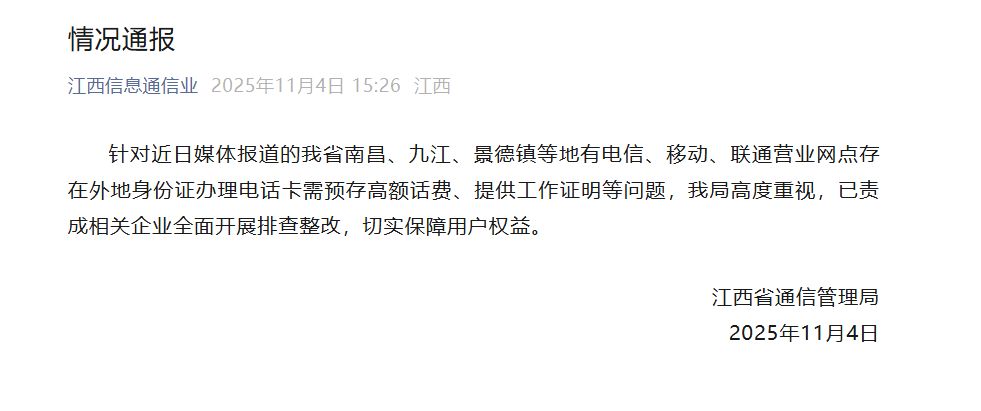
乘风乌镇、数绘浙江 中国电信跑出人工智能落地创效加速度
Zhong Guo Jin Rong Xin Xi Wang· 2025-11-09 08:28
Core Viewpoint - China Telecom Zhejiang Company is showcasing its achievements in the "cloud transformation, digital transformation, and intelligent benefits" strategy at the 2025 World Internet Conference, emphasizing its role in the digital construction of Zhejiang and the application of AI large models to empower economic and social transformation [1] Group 1: Digital Government Construction - China Telecom is focusing on the national "digital government" construction needs by transforming the government hotline into a core scenario for intelligent transformation, utilizing self-developed AI models and domestic computing power [2] - The company integrates voice understanding, knowledge reasoning, and multimodal interaction to create a comprehensive intelligent solution for government services, enhancing digital governance capabilities [2] Group 2: AI Applications in Governance - AI applications developed by China Telecom demonstrate significant value in various governance scenarios, such as real-time monitoring of e-commerce live broadcasts, which has monitored over 1.9 million sessions and identified over 1.4 million illegal clues [3] - The AI fire warning system has established a complete loop for monitoring, warning, and handling fire incidents, currently covering tens of thousands of key fire safety locations [3] - The intelligent prison management system utilizes AI for tasks such as intelligent matching of clauses and parole screening, transitioning from experience-based to data-driven management [3] Group 3: Empowering Industry Transformation - Zhejiang is leveraging new industrialization to transform its manufacturing sector towards high-end, intelligent, green, and human-centered models, with "future factories" serving as benchmarks [4] - China Telecom is assisting in the establishment of data platforms for smart manufacturing, integrating AI and big data technologies to support various applications in the manufacturing sector [4] - The company offers a one-stop solution for AI transformation in small and medium-sized manufacturing enterprises, integrating various data resources and supporting multiple intelligent applications [4] Group 4: Emerging Fields and Urban Governance - China Telecom is actively engaging in emerging fields such as low-altitude economy, developing applications for urban governance, traffic law enforcement, and environmental protection [5] - The low-altitude service supervision platform in Zhejiang promotes efficient and orderly low-altitude regulation through a unified data foundation and service window [5] Group 5: Enhancing Quality of Life - In healthcare, China Telecom has implemented the "Health Cloud Inspection" project to improve diagnostic accuracy and efficiency through AI, serving over 30,000 patients [7] - The education sector benefits from the "Lake Small Question" intelligent education system, providing personalized learning plans and data analysis for educational management [7] - The "Beautiful Home AI Home" initiative creates smart home scenarios, enhancing user experience with high-quality network solutions [7] Group 6: Future Outlook - China Telecom Zhejiang aims to continue empowering various industries through technological innovation, responding to public expectations for information development, and promoting high-quality development [8]

每周股票复盘:中国电信(601728)股本及股份发行无变动
Sou Hu Cai Jing· 2025-11-08 18:16
Core Viewpoint - China Telecom's stock price increased by 2.54% to 6.86 yuan as of November 7, 2025, with a market capitalization of 627.39 billion yuan, ranking 2nd in the telecommunications sector and 22nd in the A-share market [1]. Group 1: Company Stock Performance - As of November 7, 2025, China Telecom's stock reached a high of 6.87 yuan and a low of 6.68 yuan during the week [1]. - The total market capitalization of China Telecom is 627.39 billion yuan, placing it 2nd out of 39 companies in the telecommunications services sector [1]. Group 2: Company Announcements - As of October 31, 2025, there were no changes in the registered capital of China Telecom, with H-shares and A-shares remaining stable [2][4]. - The number of issued shares for both H-shares and A-shares remained unchanged, with zero inventory shares reported [3][4].
从“地面”到“云端”,三大运营商硬核技术护航十五运会
2 1 Shi Ji Jing Ji Bao Dao· 2025-11-08 13:04
Core Viewpoint - The 15th National Games serves as a platform for showcasing athletic talent and advanced communication technology, with major telecom operators providing a comprehensive digital support system for the event [1] Group 1: Ultra HD Broadcasting - The three major telecom operators have utilized ultra HD broadcasting technology to break geographical barriers, enabling millions of viewers to experience the event in real-time [2] - China Unicom is the sole official partner for cloud broadcasting, employing a "Unicom Cloud + 5G backpack + 5G network slicing" solution to enhance broadcasting capabilities [2][3] - The broadcasting network covers 69 venues and supports 8K technology transmission, marking the largest scale of broadcasting network established for the National Games [3] Group 2: AI Integration - AI technology has been deeply integrated into event management, spectator services, and athlete training, enhancing the overall experience of the National Games [7] - China Unicom's cloud broadcasting platform uses AI algorithms to automatically edit highlight moments from the events, significantly reducing production time [7] - China Telecom has introduced an AI mascot that can interact with visitors, providing information and recommendations, thus enhancing the spectator experience [8] Group 3: Network Infrastructure - China Mobile has optimized 5G networks across 126 venues, adding 634 new 5G base stations to support high concurrent access during the event [4] - The deployment of a 5G-A network at Shenzhen Bao'an International Airport offers speeds 5-10 times faster than standard 5G, ensuring smooth live streaming for spectators [6] - A quantum encryption platform has been implemented in the power emergency command system, enhancing security against quantum computing attacks [6] Group 4: Long-term Benefits - The technological advancements demonstrated during the National Games are expected to benefit urban governance and long-term development beyond the event itself [9] - The MOC platform technology can be reused for city emergency command and various sporting events, promoting digital collaboration in the Guangdong-Hong Kong-Macao Greater Bay Area [9]


把“信号栏”变成“广告栏”,运营商的创新还是骚扰?
Guan Cha Zhe Wang· 2025-11-08 08:07
Core Viewpoint - The article discusses the recent trend of mobile operators in China replacing the operator name in the signal bar with promotional messages, which has raised concerns among users about privacy and the integrity of mobile services [1][5][13]. Group 1: Advertising in Signal Bars - Mobile operators have begun to modify the signal bar to display promotional messages related to local events, which users cannot turn off manually [1][5]. - This change is attributed to operators altering the global mobile communication standards, allowing them to push advertisements through the NITZ protocol instead of displaying the operator name from the SIM card [6][10]. - The new practice has been linked to the operators' need to find additional revenue streams amid declining average revenue per user (ARPU) in a saturated market [17][18]. Group 2: Regulatory and Compliance Issues - The modification of the signal bar for advertising purposes violates the 3GPP standards, which prioritize displaying the SIM card information over NITZ messages [10][13]. - Legal experts have indicated that this practice may infringe upon telecommunications regulations, as it constitutes forced advertising without user consent [13][19]. - There is a call for regulatory bodies to enhance compliance checks on operators to prevent such practices from becoming widespread [19][20]. Group 3: User Experience and Industry Response - Users have expressed dissatisfaction with the intrusive nature of these advertisements, which detract from the intended functionality of the signal bar [19]. - The article suggests that operators should focus on improving service quality and user experience rather than resorting to aggressive advertising tactics [18][20]. - There is a potential for operators to utilize the signal bar for practical notifications, such as data usage alerts, rather than commercial promotions [19].




央企战略新基金创立 三大运营商出资90亿元
Zhong Guo Jing Ying Bao· 2025-11-07 20:31
Core Insights - China Unicom announced an investment of 1.5 billion RMB in the Central Enterprise Strategic Emerging Industry Development Fund, acquiring a 2.94% stake [2][4] - The fund, initiated by the State-owned Assets Supervision and Administration Commission (SASAC), has a total size of 51 billion RMB and aims to support strategic emerging industries such as AI, new energy, and quantum technology [2][5] - The fund's investment period is set for 5 years, with a total management and exit period of 8 years, extendable to 15 years [2][5] Investment Strategy - The establishment of the fund aligns with China's economic development goals and the "14th Five-Year Plan," focusing on enhancing self-reliance in key technologies [3][5] - The fund aims to strengthen the industrial chain and promote the development of state-owned enterprises in strategic new industries [5][6] Participation of Major Telecom Operators - The three major telecom operators, including China Unicom, China Telecom, and China Mobile, are significant contributors to the fund, collectively holding nearly 21% of the fund's shares [7][9] - China Mobile's investment of 6 billion RMB gives it an 11.76% stake, making it the third-largest shareholder after China Guoxin and Beijing Financial Street Capital [7][9] Long-term Capital Support - The fund is designed to provide long-term capital support, differentiating itself from traditional short-cycle private equity and venture capital operations [5][6] - The involvement of state-owned enterprises in the fund is expected to enhance the speed of capacity and technology iteration in the industry [6][10] Focus on Emerging Technologies - The fund will prioritize investments in quantum technology, AI, and high-end equipment, aligning with the telecom operators' current investment strategies [10][11] - The integration of digital technology and green energy is also a focus area, supporting the operators' dual carbon goals [11][12] Transformation of Telecom Operators - The participation in the fund signifies a shift for telecom operators from traditional service providers to new information service providers, emphasizing the importance of capital in this transformation [12] - The fund is expected to accelerate the operators' layout in the "new quality productivity" sector, enhancing their capital evolution [12]
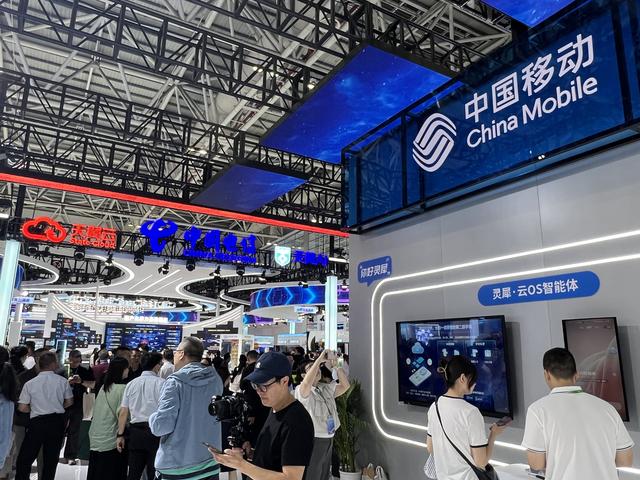
通信服务板块11月7日涨0.62%,普天科技领涨,主力资金净流出1.52亿元
Zheng Xing Xing Ye Ri Bao· 2025-11-07 08:41
Core Insights - The communication services sector saw a rise of 0.62% on November 7, with Putian Technology leading the gains [1] - The Shanghai Composite Index closed at 3997.56, down 0.25%, while the Shenzhen Component Index closed at 13404.06, down 0.36% [1] Stock Performance - The top-performing stocks in the communication services sector included: - Yintian Technology (002544) with a closing price of 27.43, up 6.73% and a trading volume of 389,700 shares [1] - Sanwei Communication (002115) closed at 11.46, up 1.78% with a trading volume of 803,800 shares [1] - Guantong Century (300310) closed at 6.18, up 1.64% with a trading volume of 362,400 shares [1] - Major stocks that experienced declines included: - Online and Offline (656000E) closed at 100.00, down 4.03% with a trading volume of 66,100 shares [2] - Century Hengtong (301428) closed at 35.02, down 3.13% with a trading volume of 34,300 shares [2] Capital Flow - The communication services sector experienced a net outflow of 152 million yuan from institutional investors and 135 million yuan from speculative funds, while retail investors saw a net inflow of 287 million yuan [2] - Notable capital flows for specific stocks included: - Putian Technology (002544) had a net inflow of 141 million yuan from institutional investors [3] - China Mobile (600941) saw a net inflow of 45.06 million yuan from institutional investors [3] - China Telecom (601728) had a net inflow of 31.81 million yuan from retail investors [3]


238只港股获南向资金大比例持有
Zheng Quan Shi Bao Wang· 2025-11-07 01:41
Core Insights - The overall shareholding ratio of southbound funds in Hong Kong Stock Connect stocks is 19.12%, with 238 stocks having a shareholding ratio exceeding 20% [1] - Southbound funds hold a total of 4,829.92 million shares, accounting for 19.12% of the total share capital of the stocks, with a market value of 62,903.32 billion HKD, representing 14.56% of the total market value [1] - The stocks with the highest shareholding ratios by southbound funds are primarily AH concept stocks, with 127 out of 238 stocks exceeding 20% shareholding being AH stocks [1] Summary by Category Southbound Fund Holdings - Southbound funds have a significant presence in the Hong Kong market, with 238 stocks having over 20% shareholding, 135 stocks between 10% and 20%, 96 stocks between 5% and 10%, 82 stocks between 1% and 5%, and 18 stocks below 1% [1] - The highest shareholding is in China Telecom (601728) at 71.42%, followed by Green Power (601330) at 69.43% and COSCO Shipping Energy (600026) at 69.25% [2] Industry Distribution - The stocks with over 20% shareholding by southbound funds are mainly concentrated in the healthcare, industrial, and financial sectors, with 56, 35, and 34 stocks respectively [2] - A detailed list of high shareholding stocks includes China Telecom, Green Power, COSCO Shipping Energy, and others, with varying market prices and daily price changes [2][3]
研判2025!中国海洋物联网行业政策、产业链图谱、发展现状、细分市场及未来发展趋势分析:迈向空天地海一体,激活海洋经济新质生产力【图】
Chan Ye Xin Xi Wang· 2025-11-07 01:12
Core Insights - The article discusses the deep application of Internet of Things (IoT) technology in the marine sector, aiming to promote the digital and intelligent transformation of the marine economy through "interconnectivity" [1][2] - China's strategic elevation of marine power construction has led to the introduction of various policies to support the development of marine IoT, with a projected industry scale of 84.4 billion yuan in 2024 and expected to exceed 100 billion yuan in 2025 [1][12] - Key players in the industry include major companies like Huawei and ZTE, which dominate the market, while specialized enterprises focus on vertical breakthroughs [1][16] Marine IoT Overview - Marine IoT (Ocean IoT) involves the deployment of sensors, communication devices, and intelligent terminals, combined with cloud computing and big data, to create a real-time perception and decision support network for marine environments [1][2] - The core objective is to achieve full-chain connectivity of marine data, facilitating the transition from traditional development to digital and intelligent operations [1][2] Industry Policies - China has intensified its investment in marine technology and information sectors, with marine IoT being a key vehicle for innovation and industrial upgrading [7][11] - National policies such as the "Digital China Construction Overall Layout Plan" and local initiatives from cities like Qingdao aim to create a favorable environment for marine IoT development [7][11] Industry Chain - The marine IoT industry chain consists of three segments: upstream focuses on sensing and communication infrastructure, midstream involves equipment integration and platform services, and downstream emphasizes diverse application implementations [8][10] - The entire industry chain is evolving through technological breakthroughs and application deepening, forming a complete ecosystem from hardware support to intelligent services [8][10] Current Development Status - The marine IoT industry is experiencing rapid growth, with a market size projected to reach approximately 4.01 trillion yuan in 2024 and 4.55 trillion yuan in 2025, reflecting a year-on-year growth of about 13.7% [10][11] - The industry is transitioning from external growth characterized by "connection scale expansion" to internal development focused on "data value mining" [10][11] Market Size and Forecast - The marine IoT market is expected to reach 84.4 billion yuan in 2024 and is projected to exceed 100 billion yuan in 2025, indicating a robust growth trajectory [12][14] Competitive Landscape - The competitive landscape of the marine IoT industry is characterized by "head concentration, cross-industry penetration, and niche breakthroughs," with major players like Huawei and ZTE leading the market [16] - Companies are primarily concentrated in coastal economic zones, focusing on core scenarios such as smart ports and marine security [16] Future Development Trends - The marine IoT industry is expected to see deep technological integration, expansion of application scenarios, and collaborative industrial ecosystems [17][18] - Future applications will extend from single-point empowerment to full-chain collaboration, integrating marine agriculture, industry, and services [18][19] - The competitive landscape will shift towards ecological collaboration, supported by policies that enhance technology implementation and industry cluster development [19]



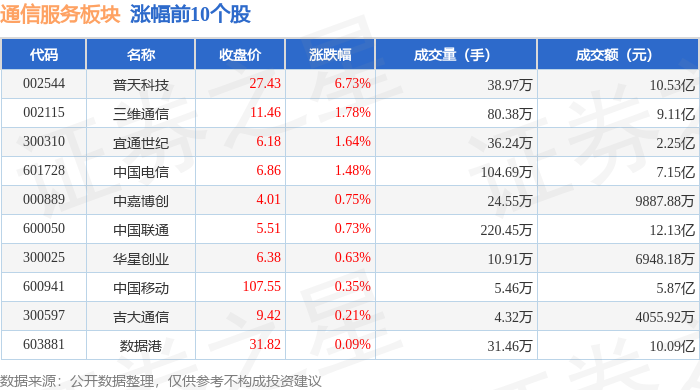
通信服务板块11月6日涨0.23%,世纪恒通领涨,主力资金净流出2.55亿元
Zheng Xing Xing Ye Ri Bao· 2025-11-06 08:50
Market Overview - The communication services sector increased by 0.23% on November 6, with Century Hengtong leading the gains [1] - The Shanghai Composite Index closed at 4007.76, up 0.97%, while the Shenzhen Component Index closed at 13452.42, up 1.73% [1] Top Gainers in Communication Services - Century Hengtong (301428) closed at 36.15, up 2.52% with a trading volume of 49,400 shares and a turnover of 176 million yuan [1] - Data Port (603881) closed at 31.79, up 1.50% with a trading volume of 163,300 shares and a turnover of 517 million yuan [1] - Super Communication (603322) closed at 47.07, up 1.36% with a trading volume of 91,400 shares and a turnover of 428 million yuan [1] Top Losers in Communication Services - Zhongfutong (300560) closed at 14.56, down 3.83% with a trading volume of 233,400 shares and a turnover of 341 million yuan [2] - Hengxin Oriental (300081) closed at 5.51, down 2.48% with a trading volume of 301,000 shares and a turnover of 166 million yuan [2] - Lian Technology (300603) closed at 10.71, down 1.47% with a trading volume of 111,700 shares and a turnover of 12 million yuan [2] Capital Flow Analysis - The communication services sector experienced a net outflow of 255 million yuan from institutional investors, while retail investors saw a net inflow of 267 million yuan [2] - Major stocks like China Telecom (601728) had a net inflow of 24.02 million yuan from institutional investors, but a net outflow of 63.54 million yuan from speculative funds [3] - Century Hengtong (301428) saw a net inflow of 14.68 million yuan from institutional investors, while retail investors had a net outflow of 16.96 million yuan [3]



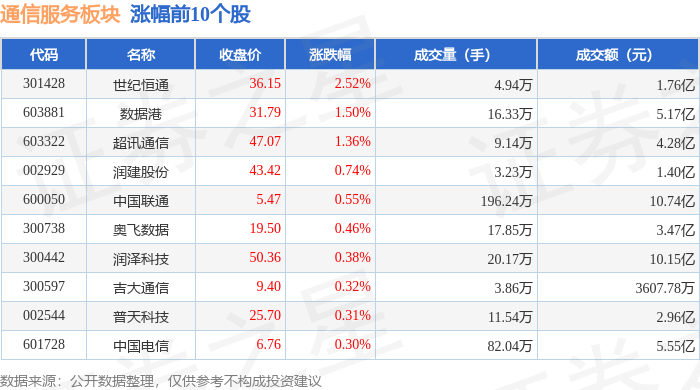
办电话卡需预存高额话费、提供工作证明等?官方通报:已责成相关企业全面开展排查整改
Mei Ri Jing Ji Xin Wen· 2025-11-06 06:43
Core Viewpoint - The Jiangxi Provincial Communication Administration has responded to media reports regarding the high barriers for obtaining phone cards with out-of-town ID cards, including the requirement for work proof and high prepayment amounts, emphasizing the need to protect user rights [1][4]. Group 1: Regulatory Response - The Jiangxi Communication Administration has mandated relevant companies to conduct thorough inspections and rectifications to ensure user rights are safeguarded [1]. - The administration's response indicates a proactive approach to address the issues raised by the media regarding the barriers for out-of-town residents [1]. Group 2: Operator Practices - In Jiangxi, mobile service providers such as China Mobile and China Unicom require out-of-town ID card holders to provide work proof, business licenses, or housing contracts, along with a prepayment of 500 yuan [4][5]. - Different operators have varying requirements; for instance, some locations may allow for a simplified process if the user can confirm local residency [4]. - In contrast, other provinces like Fujian and Gansu have more lenient requirements for out-of-town card applications, indicating regional disparities in practices [5]. Group 3: Expert Opinions - Liu Xingliang, a member of the Ministry of Industry and Information Technology's expert committee, highlighted that while real-name registration is regulated, the additional requirements imposed by operators lack a national legal basis [6]. - Liu suggested the establishment of a "basic standard for out-of-town card applications" to streamline the process and reduce unnecessary barriers for low-risk users [6]. - The recommendation includes a model for a unified set of basic materials required nationwide, with the possibility of local additions, to enhance user experience and rights [6].