
BANK OF CHINA(601988)

Search documents
折扣叠加财政贴息 银行信用卡账单分期成本下降
Zheng Quan Ri Bao· 2026-02-27 16:10
Core Viewpoint - The implementation of the personal consumption loan interest subsidy policy by the Ministry of Finance and other departments aims to stimulate consumer spending by reducing the cost of credit card installment payments through combined financial incentives from banks and government subsidies [1][2]. Group 1: Policy Implementation - The personal consumption loan interest subsidy policy has been extended until the end of 2026, allowing banks to include credit card installment payments in the subsidy scope, which directly lowers their funding costs [2][3]. - Banks have responded by lowering installment fees and offering discounts, which, combined with the subsidy, significantly reduces the financial burden on consumers [2][3]. Group 2: Bank Initiatives - Several banks, including Bank of China and Nanjing Bank, have launched promotional activities that offer substantial discounts on installment interest rates, with some rates dropping to as low as 2% [3][4]. - For instance, Nanjing Bank offers a special rate of 4.4% to 4.57% for certain installment plans, down from an original annual rate of around 14% [3]. Group 3: Consumer Impact - The dual incentives from the subsidy and bank promotions have effectively lowered the actual cost of consumer spending, thereby enhancing consumer confidence and willingness to spend [4]. - Consumers have reported significant savings on their installment payments, with some experiencing reductions in annualized interest rates from 3.06% to below 2% due to the combined effects of bank discounts and the subsidy [3][4]. Group 4: Market Dynamics - The policy is expected to stimulate the growth of consumer credit, contributing to increased domestic demand and a positive cycle of credit and consumption [4][5]. - The rapid growth in consumer credit activity has been observed, with banks reporting increases in customer numbers, transaction volumes, and lending scales [4].


中国银行山东省分行助力小微企业喜迎新春
Zhong Guo Jin Rong Xin Xi Wang· 2026-02-27 12:07
Core Insights - The article highlights the significant role of the Bank of China Shandong Branch in supporting local businesses during the Chinese New Year, particularly through quick and efficient loan services that enhance the festive consumption atmosphere [1][4]. Group 1: Financial Support for Local Businesses - The Bank of China provided 10 million yuan in credit support to a local ecological agriculture company producing "Jiaodong flower steamed buns," helping to stabilize employment for nearly 100 local farmers and boost production and sales during the festive season [1]. - A transportation company in Binzhou received 900,000 yuan in emergency loans within two days, allowing them to secure raw materials and meet increased demand during the holiday [2]. - The Bank of China tailored a 30 million yuan loan for a flour company in Zaozhuang, ensuring a steady supply of quality wheat and supporting local food production [2]. Group 2: Timely Assistance to Small Enterprises - A dumpling shop in Jining received 500,000 yuan in a no-repayment loan extension, enabling them to stock up on ingredients and maintain operations during the peak season [3]. - A seafood merchant in Weihai was granted 1 million yuan in credit within 48 hours, allowing them to dispatch 1,500 boxes of fish and generate over 1.2 million yuan in sales, while also creating jobs for local fishermen's families [3]. - The Bank of China has disbursed over 10 million yuan in loans to more than 20 seafood businesses, ensuring a stable supply of festive products for families [3].
中国银行党委召开扩大会议暨党建工作领导小组会议 部署开展树立和践行正确政绩观学习教育工作
Xin Lang Cai Jing· 2026-02-27 11:51
来源:中国银行 2月27日,中国银行党委召开扩大会议暨党建工作领导小组会议,认真学习贯彻习近平总书记关于树立 和践行正确政绩观学习教育的重要讲话和重要指示精神,传达学习中央党的建设工作领导小组会议部 署、中共中央办公厅《关于在全党开展树立和践行正确政绩观学习教育的通知》精神,审议《关于在全 行开展树立和践行正确政绩观学习教育的实施方案》,对全行学习教育工作进行动员部署。中国银行党 委书记、党建工作领导小组组长葛海蛟主持会议并讲话。 会议认为,在"十五五"开局之年,党中央决定开展树立和践行正确政绩观学习教育,充分彰显了立党为 公、执政为民的价值追求,具有重大意义。党的十八大以来,习近平总书记反复强调要树立和践行正确 政绩观,近期又在多次重要讲话中特别加以强调,为全行准确把握正确政绩观的科学内涵、精神实质、 实践要义,开展学习教育指明了方向、提供了重要遵循。各级党组织和广大党员干部要深入学习领会, 进一步提高政治站位,深刻认识开展这次学习教育是坚定拥护"两个确立"、坚决做到"两个维护"的实际 行动,是贯彻落实党的二十届四中全会战略部署、以实干担当推动高质量发展的有力保障,是始终站稳 人民立场、深入践行金融为民理念 ...
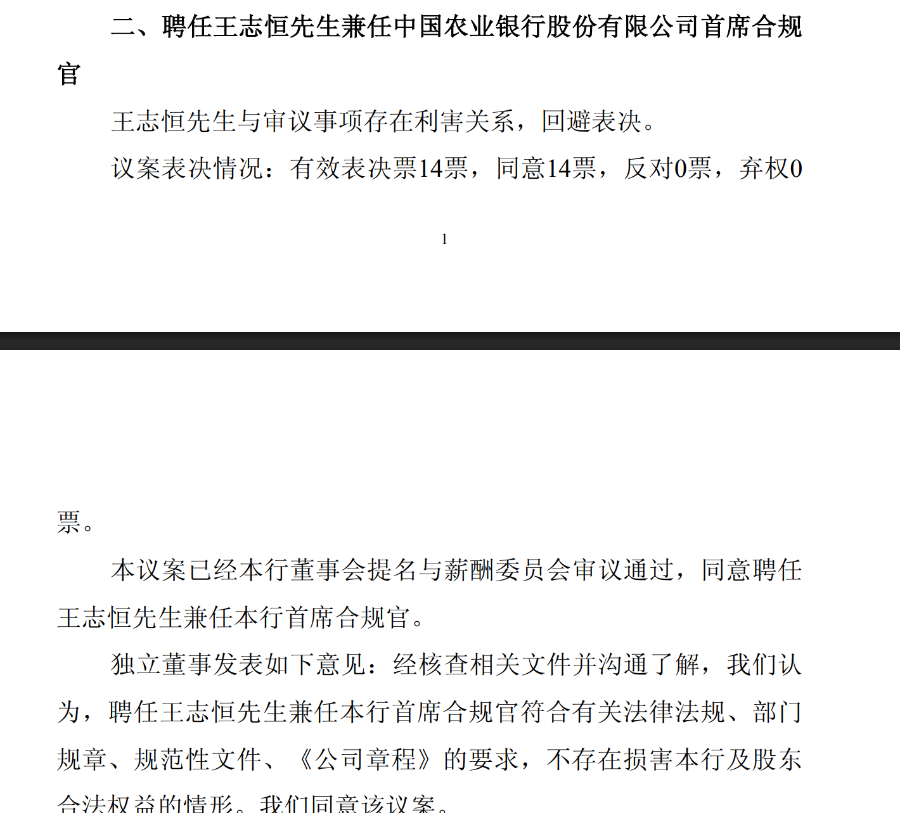
凸显合规治理 农行、中行“高配”首席合规官
2 1 Shi Ji Jing Ji Bao Dao· 2026-02-27 09:12
Group 1 - The core viewpoint of the articles is the establishment of the Chief Compliance Officer (CCO) position by major Chinese banks, reflecting a heightened emphasis on compliance and internal control within the banking sector [1][2][6] - Agricultural Bank of China and Bank of China have appointed their respective presidents as CCOs, marking the first time these banks have created this position [1][2] - The appointments are in response to the regulatory requirements set forth by the National Financial Regulatory Administration's "Compliance Management Measures for Financial Institutions," which mandates the establishment of a CCO at the headquarters of financial institutions [2][6] Group 2 - The "Compliance Measures" came into effect on March 1, 2025, with a one-year transition period, leading to a wave of CCO appointments across various banking institutions [2][6] - Other banks, such as Industrial Bank and Ping An Bank, have also appointed CCOs, indicating a broader trend in the industry [2] - The role of the CCO is distinct from that of the Chief Risk Officer (CRO), with the CCO focusing on compliance with laws and regulations, while the CRO manages substantive risks [4][5] Group 3 - The CCO position is expected to enhance compliance governance and integrate compliance requirements into business processes and decision-making, thereby influencing the corporate culture and sustainable development of the banking industry [6] - The qualifications for the CCO include a bachelor's degree and significant experience in finance and compliance, reflecting the importance of expertise in this role [5][6] - The establishment of the CCO role is seen as a significant restructuring of internal governance and risk management within banks, driven by regulatory changes and the evolving risk environment [6]


艺术品抵押贷款,唤醒沉睡资产
Sou Hu Cai Jing· 2026-02-27 03:45
Core Viewpoint - The Chinese cultural industry has surpassed a trillion yuan in scale, but financing challenges persist for collectors, artists, and cultural enterprises. The recent approval of the "Bank Support for Cultural Industry Development Report" marks a significant step towards integrating art and finance, enabling collectors to leverage their assets, artists to focus on creation, and cultural enterprises to accelerate expansion, thus making art collateral loans mainstream and enhancing the value of collections [1][2]. Group 1: Market Demand and Growth - The total estimated value of private collections in China exceeds 12 trillion yuan, yet the legal circulation rate remains below 1%, highlighting a significant market demand for art collateral loans [2]. - By 2025, the scale of art collateral loans in China is projected to exceed 1.2 trillion yuan, indicating rapid growth and a vast potential market in art finance [1]. Group 2: Banking Sector Involvement - Major state-owned banks dominate the art collateral loan market, with specific strategies: China Construction Bank focuses on traditional cultural items with a maximum collateral ratio of 70% and a loan cap of 5 million yuan; Industrial and Commercial Bank of China covers various art forms with a 60% collateral ratio; Bank of China targets antiques and ceramics with a similar collateral ratio but a lower loan cap of 3 million yuan [2]. - Joint-stock banks adopt a more cautious approach, with banks like Bank of Communications and China Merchants Bank only accepting renowned artworks, maintaining a uniform collateral ratio of 50% and a loan cap of 2 million yuan [2]. Group 3: Innovative Financing Models - Weifang Bank has pioneered a pre-purchase model for art, successfully lending 1.1 billion yuan with zero bad debts, demonstrating the feasibility of innovative financing methods [2][4]. - A new "four-step" service model for copyright pledge loans has been established in Feicheng, focusing on copyright assessment, pledge registration, financing credit, and loan issuance, creating a closed-loop system for financing [6]. Group 4: Technology Integration - Technologies such as blockchain and AI are being utilized to address trust issues in art financing, providing a permanent, traceable digital record for artworks, which helps solve problems related to authenticity, valuation, and ownership [8]. - The global art collateral loan market is maturing, with Deloitte reporting that global loan balances are expected to exceed $36 billion by 2024, indicating strong growth potential [8]. Group 5: Changing Perceptions of Art - 73% of clients use art financing to release liquidity for other business activities rather than solely purchasing more art, indicating a shift in perception of art from mere aesthetic objects to active capital [9]. - Art is increasingly recognized as a liquid asset that can address funding gaps for startups, provide operational cash flow for businesses, and serve as a tool for family wealth transfer [9].


上调至100%!金价迅猛上涨,国有大行紧急出手
Sou Hu Cai Jing· 2026-02-27 00:39
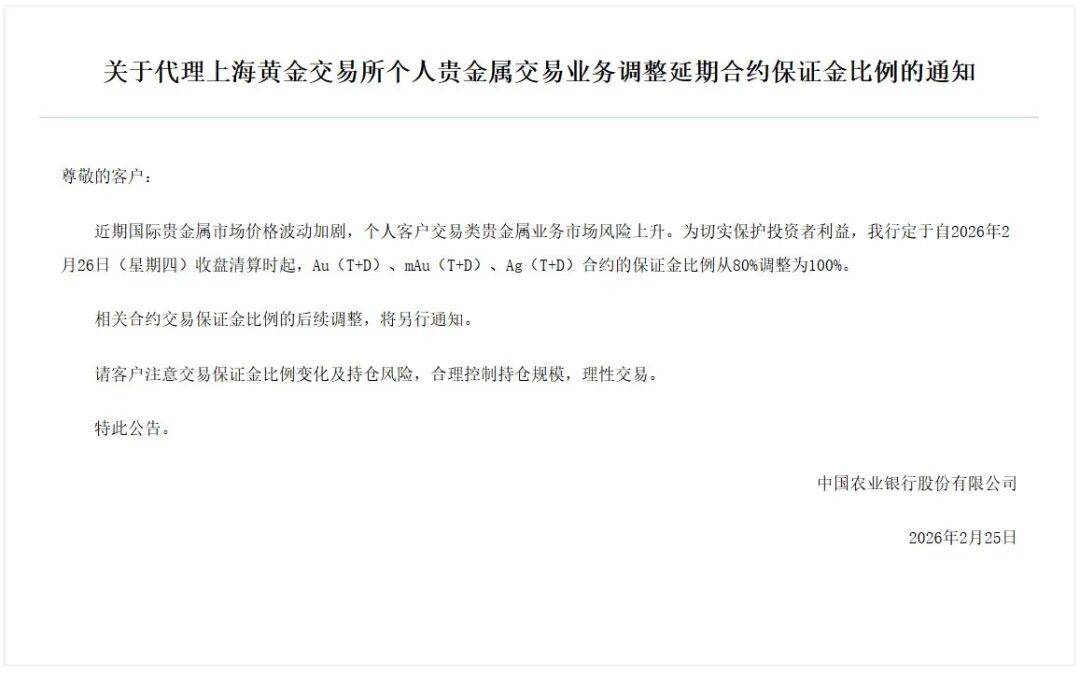
Core Viewpoint - The recent adjustments in margin requirements for personal precious metals trading by several banks reflect increased market volatility and risk in the international precious metals market, particularly gold and silver. Group 1: Price Movements - London spot gold rebounded to over $5200 per ounce on February 26, following a period of price fluctuations [1] - Major jewelry brands in China, such as Chow Tai Fook, reported an increase in gold prices, with the latest price for 24K gold jewelry at 1576 RMB per gram, up from 1570 RMB per gram [1] Group 2: Margin Requirement Adjustments - Agricultural Bank of China announced an increase in the margin requirement for personal precious metals trading from 80% to 100% effective February 26, 2026, due to heightened market risks [2] - Industrial and Commercial Bank of China also confirmed a similar adjustment, effective February 27, 2026, for various gold and silver contracts [4][5] - Other banks, including China Construction Bank and Bank of China, have also made similar margin adjustments in response to market conditions [8] Group 3: Price Increase Announcements - Multiple jewelry brands are expected to raise prices, with Chow Tai Fook planning a price adjustment for gold products around March 10, with anticipated increases of 15% to 30% [11] - Lao Pu Gold announced a price increase starting February 28, 2026, following previous adjustments in 2025 [11] Group 4: Market Outlook - Deutsche Bank maintains a bullish outlook on gold prices, predicting a target of $6000 per ounce, supported by strong demand for gold and other precious metals [12] - JPMorgan has raised its long-term gold price forecast to $4500 per ounce, while maintaining a year-end target of $6300 per ounce for 2026 [12] - Bank of America anticipates gold prices could reach $6000 per ounce within the next 12 months, despite potential short-term declines in silver prices [12]
继续降,部分银行代理贵金属业务杠杆已降至1倍
Di Yi Cai Jing· 2026-02-26 22:46
Core Viewpoint - The recent fluctuations in gold and silver prices have prompted banks to increase margin requirements for precious metals trading, reflecting heightened market risks and regulatory compliance needs [2][4][8]. Group 1: Margin Adjustments by Banks - Agricultural Bank of China announced an increase in margin requirements for gold and silver contracts from 80% to 100% due to rising market risks [4]. - Industrial and Commercial Bank of China also raised the margin for various gold and silver contracts to 100%, following a previous increase from 60% to 80% [4][5]. - Several banks, including China Construction Bank and Bank of China, have similarly adjusted their margin requirements, with some reaching 100% [5][6]. Group 2: Regulatory and Compliance Actions - Banks are not only increasing margins but also cleaning up existing business, including closing accounts with no activity and reducing transaction channels [2][10]. - Postal Savings Bank announced a complete cessation of certain precious metals trading services, with mandatory liquidation for inactive accounts by a specified deadline [10]. - Many banks have already suspended new account openings and trading activities in precious metals, focusing on existing clients [9][10]. Group 3: Market Context and Implications - The adjustments in margin requirements come in response to significant price volatility in the precious metals market, which has seen historical highs [8]. - The tightening of margin requirements indicates a broader trend of risk management among banks in the face of fluctuating commodity prices [2][8].


多家上市银行首席合规官密集“就位”
Zheng Quan Ri Bao Zhi Sheng· 2026-02-26 16:06
Core Viewpoint - The recent appointment of Chief Compliance Officers (CCOs) by multiple banks reflects a significant shift in compliance management, aligning with regulatory requirements aimed at enhancing governance and risk management in the financial sector [1][2][3] Group 1: Regulatory Changes - The National Financial Regulatory Administration has introduced the "Compliance Management Measures for Financial Institutions," mandating the establishment of CCOs at headquarters and emphasizing their direct accountability to the board [1] - The measures will take effect on March 1, 2025, with a one-year transition period, indicating a structured approach to compliance management [1] Group 2: Bank Appointments - Several banks, including Agricultural Bank of China and Bank of China, have recently announced the appointment of CCOs, highlighting a trend among listed banks to comply with new regulatory standards [2] - The appointments are seen as crucial for enhancing the independence and authority of compliance management within financial institutions [2] Group 3: Importance of Compliance Management - Compliance management is identified as a key factor for the stable operation and high-quality development of financial institutions, transitioning from passive compliance to proactive governance [2] - Experts suggest that the establishment of CCO positions will improve the effectiveness of compliance management and help mitigate risks in a complex operating environment [2][3] Group 4: Impact on Governance - The introduction of CCOs represents a significant institutional change, moving compliance from a cost center to a value center, thereby protecting long-term bank value [3] - The role of CCOs is expected to reshape corporate governance, balancing business innovation with compliance requirements, although it may initially extend decision-making processes [3]




银行存贷差走阔意味着什么?
GF SECURITIES· 2026-02-26 15:12
Investment Rating - The report provides a "Buy" rating for the banking sector, indicating an expectation that stock prices will outperform the market by more than 10% over the next 12 months [54]. Core Insights - Recent high growth in bank deposits has led to market interpretations of banks being "asset deficient." However, this interpretation is challenged by the contractual nature of banking operations, where deposits and loans are derived simultaneously [4][12]. - The widening of the loan-to-deposit spread (LDR) is influenced by six key factors: cash withdrawal demand, reserve requirements, interbank lending, bond investment scale, bond issuance, and bank capital [4][14]. - The increase in net bond financing is a significant factor contributing to the widening of the loan-to-deposit spread. Two scenarios are identified: when bond financing costs are lower than loan rates, and when non-bank entities reduce their borrowing, leading to a return of funds to banks [4][35]. - From January 2025 to January 2026, the loan-to-deposit spread widened by 11.4 trillion CNY, with new bond investments contributing 16.6 trillion CNY and market bond net financing at 20.6 trillion CNY [4][45]. - In January 2026, net bond investment increased by 1.9 trillion CNY, while total market bond net financing was only 1.4 trillion CNY, indicating a negative contribution of -9.68% from bond financing to the loan-to-deposit spread [4][45]. Summary by Sections Section 1: Implications of Widening Loan-to-Deposit Spread - The loan-to-deposit spread for large banks increased from 15.8 trillion CNY in January 2025 to 21.8 trillion CNY in January 2026, while for medium-sized banks, it rose from 16.5 trillion CNY to 23.5 trillion CNY [12]. - The decline in loan-to-deposit ratios for large banks from 89.1% to 86.5% and for medium-sized banks from 88.3% to 84.7% reflects a shift in asset allocation demands [12]. Section 2: Factors Influencing Loan-to-Deposit Spread - The six factors affecting the loan-to-deposit spread include: 1. Cash withdrawal demand 2. Reserve situation 3. Interbank lending to non-banking entities 4. Scale of bond investments 5. Bond issuance 6. Bank capital [4][14]. - The report emphasizes that the relationship between bond financing and loans must differentiate between government and non-government bonds, as the issuance of government bonds does not affect the loan-to-deposit spread [4][35]. Section 3: Analysis of Recent Changes in Bank Assets and Liabilities - The report details the contributions of various factors to the loan-to-deposit spread, including a -47% contribution from bank funds exiting the balance sheet and a 173% contribution from the substitution effect of bonds for loans [4][45]. - The analysis of January 2026 data shows that non-bank funds returning to banks contributed 25.9% to the loan-to-deposit spread, while interbank net assets contributed 43.3% [4][45].
继续降!部分银行代理贵金属业务杠杆已降至1倍
Di Yi Cai Jing· 2026-02-26 14:31
Core Viewpoint - The recent fluctuations in gold and silver prices have prompted banks to increase margin requirements for precious metal trading, effectively reducing leverage to 1 for many institutions [1][4]. Group 1: Margin Adjustments by Banks - Agricultural Bank announced an increase in margin requirements for gold and silver contracts from 80% to 100% due to heightened market risks [2]. - Industrial and Commercial Bank also raised its margin requirements for various gold and silver contracts to 100%, following a previous increase from 60% to 80% [2]. - Other banks, including China Construction Bank and Bank of China, have similarly raised their margin requirements, with some reaching 100% [4]. Group 2: Regulatory and Compliance Actions - Banks are not only increasing margin requirements but are also cleaning up existing business, including the closure of accounts with no activity and the reduction of trading channels [1][6]. - Some banks, like Postal Savings Bank, have announced the cessation of related business, with plans for forced liquidation of positions if clients do not act by specified deadlines [8]. Group 3: Market Context and Risk Management - The Shanghai Gold Exchange recently adjusted margin levels downward, yet banks have chosen to increase their margin requirements, indicating a cautious approach to risk management amid volatile market conditions [3][4]. - The tightening of margin requirements reflects a broader trend of banks reducing exposure to precious metals trading, particularly for new accounts and positions [6][7].
