
WANTAI BIOLOGICAL(603392)

Search documents
生物制品板块12月2日跌1.72%,奥浦迈领跌,主力资金净流出4.56亿元
Zheng Xing Xing Ye Ri Bao· 2025-12-02 09:03
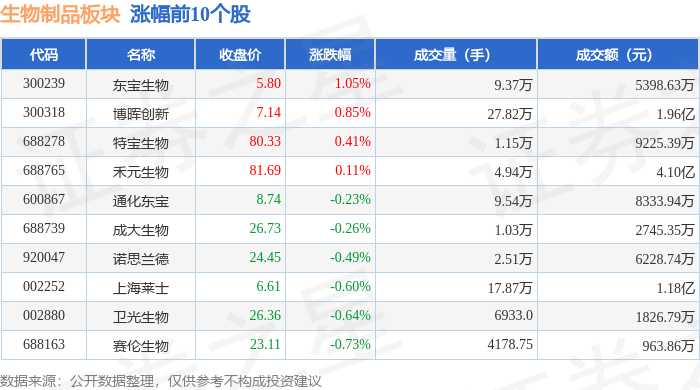
Market Overview - The biopharmaceutical sector experienced a decline of 1.72% on December 2, with Aopumai leading the drop [1] - The Shanghai Composite Index closed at 3897.71, down 0.42%, while the Shenzhen Component Index closed at 13056.7, down 0.68% [1] Individual Stock Performance - Dongbao Bio (300239) closed at 5.80, up 1.05% with a trading volume of 93,700 shares and a transaction value of 53.99 million yuan [1] - Aopumai (688293) saw a significant drop of 8.01%, closing at 50.32 with a trading volume of 33,400 shares and a transaction value of 171 million yuan [2] - Other notable declines included Kanghong Pharmaceutical (002773) down 3.78% and Watson Bio (300142) down 3.17% [2] Capital Flow Analysis - The biopharmaceutical sector experienced a net outflow of 456 million yuan from institutional investors, while retail investors saw a net inflow of 270 million yuan [2] - Notable stocks with significant capital inflows included He Yuan Bio (688765) with a net inflow of 17.69 million yuan from institutional investors [3] - Conversely, stocks like Rongchang Bio (688331) and Shenzhou Cell (688520) also saw mixed capital flows, indicating varied investor sentiment [3]


万泰生物跌2.04%,成交额8056.05万元,主力资金净流出859.72万元
Xin Lang Zheng Quan· 2025-12-02 03:01
Core Viewpoint - Wante Bio's stock has experienced a significant decline in 2023, with a year-to-date drop of 31.81% and a recent 20-day decline of 13.58% [2] Company Overview - Wante Bio, established on April 24, 1991, and listed on April 29, 2020, is located in Changping District, Beijing. The company specializes in the research, production, and sales of in vitro diagnostic reagents, instruments, and vaccines [2] - The revenue composition of Wante Bio includes: diagnostic reagents (67.06%), vaccines (20.36%), diagnostic instruments (4.98%), agency products (4.97%), other (1.88%), and active raw materials (0.76%) [2] - As of September 30, 2025, Wante Bio had 42,000 shareholders, an increase of 9.41% from the previous period, with an average of 30,124 circulating shares per shareholder, a decrease of 8.60% [2] Financial Performance - For the period from January to September 2025, Wante Bio reported a revenue of 1.498 billion yuan, a year-on-year decrease of 23.09%, and a net profit attributable to shareholders of -173 million yuan, a year-on-year decrease of 165.04% [2] - Since its A-share listing, Wante Bio has distributed a total of 1.541 billion yuan in dividends, with 1.311 billion yuan distributed over the past three years [3] Shareholder Structure - As of September 30, 2025, the top ten circulating shareholders of Wante Bio include Hong Kong Central Clearing Limited, which holds 12.8991 million shares (a decrease of 9.8553 million shares), and Huatai-PB CSI 300 ETF, holding 6.4061 million shares (a decrease of 318,300 shares) [3] - The newly entered shareholder in the top ten is the China National Securities Biomedicine Index A, holding 4.9609 million shares [3]

生物制品板块12月1日涨0.23%,禾元生物领涨,主力资金净流出2.73亿元
Zheng Xing Xing Ye Ri Bao· 2025-12-01 09:09
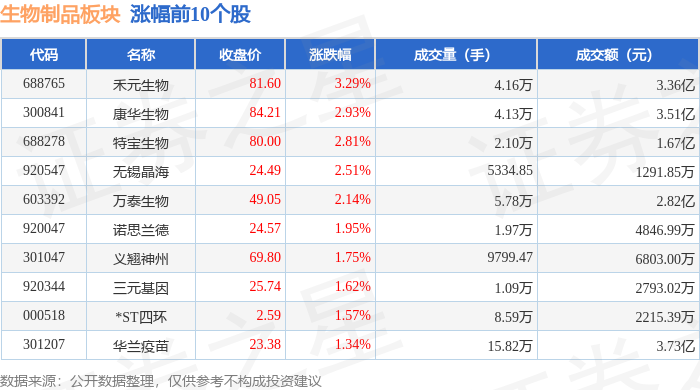
Core Viewpoint - The biopharmaceutical sector experienced a slight increase of 0.23% on December 1, with He Yuan Bio leading the gains. The Shanghai Composite Index rose by 0.65%, while the Shenzhen Component Index increased by 1.25% [1]. Group 1: Market Performance - The biopharmaceutical sector's performance on December 1 showed a mixed trend, with notable gainers including He Yuan Bio, which closed at 81.60 with a rise of 3.29%, and Kanghua Bio, which closed at 84.21 with a rise of 2.93% [1]. - The overall trading volume in the biopharmaceutical sector was significant, with He Yuan Bio achieving a transaction amount of 336 million yuan and Kanghua Bio reaching 351 million yuan [1]. Group 2: Individual Stock Performance - The table of individual stock performance indicates that several companies in the biopharmaceutical sector saw positive price movements, with Te Bao Bio and Wu Xi Jing Hai also recording increases of 2.81% and 2.51%, respectively [1]. - Conversely, some companies faced declines, such as Rong Chang Bio, which fell by 4.47%, and Bai Pu Sai Si, which decreased by 3.65% [2]. Group 3: Capital Flow - The biopharmaceutical sector experienced a net outflow of 273 million yuan from institutional investors, while retail investors contributed a net inflow of 178 million yuan [2]. - The capital flow data highlights that He Yuan Bio attracted a net inflow of 51.47 million yuan from institutional investors, despite a net outflow from retail investors [3].

万泰生物涨2.14%,成交额1.06亿元,主力资金净流出315.83万元
Xin Lang Cai Jing· 2025-12-01 02:55
Core Viewpoint - Wante Bio's stock has experienced a significant decline this year, with a 30.39% drop, and the company is facing challenges in revenue and profit margins [1][2]. Financial Performance - For the period from January to September 2025, Wante Bio reported a revenue of 1.498 billion yuan, a year-on-year decrease of 23.09% [2]. - The net profit attributable to the parent company was -173 million yuan, reflecting a year-on-year decrease of 165.04% [2]. Stock Market Activity - As of December 1, Wante Bio's stock price was 49.05 yuan per share, with a market capitalization of 62.054 billion yuan [1]. - The stock has seen a trading volume of 1.06 billion yuan, with a turnover rate of 0.17% [1]. - The stock has experienced a decline of 4.76% over the last five trading days and 11.21% over the last 20 days [1]. Shareholder Information - As of September 30, 2025, the number of shareholders increased to 42,000, a rise of 9.41% [2]. - The average number of circulating shares per shareholder decreased by 8.60% to 30,124 shares [2]. Dividend Distribution - Wante Bio has distributed a total of 1.541 billion yuan in dividends since its A-share listing, with 1.311 billion yuan distributed over the past three years [3]. Institutional Holdings - As of September 30, 2025, Hong Kong Central Clearing Limited was the fifth-largest circulating shareholder, holding 12.8991 million shares, a decrease of 9.8553 million shares from the previous period [3]. - The top ten circulating shareholders included new entrants and exits, indicating changes in institutional interest [3].
北京万泰生物药业股份有限公司关于选举职工代表董事的公告
Shang Hai Zheng Quan Bao· 2025-11-28 20:13
Core Points - The company held its second extraordinary general meeting on November 28, 2025, where it approved the proposal to cancel the supervisory board and amend the Articles of Association [1][5] - Chen Hao was elected as the employee representative director of the sixth board of directors, ensuring compliance with relevant laws and regulations [2][4] Group 1: Meeting Details - The extraordinary general meeting took place on November 28, 2025, at the company's conference room in Beijing [6] - The meeting was chaired by the company's chairman, Qiu Zixin, and utilized a combination of on-site and online voting [7] Group 2: Resolutions Passed - The following proposals were approved during the meeting: 1. Cancellation of the supervisory board and amendment of the Articles of Association 2. Revision of the related party transaction management system 3. Revision of the board meeting rules 4. Revision of the shareholders' meeting rules 5. Revision of the independent director work system 6. Revision of the cumulative voting implementation details [8][9] Group 3: Legal Compliance - The meeting was witnessed by Beijing Zhonglun Law Firm, confirming that all procedures and voting results complied with legal and regulatory requirements [9]
万泰生物:选举职工代表董事
Zheng Quan Ri Bao Wang· 2025-11-28 13:12
证券日报网讯 11月28日晚间,万泰生物(603392)发布公告称,公司召开2025年第三次职工代表大 会。经与会职工代表审议,同意选举陈淏先生为公司第六届董事会职工董事。 ...
万泰生物(603392) - 万泰生物关于选举职工代表董事的公告
2025-11-28 09:30
证券代码:603392 证券简称:万泰生物 公告编号:2025-061 北京万泰生物药业股份有限公司董事会 2025 年 11 月 29 日 附件:职工代表董事简历 为保证公司董事会的合规运作,公司于同日召开 2025 年第三次职工代表大 会。经与会职工代表审议,同意选举陈淏先生为公司第六届董事会职工董事(简 历详见附件)。陈淏先生将与其他 7 名现任董事以及 2025 年第二次临时股东会选 举产生的 1 名非独立董事,共同组成公司第六届董事会,任期自本次职工代表大 会审议通过之日起至公司第六届董事会任期届满之日止。 陈淏先生符合《中华人民共和国公司法》及《公司章程》规定的有关职工董 事任职资格和条件。陈淏先生当选公司职工代表董事后,公司第六届董事会中兼 任公司高级管理人员以及由职工代表担任的董事人数未超过公司董事总数的二 分之一,独立董事不少于全体董事成员的三分之一,符合相关法律法规及《公司 章程》的规定。 特此公告。 北京万泰生物药业股份有限公司 关于选举职工代表董事的公告 本公司董事会及全体董事保证本公告内容不存在任何虚假记载、误导性 陈述或者重大遗漏,并对其内容的真实性、准确性和完整性承担法律责任。 ...
万泰生物(603392) - 万泰生物2025年第二次临时股东会决议公告
2025-11-28 09:30
(一)股东会召开的时间:2025 年 11 月 28 日 (二)股东会召开的地点:北京市昌平区科学园路 31 号公司会议室 证券代码:603392 证券简称:万泰生物 公告编号:2025-060 北京万泰生物药业股份有限公司 2025年第二次临时股东会决议公告 本公司董事会及全体董事保证本公告内容不存在任何虚假记载、误导性陈述 或者重大遗漏,并对其内容的真实性、准确性和完整性承担法律责任。 重要内容提示: 本次会议是否有否决议案:无 一、 会议召开和出席情况 (三)出席会议的普通股股东和恢复表决权的优先股股东及其持有股份情况: | 1、出席会议的股东和代理人人数 | 515 | | --- | --- | | 2、出席会议的股东所持有表决权的股份总数(股) | 993,999,969 | | 3、出席会议的股东所持有表决权股份数占公司有表决权股 | 78.6148 | | 份总数的比例(%) | | (四)表决方式是否符合《公司法》及《公司章程》的规定,会议主持情况等 本次股东会由公司董事会召集并发布公告通知,由公司董事长邱子欣先生主 持。会议表决方式为现场和网络投票相结合,本次会议的召集与召开程序、出席 会 ...
万泰生物(603392) - 北京市中伦律师事务所关于北京万泰生物药业股份有限公司2025年第二次临时股东会的法律意见书
2025-11-28 09:30
北京市中伦律师事务所 关于北京万泰生物药业股份有限公司 2025 年第二次临时股东会的法律意见书 二〇二五年十一月 北京市中伦律师事务所 关于北京万泰生物药业股份有限公司 2025 年第二次临时股东会的法律意见书 致:北京万泰生物药业股份有限公司 北京市中伦律师事务所(以下简称"本所")接受北京万泰生物药业股份有限 公司(以下简称"公司")的委托,就公司 2025 年第二次临时股东会(以下简称 "本次会议")相关事宜,根据《中华人民共和国公司法》《中华人民共和国证券 法》《上市公司股东会规则》《上海证券交易所股票上市规则》等法律、法规和 规范性文件及现行有效的《北京万泰生物药业股份有限公司章程》(以下简称《公" 司章程》"),依法出具本法律意见书。 本法律意见书仅就本次会议的召集和召开程序、出席会议人员资格、召集人 资格、本次会议表决程序及表决结果等事项发表法律意见,并不对本次大会所审 议议案的内容以及前述议案所表述的事实或数据的真实性和准确性发表意见。本 所律师并假定:公司提交给本所律师的所有资料(包括但不限于有关人员的居民 身份证、授权委托书、营业执照、股东名册、网络投票结果等)均真实、准确、 完整;该等 ...
万泰生物跌2.02%,成交额1.31亿元,主力资金净流出1736.87万元
Xin Lang Cai Jing· 2025-11-28 05:57
Core Viewpoint - Wante Bio's stock has experienced a significant decline in 2023, with a year-to-date drop of 31.73% and a recent 60-day decline of 17.40% [2] Company Overview - Wante Bio, established on April 24, 1991, and listed on April 29, 2020, is located in Changping District, Beijing. The company specializes in the research, production, and sales of in vitro diagnostic reagents, instruments, and vaccines [2] - The revenue composition of Wante Bio includes: diagnostic reagents (67.06%), vaccines (20.36%), diagnostic instruments (4.98%), agency products (4.97%), other (1.88%), and active raw materials (0.76%) [2] - As of September 30, 2025, Wante Bio had 42,000 shareholders, an increase of 9.41% from the previous period, with an average of 30,124 circulating shares per shareholder, a decrease of 8.60% [2] Financial Performance - For the period from January to September 2025, Wante Bio reported a revenue of 1.498 billion yuan, a year-on-year decrease of 23.09%, and a net profit attributable to shareholders of -173 million yuan, a year-on-year decrease of 165.04% [2] - Since its A-share listing, Wante Bio has distributed a total of 1.541 billion yuan in dividends, with 1.311 billion yuan distributed over the past three years [3] Shareholder Structure - As of September 30, 2025, the top ten circulating shareholders of Wante Bio include Hong Kong Central Clearing Limited, which holds 12.8991 million shares (a decrease of 9.8553 million shares), and Huatai-PB CSI 300 ETF, holding 6.4061 million shares (a decrease of 318,300 shares) [3] - The China National Securities Bio-Medical Index A has entered the top ten circulating shareholders with 4.9609 million shares as a new shareholder, while E Fund CSI 300 Medical ETF has exited the list [3] Market Activity - On November 28, Wante Bio's stock price fell by 2.02%, trading at 48.10 yuan per share, with a total transaction volume of 131 million yuan and a turnover rate of 0.21%. The total market capitalization is 60.852 billion yuan [1] - In terms of capital flow, there was a net outflow of 17.3687 million yuan from main funds, with large orders showing a buy of 23.094 million yuan (17.66%) and a sell of 27.222 million yuan (20.82%) [1]