
WANTAI BIOLOGICAL(603392)

Search documents
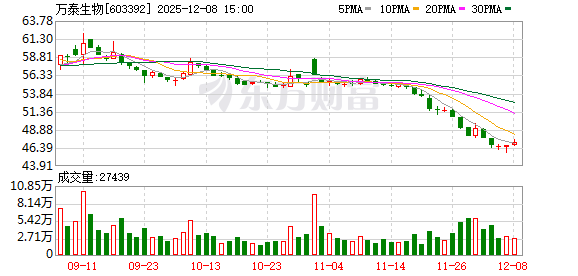
万泰生物:公司现阶段的亏损主要由于疫苗、IVD板块受市场调整、政府集采等影响
Zheng Quan Ri Bao Wang· 2025-12-08 14:13
Core Viewpoint - The company is currently experiencing losses primarily due to market adjustments and government procurement impacts on its vaccine and IVD segments [1] Group 1 - The company aims to continuously improve management levels to enhance business scale and efficiency [1] - The company plans to promote sustainable development and create greater value for shareholders through both organic growth and external expansion [1] - The company is committed to providing better returns for investors [1]

万泰生物:截至2025年11月,公司九价HPV疫苗已完成超过20个省份准入与首针接种工作
Zheng Quan Ri Bao Wang· 2025-12-08 13:41
证券日报网讯12月8日,万泰生物(603392)在互动平台回答投资者提问时表示,截至2025年11月,公 司九价HPV疫苗已完成超过20个省份准入与首针接种工作。公司营销团队正全力推进九价HPV疫苗的市 场覆盖工作。 ...
万泰生物:鼻喷流感疫苗正在按计划开展药学研究和药效研究
Zheng Quan Ri Bao· 2025-12-08 12:15
证券日报网讯 12月8日,万泰生物在互动平台回答投资者提问时表示,鼻喷流感疫苗正在按计划开展药 学研究和药效研究,进展顺利。 (文章来源:证券日报) ...

三价流感疫苗中标价低至5.5元,多款疫苗卷入价格战
Cai Jing Wang· 2025-12-08 05:09
Group 1 - The core point of the article highlights the significant price drop in various vaccines in the domestic market, with the three-valent flu vaccine priced at only 5.5 yuan, marking a new low for public flu vaccines [1] - The price of the two-valent HPV vaccine from Watson Bio has plummeted from 245 yuan per dose in 2022 to 27.5 yuan per dose in 2025, a decrease of nearly 90% [1] - The nine-valent HPV vaccine from Wantai Bio is priced at 499 yuan per dose, significantly lower than imported products, prompting the latter to engage in promotional activities to lower prices [1] Group 2 - The sharp decline in vaccine prices is expected to reduce public vaccination costs, theoretically improving vaccine accessibility and uptake [2] - Concerns have been raised regarding the potential impact of such low prices on public trust in vaccine quality, with fears that low-cost vaccines may compromise safety and effectiveness [2] - The public's skepticism may lead to a mindset of avoiding vaccinations altogether due to perceived risks associated with low-priced vaccines [2]


2025年三季报总结:医疗器械、生命科学上游、疫苗
2025-12-08 00:41
Summary of Conference Call Records Industry Overview - The medical device industry is experiencing overall performance pressure in 2025, but third-quarter revenues have shown a year-on-year increase, with a narrowing decline in net profit attributable to the parent company, primarily due to domestic medical insurance cost control and geopolitical influences. It is expected that normal growth rates will resume in 2026 [1][3][8]. Key Points on Medical Device Sector - **Domestic Market Dynamics**: The slowdown in hospital bidding in 2024 is impacting revenue realization, with an expected boost from the "old-for-new" policy by the end of 2025. The In Vitro Diagnostics (IVD) sector is under pressure due to centralized procurement price adjustments and tax reimbursements [1][4]. - **International Market Challenges**: Companies are strengthening their overseas presence, but initial high costs are pressuring short-term profits. The impact of US-China tariffs on low-value consumables is significant, with expectations of price recovery in the glove industry from late 2025 to 2026 after inventory digestion [1][4][11]. - **Performance Metrics**: In the first three quarters of 2025, the medical device sector reported revenues of 145.7 billion yuan, a year-on-year decline of 2.4%, and a net profit of 26.5 billion yuan, down 14.4%. However, the third quarter showed a positive revenue trend and a narrowing profit decline [3][15]. Specific Sector Insights - **IVD Sector**: The IVD sector saw a year-on-year decline of 14.5% in the first three quarters, but the third quarter showed improvement with revenues of 11.02 billion yuan, benefiting from the implementation of centralized procurement and the release of DRG/DIP 2.0 [16]. - **High-Value Consumables**: This segment experienced a revenue growth of 6.6% year-on-year, with orthopedics showing a significant growth rate of 18.7%. The recovery in cardiovascular surgeries is driving sales, and the ophthalmology sector presents potential due to low penetration rates [17]. - **Medical Equipment**: The medical equipment sector's revenue remained flat, but profit growth was slightly higher. The imaging equipment sector is benefiting from the "old-for-new" projects, with a notable recovery in the endoscope segment [15]. Vaccine Sector Performance - The vaccine sector faced significant pressure, with revenues declining nearly 50% and profits turning negative. However, there is a quarter-on-quarter improvement trend. Future focus includes the recovery of traditional vaccines and the launch of new pipeline products, such as the domestically produced nine-valent HPV vaccine [2][23]. Life Sciences Upstream Sector - The life sciences upstream sector's performance remained stable, with a year-on-year profit growth of 68% in the third quarter, driven by recovering terminal demand and improved gross margins. The sector is benefiting from the expansion of the biopharmaceutical market and policy support [24]. Regulatory Environment and Challenges - The current regulatory environment emphasizes innovation while ensuring safety and efficacy. Domestic companies face challenges in international certifications, particularly with the FDA and CE, due to quality control issues [20][21][22]. Future Outlook - The industry outlook for 2026 includes a focus on self-sufficiency, innovative devices, and accelerated realization of centralized procurement categories. The recovery of orthopedic products is already evident, and international expansion remains a key area of interest [5][7][19].




过去10年,顶级富豪们都怎么赚钱?
首席商业评论· 2025-12-05 04:14
Core Viewpoint - The article discusses the shifting landscape of wealth in China over the past decade, highlighting the rise of new wealthy individuals in the "emotional" economy, contrasting with the decline of traditional real estate tycoons [4][6]. Group 1: New Wealth Creation - The top new wealthy individuals in 2025 include Xu Gaoming and Xu Dongbo from Laopu Gold, with a wealth of 69.5 billion yuan, and Li Qibin and Qi Yan from Card Game, with 60 billion yuan [6]. - Companies like Pop Mart and Laopu Gold reported revenue and net profit growth exceeding 200% year-on-year in their latest financial reports [6][9]. - Card Game's revenue is projected to surpass 10 billion yuan in 2024, with a net profit margin exceeding 40%, outperforming Pop Mart [6]. Group 2: Emotional Economy - The rise of brands like milk tea chains has created a new class of wealthy individuals, emphasizing emotional connection and cultural identity over mere product functionality [9]. - The article notes a significant shift from high-tech internet and manufacturing wealth creation in 2015 to emotional-driven businesses in 2025 [9][10]. Group 3: Investment Challenges - Many of the new wealthy individuals faced initial skepticism from major investment firms, which underestimated their potential before they achieved significant financial success [10][11]. - For instance, Pop Mart's founder struggled to secure funding until a key investor provided crucial support, leading to the brand's eventual success [10]. Group 4: Female Entrepreneurs - The article highlights the increasing presence of female entrepreneurs on the wealth list, with 22.4% of the total being women, many of whom are first-generation wealth creators [12][15]. - Notable female figures include Zong Fuli, who became the first female billionaire in the beverage industry, and Zhong Huijuan, who emerged as a new female billionaire in the pharmaceutical sector [15][16]. Group 5: Decline of Real Estate Tycoons - The article notes a significant decline in the representation of real estate tycoons on the wealth list, dropping from 30% to just 10% over the past decade [25][28]. - High-profile figures like Wang Jianlin and Xu Jiayin have fallen from grace due to financial struggles and legal issues, reflecting the broader challenges facing the real estate sector [28][29]. Group 6: Market Dynamics - The article discusses the changing dynamics in the market, with traditional brands in the apparel sector facing difficulties adapting to new consumer preferences and competition from emerging brands [30][32]. - Companies like Meisibangwei and others have struggled with financial losses and are attempting to pivot their business models to survive in a competitive landscape [30].


北京启动首款国产九价HPV疫苗接种
Ke Ji Ri Bao· 2025-12-05 00:42
Group 1 - The first domestically produced nine-valent HPV vaccine has been officially launched in Beijing, providing a new and economical option for women aged 9 to 45 in cervical cancer prevention [1] - The vaccine can effectively prevent over 70% of cervical cancer cases and reduce the incidence of other diseases caused by HPV infection [1] - The National Health Commission has included the HPV vaccine in the national immunization program, offering free vaccinations for girls aged 13 who were born after November 10, 2011 [1] Group 2 - The nine-valent HPV vaccine was developed by Xiamen University and Beijing Wantai Biological Pharmacy Enterprise Co., Ltd., taking 18 years to complete [2] - Clinical trials involving over 11,000 healthy volunteers aged 9 to 45 have been conducted since 2019, demonstrating the vaccine's immunogenicity and safety comparable to imported products [2] - The vaccine is priced at 499 yuan per dose, with a total of 3 doses required for women aged 18 to 45, while those aged 9 to 17 only need 2 doses [2]
解密主力资金出逃股 连续5日净流出621股
Zheng Quan Shi Bao Wang· 2025-12-04 09:37
Group 1 - As of December 4, a total of 621 stocks in the Shanghai and Shenzhen markets have experienced a net outflow of main funds for five consecutive days or more [1][2] - WanTai Biologics has the longest streak of net outflow, with 27 consecutive days, followed by Zhongyou Capital with 26 days [1] - BlueFocus Media has the largest total net outflow amount, with 4.874 billion yuan over eight days, followed by Shanghai Electric with 3.172 billion yuan over 11 days [1] Group 2 - The stock with the highest percentage of net outflow relative to trading volume is Guanghui Energy, which has seen a 1.19% decline over the past seven days [1] - The table lists various companies with their respective net outflow days, amounts, percentages, and cumulative price changes, indicating a trend of declining stock prices among those with significant net outflows [1][2][3] - Notable companies with substantial net outflows include Longi Green Energy, Zhongyou Capital, and Guanghui Energy, all showing negative cumulative price changes [1][2]





2025年中国生物制剂行业政策、产业链、市场规模、研发支出、竞争格局及未来发展趋势研判:已成为医药行业增长最快的领域之一,市场规模将达到6752亿元[图]
Chan Ye Xin Xi Wang· 2025-12-03 01:24
Core Insights - The biopharmaceutical sector is one of the fastest-growing areas in the pharmaceutical industry, driven by an aging population and increased public health awareness [1][5] - China's biopharmaceutical market is projected to grow from CNY 312 billion in 2019 to CNY 587.1 billion in 2024, and is expected to reach CNY 675.2 billion by 2025, with a potential to hit CNY 1.149 trillion in the next five years [1][5][6] - Innovation remains the core driver of growth in the biopharmaceutical industry, which is capital-intensive and requires significant R&D investment [1][6] Industry Definition and Classification - Biopharmaceuticals are medical products manufactured using biological methods, aimed at replicating the activity of natural substances [2][4] - They can be categorized into vaccines, blood products, biopharmaceutical drugs, diagnostic reagents, and others, with further subdivisions based on source or mechanism of action [2] Current Industry Status - The global biopharmaceutical market is expected to grow from USD 286.4 billion in 2019 to USD 461.6 billion in 2024, with the original biopharmaceutical market projected to increase from USD 268.9 billion to USD 427.9 billion in the same period [5] - China plays a significant role in the global biopharmaceutical market, with rapid growth driven by favorable policies, increased R&D investment, and advancements in biotechnology [5][6] Industry Development Environment - Policies - The Chinese government has implemented various laws and policies to encourage biopharmaceutical R&D, including the Drug Registration Management Measures and regulations for clinical research and application of biomedical technologies [7] Competitive Landscape - The biopharmaceutical sector is recognized as a "new frontier" in the pharmaceutical industry, with major global players actively entering the market [9] - Key companies in China's biopharmaceutical industry include WuXi AppTec, Hengrui Medicine, ZhiFei Biological, BeiGene, and others, with a competitive landscape characterized by differentiated strategies [9] Future Development Trends - Market demand for biopharmaceuticals is expected to continue growing, supported by policy backing, technological advancements, and increased health awareness [10] - Domestic companies are transitioning from biosimilars to First-in-Class drugs, with examples like Hengrui Medicine's ADC drug showing superior efficacy [10][11] - Personalized medicine based on genetic testing is anticipated to become a trend, with increasing international recognition of Chinese innovative drugs [11]




解密主力资金出逃股 连续5日净流出459股
Zheng Quan Shi Bao Wang· 2025-12-02 09:03
Core Viewpoint - As of December 2, a total of 459 stocks in the Shanghai and Shenzhen markets have experienced net outflows of main funds for five consecutive days or more, indicating a significant trend of capital withdrawal from these stocks [1]. Group 1: Stocks with Longest Net Outflow Duration - Wantai Biological Pharmacy has the longest net outflow duration at 25 days, followed by Zhongyou Capital at 24 days [1]. - The stocks with the highest net outflow amounts include Dongfang Caifu with a total outflow of 6.068 billion yuan over 13 days and BlueFocus with 3.668 billion yuan over 6 days [1]. Group 2: Stocks with Significant Net Outflow Amounts - Dongfang Caifu (300059) has a net outflow of 6.068 billion yuan, with a net outflow ratio of 9.65% and a cumulative decline of 10.03% [1]. - BlueFocus (300058) has a net outflow of 3.668 billion yuan, with a net outflow ratio of 6.22% and a cumulative decline of 6.98% [1]. - Longi Green Energy (601012) has a net outflow of 2.710 billion yuan, with a net outflow ratio of 9.42% and a cumulative decline of 13.63% [1]. Group 3: Stocks with Notable Net Outflow Ratios - Guanghui Energy (600256) has the highest net outflow ratio at 23.41% over 5 days, with a cumulative decline of 0.99% [1]. - Zhongyou Capital (000617) has a net outflow ratio of 13.93% over 24 days, with a cumulative decline of 17.25% [1]. - Shanghai Electric Power (600021) has a net outflow ratio of 13.53% over 9 days, with a cumulative decline of 17.54% [1].
