Eastroc Beverage(605499)

Search documents
东鹏饮料(605499) - 东鹏饮料(集团)股份有限公司关于使用部分闲置自有资金进行现金管理的进展公告
2025-10-09 09:45
证券代码:605499 证券简称:东鹏饮料 公告编号:2025-060 关于使用部分闲置自有资金进行现金管理的进展公告 本公司董事会及全体董事保证本公告内容不存在任何虚假记载、误导性陈述 或者重大遗漏,并对其内容的真实性、准确性和完整性承担法律责任。 重要内容提示: 1.委托理财受托方:中银理财有限责任公司、Morgan Stanley Finance LLC、 China CITIC Bank International Limited、上海海通证券资产管理有限公司、 华鑫国际信托有限公司、厦门国际信托有限公司、华夏银行股份有限公司; 2.本次委托理财金额:合计 89,358.00 万元; 3.委托理财产品类型:理财、结构性存款、资管计划、信托计划; 4.委托理财期限:无固定期限、6 个月、28 个月、1091 天; 5.履行的审议程序:东鹏饮料(集团)股份有限公司(以下简称"公司") 于 2025 年 3 月 7 日召开第三届董事会第十三次会议和第三届监事会第十二次会 议及 2025 年 4 月 2 日召开 2024 年年度股东大会,分别审议通过了《关于 2025 年度使用闲置自有资金进行现金管理的议案》 ...

东鹏饮料(605499) - 东鹏饮料(集团)股份有限公司关于使用部分闲置募集资金进行现金管理到期赎回的公告
2025-10-09 09:45
证券代码:605499 证券简称:东鹏饮料 公告编号:2025-061 东鹏饮料(集团)股份有限公司 关于使用部分闲置募集资金进行现金管理到期赎回的公告 本公司董事会及全体董事保证本公告内容不存在任何虚假记载、误导性陈述 或者重大遗漏,并对其内容的真实性、准确性和完整性承担法律责任。 东鹏饮料(集团)股份有限公司(以下简称"公司")于 2025 年 3 月 7 日召 开第三届董事会第十三次会议和第三届监事会第十二次会议及 2025 年 4 月 2 日 召开 2024 年年度股东大会,分别审议通过了《关于 2025 年度使用闲置募集资金 进行现金管理的议案》,公司股东大会拟授权公司及其子公司在保证日常经营资 金需求和资金安全的前提下,使用不超过人民币 1 亿元的范围内择机购买原则为 安全性高、低风险、流动性好的理财产品、不影响募集资金投资计划正常进行, 使用期限自股东大会审议通过之日起至 2025 年年度股东大会召开之日止,投资 产品期限不长于上述授权使用期限且不超过 12 个月,在上述使用期限及额度范 围内,资金可以循环滚动使用。 在规定额度范围内,授权公司董事长或董事长指定的授权代理人,行使相关 决策权并签 ...
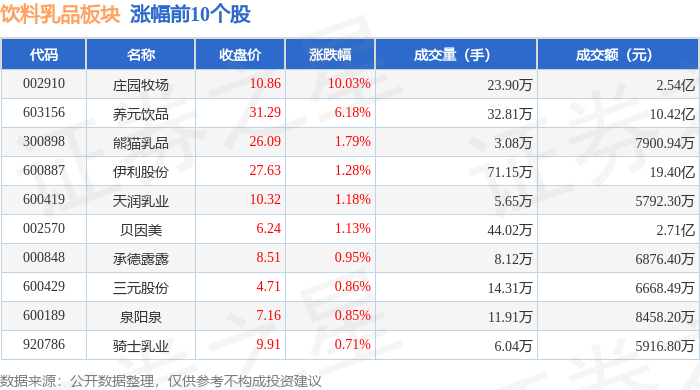
饮料乳品板块10月9日涨0.66%,庄园牧场领涨,主力资金净流入4731.5万元
Zheng Xing Xing Ye Ri Bao· 2025-10-09 08:53
Core Insights - The beverage and dairy sector experienced a rise of 0.66% on October 9, with Zhuangyuan Pastoral leading the gains [1] - The Shanghai Composite Index closed at 3933.97, up 1.32%, while the Shenzhen Component Index closed at 13725.56, up 1.47% [1] Sector Performance - Zhuangyuan Pastoral (002910) closed at 10.86, with a significant increase of 10.03%, trading volume of 239,000 shares, and a transaction value of 254 million [1] - Qiaoyuan Beverage (603156) saw a rise of 6.18%, closing at 31.29, with a trading volume of 328,100 shares and a transaction value of 1.042 billion [1] - Panda Dairy (300898) increased by 1.79%, closing at 26.09, with a trading volume of 30,800 shares and a transaction value of 79.09 million [1] - Yili Group (600887) rose by 1.28%, closing at 27.63, with a trading volume of 711,500 shares and a transaction value of 1.94 billion [1] - Tianrun Dairy (600419) and Beingmate (002570) also showed modest increases of 1.18% and 1.13%, respectively [1] Capital Flow - The beverage and dairy sector saw a net inflow of 47.31 million from institutional investors, while retail investors experienced a net outflow of 1.09 billion [2] - The sector's overall capital flow indicates a strong interest from institutional and speculative investors, despite the outflow from retail investors [2]



招股书失效后,东鹏饮料再度递表港交所
Xin Jing Bao· 2025-10-09 07:45
近几年,东鹏饮料业绩增长迅速,2022年—2024年,东鹏饮料的收入分别约为85亿元、112.57亿元、 158.3亿元;毛利分别约为35.32亿元、47.61亿元、69.83亿元;净利润分别约为14.41亿元、20.4亿元、 33.26亿元。 进军港股并非一帆风顺,此前东鹏饮料曾被证监会要求补充材料。根据证监会官网披露的境外发行上市 备案补充材料要求(2025年4月25日—2025年5月9日)显示,要求东鹏饮料补充说明公司及子公司的经 营范围是否涉及《外商投资准入特别管理措施(负面清单)(2024年版)》所涵盖的领域,以及本次发 行上市前后是否持续符合外资准入政策要求;鉴于公司及下属公司经营范围包含酒的生产和销售,需补 充说明公司及下属公司是否从事白酒的生产及销售,若存在该业务,请详细说明情况;补充说明公司及 下属公司开发、运营的网站、App、小程序等产品情况,包括收集及储存的用户信息规模、数据收集使 用情况,是否涉及向第三方提供个人用户信息,以及上市前后在个人信息保护和数据安全方面的安排或 措施;补充说明此次发行的境内募投项目在审批、核准或备案方面的进展情况。 编辑 唐峥 校对 陈荻雁 新京报讯(记者王子 ...
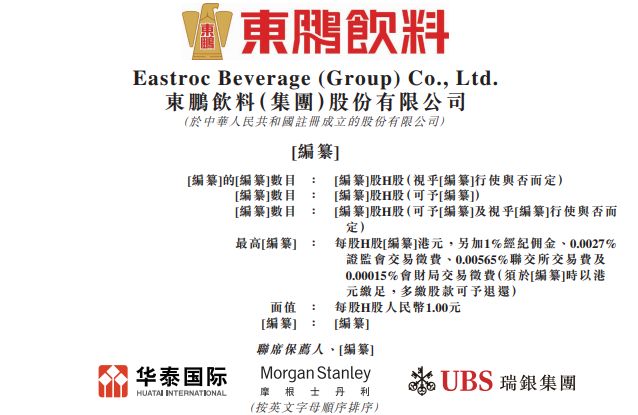
东鹏饮料,递交IPO招股书,拟赴香港上市,华泰国际、摩根士丹利、瑞银联席保荐 | A股公司香港上市
Xin Lang Cai Jing· 2025-10-09 05:54
Core Viewpoint - Eastroc Beverage (Group) Co., Ltd. is planning to list on the Hong Kong Stock Exchange after previously submitting an invalid application in April 2025. The company is recognized as a leading functional beverage enterprise in China and aims to leverage its strong market position for growth [2][6]. Company Overview - Established in 1994, Eastroc Beverage is the first and a globally leading functional beverage company in China, with the fastest revenue growth among the top 20 listed soft drink companies worldwide [6]. - The company's brand, "Eastroc," has significant consumer recognition, with the slogan "When tired, drink Eastroc Special Drink" deeply ingrained in the market [6]. Market Position - According to a report by Frost & Sullivan, Eastroc Beverage has ranked first in the Chinese functional beverage market by sales volume for four consecutive years since 2021, with market share increasing from 15.0% in 2021 to 26.3% in 2024 [6]. Sales Network and Technology - As of June 30, 2025, Eastroc Beverage has established a comprehensive sales network covering over 4.2 million retail outlets across nearly 100% of China's prefecture-level cities. The company has implemented advanced technologies such as "one code for one product" and "five codes association" to enhance its digital operations [8]. - The company has connected with over 250 million consumers and collaborates with more than 3,200 distributors, creating a robust operational moat [8]. Production Capacity - Eastroc Beverage has strategically established nine production bases across key regions in China, including locations in Guangdong, Anhui, Guangxi, Chongqing, and Zhejiang. The product portfolio includes energy drinks, sports drinks, tea beverages, coffee drinks, plant-based protein drinks, and fruit and vegetable juices [8]. Financial Performance - The company's revenue for the years 2022, 2023, 2024, and the first half of 2025 was approximately RMB 85.00 billion, RMB 112.57 billion, RMB 158.30 billion, and RMB 107.32 billion, respectively. Corresponding net profits were RMB 14.41 billion, RMB 20.40 billion, RMB 33.26 billion, and RMB 23.75 billion [16][17]. Shareholder Structure - Prior to the Hong Kong listing, the major shareholder structure shows Lin Muqin holding 50.16% of the shares, with other family members and entities holding the remainder [11][12]. Management Team - The board of directors consists of 10 members, including 6 executive directors and 4 independent non-executive directors, with Lin Muqin serving as the chairman and president [14][15].
从460万接盘到千亿市值,林木勤带领东鹏饮料为大湾区经济发展赋能
Sou Hu Wang· 2025-10-09 05:11
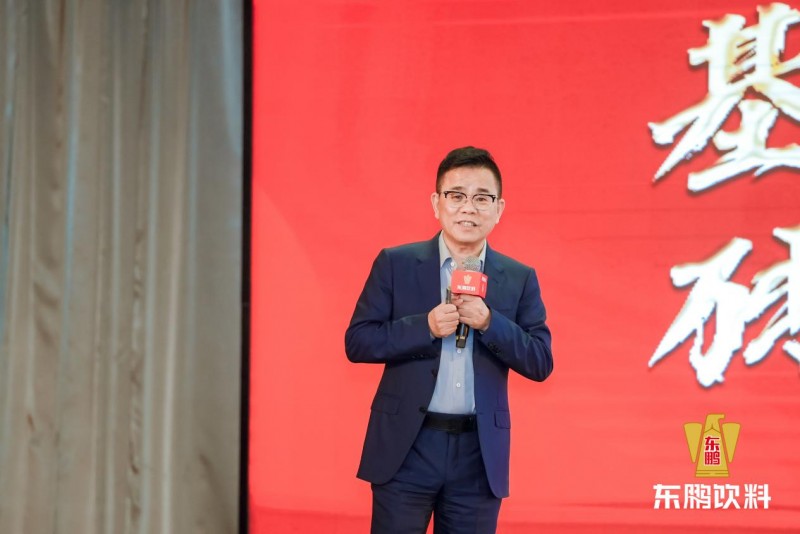
Core Insights - The article highlights the entrepreneurial journey of Lin Muqin, Chairman of Dongpeng Beverage Group, who transformed the company from near bankruptcy to a market capitalization exceeding 100 billion yuan, establishing it as the leading functional beverage brand in China [1][12]. Company Background - Lin Muqin was born in a modest family in Guangdong's Shanwei and pursued a master's degree in business administration at Sun Yat-sen University, laying the foundation for his entrepreneurial endeavors in the Greater Bay Area [4]. - In 1997, Lin joined Dongpeng Beverage, which was struggling with outdated equipment and a limited product range. He recognized the company's potential and initiated a turnaround strategy [5]. Business Transformation - After acquiring Dongpeng Beverage in 2003 for 4.6 million yuan, Lin led the company through a critical transformation from state-owned to privately owned, averting bankruptcy and marking the beginning of a new chapter for the enterprise [5]. - Lin implemented a differentiation strategy targeting price-sensitive young consumers and laborers, leading to the launch of Dongpeng Special Drink in 2009, which became a key product for the brand's resurgence [7][9]. Market Strategy - The company focused on building a robust distribution network, expanding from local convenience stores to rural markets, and leveraging online platforms for brand promotion [10][11]. - Lin's marketing strategy included signing celebrity endorsements and associating the brand with sports events to enhance brand visibility and consumer engagement [11]. Financial Performance - In the first half of 2025, Dongpeng Beverage reported impressive financial results, with revenue of 10.737 billion yuan, a year-on-year increase of 36.37%, and a net profit of 2.375 billion yuan, up 37.22% [12]. - The core energy drink segment generated 8.361 billion yuan in revenue, accounting for 77.91% of total sales, while the electrolyte drink segment saw a significant increase in revenue, rising 213.71% year-on-year [12]. Expansion and Future Outlook - Dongpeng Beverage is set to issue H-shares to list on the Hong Kong Stock Exchange, aiming to enhance its global presence and serve as a benchmark for enterprises in the Greater Bay Area [12][13]. - The company has expanded its market reach to 31 countries, including Vietnam and the United States, and is establishing subsidiaries in Indonesia and Vietnam to boost overseas production capacity [13].
突发!两度递表,资本梦未灭!东鹏饮料为何在“金钱充裕”之下执意赴港?|IPO锐观察
Xin Lang Cai Jing· 2025-10-09 04:38
Core Viewpoint - Dongpeng Beverage is making a second attempt to list on the Hong Kong Stock Exchange (HKEX) after its initial application was unsuccessful, aiming for a dual listing in both A-share and H-share markets, indicating its strong ambition for international expansion and capital market presence [1][4]. Group 1: Listing Strategy - Dongpeng Beverage submitted its H-share listing application to HKEX, with the same underwriters as its first attempt, highlighting its determination to succeed this time [1]. - The company aims to become the second Chinese beverage company to achieve a dual listing after Andeli, reflecting its strategic goal to enhance brand recognition and attract global investors [1][3]. - The rapid reapplication within six days after the first attempt suggests a strong commitment to the Hong Kong market [1]. Group 2: Financial Position - As of the end of 2024, Dongpeng Beverage reported cash and cash equivalents of 5.653 billion yuan, with total liquid assets reaching 14.223 billion yuan, indicating a robust financial position despite pursuing additional fundraising [2][3]. - The company plans to utilize up to 11 billion yuan of idle funds for low-risk financial products, suggesting a strategy to optimize its capital structure [3]. Group 3: Market Expansion and Challenges - Dongpeng Beverage is focusing on internationalization, particularly targeting Southeast Asia, with plans to leverage the HKEX listing to facilitate this expansion [4][8]. - The company has already begun exporting products to 25 countries, including Vietnam and Malaysia, and is establishing production bases aimed at the Southeast Asian market [8]. - However, challenges such as brand recognition, local market adaptation, and competition from established brands like Red Bull and Monster pose significant hurdles for Dongpeng's international ambitions [9][10]. Group 4: Growth Strategy - Dongpeng Beverage has introduced a "1+6 multi-category strategy," focusing on its core product while expanding into six new beverage categories to sustain growth [6]. - The company has experienced significant revenue growth, with a reported 40.6% increase in revenue for 2024 and a 36.37% increase in the first half of 2025 [4]. Group 5: Market Dynamics - The competitive landscape in the functional beverage sector is intensifying, with various brands vying for market share, necessitating Dongpeng to innovate and maintain its market position [9][10]. - The company faces pressure to enhance its distribution channels and marketing strategies to counteract competition and ensure sustained sales growth [7][10].
功能饮料巨头,二度递表港交所!
Shen Zhen Shang Bao· 2025-10-09 04:33
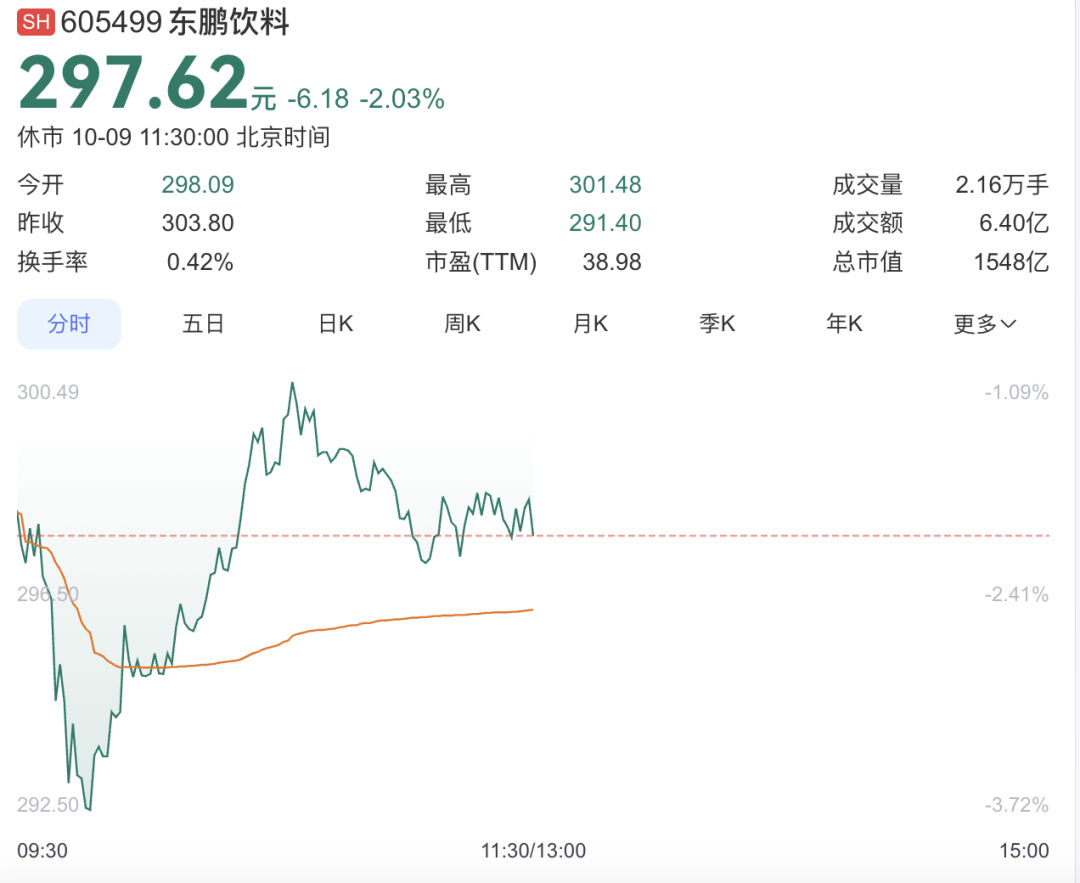
公开资料显示,2021年5月27日,东鹏饮料在上交所主板上市。10月9日,东鹏饮料低开1.88%报298.09元/股,截至午间休市,该股跌超2%,总市值约1548 亿元。今年以来,该股涨幅超两成。 同时,东鹏饮料近年的销售费用呈增长态势。2022年至2024年,东鹏饮料的销售费用分别达14.49亿元、19.56亿元、26.81亿元,同比增速从5.91%逐年攀 升至37.09%,营收占比在17%左右,三年累计支出超过60亿元。 业绩方面,2022年至2024年,东鹏饮料营业收入分别为85.05亿元、112.63亿元、158.39亿元,同比增长21.89%、32.42%、40.63%;归母净利润分别为 14.41亿元、20.40亿元、33.27亿元,同比增长20.75%、41.60%、63.09%。2025年上半年,东鹏饮料营业收入107.37亿元,同比增长了36.37%。归母净利润 23.75亿元,同比增长37.22%。 根据弗若斯特沙利文报告,按销量计,东鹏饮料在中国功能饮料市场自2021年起连续四年排名第一,市场份额从2021年的15.0%增长到2024年的26.3%。 按零售额计,东鹏饮料是2024年第二 ...
东鹏饮料二次递表港交所
Bei Jing Shang Bao· 2025-10-09 03:00
北京商报讯(记者孔文燮)10月9日,据港交所披露,东鹏饮料(605499)向港交所主板提交上市申请 书,华泰国际、摩根士丹利、瑞银集团为联席保荐人。值得一提的是,东鹏饮料曾于2025年4月3日向港 交所递交过上市申请。 ...
东鹏饮料二次递表港交所 收入增速在全球TOP20软饮企业位列第一
Zhi Tong Cai Jing· 2025-10-09 00:54
Core Viewpoint - Dongpeng Beverage has submitted an application for listing on the Hong Kong Stock Exchange, with a strong market position in the functional beverage sector and significant revenue growth prospects [1][3]. Company Overview - Dongpeng Beverage is the leading functional beverage company in China, ranking first in revenue growth among the top 20 listed soft drink companies globally [3]. - The company has maintained its position as the top player in the Chinese functional beverage market for four consecutive years since 2021, with market share increasing from 15.0% in 2021 to 26.3% in 2024 [3]. - By retail revenue, Dongpeng is projected to be the second-largest functional beverage company in 2024, holding a market share of 23.0% [3]. - The company has built a strong brand with national influence, focusing on product innovation and a diversified product portfolio [3]. Sales and Distribution Strategy - Dongpeng Beverage employs a refined channel management strategy, utilizing a "product + service" model supported by a sales team of over 7,000 [4]. - The company has implemented advanced tracking technologies, including a unique QR code system for product traceability, enhancing operational efficiency [4]. - As of June 30, 2025, Dongpeng has connected with over 250 million consumers and interacted efficiently with over 420 million retail points [4]. Industry Insights - The Chinese soft drink market is projected to reach approximately RMB 1.3 trillion in retail sales by 2024, making it the second-largest soft drink consumption market globally [5]. - The functional beverage segment is the fastest-growing sector, with a compound annual growth rate (CAGR) of 8.3% from 2019 to 2024, outpacing the overall soft drink market growth of 4.7% during the same period [5]. - The energy drink market in China is expected to reach RMB 180.7 billion by 2029, with a CAGR of 10.3% from 2025 to 2029 [5]. Financial Performance - Dongpeng Beverage's revenue for the fiscal years 2022, 2023, 2024, and the first half of 2025 was approximately RMB 8.5 billion, RMB 11.26 billion, RMB 15.83 billion, and RMB 10.73 billion, respectively [7]. - The total comprehensive income for the same periods was approximately RMB 1.43 billion, RMB 2.06 billion, RMB 3.36 billion, and RMB 2.35 billion [7].