WST(688122)

Search documents
重视无人智能装备发展
HTSC· 2026-03-30 05:23
Investment Rating - The report maintains a "Buy" rating for key companies in the aerospace and defense sector, including AVIC Shenyang Aircraft Corporation, Guorui Technology, Western Superconducting Technologies, Aerospace Intelligent Manufacturing, Ruichuang Micro-Nano, North Navigation, and Guotai Group [8][43]. Core Insights - The report emphasizes the importance of the development of unmanned intelligent equipment, highlighting the shift from small-scale production to large-scale deployment in defense construction during the 14th Five-Year Plan period [1][16]. - It notes that the demand for military equipment is expected to increase in a stable manner, with significant structural opportunities arising in new domains, advanced weapons, and low-cost equipment [2][21]. - The report identifies the ongoing conflicts, such as the Russia-Ukraine war and the Iran-Israel conflict, as pivotal in demonstrating the effectiveness and strategic importance of unmanned aerial vehicles (UAVs) in modern warfare [11][15]. Summary by Sections Industry Investment Rating - The aerospace and defense sector is rated as "Overweight" with a focus on unmanned intelligent equipment and new structural opportunities in military modernization [8][21]. Key Companies - Recommended companies include: - AVIC Shenyang Aircraft Corporation (600760 CH) with a target price of 80.96 - Guorui Technology (600562 CH) with a target price of 38.26 - Western Superconducting Technologies (688122 CH) with a target price of 99.18 - Aerospace Intelligent Manufacturing (300446 CH) with a target price of 26.00 - Ruichuang Micro-Nano (688002 CH) with a target price of 131.07 - North Navigation (600435 CH) with a target price of 18.90 - Guotai Group (603977 CH) with a target price of 17.25 [3][8][43]. Market Trends - The report highlights the increasing use of UAVs in conflicts, with both sides in the Russia-Ukraine war utilizing drones extensively, marking it as the first comprehensive drone war [11][15]. - It also discusses the advancements in China's unmanned intelligent equipment showcased in a recent CCTV documentary, indicating a significant leap in capabilities and operational readiness [16][19]. Future Outlook - The report anticipates a transition in military equipment demand from quantity to quality during the 14th Five-Year Plan, with a focus on new technologies and capabilities [2][21]. - It suggests that the military modernization efforts will create substantial growth opportunities in the defense sector, particularly in unmanned systems and advanced weaponry [21][24].


稀有金属ETF华富(561800)开盘跌2.40%,重仓股洛阳钼业跌1.54%,北方稀土跌2.06%
Xin Lang Cai Jing· 2026-03-27 01:40
Group 1 - The Rare Metal ETF Huafu (561800) opened down 2.40%, priced at 1.017 yuan [1][2] - Major holdings of the ETF experienced declines, including Luoyang Molybdenum down 1.54%, Northern Rare Earth down 2.06%, and Huayou Cobalt down 1.60% [1][2] - The ETF's performance benchmark is the CSI Rare Metal Theme Index return, managed by Huafu Fund Management Co., with a return of 4.11% since its establishment on August 11, 2021, and a recent one-month return of -15.23% [1][2] Group 2 - The article mentions the formation of a MACD golden cross signal, indicating potential upward momentum for certain stocks, although specific stocks are not detailed [3]





可控核聚变系列报告(一):未来能源,聚变已至
Guotou Securities· 2026-03-20 10:41
Investment Rating - The report maintains an investment rating of "Outperform the Market - A" [5] Core Insights - Nuclear fusion is considered one of humanity's ultimate energy solutions, currently in the engineering verification stage, characterized by its infinite resources, high energy density, safety, and cleanliness [1][15] - The D-T (deuterium-tritium) reaction is the most feasible fusion reaction on Earth, with global research primarily focused on magnetic confinement fusion and inertial confinement fusion technologies [2][22] - The global fusion industry is experiencing active financing, with a total of $9.766 billion raised by 2025, and 78% of companies expect to have their first commercial demonstration plant operational between 2030 and 2035 [3][4] Summary by Sections 1. Transition from Laboratory to Engineering in Controlled Nuclear Fusion - Controlled nuclear fusion is viewed as the ultimate energy solution, with characteristics such as infinite resources, high energy density, safety, and cleanliness [1][15] - Achieving fusion ignition requires meeting the Lawson criteria, with energy balance being a crucial indicator for commercial viability [17][20] - The main technical paths for achieving fusion include magnetic confinement and inertial confinement [25] 2. Magnetic Confinement Fusion: Tokamak as the Main Pathway - The Tokamak is recognized as the most promising method for achieving controlled nuclear fusion, with ITER being the largest experimental Tokamak reactor [27][29] - The core components of the Tokamak include superconducting magnet systems, vacuum chambers, and blanket systems, which are critical for maintaining plasma stability and achieving fusion [42][43] 3. Global Acceleration of Nuclear Fusion Commercialization - The fusion industry is seeing a surge in financing, with a total of $9.766 billion raised by 2025, and a fivefold increase in new financing from 2024 to 2025 [3][4] - In China, a dual-driven model involving state-owned enterprises and private companies is emerging, with significant milestones such as the establishment of China Fusion Energy Co., which is pivotal for commercialization [3][4][11] 4. Investment Recommendations - Focus on companies involved in materials and equipment manufacturing that have received validation or orders from large scientific installations in the short term [11] - Long-term attention should be directed towards operational companies in the fusion energy sector [11]



可控核聚变行业点评报告:上海闵行区将聚变能列为四大未来能源,聚变产业化进程加速
ZHESHANG SECURITIES· 2026-03-19 10:25
Investment Rating - The industry investment rating is "Positive" (maintained) [4] Core Insights - Shanghai Minhang District has accelerated the commercialization of fusion energy, establishing a comprehensive industrial ecosystem that includes R&D, manufacturing, and services [1] - The industry is entering a phase of intensive equipment procurement, bidding, and construction, driven by increasing power demand from AI computing and the growing importance of controlled nuclear fusion as a "ultimate energy" source [2] - The global nuclear fusion equipment market is projected to reach an average annual scale of 266 billion yuan by 2035 [2] Summary by Sections Industry Development - The Shanghai government has identified fusion energy as one of the four key future energy developments, focusing on a three-step development approach: pilot experimental reactors, demonstration reactors, and commercial reactors [1] - The industry aims to create a complete ecosystem that includes core R&D, supporting manufacturing, and service support, while encouraging the application of fusion technology in fields such as healthcare, new materials, and high-end equipment [1] Market Outlook - The industry is expected to see a surge in orders for upstream materials and midstream core equipment suppliers as it moves into the "engineering feasibility verification" stage [2] - Multiple technical paths are being explored, with magnetic confinement and inertial confinement technologies advancing simultaneously [2] Investment Focus - Investment strategies should focus on high-value segments of the Tokamak device cost structure, with significant cost components including the magnetic system (28%), vacuum chamber components (17%), and power supply (8%) [3] - Key "chain leader" companies in the nuclear fusion sector include China Fusion Energy Company and Jiangxi Fusion New Energy, with major devices such as HL-3, HL-4, and Spark One [3] - Midstream equipment companies to watch include Lianchuang Optoelectronics, Xuguang Electronics, and others [4][5]




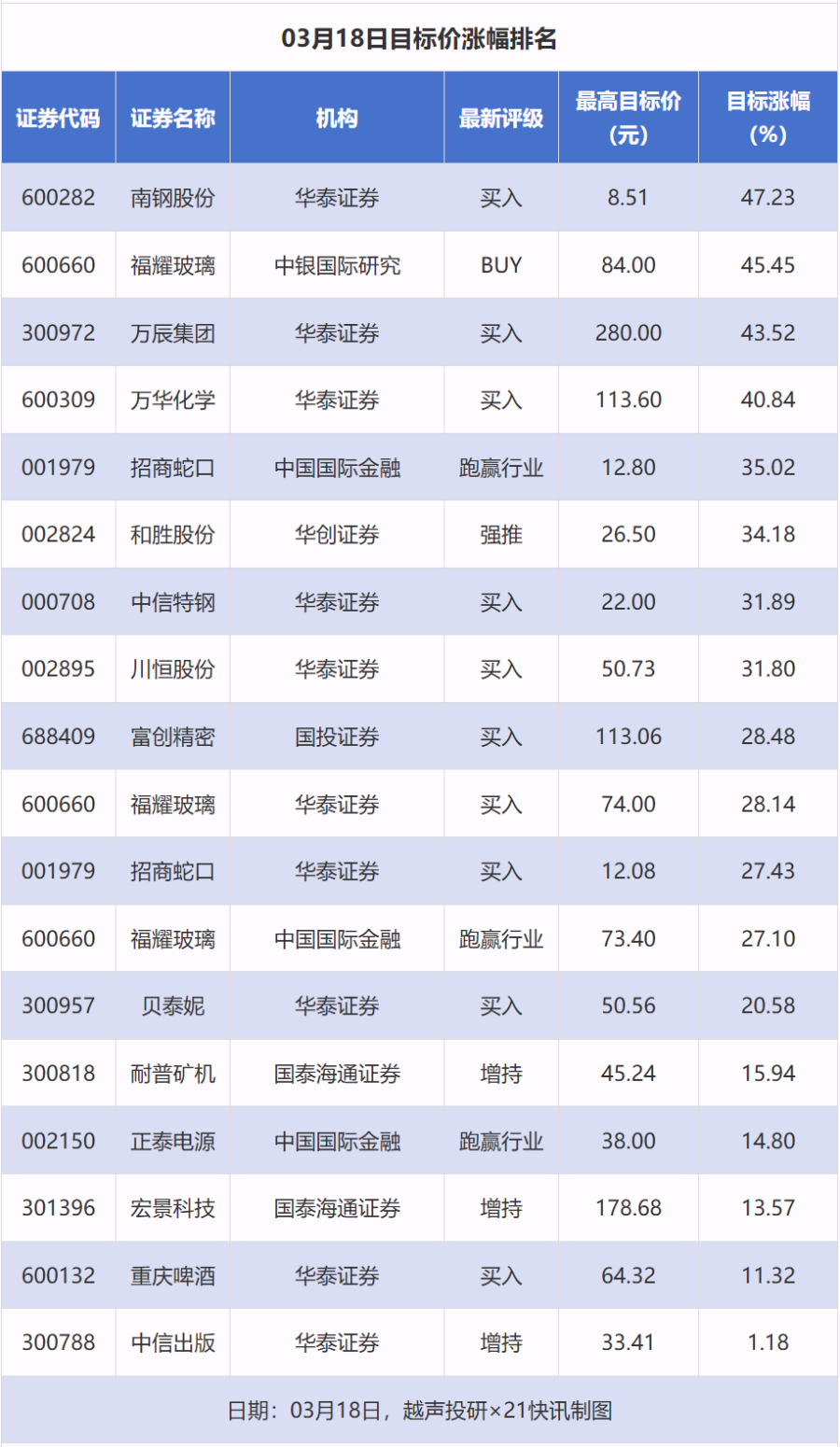
34股获推荐,福耀玻璃等目标价涨幅超40%
2 1 Shi Ji Jing Ji Bao Dao· 2026-03-19 01:25
Core Viewpoint - On March 18, brokerages provided target prices for listed companies, with notable increases for Nanjing Steel, Fuyao Glass, and Wancheng Group, showing target price increases of 47.23%, 45.45%, and 43.52% respectively, across the steel, automotive parts, and retail sectors [1][2]. Group 1: Target Price Increases - Nanjing Steel (600282) received a target price of 8.51 yuan, reflecting a target price increase of 47.23% [2] - Fuyao Glass (600660) has a target price of 84.00 yuan, with a target price increase of 45.45% [2] - Wancheng Group (300972) was assigned a target price of 280.00 yuan, indicating a target price increase of 43.52% [2] - Wanhua Chemical (600309) has a target price of 113.60 yuan, with a target price increase of 40.84% [2] - China Merchants Shekou (001979) received a target price of 12.80 yuan, reflecting a target price increase of 35.02% [2] Group 2: Brokerage Recommendations - A total of 34 listed companies received brokerage recommendations on March 18, with China Merchants Shekou, CITIC Publishing, Fuyao Glass, and Wancheng Group each receiving recommendations from three brokerages [3][4] - China Merchants Shekou (001979) closed at 9.48 yuan with three brokerage recommendations [4] - Fuyao Glass (600660) closed at 57.75 yuan, also receiving three brokerage recommendations [4] - Wancheng Group (300972) closed at 195.09 yuan, with three brokerages recommending it [4] Group 3: Rating Adjustments - On March 18, one company had its rating upgraded, with Zhongtai Securities raising Shanghai Bank's rating from "Hold" to "Buy" [5] - Shanghai Bank (601229) is now rated "Buy" by Zhongtai Securities [5] Group 4: First Coverage - Eight companies received initial coverage on March 18, with Hesheng Co. receiving a "Strong Buy" rating from Huachuang Securities [6] - Tian Gong Co. was given an "Add" rating by Dongwu Securities [6] - Neipu Mining (300818) received an "Add" rating from Guotai Junan Securities [6] - Bozhong Precision (688097) was rated "Add" by Northeast Securities [6] - Bojie Co. (002975) received a "Buy" rating from Zhongyou Securities [6]



西部超导(688122):公司首次覆盖报告:军工材料龙头崛起,多业务协同开启成长新周期
KAIYUAN SECURITIES· 2026-03-18 11:48
Investment Rating - The report assigns a "Buy" rating for the company, marking its first coverage [1]. Core Viewpoints - The company is positioned as a leader in high-end titanium alloys and superconducting materials, benefiting from the dual drivers of military and civil aviation demand, as well as the nuclear fusion industry [1][2][3]. - The company has established a comprehensive technical capability in high-end materials, with a focus on three main business segments: high-end titanium alloys, superconducting materials, and high-performance superalloys [12][16]. - Revenue growth is expected to accelerate, with projections indicating a compound annual growth rate (CAGR) of over 25% from 2024 to 2027, driven by the recovery in high-end material demand and the expansion of the superconducting materials market [55][67]. Summary by Relevant Sections Company Overview - The company has over 20 years of experience in high-end titanium alloys and superconducting materials, transitioning from research to large-scale industrial application [12][13]. - It has developed a full-chain technical capability covering smelting, forging, rolling, and heat treatment, with products widely used in high-end fields such as aerospace and nuclear fusion [12][16]. Main Business Segments - High-end titanium alloy business is expected to benefit from the acceleration of domestic aircraft production and military modernization, with a projected revenue contribution of 62.79% by 2024 [16][35]. - The superconducting materials segment is anticipated to experience rapid growth due to the nuclear fusion industry and medical imaging market, with revenue expected to reach 29.74% by 2024 [17][52]. - The high-performance superalloy business is in a ramp-up phase, projected to contribute 7.47% of revenue by 2024, supported by advancements in domestic aerospace engine development [18][54]. Financial Performance and Projections - The company’s revenue is projected to grow from 41.59 billion yuan in 2023 to 81.29 billion yuan by 2027, with net profit expected to increase from 7.52 billion yuan to 13 billion yuan over the same period [4][67]. - The gross margin is expected to remain stable, with projections of 34.3% in 2025, 33.5% in 2026, and 34.1% in 2027, supported by product structure optimization and scale effects [67]. Valuation and Investment Recommendation - The current price-to-earnings (P/E) ratios for 2025, 2026, and 2027 are projected to be 57.6, 45.0, and 37.2 respectively, indicating a premium over comparable companies in the high-end metal materials sector [67]. - Given the company's growth potential and strategic positioning, the report recommends a "Buy" rating [67].
西部超导:公司首次覆盖报告军工材料龙头崛起,多业务协同开启成长新周期-20260317
KAIYUAN SECURITIES· 2026-03-17 04:25
Investment Rating - The report assigns a "Buy" rating for the company, marking its first coverage [1]. Core Insights - The company is positioned as a leader in high-end titanium alloys and superconducting materials, benefiting from the "Two Aircraft Special" and nuclear fusion developments, which are expected to catalyze revenue growth across its three main business segments [1][2][3]. - The company has established a comprehensive technical capability in high-end materials, with a focus on titanium alloys, superconducting materials, and high-performance superalloys, which are critical for aerospace and defense applications [12][16][19]. Financial Summary and Valuation Metrics - The company’s projected revenue for 2025, 2026, and 2027 is estimated at 52.8 billion, 65.9 billion, and 82.5 billion CNY respectively, with corresponding net profits of 5.28 billion, 7.25 billion, and 9.05 billion CNY [4][63][66]. - The expected EPS for the same years is 0.81, 1.12, and 1.39 CNY per share, leading to a PE ratio of 96.1, 69.9, and 56.0 times respectively [1][4][68]. - The company’s revenue is anticipated to grow at a compound annual growth rate (CAGR) exceeding 25% from 2024 to 2027, driven by the recovery in high-end material demand and the expansion of its superconducting materials and high-temperature alloy businesses [55][63]. Business Segments High-End Titanium Alloys - The high-end titanium alloy business is expected to benefit from the acceleration of domestic aircraft production, particularly the C919, and the increasing demand for advanced aerospace materials [2][35]. - The company is a key supplier of titanium alloy materials for aerospace applications, with a significant market share in the production of titanium rods and wires [35][40]. Superconducting Materials - The superconducting materials segment is projected to experience rapid growth due to advancements in nuclear fusion technology and the expansion of the medical imaging market [3][42]. - The company is the only domestic supplier capable of providing a full range of NbTi and Nb3Sn superconducting wire materials, which are critical for major international projects like ITER [3][49]. High-Performance Superalloys - The high-temperature alloy business is in a ramp-up phase and is expected to become a significant growth driver as production capacity increases and demand from the aerospace sector rises [54][55]. - The company has begun mass production of high-temperature alloys, which are essential for components in advanced aircraft engines [54]. Conclusion - The report highlights the company's strong market position and growth potential across its three main business segments, supported by favorable industry trends and robust financial projections [1][55][63].
超3800只个股下跌,风电设备、煤炭、电力板块涨幅居前
第一财经· 2026-03-12 07:40
Market Overview - On March 12, A-shares saw a collective decline across the three major indices, with the Shanghai Composite Index down 0.1%, the Shenzhen Component Index down 0.63%, and the ChiNext Index down 0.96% [3][4] - The total market saw over 3,800 stocks decline, indicating a broad market downturn [3] Sector Performance - The coal sector experienced significant gains, with stocks such as Zhengzhou Coal Electricity, Yanzhou Coal Mining, and Shaanxi Black Cat reaching their daily limit up [5][6] - The military equipment sector faced adjustments, with stocks like Hangya Technology and Western Superconducting seeing declines of over 6% [6][7] Trading Volume - The trading volume in the Shanghai and Shenzhen markets was 2.44 trillion yuan, a decrease of 66.5 billion yuan compared to the previous trading day [8] Capital Flow - Main capital flows showed net inflows into sectors such as public utilities, construction decoration, and basic chemicals, while there were net outflows from defense, electronics, and communications sectors [9] - Specific stocks like China Energy Construction and Sanan Optoelectronics saw net inflows of 5.755 billion yuan and 2.648 billion yuan, respectively [9] Institutional Insights - Huatai Securities suggests that hydrogen energy may experience a nonlinear growth inflection point due to domestic and international policy resonance [11] - CICC expresses cautious optimism regarding the sustainability of excess returns for active equity funds [12] - CITIC Securities continues to recommend investments in the global electricity shortage supply chain [13]





26年国防预算增速7%,关注军贸机遇
HTSC· 2026-03-09 07:52
Investment Rating - The report maintains a "Buy" rating for key companies in the defense industry, including AVIC Shenyang Aircraft Corporation, Guorui Technology, Ruichuang Micro-Nano, Western Superconducting Technologies, Aerospace Intelligence Manufacturing, Guotai Group, and North Navigation [8][40]. Core Insights - In 2026, China's defense budget is set at 1,909.561 billion RMB, reflecting a 7% year-on-year increase, slightly down from 7.2% in 2025. This growth is consistent with the principle of "moderate" increase in defense spending [11][12]. - The ongoing conflict between the U.S. and Iran is expected to drive demand for military trade, particularly in missile and drone technologies, enhancing the international military trade market's activity [11][13]. - The "14th Five-Year Plan" is anticipated to shift the focus from quantity to quality in military modernization, with significant structural opportunities emerging in new domains, unmanned systems, advanced weaponry, and low-cost equipment [16][17]. Summary by Sections Defense Budget - The defense budget for 2026 is projected at 1,909.561 billion RMB, with a 7% increase compared to the previous year, indicating a stable growth trend [11][12]. - The report emphasizes that the growth rate is in line with the "moderate" principle, balancing national defense needs with economic development [11]. Military Trade Opportunities - The report highlights the potential for increased overseas demand for military equipment, as China is one of the few suppliers capable of providing comprehensive solutions [13][19]. - The international military trade market is expected to remain active, driven by geopolitical tensions and increased defense spending globally [11][19]. Key Companies to Watch - Recommended companies include AVIC Shenyang Aircraft Corporation, Guorui Technology, Ruichuang Micro-Nano, Western Superconducting Technologies, Aerospace Intelligence Manufacturing, Guotai Group, and North Navigation, all rated as "Buy" [8][40]. - The report suggests that these companies are well-positioned to benefit from the anticipated growth in military trade and modernization efforts [19][20]. Emerging Trends - The report identifies significant opportunities in new equipment construction, particularly in unmanned systems and advanced weaponry, as part of the military modernization strategy [16][18]. - The focus on military-civilian integration is expected to create new market spaces in commercial aerospace, low-altitude economy, deep-sea technology, and nuclear energy [20].
量子计算:技术突破与政策催化共振,商业化落地加速可期
Orient Securities· 2026-03-06 06:36
Investment Rating - The report maintains a "Positive" investment rating for the quantum computing industry [5]. Core Insights - Quantum computing has made significant breakthroughs, particularly in error correction, bringing it closer to fault-tolerant quantum computing and accelerating commercialization [3]. - Government policies supporting quantum computing as a new productive force are expected to create a larger market space and unlock performance potential [3]. - Investors are advised to focus on upstream core equipment and components, midstream integrated platforms, and downstream application security sectors [3]. Summary by Sections 1. Classic Computing Performance Bottlenecks - The performance of classical computing is showing signs of stagnation, with quantum computing emerging as a new paradigm for accelerated computation [9][14]. - Quantum computing leverages quantum superposition and entanglement to process information in parallel, significantly reducing computational complexity for specific problems [8][14]. 2. Mainstream Quantum Computing Technology Paths - Multiple quantum computing technologies are being developed, including superconducting, ion trap, neutral atom, and photonic quantum computing, each with its own advantages and challenges [8][41]. - The progress in quantum computing has accelerated, with significant advancements in quantum superiority and error correction capabilities [8][41]. 3. National Policies Focused on Quantum Technology - Major countries are formulating quantum technology strategies and investing heavily, with the U.S. and China leading in government support and funding [8][9]. - Policies are accelerating industry development through planning, financial investment, and export controls [9]. 4. Accelerating Development of the Quantum Computing Industry - The quantum computing industry is in its early commercialization stage, primarily focusing on research-grade systems and key components, with revenue largely driven by government and research institution demand [8][9]. - Key players in the industry include IBM, Google, and domestic companies like GuoShun Quantum and Benyuan Quantum, which are making significant progress in core technology development [8][9]. 5. Overview of Domestic Quantum Computing Companies - Notable companies include GuoShun Quantum, a national leader in quantum technology, and Turing Quantum, a leader in photonic quantum computing [8][9].