
WST(688122)

Search documents
陕西国企改革板块2月9日涨1.5%,广电网络领涨,主力资金净流出1.65亿元

Sou Hu Cai Jing· 2026-02-09 09:39
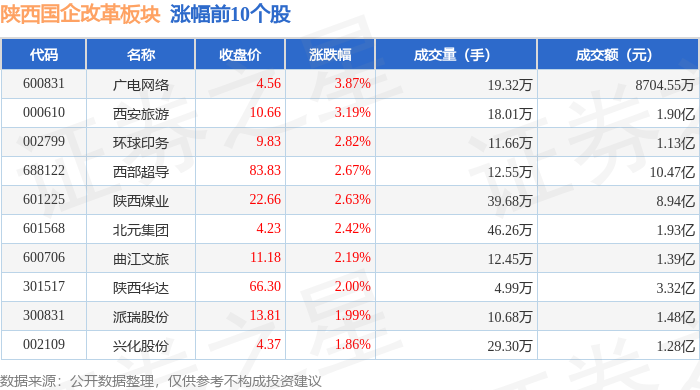
Market Performance - The Shaanxi state-owned enterprise reform sector rose by 1.5% compared to the previous trading day, with Guangdian Network leading the gains [1] - The Shanghai Composite Index closed at 4123.09, up 1.41%, while the Shenzhen Component Index closed at 14208.44, up 2.17% [1] Individual Stock Performance - Guangdian Network (600831) closed at 4.56, with a gain of 3.87% and a trading volume of 193,200 shares, amounting to a transaction value of 87.05 million yuan [1] - Xi'an Tourism (000610) closed at 10.66, up 3.19%, with a trading volume of 180,100 shares and a transaction value of 190 million yuan [1] - Global Printing (002799) closed at 9.83, gaining 2.82%, with a trading volume of 116,600 shares and a transaction value of 113 million yuan [1] - Western Superconducting (688122) closed at 83.83, up 2.67%, with a trading volume of 125,500 shares and a transaction value of 1.047 billion yuan [1] - Shaanxi Coal and Chemical Industry (601225) closed at 22.66, gaining 2.63%, with a trading volume of 396,800 shares and a transaction value of 894 million yuan [1] Capital Flow Analysis - The Shaanxi state-owned enterprise reform sector experienced a net outflow of 165 million yuan from institutional investors, while retail investors saw a net inflow of 99.38 million yuan [2] - The main capital inflow was observed in Western Superconducting, with a net inflow of 1.23 billion yuan from institutional investors, despite a net outflow from retail investors [3] - North Yuan Group (601568) had a net inflow of 28.15 million yuan from institutional investors, while retail investors experienced a net outflow of 25.58 million yuan [3]

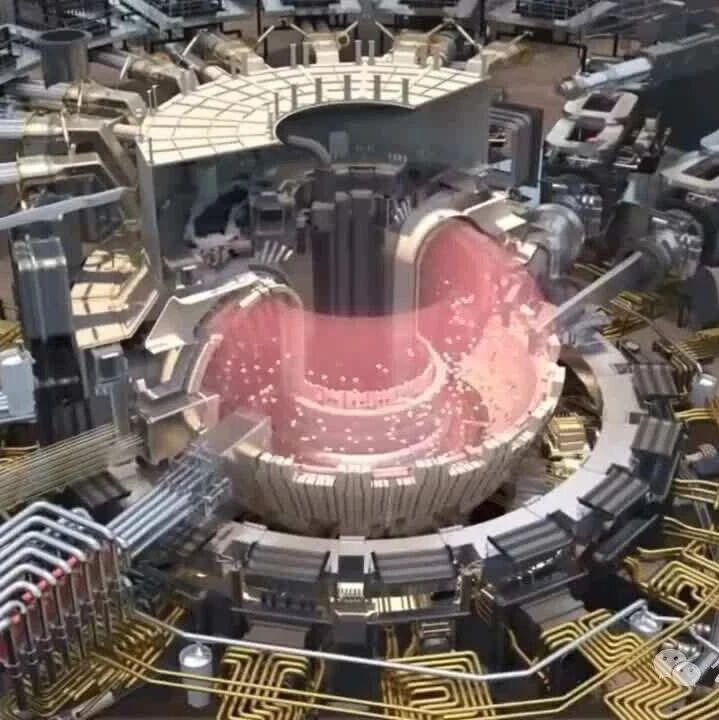
核聚变深度:磁体材料迭代推动产业升级(附34页PPT)
材料汇· 2026-02-08 15:24
Group 1 - The fusion industry is entering an accelerated phase driven by policy support and capital expenditure, with major countries expected to introduce fusion policies by 2025, marking a shift from laboratory research to industrial layout and regulatory framework construction [2][9] - Domestic policy support for controllable nuclear fusion is forming a clear advancement logic, with a national framework being established to optimize regulatory processes and provide clear guidance for technological research and development [6][8] - The superconducting materials landscape is characterized by a parallel development of low-temperature superconductors (NbTi, Nb₃Sn) and high-temperature superconductors (REBCO), with low-temperature superconductors currently supporting existing fusion operations and high-temperature superconductors poised to become key for next-generation high-field fusion technology breakthroughs [2][3][27] Group 2 - The magnet system is a core cost component of fusion projects, with the ITER project showing that component costs account for 86%, of which magnets represent 28%, primarily due to the reliance on high-cost low-temperature liquid helium for cooling [3][55] - In high-temperature superconducting projects, the cost of the magnet system is expected to increase further, as seen in the ARC project where the magnet system accounts for 46% of the total cost [57] - The global market for second-generation high-temperature superconducting tapes used in controllable nuclear fusion devices is projected to grow from 300 million yuan in 2024 to 4.9 billion yuan by 2030, with a compound annual growth rate (CAGR) of 59.3% from 2024 to 2030 [3][65] Group 3 - Investment recommendations focus on the magnet segment of the fusion system, which is currently transitioning from low-temperature to high-temperature technology, indicating a significant demand increase driven by the capital expenditure cycle in nuclear fusion [3][8] - The BEST project, aimed at bridging the gap between experimental and demonstration reactors, is expected to accelerate capital expenditure, with significant procurement activities already underway [59][63] - The global market for superconducting materials is expected to see substantial growth, driven by the increasing demand for high-temperature superconductors in fusion applications, with REBCO materials showing significant potential for enhancing magnetic field strength and reducing magnet size [27][31]


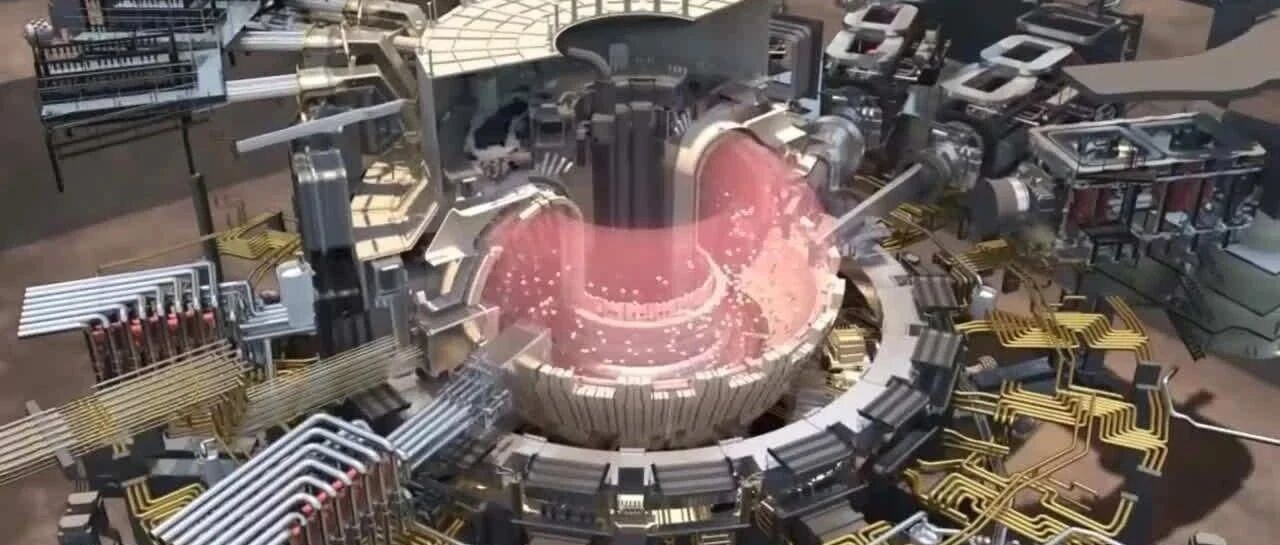
未来产业:核聚变关键部件与材料投资机会(附投资逻辑与标的)
材料汇· 2026-02-07 15:18
Group 1 - The article discusses the current advancements in nuclear fusion technology and key future milestones [1] - It highlights the operational status and financing situation of global nuclear fusion devices [2][6] - The article analyzes the value of key components such as magnet systems, divertors, and blanket systems, along with a breakdown of essential materials [7][8] Group 2 - ITER (International Thermonuclear Experimental Reactor) is set to begin plasma experiments with deuterium-tritium in 2036, with China responsible for 18 key component procurement packages [2][51] - The HL-3 (Chinese Circulation No. 3) aims to achieve a fusion triple product of 10^20 by May 2025, marking a significant advancement in fusion research [3] - EAST (Experimental Advanced Superconducting Tokamak) achieved a world record of 1 billion degrees Celsius for 1066 seconds in January 2025 [4] Group 3 - The BEST (Compact Fusion Energy Experimental Device) project is scheduled to be completed by 2027, with plans to demonstrate power generation by 2030 [5][71] - The global nuclear fusion industry is projected to attract over $7.1 billion in investment in 2024, with a compound annual growth rate of 5.1% expected until 2037 [6] - Key components in ITER, such as the magnet system, in-vessel components, and vacuum chamber, account for 28%, 17%, and 8% of the total construction cost, respectively [7][50] Group 4 - The article emphasizes the advantages of nuclear fusion energy, including high energy density, environmental friendliness, and safety [15][19] - It outlines the necessary conditions for achieving controlled nuclear fusion, which include sufficient temperature, density, and energy confinement time [19][20] - The article details the operational status of various fusion devices globally, with a focus on the number of devices in operation, under construction, and planned [36][44]
中上游企业25年业绩恢复性高增长
HTSC· 2026-02-02 07:09
Investment Rating - The report maintains an "Overweight" rating for the aerospace and defense sector [8] Core Insights - The aerospace and defense industry is expected to experience significant recovery and growth in 2025, with 30 out of 75 listed companies forecasting positive earnings growth compared to the previous year [11][12] - The report highlights structural opportunities in military equipment demand during the "14th Five-Year Plan" period, focusing on new domains, unmanned systems, advanced weaponry, and low-cost equipment [14][16] Summary by Sections Industry Performance - As of January 31, 2025, 75 out of 120 listed companies in the defense sector have disclosed earnings forecasts, with 30 companies expecting positive growth, 7 expecting positive but declining growth, 17 expecting losses but reduced compared to the previous year, and 21 expecting increased losses [11][12] Key Companies to Watch - Recommended companies include: - AVIC Shenyang Aircraft Corporation (600760 CH) - Guorui Technology (600562 CH) - Steel Research (300797 CH) - Guotai Group (603977 CH) - West Superconductor (688122 CH) - Ruichuang Micro-Nano (688002 CH) - Beifang Navigation (600435 CH) - Gaode Infrared (002414 CH) - Aerospace Intelligence (300446 CH) - Aerospace Rainbow (002389 CH) [3][8][9] Earnings Forecasts - Notable companies with significant earnings growth forecasts include: - Beimo High-Tech: 1169% growth due to product delivery and cost reduction [12] - Hailanxin: 509% growth from increased self-produced products [12] - *ST Chengchang: 452% growth driven by industry recovery [12] - Zhimin Da: 414% growth from increased demand in previously established product lines [12] - Aileda: 351% growth from increased military and civilian product demand [12] Long-term Outlook - The report emphasizes the importance of new equipment construction cycles and suggests focusing on new products and markets during the "14th Five-Year Plan" [14][16] - The military trade market is expected to grow, with China aiming to increase its market share in global military trade [17] Market Trends - The report notes a decline in the defense sector index by 7.69% over the past week, underperforming the broader market [28] - The current PE (TTM) for the defense sector is 95.23, indicating a high valuation compared to historical levels [36] Investment Opportunities - The report suggests that companies involved in unmanned systems, low-cost munitions, and military AI are likely to see significant growth opportunities [16][18] - The commercial aerospace sector is also highlighted as a growing area, with advancements in satellite internet and low-altitude economy [18][25]



2026超导材料产业链研究报告:高温超导规模化落地,核聚变打开超导材料新纪元
深企投产业研究院· 2026-01-31 09:36
Investment Rating - The report does not explicitly state an investment rating for the superconducting materials industry Core Insights - The superconducting materials industry is transitioning from low-temperature superconductors (LTS) to high-temperature superconductors (HTS), with significant implications for commercial applications and nuclear fusion technology [11][21] - Room-temperature superconductors remain a theoretical goal, but breakthroughs could revolutionize energy, transportation, and information sectors [11][43] - The market for low-temperature superconductors currently dominates, accounting for over 90% of the superconducting materials market, primarily used in MRI machines and fusion devices [20][31] - High-temperature superconductors are in the early stages of commercialization, with potential applications in nuclear fusion and high-efficiency power transmission [21][30] Summary by Sections Superconducting Materials Overview - Superconducting materials are recognized as strategic, disruptive materials with unique properties such as zero electrical resistance and complete diamagnetism [12][11] - The industry is experiencing a shift towards high-temperature superconductors, which can operate at higher temperatures and lower costs, facilitating their commercial viability [11][21] Low-Temperature Superconductors - Low-temperature superconductors, such as NbTi and Nb₃Sn, have established commercial production and dominate the market due to their mature technology and cost advantages [15][20] - The main applications include MRI machines, superconducting magnets for fusion devices, and particle accelerators [20][31] - Limitations include reliance on liquid helium for cooling and performance degradation in high magnetic fields [20] High-Temperature Superconductors - High-temperature superconductors, including BSCCO and REBCO, are seen as the future of superconducting materials, with applications in nuclear fusion and power transmission [21][30] - The production costs are currently high, but ongoing advancements in manufacturing processes are expected to reduce prices and enhance market penetration [29][30] - The market price for high-temperature superconductors is significantly higher than that of low-temperature superconductors, which poses a barrier to widespread adoption [28][29] Applications of Superconducting Materials - Superconducting materials are critical in various sectors, including energy, healthcare, and advanced manufacturing [31][32] - In energy, superconducting cables can achieve high capacity and low loss, while in healthcare, they are essential for high-field MRI machines [31][32] - The report highlights ongoing projects and applications in superconducting power transmission, magnetic confinement fusion, and advanced manufacturing processes [31][36]
钨精矿逼近55万关口,稀有金属ETF(562800)聚焦稀有金属板块投资机遇
Xin Lang Cai Jing· 2026-01-28 02:59
Group 1 - The small metal sector saw a rise on January 28, 2026, with the China Rare Metals Theme Index increasing by 0.23%, and notable stock performances included Dongfang Tantalum Industry up by 8.41%, Zhuhai Group up by 5.25%, and others [1] - Tungsten concentrate prices approached 550,000 RMB per ton, ammonium paratungstate prices exceeded 800,000 RMB, and tungsten powder prices surpassed 1,300,000 RMB [1] - Industrial-grade lithium carbonate prices reached 168,000 RMB per ton with a weekly increase of 9.80%, while lithium iron phosphate prices rose by 4.43% compared to January 4 [1] Group 2 - Longcheng Securities estimated that the static cost share of lithium carbonate, rare earths, and antimony in downstream applications is nearing historical highs, with a demand growth rate of over 10% expected in sensitive sectors like wind power in 2026 [1] - The auction price for lithium spodumene concentrate from Wodgina reached 16,852 RMB per dry ton, indicating a significant premium for overseas lithium resources [1] - The Congolese government submitted a shortlist of state-owned mineral assets to the U.S., highlighting ongoing geopolitical supply disruptions that reinforce the scarcity of strategic metals [1] Group 3 - As of December 31, 2025, the top ten weighted stocks in the China Rare Metals Theme Index included Luoyang Molybdenum, Northern Rare Earth, and others, accounting for 59.54% of the total index [2] - The Rare Metals ETF (562800) tracks the China Rare Metals Theme Index, providing a convenient tool for investing in the rare metals sector [3] - Investors can also explore investment opportunities in the rare metals sector through the Rare Metals ETF linked fund (014111) [4]




研判2026!中国量子精密测量行业政策、产业链、市场规模、应用分布、竞争格局及发展趋势分析:市场规模有望达到5.2亿美元,军事国防领域为主要市场[图]
Chan Ye Xin Xi Wang· 2026-01-27 01:29
Core Insights - Quantum precision measurement leverages the high sensitivity of quantum states to surpass classical measurement limits, with applications in communication, navigation, energy, and healthcare, showcasing advantages of "ultra-precision, high stability, and anti-interference" [1][5][6] Industry Overview - The global quantum precision measurement market is projected to grow from $1.67 billion in 2024 to approximately $2.24 billion in 2026, with a forecasted market size of $4.457 billion by 2035, reflecting a compound annual growth rate (CAGR) of 14.4% from 2024 [6] - In China, the quantum precision measurement market is expected to reach $295 million in 2024, $435 million in 2025, and $520 million in 2026, with a long-term projection of $1.053 billion by 2035 [6][7] Application Distribution - The primary applications of quantum precision measurement in China are in military defense, which holds a market share of 58.98%, followed by civilian and scientific fields, which together account for approximately 10.51% [7] Industry Chain - The upstream of the quantum precision measurement industry includes components such as lasers, low-temperature equipment, and superconducting magnets, while the midstream focuses on the production of various measurement devices, including time, inertial, magnetic, and gravity measurement equipment [8][9] Competitive Landscape - The domestic quantum precision measurement market is characterized by increasing competition, with key players including Guo Yi Quantum, Tian Ao Electronics, and others, focusing on various measurement devices such as quantum clocks and quantum gravity meters [11][12] - Guo Yi Quantum is recognized as a leading company in the sensor industry, providing enhanced quantum sensors and scientific instruments, with significant advancements in measurement sensitivity and precision [12] Development Trends - The integration of AI with quantum precision measurement is anticipated to drive technological and industry transformations, enhancing data processing and expanding application ranges [13] - Future advancements will focus on improving technology maturity and overcoming challenges related to size, power consumption, cost, and adaptability to task environments [13][14]




西部超导材料科技股份有限公司2026年第一次临时股东会决议公告
Shang Hai Zheng Quan Bao· 2026-01-26 19:19
Meeting Overview - The first extraordinary general meeting of shareholders was held on January 26, 2026, at the company's conference room [2] - The meeting was convened by the board of directors and chaired by Mr. Feng Yong, with both on-site and online voting methods employed [2][3] - The meeting was witnessed by lawyers from Guohao Law Firm (Xi'an) [8] Voting Results - All proposed resolutions were approved without any objections [2] - Key resolutions included amendments to the company's articles of association, rules for shareholder meetings, rules for board meetings, and the 2026 annual related party transaction plan [4][5] - The proposal for the registration and issuance of technology innovation corporate bonds was also approved [5] Legal Compliance - The meeting's procedures were confirmed to comply with relevant laws and regulations, including the Company Law and Securities Law [8] - The qualifications of attendees and the convenor were deemed valid, and the voting procedures and results were confirmed as legal and effective [8]
西部超导(688122) - 2026年第一次临时股东会决议公告
2026-01-26 10:00
一、 会议召开和出席情况 (一) 股东会召开的时间:2026 年 1 月 26 日 (二) 股东会召开的地点:西部超导材料科技股份有限公司 103 会议室 (三) 出席会议的普通股股东、特别表决权股东、恢复表决权的优先股股东及其 持有表决权数量的情况: 证券代码:688122 证券简称:西部超导 公告编号:2026-006 西部超导材料科技股份有限公司 2026年第一次临时股东会决议公告 本公司董事会及全体董事保证公告内容不存在任何虚假记载、误导性陈述或 者重大遗漏,并对其内容的真实性、准确性和完整性依法承担法律责任。 重要内容提示: 本次会议是否有被否决议案:无 | 1、出席会议的股东和代理人人数 | 620 | | --- | --- | | 普通股股东人数 | 620 | | 2、出席会议的股东所持有的表决权数量 | 269,398,030 | | 普通股股东所持有表决权数量 | 269,398,030 | | 3、出席会议的股东所持有表决权数量占公司表决权数量的比例(%) | 41.4672 | | 普通股股东所持有表决权数量占公司表决权数量的比例(%) | 41.4672 | (四) 表决方式是否符 ...
西部超导(688122) - 国浩律师(西安)事务所关于西部超导材料科技股份有限公司2026年第一次临时股东会的法律意见书
2026-01-26 10:00
西安市高新区锦业路绿地中心 B 座 46 层 邮编:710065 联系电话:029-8819 9711 46th Floor, B Tower, Greenland Center, Jinye Road, High-tech District, Xi'an, Shaanxi, China 国浩律师(西安)事务所 关于西部超导材料科技股份有限公司 2026 年第一次临时股东会的 法律意见书 致:西部超导材料科技股份有限公司 根据《中华人民共和国证券法》(以下简称"证券法")《中华人民共和国 公司法》(以下简称"《公司法》")及中国证券监督管理委员会《上市公司股 东会规则》(以下简称"《股东会规则》")等法律、行政法规和规范性文件的 规定,国浩律师(西安)事务所(以下简称"本所"或"国浩")接受西部超导 材料科技股份有限公司(以下简称"公司"或"西部超导")的委托,指派律师 出席公司 2026 年第一次临时股东会(以下简称"本次股东会"),并对本次股 东会的相关事项进行见证,依法出具本法律意见书。 国浩及经办律师依据《证券法》《律师事务所从事证券法律业务管理办法》 和《律师事务所证券法律业务执业规则(试行)》等规 ...