
BeiGene(688235)

Search documents
国产减肥药战胜司美格鲁肽
Xin Lang Cai Jing· 2025-10-29 06:51
Core Insights - The head-to-head clinical trial results indicate that the Chinese drug Masitide (玛仕度肽) from Innovent Biologics outperformed Semaglutide (司美格鲁肽) in terms of glycemic control and weight management for Chinese patients with type 2 diabetes and obesity [1][4] Group 1: Clinical Trial Results - The DREAMS-3 trial showed that 48.0% of patients in the Masitide group achieved HbA1c < 7.0% and a weight loss of ≥10% after 32 weeks, compared to 21.0% in the Semaglutide group (P < 0.0001) [1] - The mean change in HbA1c from baseline at week 32 was -2.03% for Masitide and -1.84% for Semaglutide, while the average percentage weight loss was 10.29% for Masitide and 6.00% for Semaglutide (P < 0.05) [1][4] - The trial included 349 participants with an average age of 42.4 years and an average baseline HbA1c of 8.02% [4] Group 2: Market Context - The global market for GLP-1 peptide drugs is projected to reach $165 billion by 2031, with the U.S. market expected to hit $100 billion, where the weight loss indication market will surpass the diabetes market, accounting for 60% [5] - There are nearly 10 similar drugs to Semaglutide in the domestic market awaiting approval [6] Group 3: Drug Development Trends - The development strategies for new generation weight loss drugs include multi-target agonists and combination therapies with Amylin and GIP pathways [8] - The treatment landscape for obesity is still in its early stages, similar to the state of diabetes treatment 40 years ago, indicating significant future potential for drug development [10]



多家生物医药企业三季报业绩亮眼,港股创新药精选ETF(520690)午后震荡拉升
Xin Lang Cai Jing· 2025-10-29 05:38
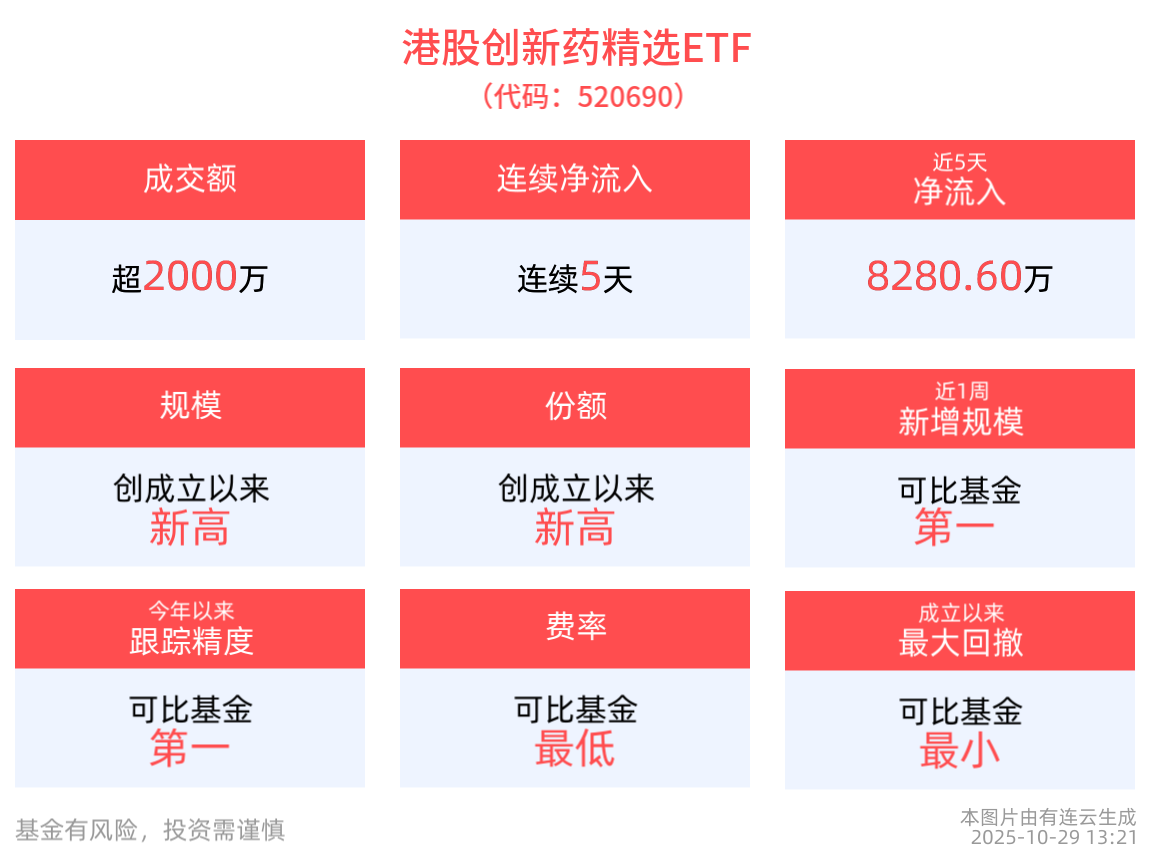
Group 1: Market Performance - The Hong Kong Innovative Drug Selected ETF (520690) increased by 0.22%, with the latest price at 0.89 yuan as of October 29, 2025 [3] - The ETF recorded a turnover of 4.25% during the trading session, with a total transaction value of 21.78 million yuan [3] - Over the past year, the average daily transaction volume of the ETF was 120 million yuan [3] Group 2: Clinical Data and Industry Insights - Grail presented initial data from its multi-cancer early detection product Galleri at the 2025 ESMO annual meeting, showing a positive predictive value of 61.6% and a specificity of 99.6% [3] - Among the detected new cancers, 69.3% were in stages I-III, with a tissue origin accuracy of 91.7% [3] - Guosen Securities views this data as a significant milestone in the multi-cancer early detection field, suggesting Galleri could enhance existing screening systems [3] Group 3: Company Earnings and Trends - Over 280 pharmaceutical and biotech companies, including Heng Rui Pharmaceutical and WuXi AppTec, reported strong Q3 results, driven by advancements in R&D pipelines and new drug launches [3] - The overall industry is exhibiting a positive trend characterized by "innovation as a foundation and overseas expansion" [3] Group 4: CDMO Sector Performance - Lonza, a leading overseas CDMO, reported strong Q3 results, maintaining a revenue growth forecast of 20-21% for the year, with core EBITDA margins between 30-31% [4] - Medpace has seen consecutive growth in new orders for two quarters, indicating a recovering financing environment for U.S. small and mid-sized biotech firms [4] - WuXi AppTec exceeded Q3 performance expectations and raised its full-year guidance, further confirming the positive outlook for the CXO industry [4] Group 5: ETF Size and Inflows - The latest size of the Hong Kong Innovative Drug Selected ETF reached 512 million yuan, marking a new high since its inception [4] - The ETF's share count also hit a record high of 574 million shares [4] - In the past five days, the ETF experienced continuous net inflows, with a peak single-day net inflow of 31.48 million yuan, totaling 82.81 million yuan in net inflows [4]


基金三季度控盘比例超10%个股(附名单)
Zheng Quan Shi Bao Wang· 2025-10-29 04:05
Core Insights - The report indicates that 2888 stocks are listed as heavy holdings by funds in the third quarter, with 108 stocks having a fund holding ratio exceeding 10% [1][2] - A total of 15 stocks have a fund holding ratio above 20%, while 93 stocks fall between 10% and 20%, and 245 stocks have a holding ratio between 5% and 10% [1] - The stock with the highest fund holding ratio is Xinyi Technology, with 1124 funds collectively holding 301.04 million shares, accounting for 34.00% of its circulating stock [2][3] Fund Holdings Overview - Among stocks with a fund holding ratio over 10%, 48 stocks are held by more than 100 funds, and 25 stocks are held by 50 to 99 funds [2] - The stock with the most fund holders is CATL, with 2127 funds holding a total of 12.10% of its shares [2] - Other notable stocks with high fund holdings include Zijin Mining and Zhongji Xuchuang, with 1602 and 1162 funds holding them, respectively [2] Valuation Metrics - Among high fund holding stocks, 22 stocks have a price-to-earnings (P/E) ratio below 30, with China Ping An having the lowest dynamic P/E ratio of 5.90 [2] - Other stocks with low P/E ratios include Gujing Distillery, Luzhou Laojiao, and Shanxi Fenjiu, with dynamic P/E ratios of 11.00, 12.53, and 13.43, respectively [2] Sector Distribution - The stocks with high fund holdings are primarily concentrated in the electronics, pharmaceutical biology, and power equipment sectors, with 25, 21, and 13 stocks in these categories, respectively [2][3] - The report also highlights that there are 26 stocks in the Growth Enterprise Market, 42 in the Sci-Tech Innovation Board, 36 in the Shanghai and Shenzhen main boards, and 4 in the Beijing Stock Exchange [2]


467只科创板股现身基金重仓股名单
Zheng Quan Shi Bao Wang· 2025-10-29 02:15
Group 1 - In the third quarter, 467 Sci-tech Innovation Board stocks appeared in the fund's heavy holdings list, with 54 new additions, 196 increased holdings, and 212 reduced holdings compared to the previous quarter [1] - The total holding amount of these stocks reached 4.594 billion shares, with a total market value of 571.853 billion yuan at the end of the period [1] - The top three stocks by fund holding volume are SMIC, Lattice Semiconductor, and Haiguang Information, with holdings of 396 million shares, 292 million shares, and 207 million shares respectively [1] Group 2 - The stocks with the highest fund holding ratios include BeiGene, Baillie Gifford, and Lattice Semiconductor, with holding ratios of 26.78%, 26.63%, and 25.49% respectively [2] - A total of 186 stocks are held by more than 10 funds, while 89 stocks saw collective new investments from 5 to 9 funds [1][2] - The stock with the most fund holders is Cambricon Technologies, with 925 funds collectively holding 53.816 million shares, accounting for 12.86% of its circulating shares [1] Group 3 - In terms of changes in holdings, 54 new stocks were added, with the most significant new positions in China Shipbuilding Gas, SANY Heavy Energy, and World, holding 15.456 million shares, 2.5973 million shares, and 1.9851 million shares respectively [2] - The stocks with the highest increase in holdings include Yunzhong Technology, Jiachi Technology, and Yandong Micro, with increases of 180930.52%, 113289.44%, and 56633.22% respectively [2] - The stocks with the largest reductions in holdings include Baotai, Xingfu Electronics, and Yingstone Network, with reductions of 99.88%, 99.52%, and 99.29% respectively [2]



高投入驱动高成长 科创成长层公司演绎“研发反哺”新范式
Sou Hu Cai Jing· 2025-10-27 22:23
Core Insights - The launch of the "1+6" reform for the Sci-Tech Innovation Board (STAR Market) includes the establishment of a growth tier, with 32 existing companies included at the outset, aiming to enhance the market's depth and breadth [1] Group 1: Financing and Economic Impact - The 32 existing companies in the growth tier raised a total of 105.2 billion yuan through IPOs, significantly contributing to R&D investments and commercial capacity [1] - Among these, 27 companies raised over 1 billion yuan, with BeiGene and Chipone Integrated Circuits each raising over 10 billion yuan [1] Group 2: Market Capitalization - The total market capitalization of the 32 companies has reached approximately 1.22 trillion yuan, with a combined market cap nearing 1.5 trillion yuan when including other markets [1] - 20 of these companies have a market cap exceeding 10 billion yuan, with notable leaders like Cambricon and BeiGene [1] Group 3: Revenue Performance - In 2024, the 32 companies collectively achieved a revenue of 67.6 billion yuan, with 29 companies surpassing 100 million yuan in revenue [2] - The largest revenue contributor, BeiGene, exceeded 27 billion yuan, while the total revenue for the first half of 2024 was 40.7 billion yuan [2] Group 4: Profitability Trends - Despite facing losses due to high R&D costs and depreciation, the companies are showing signs of reduced losses, with a total loss of 21.1 billion yuan in 2024, a decrease of 3.8 billion yuan from 2023 [2] - 19 companies reported a year-on-year reduction in losses for 2024 [2] Group 5: R&D Investment - The 32 companies invested a total of 30.6 billion yuan in R&D in 2024, with a median R&D expenditure to revenue ratio of 65.4%, leading the STAR Market [3] - Ten companies reported R&D expenditures exceeding 100% of their revenue [3]
速递|48%受试者减重超10%!信达生物玛仕度肽重磅新结果发布
GLP1减重宝典· 2025-10-27 15:53
Core Viewpoint - The article discusses the successful results of the DREAMS-3 clinical trial for the dual receptor agonist IBI362 (Mastrutide), highlighting its efficacy in reducing HbA1c and body weight in Chinese patients with type 2 diabetes and obesity [6][8]. Group 1: Clinical Trial Results - The DREAMS-3 trial demonstrated that 48.0% of patients in the Mastrutide group achieved HbA1c < 7.0% and a weight loss of ≥10% by week 32, significantly outperforming the Semaglutide group at 21.0% (P < 0.0001) [6]. - The mean change in HbA1c from baseline at week 32 was -2.03% for the Mastrutide group and -1.84% for the Semaglutide group, with both showing statistically significant results (P < 0.05) [6]. - The average percentage weight loss from baseline at week 32 was 10.29% for Mastrutide and 6.00% for Semaglutide, indicating a notable difference in efficacy [6]. Group 2: Study Design and Demographics - The DREAMS-3 trial was a multicenter, randomized, open-label Phase III study involving 349 Chinese participants with early-stage type 2 diabetes and obesity, with an average age of 42.4 years and an average disease duration of 1.8 years [8]. - Participants had a baseline HbA1c of 8.02%, a baseline weight of 90.47 kg, and a baseline BMI of 32.98 kg/m², indicating a population with significant metabolic challenges [8]. - The study randomized participants to receive either 6 mg of Mastrutide or 1 mg of Semaglutide for 32 weeks, followed by an extension phase based on weight loss outcomes [8]. Group 3: Safety Profile - The overall safety profile of Mastrutide was consistent with previous clinical studies, with no new safety signals identified during the trial [6]. - Gastrointestinal adverse events were the most common, primarily mild to moderate in severity, indicating a manageable safety profile for patients [6].
银华基金马君旗下银华中证创新药产业ETF三季报最新持仓,重仓药明康德
Sou Hu Cai Jing· 2025-10-26 21:39
Group 1 - The core point of the article is the performance and changes in the top holdings of the Yinhua CSI Innovation Drug Industry ETF, which reported a net value growth rate of 24.54% over the past year [1] - The fund has added new top holdings including Kanglong Chemical and Baile Tianheng, while increasing its stake in WuXi AppTec by 64.87 million shares, making it the largest holding [1] - The fund has exited from its previous top holdings, including Tigermed and Tonghua Golden Horse [1] Group 2 - The detailed data shows the number of shares held and market value for each of the top holdings, with WuXi AppTec holding 15.52 million shares valued at 1.74 billion and Kanglong Chemical holding 8.56 million shares valued at 306 million [1] - Other significant holdings include Hengrui Medicine, Changchun High-tech, and Kelun Pharmaceutical, with respective increases in shareholding [1] - The report indicates a strategic shift in the fund's portfolio, reflecting a focus on companies with strong growth potential in the pharmaceutical sector [1]



鹏华基金苏俊杰旗下鹏华上证科创板100ETF三季报最新持仓,重仓华虹公司
Sou Hu Cai Jing· 2025-10-26 21:39
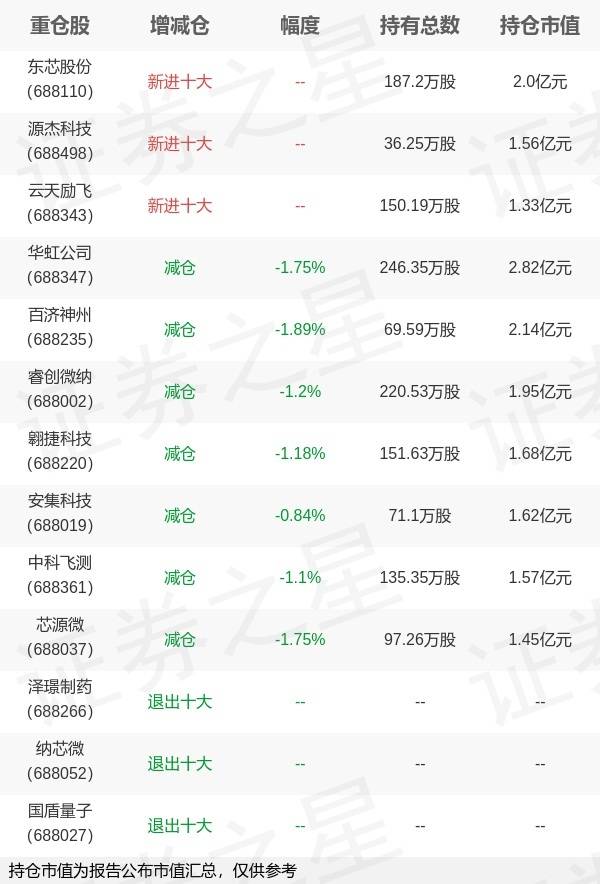
Group 1 - The core viewpoint of the article highlights the performance of the Penghua Science and Technology Innovation 100 ETF, which reported a net value growth rate of 49.82% over the past year [1] - The fund's top ten holdings have seen changes, with new additions including Dongxin Co., Ltd., Yuanjie Technology, and Yuntian Lefe [1] - Huahong Technology remains the largest holding at 3.74% of the fund's portfolio, while Zexing Pharmaceutical, Naxin Micro, and Guodun Quantum have exited the top ten holdings [1] Group 2 - Detailed data on the fund's top holdings shows that Dongxin Co., Ltd. has entered the top ten with 1.872 million shares valued at 200 million yuan, and Yuanjie Technology has also entered with 362,500 shares valued at 156 million yuan [1] - Other notable changes include a reduction in holdings for Huahong Technology by 1.75%, with 2.4635 million shares valued at 282 million yuan, and a decrease in holdings for Baijie Shenzhou by 1.89% [1] - The fund's overall strategy reflects a shift in focus towards emerging technology companies, as indicated by the new additions and reductions in existing holdings [1]



医药生物行业跟踪周报:2025ESMO中国之声闪耀全球,PD1双抗与ADC成为全球焦点-20251026
Soochow Securities· 2025-10-26 09:29
Investment Rating - The report maintains an "Overweight" investment rating for the pharmaceutical and biotechnology industry [1]. Core Insights - The report highlights that the 2025 ESMO conference showcased significant advancements from Chinese innovative drug companies, marking a shift from being followers to leaders in the global market [19][22]. - The A-share pharmaceutical index has shown a year-to-date increase of 19.54%, with a weekly increase of 0.58%, while the Hang Seng Biotechnology Index has surged by 81.15% year-to-date [9]. - Key sub-sectors showing positive performance include medical services (+3.94%), pharmaceutical commerce (+2.27%), and medical devices (+0.89%), while chemical pharmaceuticals and traditional Chinese medicine experienced declines [9]. Summary by Sections Industry Trends - The report notes that the Chinese pharmaceutical sector is entering a harvest period, with a significant increase in the number and quality of research presented at the ESMO conference [16][19]. - The report emphasizes the successful approval of innovative drugs, such as Boehringer Ingelheim's treatment for pulmonary fibrosis and Novartis' drug for polymyalgia rheumatica, which have achieved significant clinical milestones [4]. Research and Development Progress - The report details several groundbreaking studies that have the potential to change existing treatment paradigms, including studies on innovative drugs and ADCs (antibody-drug conjugates) [4][22]. - Specific companies are highlighted for their promising research pipelines, including Innovent Biologics, Rongchang Biologics, and others, which have made significant contributions to the field [12][22]. Market Performance - The report provides a detailed analysis of stock performance within the pharmaceutical sector, noting that certain stocks, such as Teva Pharmaceutical and ST Rong Control, have seen significant weekly gains [9][11]. - The report suggests a ranking of favored sub-sectors for investment, with innovative drugs, research services, and CXO services at the top of the list [10][12]. Recommendations - The report recommends specific companies for investment based on their performance and potential, including Hengrui Medicine, WuXi AppTec, and others across various sub-sectors [11][12].


科创板科创成长层创新药力量发展势能强劲
Zhong Guo Xin Wen Wang· 2025-10-24 13:10
Core Insights - He Yuan Bio, a pioneer in "rice-based hematopoiesis" innovative drugs, is set to debut on the Sci-Tech Innovation Board, marking it as the first incremental enterprise in the Sci-Tech Growth Layer [1] - The Sci-Tech Growth Layer currently includes 13 innovative pharmaceutical companies with a total market capitalization of nearly 500 billion yuan, which have collectively facilitated the approval of 25 new drugs since their listing [1] - The establishment of the fifth set of listing standards on the Sci-Tech Board has enabled unprofitable companies to issue shares, significantly boosting the innovative drug sector and attracting substantial investment, with cumulative financing exceeding 1 trillion yuan since 2019 [1][2] Company Performance - The innovative pharmaceutical companies are transitioning from R&D investment phases to commercial revenue generation, with a projected total revenue of 31.9 billion yuan in 2024, reflecting a year-on-year growth rate of 54.39% [2] - These companies have achieved an average annual compound growth rate of 52.33% in revenue since 2019, significantly outpacing the sector's average growth [2] R&D Achievements - A total of 20 new drugs classified as "global new" have been launched, with 10 innovative drugs recognized as "breakthrough therapies" by the National Medical Products Administration [3] - Four original innovative drugs from Chinese companies, including BeiGene and Junshi Biosciences, have received FDA approval for the U.S. market, highlighting the international recognition of these firms [3] - The companies have engaged in potential overseas transactions totaling nearly 5 billion USD this year, indicating strong international market confidence in the innovative drug capabilities of the Sci-Tech Growth Layer [3]

