
Zhongfu Shenying Carbon Fiber (688295)

Search documents
中复神鹰控股股东中联投资拟减持不超3%股份
Zhi Tong Cai Jing· 2026-02-08 07:56
Group 1 - The core point of the article is that Zhongfu Shenying (688295.SH) announced that its controlling shareholder, China National Building Material Group Investment Co., Ltd. (referred to as "Zhonglian Investment"), plans to reduce its shareholding by a total of no more than 27 million shares, which accounts for no more than 3% of the company's total share capital [1] Group 2 - The reduction of shares will be executed through centralized bidding and block trading methods [1]

中复神鹰(688295.SH)控股股东中联投资拟减持不超3%股份
智通财经网· 2026-02-08 07:52
智通财经APP讯,中复神鹰(688295.SH)公告,公司控股股东中建材联合投资有限公司(简称"中联投资") 拟通过集中竞价交易及大宗交易方式减持公司股份合计不超过2700万股,即不超过公司总股本的3%。 ...
中复神鹰:中联投资拟减持公司股份不超过2700万股
Mei Ri Jing Ji Xin Wen· 2026-02-08 07:50
Group 1 - The core point of the article is that Zhongfu Shenying announced a share reduction plan by its controlling shareholder, China National Building Material Group, which holds approximately 298 million shares, accounting for 33.16% of the total share capital [1] - China National Building Material Group plans to reduce its holdings by up to 27 million shares, which is no more than 3% of the total share capital [1] - The reduction plan will be executed through centralized bidding and block trading, starting from March 10, 2026, to June 9, 2026, fifteen trading days after the announcement [1]
中复神鹰(688295.SH):控股股东中联投资拟减持不超3%股份
Ge Long Hui A P P· 2026-02-08 07:44
Core Viewpoint - Zhongfu Shenying (688295.SH) announced that its controlling shareholder, Zhonglian Investment, plans to reduce its shareholding by up to 27 million shares, representing no more than 3% of the company's total share capital [1] Summary by Relevant Sections - **Share Reduction Plan** - Zhonglian Investment intends to reduce its holdings through centralized bidding and block trading within three months, starting from March 10, 2026, to June 9, 2026 [1] - **Current Shareholding Status** - As of the announcement date, Zhonglian Investment holds 298 million unrestricted circulating shares, accounting for 33.16% of the company's total share capital [1] - **Source of Shares** - The shares to be reduced were acquired prior to the company's initial public offering and have been fully listed and tradable since October 9, 2025 [1]
深度|商业航天新材料全景图:新材料企业的机遇与投资逻辑(附20+报告)
材料汇· 2026-02-02 14:42
Core Viewpoint - The global commercial aerospace market is experiencing unprecedented growth, with projections indicating a market size of $75-125 billion in 2024 and expected to reach $140 billion in 2025. China's commercial aerospace market is particularly rapid, projected to reach 2.3 trillion RMB in 2024, a year-on-year growth of 22.9%, and expected to exceed 2.8 trillion RMB in 2025. Material technology is becoming a core factor determining the competitiveness of commercial aerospace companies [1]. Group 1: Material Demand Characteristics - The demand for materials in commercial aerospace differs significantly from traditional aerospace, focusing on lightweight materials to reduce launch costs, with savings of approximately 20,000-30,000 RMB per kilogram of payload. The core logic for material selection is "lightweight equals increased energy, temperature resistance equals increased efficiency, and reliability equals cost" [1]. - Breakthroughs in reusable technology require materials to withstand over 100 uses and extreme temperature ranges from -270°C to 3000°C, as well as complex space environments [1]. Group 2: Overview of Key New Materials - A total of 128 new materials have been identified as critical for commercial aerospace applications, including aluminum-lithium alloys, titanium alloys, stainless steel, high-temperature alloys, and various composite materials [3][4]. - Key materials such as carbon fiber composites are highlighted for their strength-to-weight ratio, with T700 grade carbon fiber being used in less critical components and T1100 grade for primary load-bearing structures [9][11]. Group 3: Carbon Fiber Composites - Carbon fiber composites (CFRP) are essential in commercial aerospace, accounting for 15%-20% of the manufacturing cost of medium-sized reusable rockets, with values exceeding 20 million RMB per unit. In satellite manufacturing, CFRP costs represent 12%-15% of total manufacturing costs for low Earth orbit satellites [10][11]. - The domestic market for carbon fiber is dominated by companies like Zhongjian Technology and Guangwei Composites, with a significant market share in high-strength carbon fiber applications [12][13]. Group 4: Stainless Steel as a Core Material - Stainless steel is recognized for its low cost, high temperature resistance, and strength, making it a key material for reusable rocket technology. It is used in major structural components like rocket bodies and fuel tanks, aligning with the commercial aerospace principle of "reliability equals cost" [15][16]. - The main grades of stainless steel used can withstand temperatures up to 1400°C and maintain structural stability across a wide temperature range, significantly reducing manufacturing costs compared to advanced materials like titanium alloys [15][16]. Group 5: High-Temperature Materials and Refractory Metals - High-temperature materials are critical for rocket engine technology, directly influencing thrust, efficiency, and reusability. Materials such as ceramic matrix composites and nickel-based superalloys are essential for components exposed to extreme temperatures [19][20][25]. - The domestic production of high-temperature alloys, such as GH4169, has reached over 95% localization, indicating a strong domestic supply chain for aerospace applications [26].




化工“双碳”:政策擎双碳,化工领方向
Guolian Minsheng Securities· 2026-01-30 12:49
Investment Rating - The report maintains a positive investment rating for the chemical industry, highlighting the potential benefits from the "dual carbon" policy implementation [5]. Core Insights - The "dual carbon" policy is expected to significantly impact the chemical industry, with a focus on carbon emissions control becoming a rigid constraint during the 14th Five-Year Plan period [6][14]. - The report identifies that the attention towards "dual carbon" from provincial leaders has increased by 137% since September 2025, indicating a shift in focus towards carbon emissions as a critical performance metric [7][18]. - The chemical industry is anticipated to undergo structural changes, with high carbon intensity sectors facing supply constraints, while low-carbon leaders are expected to benefit from the transition [8][30]. Summary by Sections 1. "14th Five-Year Plan": Carbon Peak Closing Battle - Local carbon assessments may treat carbon emissions as an equally important rigid constraint [15]. - High carbon intensity sectors such as ammonia fertilizer, coal chemical, and chlorine-alkali are likely to face capacity constraints first [29][30]. 2. Petrochemical "Dual Carbon" Opportunities - The petrochemical sector is expected to undergo a transformation driven by the "dual carbon" goals, with a focus on optimizing supply and demand structures [38]. - Refining sector dynamics are shifting towards improved supply-demand balance due to stringent approval processes for new projects and the elimination of high-energy-consuming capacities [38]. 3. Basic Chemical "Dual Carbon" Opportunities - Coal chemical industry is projected to stabilize supply under carbon limits, driving quality improvements in the sector [3.1]. - Carbon fiber and fluorochemical sectors are expected to benefit from process optimization and green transitions [3.2][3.3]. 4. Investment Recommendations - The report suggests focusing on three categories of leading companies: 1. Integrated leaders in the oil chemical sector with scale and efficiency advantages [8]. 2. Coal chemical leaders with advanced processes and low emissions [8]. 3. High-quality firms in fluorochemical and carbon fiber sectors that align with "dual carbon" goals [8].


化学纤维板块1月30日跌1.66%,华峰化学领跌,主力资金净流出3.88亿元
Zheng Xing Xing Ye Ri Bao· 2026-01-30 08:54
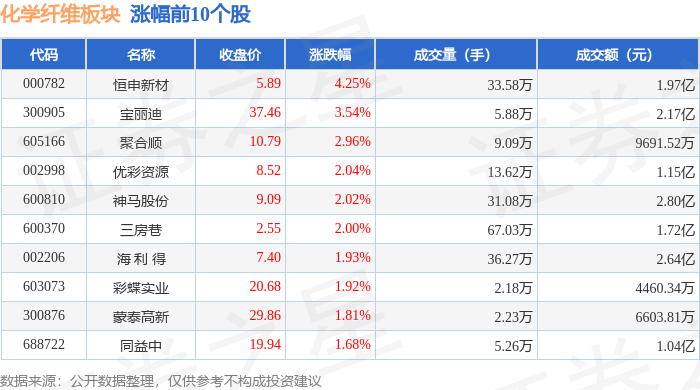
Market Overview - The chemical fiber sector experienced a decline of 1.66% on January 30, with Huafeng Chemical leading the drop [1] - The Shanghai Composite Index closed at 4117.95, down 0.96%, while the Shenzhen Component Index closed at 14205.89, down 0.66% [1] Stock Performance - Notable gainers in the chemical fiber sector included: - Hengshen New Materials (Code: 000782) with a closing price of 5.89, up 4.25% and a trading volume of 335,800 shares, totaling 197 million yuan [1] - Baolidi (Code: 300905) closed at 37.46, up 3.54% with a trading volume of 58,800 shares, totaling 217 million yuan [1] - Major decliners included: - Huafeng Chemical (Code: 002064) closed at 12.88, down 5.85% with a trading volume of 774,500 shares, totaling 26.67 million yuan [2] - Xinxiang Chemical Fiber (Code: 000949) closed at 7.27, down 3.84% with a trading volume of 985,300 shares, totaling 716 million yuan [2] Capital Flow - The chemical fiber sector saw a net outflow of 388 million yuan from main funds, while retail investors contributed a net inflow of 420 million yuan [2] - The capital flow for specific stocks showed: - Hengshen New Materials had a main fund net outflow of 12.99 million yuan, with retail inflow of 1.70 million yuan [3] - Sanfangxiang (Code: 600370) had a main fund net inflow of 7.65 million yuan, while retail outflow was 0.37 million yuan [3]


中复神鹰、光威复材,2025全年业绩公布
DT新材料· 2026-01-28 16:04
Core Viewpoint - The article discusses the performance forecasts for two companies, Zhongfu Shenying and Guangwei Composites, for the year 2025, highlighting their revenue growth and profit changes, as well as the factors driving these changes [3][4]. Company Performance Summary Zhongfu Shenying - The company expects annual revenue between 2.1 billion to 2.3 billion yuan, an increase of 543 million to 743 million yuan, representing a growth of 34.85% to 47.69% year-on-year [3]. - Net profit attributable to shareholders is projected to be between 80 million to 120 million yuan, an increase of 204 million to 244 million yuan compared to the previous year, indicating a turnaround from losses [3]. - The growth is attributed to product structure optimization and expansion into aerospace, wind power, high-end sports, and pressure vessel applications, leading to significant increases in sales revenue and profitability [3]. Guangwei Composites - The company anticipates total revenue of 2.859 billion yuan for 2025, a year-on-year increase of 16.68% [4]. - Net profit attributable to shareholders is expected to be 601 million yuan, a decrease of 18.86% compared to the previous year [4]. - The energy new materials segment is a key growth driver, with revenue expected to increase by 75.84% to 943 million yuan, while the civil fiber business is facing challenges due to industry competition [4]. - Total assets at the end of the period are projected to be 8.806 billion yuan, a 9.09% increase year-on-year, and equity attributable to shareholders is expected to grow by 3.07% to 5.684 billion yuan [4].

中复神鹰:预计2025年净利润为8000万元至1.2亿元
Zheng Quan Ri Bao Zhi Sheng· 2026-01-28 10:42
Group 1 - The company, Zhongfu Shenying, announced an expected annual revenue for 2025 between 210,000 million yuan and 230,000 million yuan, representing a year-on-year growth of 34.85% to 47.69% [1] - The company anticipates achieving a net profit attributable to the parent company of between 8,000 million yuan and 12,000 million yuan, indicating a turnaround from losses to profitability [1]
中复神鹰(688295.SH)发预盈,预计2025年归母净利润8000万元至1.2亿元,扭亏为盈
智通财经网· 2026-01-28 09:13
Core Viewpoint - Zhongfu Shenying (688295.SH) expects to achieve a net profit attributable to shareholders of 80 million to 120 million yuan in 2025, marking a turnaround from losses in the previous year [1] Group 1: Performance Drivers - The company achieved profitability due to three main drivers: 1. Market-side improvements through optimized product structure and expansion into aerospace, wind power, high-end sports, and pressure vessel applications, leading to significant growth in sales revenue and profitability [1] 2. Production-side focus on technology-driven cost reduction and efficiency improvements, leveraging large-scale production and process optimization to effectively lower unit production costs [1] 3. Management-side efforts in refined management practices to enhance efficiency and control expenses, further solidifying the profit foundation [1]