
REMEGEN(688331)

Search documents
向“领跑者”跨越! 中国双抗药物再迎高光时刻
Mei Ri Jing Ji Xin Wen· 2026-01-14 11:59
Core Insights - The announcement of a $5.6 billion licensing agreement between Rongchang Biopharma and AbbVie marks a significant milestone for Chinese innovative drugs entering the global market, indicating a shift from follower to leader in the dual antibody space [1][3] - Concurrently, Kangfang Biopharma's partner, Summit Therapeutics, submitted a Biologics License Application (BLA) for Ivoris monoclonal antibody to the FDA, further highlighting the progress of Chinese dual antibodies on the international stage [1][4] - However, the termination of a licensing agreement by Yiming Oncology with Instil Bio serves as a cautionary tale for the challenges faced by Chinese companies in global expansion [1][10] Group 1: Major Developments - Rongchang Biopharma's agreement with AbbVie includes an upfront payment of $650 million and potential milestone payments of up to $4.95 billion, along with double-digit royalties on net sales outside Greater China [3] - Kangfang Biopharma's Ivoris monoclonal antibody is positioned to address a significant unmet clinical need in treating EGFR-mutant non-small cell lung cancer, with the FDA expected to make a decision by Q4 2026 [4][5] - The competitive landscape for PD-1/VEGF dual antibodies is intensifying, with major pharmaceutical companies increasingly focusing on a few validated "winners" in the market [2][9] Group 2: Industry Trends - The recent high-value transactions in the dual antibody space reflect a growing recognition of the clinical and commercial potential of Chinese innovative drugs, with transaction amounts reaching new heights [9] - The competitive dynamics are shifting, as the number of potential international buyers decreases due to the concentration of capital and interest in a limited number of validated products [10][13] - The success of PD-1/VEGF dual antibodies is seen as pivotal for the future of cancer treatment, with ongoing clinical trials exploring their combination with other therapies to enhance efficacy [14]


荣昌生物(688331):400亿BD大单落地,创新药烽烟再起
市值风云· 2026-01-14 11:05
Investment Rating - The report indicates a strong investment opportunity for Rongchang Biopharma following the signing of a significant licensing agreement with AbbVie, which is expected to enhance the company's financial position and market presence [2][25]. Core Insights - Rongchang Biopharma has signed an exclusive licensing agreement with AbbVie for the novel PD-1/VEGF bispecific antibody drug RC148, which includes an upfront payment of $650 million (approximately 4.5 billion RMB) and potential milestone payments totaling up to $4.95 billion (approximately 34.5 billion RMB) [2][8]. - The total transaction value is close to $4 billion, marking a record for the company in terms of external licensing agreements [3][8]. - The PD-1/VEGF bispecific antibody market is identified as a "golden track" for Chinese innovative drugs going global, with increasing upfront payments reflecting the growing value of these assets [9][10]. Industry Overview - The number of BD licensing deals for Chinese innovative drugs has surged from 85 in 2023 to 157 in 2025, with a compound annual growth rate of 35.9% [11]. - The total transaction value for these deals has skyrocketed from $32 billion in 2023 to $135.7 billion in 2025, representing a growth of over three times [13]. - The industry is entering an accelerated growth phase, with a year-on-year growth rate of 161% for BD licensing deals in 2025, significantly outpacing previous years [15]. Financial Performance - Rongchang Biopharma's revenue for the first three quarters of 2025 reached 1.72 billion RMB, reflecting a year-on-year increase of 42.27% [16]. - Despite ongoing net losses exceeding 1 billion RMB from 2022 to 2024, the company has shown improvement, with losses narrowing to 551 million RMB in the first three quarters of 2025 compared to 1.071 billion RMB in the same period of 2024 [17][19]. - The anticipated upfront payment from the AbbVie deal is expected to further improve Rongchang Biopharma's profitability and cash reserves, potentially leading to profitability in 2026 if the payment is fully received [19]. Product Pipeline - Rongchang Biopharma's key products include Taitasip (IL-4Rα antibody) and Vidisicimab (HER2 ADC), which are currently the main sources of revenue [20]. - The RC148 bispecific antibody is a focus for the company, currently in I/II clinical stages, and the collaboration with AbbVie is expected to accelerate its global development [23].
荣昌生物400亿BD大单落地,创新药烽烟再起!
市值风云· 2026-01-14 10:08
Core Viewpoint - Rongchang Biopharmaceutical has signed an exclusive licensing agreement with AbbVie for the novel PD-1/VEGF bispecific antibody drug RC148, which is expected to significantly enhance the company's financial position and growth prospects [3][20]. Group 1: Licensing Agreement Details - The agreement grants AbbVie exclusive rights to develop, manufacture, and commercialize RC148 outside Greater China, with Rongchang receiving an upfront payment of $650 million (approximately 4.5 billion RMB) [3][7]. - The total potential transaction value could reach $4.95 billion (approximately 34.5 billion RMB), including milestone payments and royalties based on net sales [3][7]. - This transaction marks a record for Rongchang in terms of both upfront payment and total deal value, surpassing previous agreements [7][20]. Group 2: Industry Trends - The number of BD (business development) licensing agreements for Chinese innovative drugs has surged, with transactions increasing from 85 in 2023 to 157 in 2025, reflecting a compound annual growth rate of 35.9% [9]. - The total transaction value for these agreements is projected to rise from $32 billion in 2023 to $135.7 billion in 2025, representing over a threefold increase [11]. - The average upfront payment has also seen significant growth, increasing from $2.5 billion to $7 billion, a rise of 180% [11][13]. Group 3: Company Financial Performance - Rongchang's revenue for the first three quarters of 2025 reached 1.72 billion RMB, marking a year-on-year growth of 42.27% [14]. - Despite the revenue growth, the company has reported net losses exceeding 1 billion RMB from 2022 to 2024, with a reduced loss of 551 million RMB in the first three quarters of 2025 compared to 1.071 billion RMB in the same period of 2024 [15][16]. - The anticipated upfront payment from the AbbVie agreement is expected to further improve Rongchang's profitability and cash reserves, potentially leading to profitability in 2026 if the payment is fully received [16].

生物制品板块1月14日跌0.9%,荣昌生物领跌,主力资金净流出6.56亿元
Zheng Xing Xing Ye Ri Bao· 2026-01-14 08:58
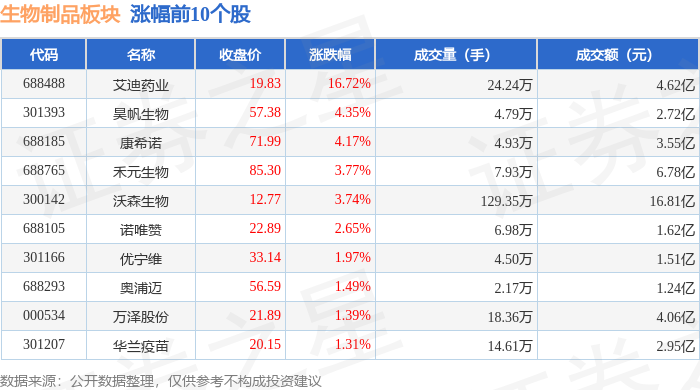
Market Overview - The biopharmaceutical sector experienced a decline of 0.9% on January 14, with Rongchang Biopharmaceutical leading the drop [1] - The Shanghai Composite Index closed at 4126.09, down 0.31%, while the Shenzhen Component Index closed at 14248.6, up 0.56% [1] Stock Performance - Notable gainers in the biopharmaceutical sector included: - Aidi Pharmaceutical, closing at 19.83 with a rise of 16.72% and a trading volume of 242,400 shares, totaling 462 million yuan [1] - Wufan Biopharmaceutical, closing at 57.38 with an increase of 4.35% and a trading volume of 47,900 shares, totaling 272 million yuan [1] - Kangbuno, closing at 71.99 with a rise of 4.17% and a trading volume of 49,300 shares, totaling 355 million yuan [1] - Rongchang Biopharmaceutical saw a significant decline, closing at 103.34 with a drop of 9.72% and a trading volume of 196,700 shares, totaling 2.091 billion yuan [2] Capital Flow - The biopharmaceutical sector experienced a net outflow of 656 million yuan from institutional investors, while retail investors saw a net inflow of 407 million yuan [2] - Notable capital flows included: - Watson Biopharmaceuticals with a net inflow of 63.73 million yuan from institutional investors [3] - Kanghua Biopharmaceuticals with a net inflow of 18.92 million yuan from institutional investors [3] - Overall, retail investors contributed a net inflow of 4.07 billion yuan to the sector [2]
荣昌生物跌9.72% 华泰证券华安证券昨刚喊买入就跌
Zhong Guo Jing Ji Wang· 2026-01-14 07:45
Core Viewpoint - Rongchang Biopharmaceutical (688331.SH) experienced a significant decline in stock price, closing at 103.34 yuan, down 9.72% [1] Group 1: Analyst Reports - Huatai Securities analysts Dai Wen, Yuan Zhongping, and Li Hang published a report on January 13, maintaining a WACC of 6.5% and a perpetual growth rate of 2.5%, adjusting the DCF-based target price for A-shares to 151.79 yuan (previously 140.42 yuan) [1] - The A/H premium was adjusted to 16.46%, consistent with the past three months' A/H premium for Rongchang Biopharmaceutical, up from the previous 8.95% [1] - The target price for H-shares was adjusted to 142.72 HKD (previously 141.13 HKD), with a "buy" rating maintained for both A-shares and H-shares [1] Group 2: Clinical Development and Product Pipeline - Huazhong Securities analysts Tan Guochao and Ren Wanying also published a report on January 13, expressing optimism about the clinical advancement of RC148, the progress of the company's pipeline, and the stable sales growth of its listed products, maintaining a "buy" rating [1]

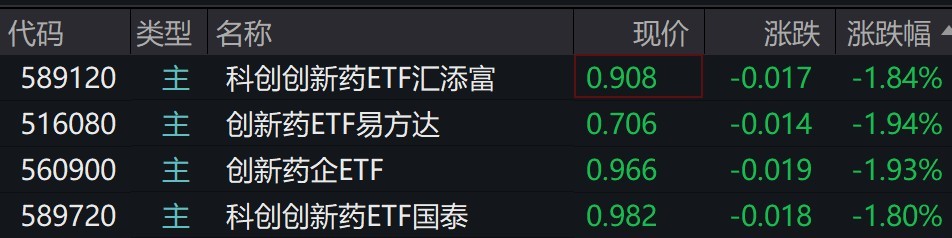
创新药概念股走低,多只创新药相关ETF跌近2%
Mei Ri Jing Ji Xin Wen· 2026-01-14 05:42
Core Viewpoint - The innovative drug sector is experiencing a decline, with several key stocks and ETFs showing significant drops in value, indicating a potential shift in market sentiment towards this industry [1][2]. Group 1: Stock Performance - Rongchang Biopharmaceutical has seen a decline of over 10% in its stock price [1]. - Other companies such as Baile Tianheng, Xinlitai, and Maiwei Biopharmaceutical-U have also dropped more than 3% [1]. - Multiple innovative drug-related ETFs have decreased nearly 2% in value [1]. Group 2: Market Analysis - Some brokerages suggest that core assets in the innovative drug sector will continue to appreciate, highlighting emerging opportunities in small nucleic acids and in vivo CAR technologies [2]. - The long-term trend of innovative drug business development (BD) is seen as a pathway for Chinese innovative drug capabilities to gain recognition on the global stage [2]. - Core assets that have been licensed to multinational corporations (MNCs) are expected to realize their value as clinical progress continues [2]. - Future focus should remain on cutting-edge technology platforms and closely monitor advancements in clinical data [2].


2026年医药投资主线浮出水面
3 6 Ke· 2026-01-14 03:45
Core Insights - The PD-1/VEGF dual antibody sector is experiencing a divergence, with Yiming Biotech facing setbacks due to the return of its PD-L1/VEGF dual antibody by partner Axion, while Rongchang Biotech secured a significant licensing deal worth $5.6 billion with AbbVie, highlighting the increasing differentiation within the dual antibody space and outlining the core investment theme for 2026: certainty [1][2] Group 1: Investment Trends - The investment landscape in the pharmaceutical sector is shifting from a focus on broad-based licensing deals to a preference for certainty in value, emphasizing three core anchors: expectation certainty, product certainty, and performance certainty [2][6] - The previous trend of "BD is king" in 2025 led to a surge in licensing deals, but the market is now recalibrating its valuation logic, moving away from blind enthusiasm towards a more rational assessment of the feasibility of these deals [1][2] Group 2: Expectation Certainty - Expectation certainty involves a rational evaluation of the feasibility of BD transactions rather than blind pursuit of total deal amounts, as the probability of new drugs progressing from early clinical stages to market approval is only 7.9% [3][4] - The competitive landscape in the PD-1/VEGF dual antibody sector shows that not all players can achieve their expected value due to overlapping targets and indications, mirroring past trends in the PD-1 monoclonal antibody market [3][4] Group 3: Product Certainty - Product certainty focuses on the potential for substantial sales post-launch, with products that have clear growth logic expected to command higher valuations [5][6] - WanTai Biotech's nine-valent HPV vaccine, priced at 499 yuan per dose (40% of imported vaccines), is positioned for significant market penetration, while Innovent Biologics' Ma Shidu peptide faces challenges due to increased competition and pricing pressures, leading to diminished commercial value [5][6] Group 4: Performance Certainty - Performance certainty seeks companies and sectors with clear growth or recovery expectations, as the essence of investment is capturing expectation differences [7][8] - WuXi AppTec's profit forecast for 2025 indicates a significant growth of 41.33% year-on-year, reflecting its foundational role in the global pharmaceutical supply chain and a potential recovery in valuation due to increased R&D investments [7][8] - The vaccine sector is also poised for recovery, with domestic companies expected to benefit from a broad replacement market and initial overseas expansion, indicating a favorable investment outlook [7][8]


大行评级|小摩:上调荣昌生物目标价至116港元 评级升至“增持”
Ge Long Hui· 2026-01-14 02:29
Core Viewpoint - Morgan Stanley reports that Rongchang Biopharma has entered into an exclusive licensing agreement with AbbVie for RC148, which includes an upfront payment of $650 million, potential milestone payments of up to $4.95 billion for development, regulatory, and commercialization, and double-digit tiered royalties on net sales outside Greater China [1] Group 1 - The collaboration is seen as a surprise and may boost market confidence in the Chinese biotech and pharmaceutical sectors, as Morgan Stanley previously assessed the likelihood of this event as low and did not factor it into their models [1] - The deal reflects the competitive advantage of RC148, with key data for its use in first-line treatment of non-small cell lung cancer (NSCLC) expected to be announced at the ASCO conference at the end of May [1] - Morgan Stanley has raised the target price for Rongchang Biopharma from HKD 77 to HKD 116 and upgraded its rating from "Neutral" to "Overweight" [1]
10只科创板股获融资净买入额超1亿元
Zheng Quan Shi Bao Wang· 2026-01-14 02:16
Core Viewpoint - The total margin balance of the Sci-Tech Innovation Board reached 288.907 billion yuan on January 13, showing an increase of 1.127 billion yuan compared to the previous trading day [1] Group 1: Margin Balance - The financing balance amounted to 287.888 billion yuan, increasing by 1.178 billion yuan from the previous trading day [1] - The margin trading balance decreased to 10.19 billion yuan, down by 0.051 billion yuan from the previous trading day [1] Group 2: Individual Stock Performance - On January 13, 311 stocks on the Sci-Tech Innovation Board experienced net financing inflows, with 10 stocks having net inflows exceeding 100 million yuan [1] - Kingsoft Office topped the list with a net financing inflow of 276 million yuan [1] - Other notable stocks with significant net financing inflows include Chengdu Xian Dao, Zhongke Xingtu, Zhongxin International, Rongchang Bio, Western Superconducting, and Green Harmony [1]




创新药出海“火爆”!荣昌生物签订重磅BD,港股创新药ETF(159567)涨超2.5%,开年以来反弹超11%
2 1 Shi Ji Jing Ji Bao Dao· 2026-01-14 02:16
Group 1 - The Hong Kong stock market saw a strong performance in the early session on January 14, with the pharmaceutical sector leading the gains. The Hong Kong Innovative Drug ETF (159567) rose by 2.52%, with trading volume quickly surpassing 300 million yuan [1] - The Hong Kong Innovative Drug ETF (159567) has experienced a rebound since the beginning of 2026, with a cumulative increase of over 11% from January 5 to January 13 [1] - The ETF closely tracks the Guozheng Hong Kong Stock Connect Innovative Drug Index (987018), which reflects the performance characteristics of listed companies in the innovative drug sector within the Hong Kong Stock Connect [1] Group 2 - On January 12, the 44th JPMorgan Global Healthcare Conference officially opened in the United States, attracting significant attention from the biopharmaceutical industry. Several domestic innovative drug companies participated, with seven companies presenting at the main venue [2] - Huatai Securities noted that the liquidity in the Hong Kong innovative drug sector has significantly improved since the beginning of 2026, and the JPMorgan conference has provided a platform for domestic pharmaceutical companies to advance overseas business development (BD) collaborations [2] - The ongoing liquidity recovery is expected to lead to a clear innovative drug beta market, with external demand-driven CXO companies likely to achieve performance that exceeds expectations, resonating with innovative drugs [2]
