
REMEGEN(688331)

Search documents
荣昌生物:调整回购股份价格上限至116元/股
Mei Ri Jing Ji Xin Wen· 2026-01-15 08:49
每经AI快讯,1月15日,荣昌生物公告称,公司拟将回购价格上限由95元/股调整为116元/股,以保障回 购股份方案顺利实施。除此调整外,回购方案其他内容不变。本次调整无需提交股东会审议。公司于 2025年12月15日已审议通过以集中竞价交易方式回购部分A股股票,拟回购资金总额不低于2000万元且 不超过4000万元,回购股份用于员工持股计划或股权激励。截至公告披露日,公司尚未开始实施回购。 ...
荣昌生物(688331):RC148数据优异,BD交易超预期,看好公司长期发展前景
NORTHEAST SECURITIES· 2026-01-15 06:15
Investment Rating - The report maintains a "Buy" rating for the company, indicating an expectation of stock price appreciation exceeding 15% over the next six months [5]. Core Insights - The company has signed an exclusive licensing agreement with AbbVie for the PD-1/VEGF dual antibody drug RC148, receiving an upfront payment of $650 million, with potential milestone payments up to $4.95 billion, and double-digit royalties on net sales outside Greater China [1][2]. - RC148 shows promising efficacy and safety data, with a reported overall response rate (ORR) of 61.9% in a Phase 1 trial and 66.7% in a Phase 2 trial for non-small cell lung cancer (NSCLC) [1]. - The company has successfully executed multiple business development (BD) transactions, enhancing its cash flow and validating its research capabilities [2]. Financial Summary - The company’s projected revenues for 2025-2027 are $250.8 million, $319.6 million, and $428.5 million, respectively, reflecting growth rates of 46.1%, 27.4%, and 34.1% [4]. - The net profit attributable to the parent company is expected to improve from a loss of $885 million in 2025 to a profit of $373 million in 2027 [4]. - Earnings per share (EPS) are projected to transition from -1.57 yuan in 2025 to 0.66 yuan in 2027, indicating a significant turnaround [4].
跨国药企“必备”肿瘤药,中国药企还有机会卖
经济观察报· 2026-01-15 05:55
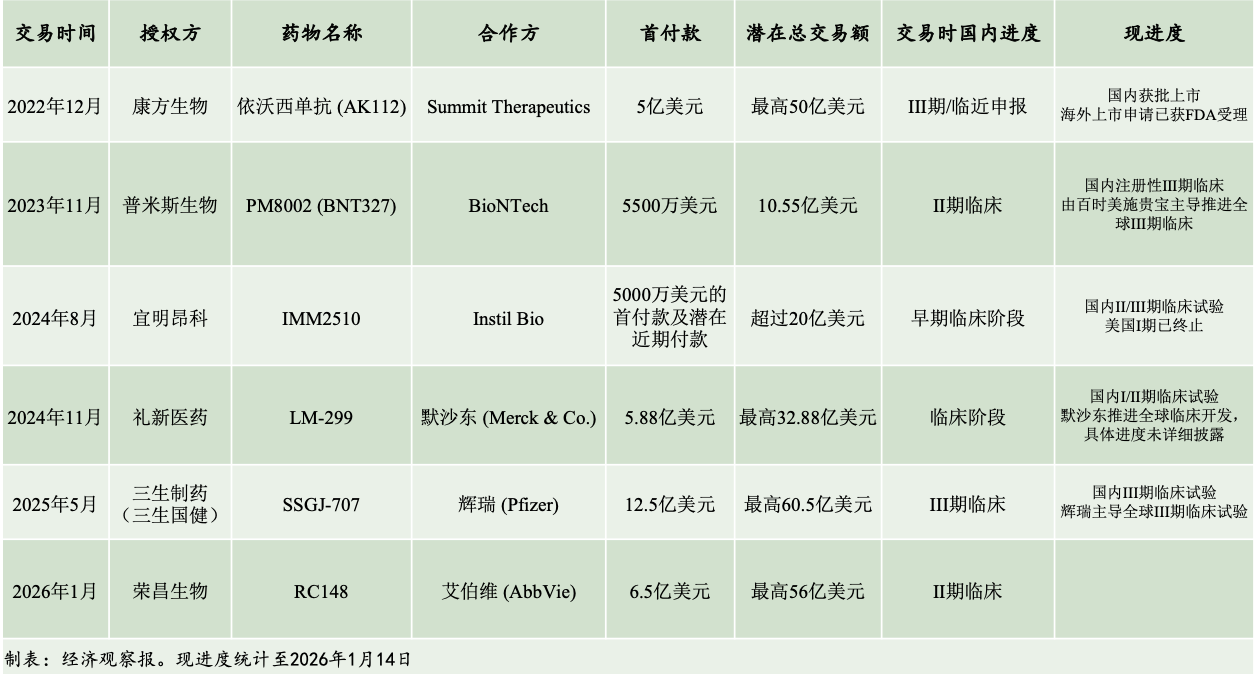
Core Viewpoint - The article discusses the potential for PD-1/VEGF drugs to generate external licensing deals, highlighting recent significant transactions in this sector and the competitive landscape among pharmaceutical companies [1][3]. Group 1: Recent Transactions - Rongchang Biopharma announced an exclusive licensing agreement with AbbVie for its dual-specific antibody drug RC148, targeting PD-1/VEGF, currently in Phase II clinical trials. The deal includes an upfront payment of $650 million and potential milestone payments up to $4.95 billion, with a total deal value of $5.5 billion [2][6]. - Other notable transactions include: - Canfite BioPharma licensed its PD-1/VEGF dual antibody to Summit Therapeutics for an upfront payment of $500 million, with a total deal value exceeding $5 billion [5][6]. - Three other companies have also secured deals for PD-1/VEGF drugs, with upfront payments ranging from $50 million to $1.25 billion and total deal values reaching up to $6.05 billion [5][6]. Group 2: Market Dynamics - The PD-(L)1/VEGF target is considered one of the most promising in oncology, combining immunotherapy and targeted therapy, with expectations of significant therapeutic benefits [5][9]. - Despite the presence of multiple drugs targeting the same pathway, there is still potential for new licensing agreements based on efficacy, different indications, and combination therapies [11][12]. - The competitive landscape is characterized by a trend where companies are looking to acquire PD-1/VEGF assets to strengthen their oncology portfolios, especially those that missed earlier opportunities in the PD-1 market [8][12]. Group 3: Future Outlook - There is an expectation for continued licensing transactions in the PD-1/VEGF space, as companies seek to leverage unique data and therapeutic advantages of their products [10][11]. - Companies like Zai Lab, Junshi Biosciences, and others are in various stages of developing PD-(L)1/VEGF pipelines, indicating ongoing interest and investment in this therapeutic area [11][12].


跨国药企“必备”肿瘤药,中国药企还有机会卖
Jing Ji Guan Cha Wang· 2026-01-15 03:32
Core Viewpoint - The recent licensing agreement between Rongchang Biologics and AbbVie for the dual-specific antibody drug RC148 highlights the competitive landscape of PD-1/VEGF targeted therapies, with significant financial implications for both companies involved [1][6]. Group 1: Licensing Agreement Details - Rongchang Biologics has entered into an exclusive licensing agreement with AbbVie for RC148, a dual-specific antibody currently in Phase II clinical trials, granting AbbVie rights outside Greater China [1][6]. - The deal includes an upfront payment of $650 million and potential milestone payments up to $4.95 billion, along with tiered royalties on net sales, bringing the total potential value of the agreement to $5.5 billion [1][6]. - This transaction's total amount is considered high, especially for a product not ranked among the top three in its category, raising questions about market share potential [6]. Group 2: Market Context and Comparisons - The PD-(L)1/VEGF target has gained significant attention in recent years, combining immunotherapy and targeted therapy, with expectations of enhanced efficacy [3]. - Several Chinese biotech companies have previously licensed their PD-(L)1/VEGF drugs to international firms, with notable deals including a $500 million upfront payment from Summit Therapeutics to Kanyin Biologics, and a $1.25 billion upfront payment from Pfizer to Sanofi [4][5]. - Despite the presence of multiple PD-1/VEGF drugs in the market, there remains potential for further licensing agreements, as efficacy and specific indications will play a crucial role in market segmentation [10]. Group 3: Future Trends and Industry Insights - The combination of PD-(L)1/VEGF drugs with ADCs (antibody-drug conjugates) is anticipated to be a major development trend among pharmaceutical companies [9]. - Companies that have not yet licensed their PD-1/VEGF drugs are actively seeking opportunities, with the success of future deals dependent on finding suitable partners and demonstrating strong clinical data [10]. - Major multinational pharmaceutical companies, including Eli Lilly, Novartis, and Sanofi, have yet to announce new licensing agreements, indicating a cautious approach while awaiting more mature data [12].
AI重塑新药研发!英伟达礼来砸百亿建联合实验室,医疗板块迎技术革命?
Jin Rong Jie· 2026-01-15 01:47
Core Insights - The 44th J.P. Morgan Healthcare Conference has highlighted significant industry developments, including a $1 billion investment by NVIDIA and Eli Lilly to establish a joint research lab in the San Francisco Bay Area to accelerate AI applications in the pharmaceutical sector [1] - The conference serves as a critical platform for domestic pharmaceutical companies to showcase core molecular product capabilities and advance overseas business development collaborations, indicating a return to global value validation for products [2] - The participation of over 8,000 global attendees and more than 500 listed companies underscores the strengthening global competitiveness of Chinese companies in the pharmaceutical sector [2] Group 1: Innovative Drugs - BeiGene focuses on oncology drug development and global commercialization, presenting progress on core products like CDK4 at the conference [2] - Rongchang Biologics has entered an exclusive licensing agreement with AbbVie for the novel PD-1/VEGF bispecific antibody drug RC148, granting AbbVie rights outside Greater China for development, production, and commercialization [2] - Hengrui Medicine, involved in the R&D, production, and sales of innovative and generic drugs, reported that over 50% of its revenue now comes from innovative drugs, with multiple self-developed products receiving approvals [2] Group 2: CRO/CMO - WuXi AppTec provides integrated CXO services covering the entire drug development and manufacturing process, projecting a 32.56% year-on-year growth in net profit for 2025 [3] - WuXi Biologics, specializing in biopharmaceutical CRDMO services, announced 209 new projects, bringing the total to 945, with potential milestone payments exceeding $4 billion from new research contracts [3] - Tigermed offers clinical trial CRO services and participated in the Asia-Pacific session of the conference, providing outsourcing services related to clinical trials for global pharmaceutical companies [3] Group 3: AI in Healthcare - NVIDIA and Eli Lilly's collaboration aims to build AI models to enhance new drug development, with a planned investment of $1 billion over the next five years [4] - RunDa Medical focuses on comprehensive medical testing services and is developing an automated testing interpretation system based on large models [4] - Anbiping has launched a digital pathology AI system and is exploring the registration and commercialization of AI medical devices in cervical cytology [4]


华西证券:维持荣昌生物“增持”评级 RC148双抗56亿美元出海
Zhi Tong Cai Jing· 2026-01-15 01:27
Recent Events - Company announced on January 12 that it has signed an exclusive licensing agreement with AbbVie for its self-developed PD-1/VEGF bispecific antibody drug RC148, granting AbbVie exclusive rights for development, production, and commercialization outside Greater China. The company will receive an upfront payment of $650 million and is eligible for up to $4.95 billion in milestone payments, as well as double-digit royalties on net sales outside Greater China [1] Product Development and International Collaboration - The recent licensing agreement further validates the company's speed in international expansion, following the external authorization of its core products RC18 and RC28 by 2025. As of January 2026, there are 17 PD-(L)1/VEGF bispecific antibody drugs in clinical trials globally, with several signed BD agreements, showcasing the company's strong R&D capabilities [2] - AbbVie, as an international MNC, has a diverse product pipeline including the first FRα-targeting ADC drug Elahere and others, which will strategically complement RC148 and expand its global reach [2] Clinical Data and Efficacy - At the 2025 ESMO-IO conference, the company disclosed promising data for RC148, showing an objective response rate (ORR) of 61.9% and a disease control rate (DCR) of 100% for monotherapy. For combination therapy, the ORR reached 66.7% and the DCR was 95.2%, indicating initial clinical advantages and manageable safety profiles [3] - Early clinical studies have shown that RC148, when used in combination with antibody-drug conjugates (ADCs), exhibits promising anti-tumor activity, with the company actively advancing related clinical trials [3]
华西证券:维持荣昌生物(09995)“增持”评级 RC148双抗56亿美元出海
智通财经网· 2026-01-15 01:25
Core Viewpoint - Huaxi Securities maintains an "overweight" rating for Rongchang Biopharmaceutical (09995), highlighting the company's strong independent R&D capabilities, stable sales growth of core products, experienced management team, steady progress in clinical indications, and reasonable domestic and international layout, with optimism regarding the company's commercialization capabilities post-product launch [1] Recent Events - On January 12, the company announced an exclusive licensing agreement with AbbVie for its independently developed PD-1/VEGF bispecific antibody drug RC148, granting AbbVie exclusive rights for development, production, and commercialization outside Greater China. The company will receive an upfront payment of $650 million and is eligible for up to $4.95 billion in milestone payments, along with double-digit royalties on net sales outside Greater China [1] International Expansion - Following the authorization of core products RC18 and RC28 in 2025, this recent agreement further validates the company's speed in international expansion. As of January 2026, 17 PD-(L)1/VEGF bispecific antibody drugs are in clinical trials globally, with several BD agreements signed, showcasing the company's R&D capabilities. AbbVie, as a partner, has a diverse product line that complements RC148, enhancing its global positioning [2] Clinical Data - At the 2025 ESMO-IO conference, the company disclosed promising data for RC148, showing an objective response rate (ORR) of 61.9% and a disease control rate (DCR) of 100% in monotherapy. In combination therapy, the ORR reached 66.7% and the DCR was 95.2%. The safety profile is manageable, indicating initial clinical advantages. The company is actively advancing related clinical studies, anticipating further clinical potential [3]
荣昌生物(09995):RC148双抗56亿美元出海,协同MNC拓展全球市场
HUAXI Securities· 2026-01-14 15:25
Investment Rating - The investment rating for the company is "Buy" [4] Core Insights - The company has signed an exclusive licensing agreement with AbbVie for its PD-1/VEGF bispecific antibody drug RC148, receiving an upfront payment of $650 million and potential milestone payments up to $4.95 billion, along with double-digit royalties on net sales outside Greater China [1][2] - The collaboration with AbbVie is expected to enhance the company's international clinical development and market expansion, leveraging AbbVie's existing oncology pipeline [2] - Initial clinical data for RC148 shows promising results, with an objective response rate (ORR) of 61.9% for monotherapy and 66.7% for combination therapy, indicating strong potential for further clinical advancement [3] Financial Summary - The company forecasts revenues of 2.75 billion, 3.38 billion, and 4.41 billion CNY for 2025, 2026, and 2027 respectively, reflecting year-on-year growth rates of 60.95%, 22.97%, and 30.40% [7] - The projected net profit for 2026 is expected to be -315.8 million CNY, with a turnaround to a profit of 383.89 million CNY by 2027 [7] - The gross margin is anticipated to remain high, with estimates of 83.65% in 2025 and 82.27% in 2026 [8]
晚间重要公告 | 600696 将被终止上市!
Zheng Quan Shi Bao Wang· 2026-01-14 14:36
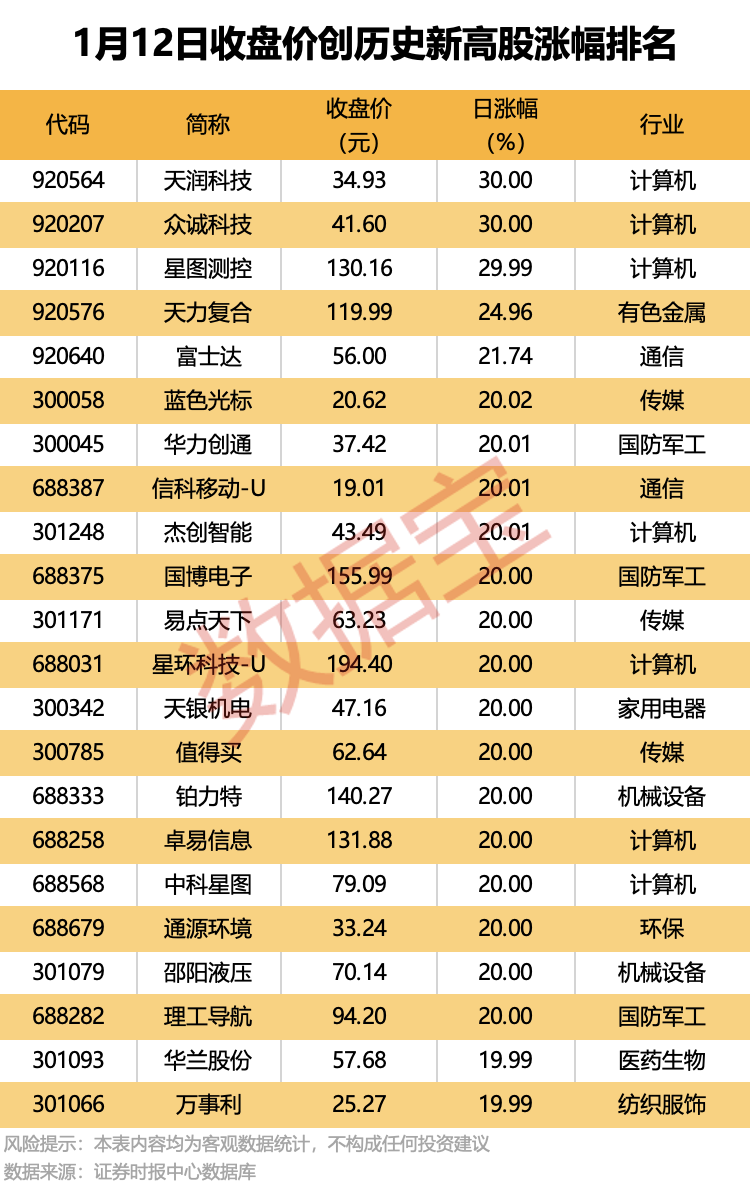
Market Overview - The A-share market saw all three major indices rise, with the Shanghai Composite Index closing at 4165.29 points, up 1.09%. The Shenzhen Component Index increased by 1.75%, and the ChiNext Index rose by 1.82%. The total market turnover reached 3.64 trillion yuan, an increase of over 490 billion yuan compared to the previous trading day, with more than 4100 stocks closing higher [1]. Historical Highs - A total of 185 stocks reached their historical closing highs today, excluding newly listed stocks from the past year. The defense, machinery, and electronics sectors had a significant concentration of stocks hitting new highs, with 28, 27, and 24 stocks respectively. The average price increase for these stocks was 9.28%, with notable gainers including Tianrun Technology, Zhongcheng Technology, and Xingtou Measurement Control, all hitting the daily limit [2]. Top Gainers - Key stocks that saw significant price increases include: - Tianrun Technology: 34.93 yuan, up 30.00% - Zhongcheng Technology: 41.60 yuan, up 30.00% - Xingtou Measurement Control: 130.16 yuan, up 29.99% - Tianli Composite: 119.99 yuan, up 24.96% - Fujida: 56.00 yuan, up 21.74% [3][4]. Institutional Activity - In the market, 20 stocks were net bought by institutions, with 22 stocks net sold. The top net buy was Shanzi Gaoke, with an amount of 484.2 million yuan, followed by Leike Defense at 235 million yuan. On the sell side, Kunlun Wanwei saw the highest net sell at 536 million yuan [5][6]. Northbound Capital - Northbound funds saw net purchases in 13 stocks, with Shanzi Gaoke leading at 532 million yuan. Other notable net buys included BlueFocus and Yanshan Technology, both exceeding 250 million yuan. Conversely, Kunlun Wanwei had the highest net sell at 250 million yuan, despite its stock hitting the daily limit [7][8]. Company Announcements - *ST Yanshi (600696)*: Expected to have an operating income of less than 300 million yuan in 2025, with both net profits before and after deductions being negative, leading to potential delisting [10]. - Honor Biologics signed a licensing agreement with AbbVie, potentially receiving up to 4.95 billion USD in milestone payments [10]. - BlueFocus reported that AI-driven revenue constitutes a small portion of its overall revenue [15].




荣昌达成重磅交易,国产创新药有望引领肿瘤免疫新时代
Orient Securities· 2026-01-14 13:12
Investment Rating - The report maintains a "Positive" outlook for the pharmaceutical and biotechnology industry in China [5] Core Insights - Domestic innovative drugs are expected to lead the tumor immunotherapy 2.0 era, with bispecific antibodies becoming a global focus and business development (BD) transaction volumes reaching new highs. The global value of Chinese innovative drugs is being rapidly uncovered [3][6] - A significant collaboration was established between Rongchang Biopharma and AbbVie, involving the PD-1/VEGF bispecific antibody (RC148), which includes a $650 million upfront payment and potential milestone payments of up to $4.95 billion, along with double-digit royalties on net sales outside Greater China. This partnership accelerates the internationalization of RC148 and highlights the potential of the tumor pipeline [6] - The report emphasizes the increasing interest from multinational pharmaceutical companies in domestic bispecific antibody drugs, indicating that these innovative drugs will be a key growth engine in the tumor immunotherapy 2.0 era [6] Summary by Sections Industry Overview - The pharmaceutical and biotechnology industry is positioned for growth, particularly in the area of innovative drugs and tumor immunotherapy [5] Investment Recommendations and Targets - Key investment targets include Rongchang Biopharma (688331), 3SBio (01530), 3SBio Guojian (688336), Innovent Biologics (01801), CanSino Biologics (09926), Kintor Pharmaceutical (06990), and Eucure Biopharma (09606), all of which are not rated yet [3] Recent Developments - The collaboration between Rongchang Biopharma and AbbVie is a pivotal event, marking a significant step in the global commercialization of innovative drugs [6]