Sunshine Guojian Pharmaceutical(688336)

Search documents
港股医药板块回暖复苏,恒生医药ETF(159892)涨近2%
Mei Ri Jing Ji Xin Wen· 2026-02-09 02:44
Group 1 - The Hong Kong stock market showed a strong opening on February 9, with the Hang Seng Index rising by 1.59%, the State-owned Enterprises Index increasing by 1.54%, and the Technology Index up by 1.9% [1] - The Hang Seng Biotechnology Index, focusing on innovative drugs, performed robustly, with the largest ETF tracking this index (159892) rising nearly 2% [1] - The innovative drug sector is expected to enter a profit realization acceleration phase by 2025, with companies like Innovent Biologics and Rongchang Biopharmaceuticals turning losses into profits, while companies like 3SBio are significantly increasing their performance [1] Group 2 - The strong performance of the innovative drug sector validates the effectiveness of the domestic innovative drug business model, with core product volume growth supported by medical insurance becoming the foundation for performance growth [1] - External collaborations, such as business development (BD) partnerships, are becoming important drivers for enhancing performance in the innovative drug sector [1] - The Hang Seng Medical ETF (159892) focuses on innovative drugs, CXO, and related industries, benefiting from the advantages of the Hong Kong Stock Exchange's 18A system, covering numerous innovative targets like BeiGene and Innovent Biologics, and is expected to continue its valuation recovery trend under catalysts like overseas expansion of innovative drugs and commercial insurance directories [1]

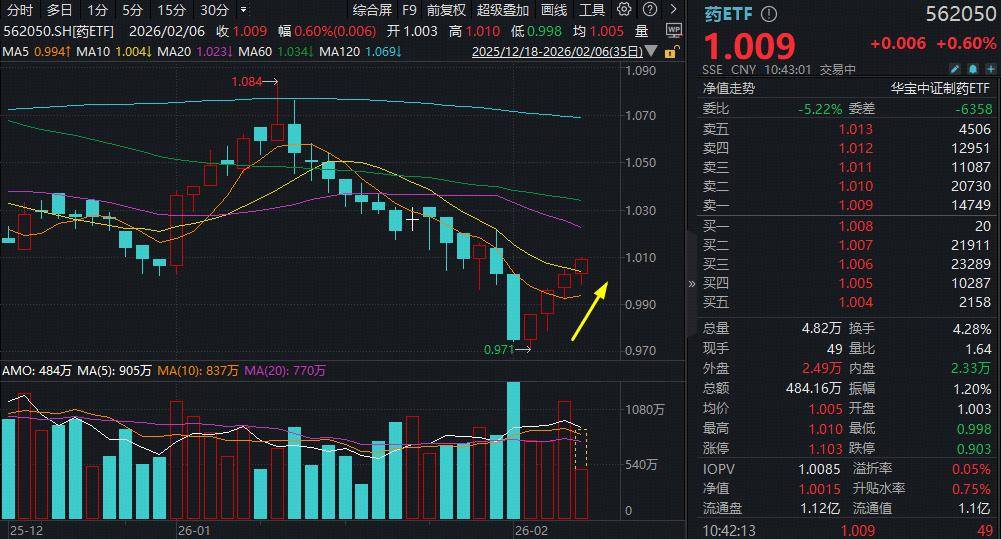
ETF盘中资讯|八部门重磅发文!中药工业迎五年黄金发展期,场内唯一药ETF(562050)冲击四连阳!
Sou Hu Cai Jing· 2026-02-06 04:34
Group 1 - The A-share market opened lower but saw the pharmaceutical sector rebound, with the only ETF tracking the pharmaceutical index recovering its 10-day moving average and aiming for a four-day winning streak [1] - The Ministry of Industry and Information Technology, along with eight other departments, issued a plan for the high-quality development of traditional Chinese medicine, outlining a development blueprint for 2026-2030 [2] - The report highlights a positive outlook for the pharmaceutical sector driven by policy support, cost improvements, and expectations for adjustments in the basic drug catalog [3] Group 2 - The report indicates that the raw material drug sector is favored, with innovative drug segments such as small nucleic acids, peptides, and ADC toxins driving continuous industry chain catalysts [3] - The pharmaceutical ETF (562050) covers 50 leading pharmaceutical companies, focusing on innovative drugs while also considering traditional Chinese medicine [5] - Notable stock performances include Xinhecheng rising over 7%, and Sanofi Guojian increasing by more than 5%, with traditional Chinese medicine stocks like Darentang and Yiling Pharmaceutical also seeing gains of over 4% [5]


三生国健:公司高度重视市场承受能力与投资者的建议
Zheng Quan Ri Bao· 2026-02-04 13:41
证券日报网讯 2月4日,三生国健在互动平台回答投资者提问时表示,公司会严格遵循交易所相关规 则,并高度重视市场承受能力与投资者的建议。 (文章来源:证券日报) ...
三生国健股价连续5天下跌累计跌幅6.83%,中银基金旗下1只基金持66.07万股,浮亏损失286.73万元
Xin Lang Cai Jing· 2026-02-03 07:15
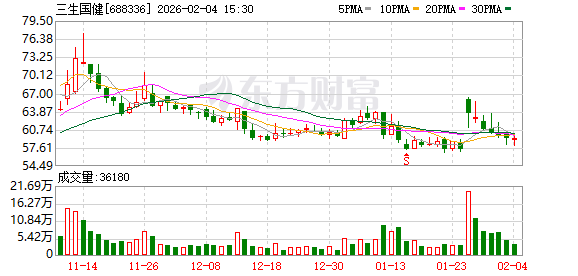
2月3日,三生国健跌0.52%,截至发稿,报59.19元/股,成交2.85亿元,换手率0.78%,总市值365.85亿 元。三生国健股价已经连续5天下跌,区间累计跌幅6.83%。 资料显示,三生国健药业(上海)股份有限公司位于中国(上海)自由贸易试验区李冰路399号,成立日期 2002年1月25日,上市日期2020年7月22日,公司主营业务涉及抗体药物的研发、生产及销售业务。主营 业务收入构成为:销售商品75.24%,提供委托加工服务15.37%,授权许可7.94%,租赁服务1.44%。 从基金十大重仓股角度 数据显示,中银基金旗下1只基金重仓三生国健。中银医疗保健混合A(005689)四季度增持1.39万股, 持有股数66.07万股,占基金净值比例为6.21%,位居第四大重仓股。根据测算,今日浮亏损失约20.48 万元。连续5天下跌期间浮亏损失286.73万元。 中银医疗保健混合A(005689)成立日期2018年6月13日,最新规模4.71亿。今年以来亏损1.25%,同类 排名8275/8874;近一年收益58.53%,同类排名1083/8124;成立以来收益224.03%。 中银医疗保健混合A(0056 ...
每周股票复盘:三生国健(688336)预计2025年净利29亿元
Sou Hu Cai Jing· 2026-01-31 19:20
Core Viewpoint - Sangfor Biopharma (三生国健) is expected to achieve significant revenue and profit growth in 2025, driven by a collaboration with Pfizer and the recognition of substantial income from a project authorization fee. Group 1: Stock Performance - As of January 30, 2026, Sangfor Biopharma's stock closed at 60.22 CNY, up 2.48% from the previous week [1] - The stock reached a weekly high of 66.28 CNY on January 27 and a low of 56.88 CNY on January 26 [1] - The company's current total market capitalization is 37.221 billion CNY, ranking 7th out of 51 in the biopharmaceutical sector and 562nd out of 5184 in the A-share market [1] Group 2: Earnings Forecast - Sangfor Biopharma forecasts a total revenue of approximately 4.2 billion CNY for the year 2025 [4] - The company anticipates a net profit attributable to shareholders of around 2.9 billion CNY for 2025 [3] - The expected net profit after deducting non-recurring gains and losses is projected to be about 2.8 billion CNY, reflecting a year-on-year growth of approximately 1,038.21% [5][7] Group 3: Revenue Drivers - The significant growth in earnings is primarily attributed to the collaboration with Pfizer, which includes a project authorization fee that will contribute approximately 2.89 billion CNY to revenue [5][7] - The projected revenue growth represents an increase of about 251.76% compared to the previous year [5]
重组蛋白板块领跌,下跌1.42%
Di Yi Cai Jing· 2026-01-28 01:59
重组蛋白板块领跌,下跌1.42%,其中百普赛斯下跌7.3%,近岸蛋白下跌2.81%,海特生物下跌2.16%, 三生国健跌超3%。(AI生成) ...


三生国健首付款到账盈利增22亿 五年投逾17亿研发丰富管线布局
Chang Jiang Shang Bao· 2026-01-28 00:29
长江商报消息 ●长江商报记者 潘瑞冬 科创板创新药企三生国健(688336.SH)业绩大涨。 1月26日晚间,三生国健发布2025年业绩预告,经财务部门初步测算,公司预计全年实现营业收入约42 亿元,较上年同期增加约30.06亿元,同比大幅增长251.76%;预计归母净利润约29亿元,较上年同期增 加约21.95亿元,同比增长311.35%;预计扣非净利润约28亿元,同比激增1038.21%。 三生国健称,2025年公司与辉瑞达成授权合作,已收到对方支付的授权许可首付款约28.9亿元,推动公 司业绩大涨。 在业绩公告发布后次日,即1月27日,三生国健股价大幅上涨,当天最大涨幅超15%,截至收盘报63.53 元/股,涨10.93%。 收到辉瑞首付款28.9亿 资料显示,三生国健专注于单抗、双抗、多抗及多功能重组蛋白等新技术研究。2020年7月,三生国健 在科创板上市。 进入2025年,公司业绩进一步爆发。根据业绩预告,公司预计2025年实现营业收入42亿元左右,较上年 同期增加30.06亿元,涨幅约251.76%;归母净利润29亿元左右,较上年同期增加21.95亿元,涨幅约 311.35%。 上市以来,随着产品 ...
太平洋医药日报:英矽智能ISM8969获FDA批准临床
Xin Lang Cai Jing· 2026-01-27 12:31
Market Performance - The pharmaceutical sector increased by +0.29% on January 26, 2025, outperforming the CSI 300 index by 0.19 percentage points, ranking 8th among 31 sub-industries in the Shenwan classification [1] - Among sub-industries, vaccines (+7.99%), in vitro diagnostics (+3.73%), and blood products (+3.47%) showed the best performance, while hospitals (-2.01%), medical R&D outsourcing (-1.36%), and offline pharmacies (-1.18%) lagged behind [1] - Top three individual stock gainers were Maike Biological (+20.03%), Cap Bio (+20.03%), and Zhijiang Biological (+20.01%), while the biggest losers were Weikang Pharmaceutical (-8.50%), Medisi (-7.28%), and Meinian Health (-6.08%) [1] Industry News - Recently, InSilico Medicine announced that its self-developed oral NLRP3 inhibitor ISM8969 has received IND approval from the FDA for the treatment of Parkinson's disease [2] - The upcoming Phase 1 clinical trial will assess the safety, tolerability, and pharmacokinetic characteristics of ISM8969 in healthy volunteers, aiming to determine the recommended dosage for subsequent studies [2] - ISM8969 is an innovative NLRP3 inhibitor with ideal blood-brain barrier penetration characteristics, targeting pathological inflammatory responses to support neuronal survival and function in neurodegenerative disease patients [2] - The drug candidate was discovered and optimized using InSilico Medicine's AI platform, Chemistry42 [2] Company News - Jiuan Medical (002432) expects to achieve a net profit attributable to shareholders of 2.02-2.35 billion yuan in 2025, representing a year-on-year growth of 21.05%-40.83%, with a non-recurring net profit forecast of 2.07-2.40 billion yuan, up 23.18%-42.81% [3] - Sanofi Guojian (688336) anticipates a revenue of 4.20 billion yuan in 2025, a significant year-on-year increase of 251.76%, with a net profit of 2.90 billion yuan, up 311.35%, and a non-recurring net profit of 2.80 billion yuan, reflecting a staggering growth of 1038.21% [3] - Dabo Medical (002901) forecasts a net profit of 580-610 million yuan in 2025, a growth of 62.55%-70.96%, with a non-recurring net profit of 455-485 million yuan, up 59.42%-69.93% [3] - Microchip Biotech (688321) expects a revenue of 910 million yuan in 2025, a year-on-year increase of 38.32%, with a net profit of 53 million yuan, marking a return to profitability, and a non-recurring net profit of 38 million yuan, also indicating a return to profitability compared to the previous year [3]



2025年报业绩预告开箱(二):半导体高歌猛进,化工靠涨价赚翻,天价授权照亮全年业绩
市值风云· 2026-01-27 10:09
Core Viewpoint - The report highlights the significant growth driven by technology in certain sectors, while also noting the substantial losses due to cyclical downturns in others [1] Performance Growth Highlights - **Zhongwei Company (688012)**: Expected net profit between 208 million to 218 million yuan, a year-on-year increase of 28.74% to 34.93%, driven by increased recognition of plasma etching equipment and a surge in market demand [5] - **Lianchuang Optoelectronics (600363)**: Expected net profit between 43.5 million to 53.2 million yuan, a year-on-year increase of 80.36% to 120.57%, attributed to significant growth in laser business and improved profitability in traditional sectors [6] - **Ruixin Microelectronics (603893)**: Expected net profit between 102.3 million to 110.3 million yuan, a year-on-year increase of 71.97% to 85.42%, driven by rapid growth in the AIoT market and recognition of new AI technology [7] - **Sangfor Health (688336)**: Expected net profit around 290 million yuan, a year-on-year increase of approximately 311.35%, due to a significant collaboration with Pfizer and advancements in clinical research [8] - **Pulite (002324)**: Expected net profit growth of 155.76% to 194.73%, driven by the demand for high polymer materials in the automotive lightweight trend [9] - **Tonghua Dongbao (600867)**: Expected net profit around 124.21 million yuan, turning from loss to profit, driven by market share gains in insulin products [10] - **Suotong Development (603612)**: Expected net profit between 73 million to 85 million yuan, a year-on-year increase of 167.98% to 212.03%, due to rising prices and demand in the prebaked anode industry [11] Major Performance Declines - **China Shipbuilding Technology (600072)**: Expected net loss between -260 million to -340 million yuan, a year-on-year decline of over 24 times, due to cyclical downturns in shipbuilding and high material costs [12] - **Silver Nonferrous Metals (601212)**: Expected net loss between -45 million to -67.5 million yuan, transitioning from profit to loss due to legal disputes affecting financial performance [13] - **China Metallurgical Group (601618)**: Expected net profit between 130 million to 160 million yuan, a year-on-year decline of 76.28% to 80.73%, impacted by the downturn in the construction industry [14] - **Jindi Group (600383)**: Expected net loss between -1.11 billion to -1.35 billion yuan, with increased losses due to declining sales and inventory impairments [15] - **Jianfa Co. (600153)**: Expected net loss between -1 billion to -520 million yuan, transitioning from profit to loss due to increased impairments in real estate [16] Industry Trend Analysis - **Technology and Innovation-Driven Sectors**: Companies in semiconductor equipment, laser military applications, and innovative pharmaceuticals are experiencing rapid growth due to high demand in AIoT, national defense, and biomedicine [23] - **Traditional Cyclical Industries**: Sectors like coal and engineering machinery are facing significant adjustments due to demand shortages and price declines, leading to widespread performance pressures [24] - **Pharmaceutical Industry Disparities**: Innovative drugs are seeing explosive growth through external licensing, while traditional formulations and raw materials are significantly impacted by procurement policies [24] - **External Environment Uncertainties**: Factors such as international trade tensions and regulatory changes are significantly affecting corporate performance, necessitating enhanced risk management [24] - **Asset Quality Risks**: Many companies are reporting substantial asset impairment provisions, indicating potential inefficiencies in previous investments [24]




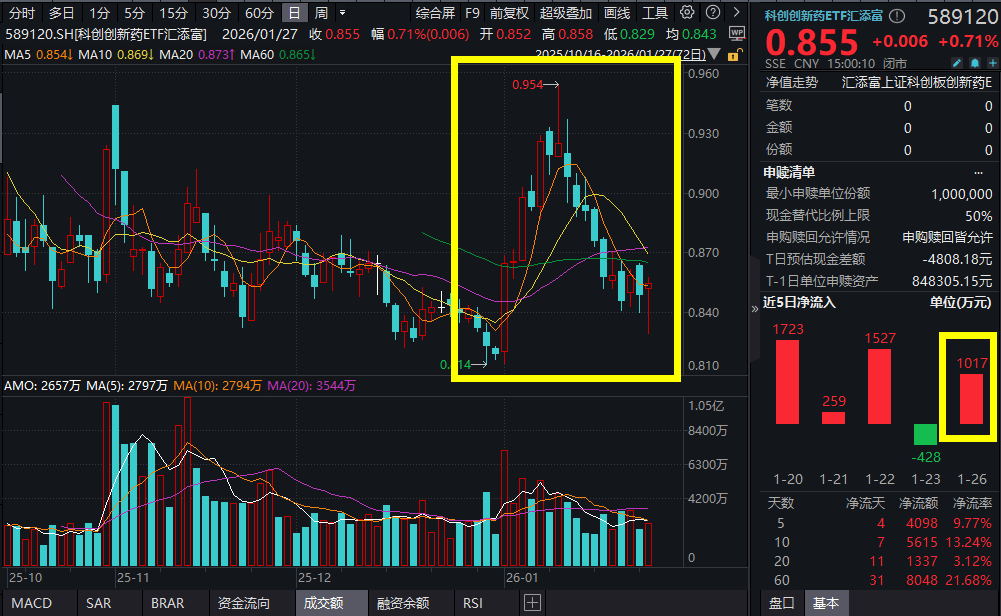
科创创新药反弹,三生国健涨超10%,25年净利或高增超310%!科创创新药ETF汇添富(589120)近5日吸金超4000万元!全球创新药新一轮周期开始?
Sou Hu Cai Jing· 2026-01-27 10:01
Core Viewpoint - The A-share market is experiencing a rebound, particularly in the innovative pharmaceutical sector, with significant capital inflow into the ETF focused on innovative drugs, indicating strong investor confidence in this segment [1][5]. Group 1: Market Performance - The A-share market showed a positive trend on January 27, with the Shanghai Composite Index fluctuating upwards, closing with a gain [1]. - The ETF for innovative drugs, Huatai-PineBridge (589120), saw a 0.71% increase in the afternoon session, attracting over 40 million yuan in capital over the past five days [1]. Group 2: Stock Performance - The majority of the index component stocks for the innovative drug ETF experienced gains, with notable performances from companies such as Sanofi (10.93% increase) and Junshi Biosciences (nearly 8% increase) [2][3]. - The top ten component stocks of the ETF include companies like BeiGene and I-Mab, with varying weightings and performance metrics [4]. Group 3: Industry Outlook - The innovative pharmaceutical sector is witnessing a recovery in performance, with over 50 companies expected to report profits for 2025, driven by improved industry conditions and favorable policies [5]. - As of January 26, more than 90 A-share innovative and biopharmaceutical companies have disclosed their 2025 earnings forecasts, with 53 companies expected to be profitable [5]. Group 4: Strategic Developments - Significant collaborations, such as the partnership between Sanofi and Pfizer, are contributing to substantial revenue growth, with Sanofi projecting a net profit of 2.9 billion yuan for 2025, marking a 311.35% increase year-on-year [5]. - The innovative drug sector is entering a phase of capital influx, research iteration, and value realization, indicating a positive cycle for the industry [8]. Group 5: Global Competitiveness - The Chinese innovative drug sector is becoming increasingly competitive on a global scale, with a record-breaking outbound transaction volume exceeding 135 billion USD in 2025 [7]. - China is expected to play a leading role in the next cycle of global innovation in pharmaceuticals, with a focus on areas such as PD-1 dual antibodies and antibody-drug conjugates [8].