
Sunshine Guojian Pharmaceutical(688336)

Search documents
三生国健(688336) - 三生国健:关于2024年限制性股票激励计划首次授予部分第一个归属期归属结果公告
2026-01-16 10:03
证券代码:688336 证券简称:三生国健 公告编号:2026-001 三生国健药业(上海)股份有限公司 关于 2024 年限制性股票激励计划首次授予部分 第一个归属期归属结果公告 本公司董事会及全体董事保证本公告内容不存在任何虚假记载、误导性陈述 或者重大遗漏,并对其内容的真实性、准确性和完整性依法承担法律责任。 重要内容提示: 根据中国证监会、上海证券交易所、中国证券登记结算有限责任 公司上海分公司有关业务规则的规定,三生国健药业(上海)股份有 限公司(以下简称"公司")于 2026 年 1 月 16 日收到中国证券登记 结算有限责任公司上海分公司出具的《证券变更登记证明》,公司于 2026 年 1 月 15 日完成了 2024 年限制性股票激励计划(以下简称"本 激励计划")首次授予部分第一个归属期的股份登记工作。现将有关 情况公告如下: 一、本次限制性股票归属的决策程序及相关信息披露 (1)2024 年 6 月 5 日,公司召开第四届董事会第二十四次会议、 第四届监事会第十八次会议,会议审议通过了《关于公司<2024 年限 制性股票激励计划(草案)>及其摘要的议案》等相关议案。公司监 事会对本激励计划 ...

三生国健股价涨5.07%,泰信基金旗下1只基金重仓,持有10万股浮盈赚取30.3万元
Xin Lang Cai Jing· 2026-01-13 03:30
Group 1 - The core viewpoint of the news is that Sanofi Guojian's stock price increased by 5.07%, reaching 62.84 CNY per share, with a trading volume of 248 million CNY and a turnover rate of 0.65%, resulting in a total market capitalization of 38.759 billion CNY [1] - Sanofi Guojian Pharmaceutical (Shanghai) Co., Ltd. is located in the China (Shanghai) Free Trade Zone and was established on January 25, 2002, with its listing date on July 22, 2020. The company's main business involves the research, production, and sales of antibody drugs [1] - The revenue composition of Sanofi Guojian includes 75.24% from product sales, 15.37% from commissioned processing services, 7.94% from licensing services, and 1.44% from leasing services [1] Group 2 - From the perspective of fund holdings, one fund under Taixin Fund has a significant position in Sanofi Guojian. The Taixin Medical Service Mixed Fund A (013072) reduced its holdings by 114,800 shares in the third quarter, holding 100,000 shares, which accounts for 4.51% of the fund's net value, ranking as the eighth largest holding [2] - The Taixin Medical Service Mixed Fund A (013072) was established on December 29, 2021, with a latest scale of 19.9853 million CNY. Year-to-date returns are 8.65%, ranking 1331 out of 8836 in its category; the one-year return is 35.53%, ranking 3965 out of 8091; and since inception, the return is 18.21% [2] - The fund manager of Taixin Medical Service Mixed Fund A (013072) is Chen Ying, who has been in the position for 3 years and 363 days, with a total asset scale of 540 million CNY. The best fund return during the tenure is 23.53%, while the worst return is -6.33% [3]
生物制品板块1月12日跌0.06%,三生国健领跌,主力资金净流出2.4亿元
Zheng Xing Xing Ye Ri Bao· 2026-01-12 09:05
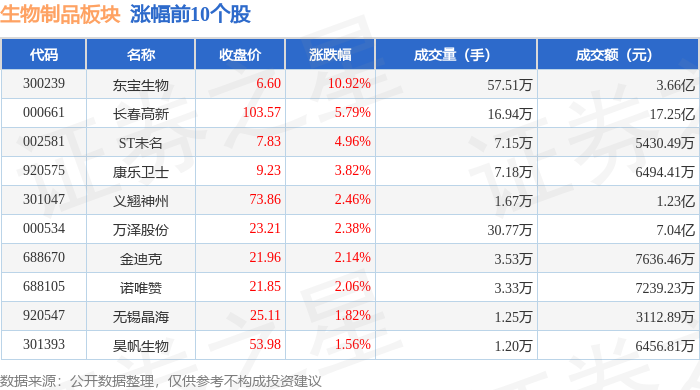
Market Overview - The biopharmaceutical sector experienced a slight decline of 0.06% on January 12, with Sanofi leading the drop [1] - The Shanghai Composite Index closed at 4165.29, up 1.09%, while the Shenzhen Component Index closed at 14366.91, up 1.75% [1] Stock Performance - Notable gainers in the biopharmaceutical sector included: - Dongbao Biological (300239) with a closing price of 6.60, up 10.92% and a trading volume of 575,100 shares, totaling 366 million yuan [1] - Changchun High-tech (000661) closed at 103.57, up 5.79%, with a trading volume of 169,400 shares, totaling 1.725 billion yuan [1] - ST Weiming (002581) closed at 7.83, up 4.96%, with a trading volume of 71,500 shares, totaling 54.3049 million yuan [1] - Conversely, significant decliners included: - Sanofi (688336) closed at 59.81, down 6.25%, with a trading volume of 93,200 shares, totaling 560 million yuan [2] - Teva Biopharma (688278) closed at 76.96, down 4.50%, with a trading volume of 41,600 shares, totaling 323 million yuan [2] - Aidi Pharmaceutical (688488) closed at 16.90, down 4.41%, with a trading volume of 98,600 shares, totaling 168 million yuan [2] Capital Flow - The biopharmaceutical sector saw a net outflow of 240 million yuan from institutional investors, while retail investors contributed a net inflow of 272 million yuan [2] - Key stocks with significant capital flow included: - Changchun High-tech (000661) had a net inflow of 122 million yuan from institutional investors, while retail investors saw a net outflow of 77.57 million yuan [3] - Dongbao Biological (300239) experienced a net inflow of 22.51 million yuan from institutional investors, with retail investors also seeing a net outflow of 10.81 million yuan [3] - Sanofi (688336) had a net inflow of 21.21 million yuan from institutional investors, while retail investors had a net inflow of 28.87 million yuan [3]


生物制品板块1月6日涨0.55%,辽宁成大领涨,主力资金净流出4.26亿元
Zheng Xing Xing Ye Ri Bao· 2026-01-06 09:00
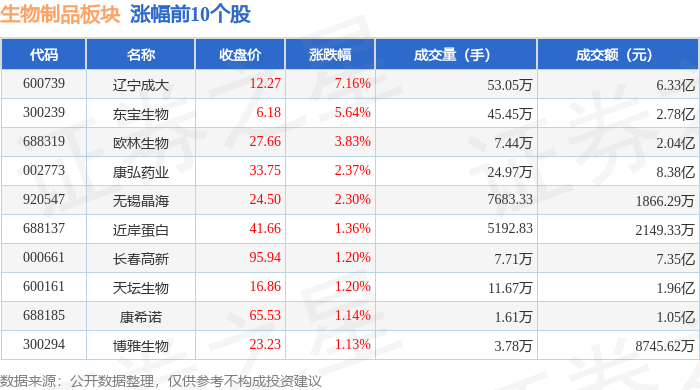
Market Performance - The biopharmaceutical sector increased by 0.55% on January 6, with Liaoning Chengda leading the gains [1] - The Shanghai Composite Index closed at 4083.67, up by 1.5%, while the Shenzhen Component Index closed at 14022.55, up by 1.4% [1] Individual Stock Performance - Liaoning Chengda (600739) closed at 12.27, with a rise of 7.16% and a trading volume of 530,500 shares, amounting to a transaction value of 633 million yuan [1] - Dongbao Biological (300239) closed at 6.18, up by 5.64%, with a trading volume of 454,500 shares and a transaction value of 278 million yuan [1] - Olin Biological (616889) closed at 27.66, increasing by 3.83%, with a trading volume of 74,400 shares and a transaction value of 204 million yuan [1] - Kanghong Pharmaceutical (002773) closed at 33.75, up by 2.37%, with a trading volume of 249,700 shares and a transaction value of 838 million yuan [1] Capital Flow Analysis - The biopharmaceutical sector experienced a net outflow of 426 million yuan from institutional investors, while retail investors saw a net inflow of 323 million yuan [2] - The net inflow from speculative funds was 104 million yuan [2] Detailed Capital Flow for Selected Stocks - Liaoning Chengda had a net inflow of 34.37 million yuan from institutional investors, while it faced a net outflow of 18.32 million yuan from retail investors [3] - Dongbao Biological saw a net inflow of 21.29 million yuan from institutional investors, with a net outflow of 13.16 million yuan from retail investors [3] - Tian Tan Biological (600161) had a net inflow of 18.06 million yuan from institutional investors, with a net outflow of 10.02 million yuan from retail investors [3]



医药行业2026年度策略报告:产业趋势明确,创新药产业链是2026年医药板块主线-20251229
HUAXI Securities· 2025-12-29 12:01
Group 1 - The core investment theme for the pharmaceutical sector in 2026 is the innovation drug industry chain, with a clear trend towards international business development and accelerated commercialization of domestic products [2][3]. - The CXO sector is experiencing continuous improvement in performance and orders, supported by favorable financing conditions that benefit the industry's upward trajectory [3]. - The medical device sector is focusing on two main lines: international expansion and innovation [3]. Group 2 - The latest trends in medical insurance show a decline in total expenditure for the first ten months of 2025, amounting to 1,903.6 billion yuan, a year-on-year decrease of 1% [5][7]. - The total income of the medical insurance fund for the same period reached 2,352 billion yuan, with a year-on-year growth of 2%, indicating a slowdown in income growth [7][11]. - The number of medical insurance beneficiaries and hospitalization cases continues to grow, with 6.07 billion total beneficiaries in 2024, a year-on-year increase of 18% [11]. Group 3 - The average medical insurance cost per visit decreased in 2024, with the average cost for employees at 629 yuan (down 10%) and for residents at 351 yuan (down 12%) [15]. - The average hospitalization cost also saw a decline, with employees averaging 11,707 yuan (down 3.8%) and residents at 7,408 yuan (down 3.5%) [15]. Group 4 - The Chinese pharmaceutical industry is witnessing a significant increase in license-out transactions, with over 100 deals completed in 2025, totaling more than 110 billion USD [21][32]. - The number of license-out transactions involving upfront payments exceeding 100 million USD has also risen, indicating a growing interest from global pharmaceutical companies in Chinese innovations [21][32]. - The ADC (Antibody-Drug Conjugate) market is expanding rapidly, with a projected market size exceeding 16 billion USD in 2025, driven by several successful product launches [38]. Group 5 - The Chinese government is actively supporting the innovation drug sector through various policies aimed at enhancing accessibility and encouraging high-quality innovation [16][18]. - The proportion of medical insurance spending on innovative drugs is steadily increasing, with 149 innovative drugs included in the insurance coverage over the past seven years [90][94]. - The average price reduction for innovative drugs during negotiations with the national medical insurance has been around 60%, with some drugs seeing reductions as high as 94% [88][94].


年末换帅潮起!多家上市药企12月密集调整核心管理层
Zhong Guo Jing Ji Wang· 2025-12-29 09:15
Group 1 - In December, several leading pharmaceutical companies experienced significant executive changes, including Guoyao Holdings, BeiGene, and Zhendong Pharmaceutical [1][2] - Kexin Pharmaceutical announced the election of Li Hongfu as the chairman of its fourth board of directors on December 1 [1] - Kang En Bei reported that Jiang Yi resigned from multiple positions, including chairman, on December 6 due to work adjustments [1] Group 2 - WuXi AppTec appointed Tian Feng as the CEO and executive director, effective December 29, 2025 [2] - Alibaba Health announced the resignation of Zhu Shunyan as non-executive director and chairman, with current CEO Shen Difan taking over as chairman [2] - Sangfor Technologies reported the resignation of core technical personnel, Weng Zhibing, from all positions in its wholly-owned subsidiary on December 16 [2] Group 3 - Zhendong Pharmaceutical announced that Yang Lianmin resigned from his positions due to reaching retirement age on December 18 [2] - BeiGene appointed Dr. Wang Lai as president and global head of R&D, effective December 19 [2] - Guoyao Holdings announced Jin Bin as the new chairman on December 19, following the resignation of Zhao Bingxiang [2] Group 4 - Shijiazhuang Pharmaceutical Group reported that Zhang Cuilong stepped down from multiple roles, while Cai Lei was appointed as vice chairman and CEO on December 19 [3] - Weichuang Bio announced the appointment of Li Jianxun as general manager, while Chairman Lu Xianping stepped down from the general manager role on December 23 [3] - Shandong Pharmaceutical Glass reported that Chairman Hu Yonggang resigned from all positions due to age, with General Manager Zhang Jun taking over the chairman's responsibilities on December 24 [3]


未来智造局 | 国产AI芯片加速追赶 为算力经济注入“中国芯”
Xin Hua Cai Jing· 2025-12-26 15:38
Core Insights - The domestic GPU industry is poised for historic development opportunities by 2025, driven by technological breakthroughs and a growing ecosystem, reflecting strong market recognition of domestic "hard technology" [1][2] - The rapid development of domestic GPUs not only supports cutting-edge industries like artificial intelligence but also enhances supply chain security, contributing to high-quality economic development [1] Industry Development - The demand for computing power has surged due to the global rise of AI models, with China accelerating the construction of robust computing infrastructure [2] - By 2025, major tech companies in China, including Alibaba, Tencent, and ByteDance, are expected to invest approximately 450 billion yuan in AI computing power, with 30% allocated for domestic chip validation and adaptation [2] - The domestic GPU industry is transitioning from technological exploration to commercialization and scaling, with leading companies innovating architectures and integrating ecosystems to catch up with international giants [2][3] Technological Innovations - Domestic GPU manufacturers are striving to capture market share through technological innovation and differentiation strategies, with some companies achieving significant breakthroughs [3] - The introduction of supernodes as core computing units in intelligent computing centers is a key focus, with Huawei showcasing its Ascend 384 supernode, achieving a total computing power of 300 PFLOPS, surpassing international competitors [3] Market Dynamics - The emergence of open-source domestic models like DeepSeek is driving explosive growth in AI applications, with future demand for inference computing power expected to be significantly higher than training power [4] - The domestic GPU sector faces challenges in general computing and high-performance scenarios due to technological gaps and ecological barriers, particularly in comparison to NVIDIA's established CUDA ecosystem [5] Ecosystem Development - To address ecological shortcomings, domestic companies are exploring paths such as chiplet technology, collaboration with model manufacturers, and enhancing software ecosystems [5][6] - Strategic collaborations among companies like Wallen Technology, Jiyue Star, and Shanghai Yidian Smart Computing aim to create a comprehensive ecosystem for domestic chips, models, and computing power [6] Capital Market Trends - The domestic GPU industry is experiencing a notable IPO boom, with significant fundraising activities, including the record-setting IPO of Moore Threads on the STAR Market [7][8] - The market's enthusiasm for domestic AI chip companies is fueled by high valuations of international competitors like NVIDIA and AMD, alongside the successful turnaround of companies like Cambricon [8] - Analysts highlight that the accelerated IPO processes reflect strong market recognition of the domestic GPU sector, with funds raised primarily aimed at R&D and ecosystem development [8]

科学家创业9年,烧钱8亿,零产品收入!如今遭老东家专利狙击
Mei Ri Jing Ji Xin Wen· 2025-12-23 09:49
Core Viewpoint - The IPO application of Maijizhi Biotechnology has not yet entered the hearing stage, raising concerns about the company's ability to successfully list and develop its core product MG-K10, an IL-4Rα antibody, amidst intense competition and patent disputes [1][2][6]. Company Overview - Maijizhi Biotechnology, founded in 2016, focuses on clinical-stage biopharmaceuticals for allergic and autoimmune diseases, with a pipeline of eight innovative candidates, the most advanced being MG-K10 [2][3]. - MG-K10 targets multiple indications, including atopic dermatitis and asthma, and is positioned as a long-acting differentiated product [2][3]. Market Context - The global market for atopic dermatitis drugs is projected to grow from $14.2 billion in 2023 to $29.1 billion by 2032, with the Chinese market expected to increase from 8.4 billion RMB to 46.4 billion RMB [3]. - The IL-4Rα antibody market is highly competitive, with several companies, including Sanofi and Regeneron, already having approved products [3][4]. Product Development and Challenges - MG-K10's application for market approval was accepted by the NMPA on October 30, 2023, but the company has expressed uncertainty about its ability to successfully develop and commercialize the product [5][6]. - The company faces significant competition from other IL-4Rα antibodies that are either already approved or in late-stage clinical trials [3][4]. Financial Situation - Since its inception, Maijizhi has operated at a loss, with cumulative losses exceeding 800 million RMB as of March 2025, and minimal revenue generated from research services [11][12]. - The company has a cash flow crisis, with only 70.8 million RMB in cash as of March 31, 2025, while the estimated cost to complete clinical trials for MG-K10 is between 500 million to 600 million RMB [12]. Patent Issues - Maijizhi is embroiled in patent disputes with its former parent company, Sangfor Biopharma, which has filed for the invalidation of a key patent related to MG-K10 [9][10]. - The stability of the core patent is crucial for the commercial value of MG-K10, and any adverse ruling could significantly impact its market prospects [10]. Investment and Financing - The company has raised over 700 million RMB through multiple financing rounds since its establishment, with a post-money valuation increasing nearly 45 times over eight years [13]. - However, the financial structure is concerning, with a debt-to-asset ratio exceeding 100% for several years, indicating a substantial risk of insolvency [13]. Shareholder Agreements - Investors have the right to require the company or its founders to repurchase shares at principal plus 12% interest if the company fails to go public by December 31, 2025, with the deadline extended to December 31, 2026, after the IPO application [14].

科学家创业9年,烧钱8亿元,零产品收入!如今遭老东家专利狙击,公司自曝:“核心产品或无法成功上市”!对赌上市倒计时1年
Mei Ri Jing Ji Xin Wen· 2025-12-23 08:40
Core Viewpoint - The IPO application of Maijizhi Biotechnology has not yet entered the hearing stage, increasing the likelihood of failure in its listing attempt, despite the acceptance of its core product MG-K10's application by the NMPA [1][6]. Company Overview - Maijizhi Biotechnology, established in 2016, focuses on clinical-stage biopharmaceuticals for allergic and autoimmune diseases, with a pipeline of eight innovative candidates, the most advanced being the long-acting anti-IL-4Rα antibody MG-K10 [2][3]. Product Development - MG-K10 targets the IL-4Rα pathway, which has significant commercial potential, as evidenced by Sanofi's Dupilumab, projected to generate $14.2 billion in sales by 2024. MG-K10 is the only long-acting anti-IL-4Rα candidate validated through Phase III clinical trials as of July 2025 [3][5]. - The global market for atopic dermatitis drugs is expected to grow from $14.2 billion in 2023 to $29.1 billion by 2032, with the Chinese market projected to increase from 8.4 billion RMB to 46.4 billion RMB [5]. Competitive Landscape - The IL-4Rα market in China is highly competitive, with several companies, including Sanofi and CanSino, already having approved products. Multiple candidates are also in Phase III trials, indicating a crowded market upon MG-K10's potential launch [5][6]. Financial Status - Since its inception, Maijizhi has operated at a loss, with cumulative losses exceeding 800 million RMB. The company reported revenues of only 8.72 million RMB, 24,000 RMB, and 0 RMB for 2023 and the first quarter of 2025, respectively [11][12]. - As of March 31, 2025, the company had only 70.78 million RMB in cash, while estimates suggest that completing the global Phase III trials for MG-K10 could require 500 to 600 million RMB [11]. Intellectual Property Challenges - Maijizhi faces significant intellectual property challenges, including ongoing patent disputes with its former parent company, 3SBio. The company has been involved in two patent disputes regarding the IL-4Rα target, which could impact the commercial viability of MG-K10 [9][10]. - The stability of core patents is crucial for the commercial value of MG-K10, as any invalidation could pose substantial risks to its market exclusivity [10]. Investment and Financing - The company has raised over 700 million RMB through multiple financing rounds since its establishment, with a post-money valuation increasing nearly 45 times over eight years [12]. - However, the financial structure is concerning, with a debt-to-asset ratio exceeding 100% for several years, indicating a precarious financial position [12]. Future Obligations - Investors have stipulated that if Maijizhi does not complete a qualified IPO or merger by December 31, 2025, they have the right to require the company or its founders to repurchase shares at principal plus 12% interest, adding pressure to meet listing deadlines [13].


中国银河证券:自免疾病蓝海市场 新靶点新机制推动行业快速发展
智通财经网· 2025-12-18 03:41
Group 1 - The autoimmune disease market is a blue ocean, with new targets and mechanisms driving rapid industry development. The global autoimmune market reached $132.3 billion in 2022 and is expected to grow to $176.7 billion by 2030, with a CAGR of 3.68% [2][3] - The drug development paradigm is shifting from broad-spectrum anti-inflammatory treatments to precision regulation, with significant room for improvement in efficacy and safety of existing drugs [2][3] Group 2 - Psoriasis affects approximately 125 million patients globally, with a focus on large molecule antibody drugs and a surge in small molecule oral TYK2 inhibitors that may replace existing treatments [3] - Atopic dermatitis impacts over 204 million people worldwide, with Dupilumab achieving sales exceeding $12.9 billion in the first three quarters of 2025, and new oral drugs like STAT6PROTAC showing superior efficacy [3] - The clinical demand for autoimmune diseases remains largely unmet, with domestic companies actively innovating in drug development, focusing on target innovation and expanding indications [4] Group 3 - Companies to watch include: 1. **Xiansheng Pharmaceutical**: Focused on differentiated targets with potential candidates like SIM0278, SIM0709, and SIM0711 [4] 2. **Kangnuo Pharmaceutical**: Rapidly increasing sales of Dupilumab, with peak sales expected to reach 5 billion yuan; CM512 shows promise as a leading TSLPxIL-13 dual antibody [4] 3. **Quansheng Biotechnology**: QX013N targets c-kit for CSU treatment, with additional dual antibody projects expected to submit IND applications between 2025 and 2026 [4] 4. **Yifang Biotechnology**: D-2570 (TYK2 inhibitor) is in Phase II clinical trials for UC, with promising Phase II data for psoriasis [4] 5. **Sanofi Genzyme**: Rapidly advancing IL-5 monoclonal antibody for asthma, with NDA submission expected by 2027 [4]

