Guangdong Lyric Robot Automation (688499)

Search documents
固态电池概念股集体上涨,金龙羽涨停
Cai Jing Wang· 2026-01-06 02:12
Group 1 - The solid-state battery concept has seen a significant surge, with Jinlongyu hitting the daily limit up, and other companies like Aotewei rising over 10% [1] - Other companies in the sector, including Zhenhua Co., Binhai Energy, Naconor, Zhongwei Co., and Liyuanheng, also experienced gains [1] - Donut Lab, a Finnish electric mobility technology company, announced the launch of the world's first commercially viable solid-state battery at the 2026 CES, emphasizing that it is now ready for production [1]



全球首款可量产全固态电池问世,商用提速背景下设备环节确定性强
Xuan Gu Bao· 2026-01-05 15:16
Industry Overview - Donut Lab has launched the world's first commercially viable all-solid-state battery, set to be showcased at CES 2026, with advantages in energy density, charging speed, cycle life, and extreme environmental adaptability, potentially transforming the electric vehicle industry [1] - The solid-state battery industry is at a critical juncture, transitioning from laboratory research to engineering validation, with a current market dominated by semi-solid-state batteries, which account for over 95% of the market [1] - Full solid-state batteries are expected to achieve small-scale vehicle validation by around 2027 and aim for mass production by 2030 [1] Market Potential - According to招商证券, the solid-state battery sector is moving from experimental validation to pilot delivery, with significant market opportunities anticipated [2] - The market for solid-state battery equipment is projected to reach 59.216 billion yuan by 2030, with a compound annual growth rate (CAGR) of 103% from 2024 to 2030 [2] Company Developments - XianDao Intelligent has developed a complete line solution for solid-state batteries, covering key equipment across various stages, and has entered the supply chains of leading battery manufacturers and automotive companies in Europe, the US, Japan, South Korea, and China [3] - LiYuanHeng has established technological reserves and layouts in the solid-state battery equipment sector, focusing on technology development and solution optimization based on core customer needs [3]


利元亨(688499) - 广东利元亨智能装备股份有限公司关于以集中竞价交易方式回购公司股份的进展公告
2026-01-05 10:17
证券代码:688499 证券简称:利元亨 公告编号:2026-001 广东利元亨智能装备股份有限公司 关于以集中竞价交易方式回购公司股份的进展公告 本公司董事会及全体董事保证本公告内容不存在任何虚假记载、误导性陈述 或者重大遗漏,并对其内容的真实性、准确性和完整性承担法律责任。 二、回购股份的进展情况 根据《上市公司股份回购规则》《上海证券交易所上市公司自律监管指引第 7 号——回购股份》等相关规定,公司在回购股份期间,应当在每个月的前 3 个交 易日内公告截至上月末的回购进展情况。现将公司回购股份进展情况公告如下: 截至 2025 年 12 月 31 日,公司通过上海证券交易所交易系统以集中竞价交易 方式累计回购公司股份 1,413,421 股,占公司总股本的比例为 0.8377%,回购成交 的最高价为 28.50 元/股,最低价为 21.97 元/股,支付的资金总额为人民币 38,585,686.77 元(不含印花税、交易佣金等交易费用)。 本次回购股份符合相关法律法规的规定及公司回购股份方案的要求。 三、其他事项 公司将严格按照《上市公司股份回购规则》《上海证券交易所上市公司自律监 管指引第 7 号—— ...
利元亨:已累计斥资3858.57万元回购0.84%股份
Xin Lang Cai Jing· 2026-01-05 10:06
Core Viewpoint - The company announced a share repurchase plan to enhance employee stock ownership and equity incentives, with a budget of 30 million to 40 million yuan and a maximum repurchase price of 36.60 yuan per share [1] Group 1: Share Repurchase Plan - The company plans to repurchase shares on February 27, 2025, with a budget of 30 million to 40 million yuan [1] - The maximum repurchase price is set at 36.60 yuan per share, and the repurchase period is 12 months [1] Group 2: Repurchase Execution - As of December 31, 2025, the company has repurchased a total of 1,413,421 shares, which accounts for 0.8377% of the total share capital [1] - The total funds used for the repurchase amount to 38.5857 million yuan, with individual repurchase prices ranging from 21.97 yuan to 28.50 yuan per share [1]
电池产业链持续走高,天际股份盘中涨停
Bei Ke Cai Jing· 2026-01-05 07:17
Group 1 - The battery industry chain is experiencing a significant rise, with Tianji Co., Ltd. hitting the daily limit increase [1] - Huasheng Lithium Battery saw an increase of over 9% during trading [1] - Other companies such as Haike New Energy, Shida Shenghua, and Liyuanheng also experienced gains [1]


引爆全场!电池产业链逆势飙升,天际股份封板,政策护航+供需改善开启价值重估窗口
Jin Rong Jie· 2026-01-05 07:08
Core Insights - The A-share battery industry chain is experiencing a significant upward trend, with key stocks showing strong performance and notable profit effects. Tianji Co., a core industry player, has reached a strong limit up, serving as a sentiment indicator for the sector [1] - The battery industry is set to benefit from multiple favorable policies and demand surges, particularly with the implementation of carbon footprint reporting for automotive power batteries by the Ministry of Industry and Information Technology [1][2] - The global demand for both power and energy storage batteries is expected to explode in 2026, with significant growth in the electric vehicle market and energy storage sector, providing robust support for the industry [2] Industry Developments - The Ministry of Industry and Information Technology has initiated carbon footprint reporting for automotive power batteries, aiming to establish a comprehensive management system by the end of 2026. This policy is expected to accelerate the green transition of the battery industry, benefiting leading companies with low emissions [1] - Global sales of new energy vehicles are projected to reach 24.5 million units in 2026, a 20% increase year-on-year, with China accounting for 18.6 million units. This growth will sustain a 20% increase in demand for power batteries [2] - The energy storage sector is anticipated to see a 50% year-on-year increase in global cell shipments, reaching 890 GWh in 2026, with China contributing 845 GWh [2] Supply and Demand Dynamics - The supply-demand balance for upstream raw materials, particularly lithium carbonate, is expected to shift from surplus to tight balance by 2026, with price fluctuations projected between 80,000 to 120,000 yuan per ton [2] - Increased consumption of new energy vehicles and significant growth in energy storage installations are driving strong support for upstream raw materials, enhancing the overall industry outlook [2] - The battery industry's improved outlook will positively impact upstream raw materials, midstream key materials, and downstream applications and equipment sectors [3] Key Material and Equipment Sectors - The demand for key materials in the battery midstream sector, including cathodes, anodes, electrolytes, and separators, is expected to rise in tandem with the growth in battery demand [3] - The expansion of battery production capacity and technological advancements will drive demand for production equipment, particularly high-end intelligent manufacturing equipment [3] - The enhanced outlook for the battery industry will also stimulate growth in downstream applications, including new energy vehicles and energy storage systems, with significant increases in global shipments expected [3]
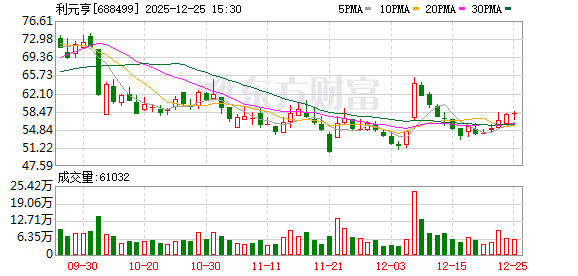
利元亨涨2.07%,成交额2.05亿元,主力资金净流出3335.50元
Xin Lang Cai Jing· 2025-12-30 05:47
Group 1 - The core viewpoint of the news is that Liyuanheng's stock has shown significant growth this year, with a year-to-date increase of 161.78% and a recent uptick in trading activity [1][2] - As of December 30, Liyuanheng's stock price reached 58.56 yuan per share, with a total market capitalization of 9.881 billion yuan [1] - The company has experienced a net outflow of main funds amounting to 3.3355 million yuan, while large orders showed mixed buying and selling activity [1] Group 2 - Liyuanheng, established on November 19, 2014, specializes in the research, production, and sales of intelligent manufacturing equipment, primarily serving industries such as lithium batteries and automotive components [2] - The company's revenue composition includes 80.56% from lithium battery manufacturing equipment, 12.23% from value-added parts and services, and smaller percentages from other sectors [2] - As of September 30, 2025, Liyuanheng reported a revenue of 2.424 billion yuan, reflecting a year-on-year growth of 4.37%, and a net profit of 47.4929 million yuan, which is a 109.14% increase [2] Group 3 - Since its A-share listing, Liyuanheng has distributed a total of 87.2418 million yuan in dividends, with 35.3218 million yuan paid out in the last three years [3] - As of September 30, 2025, the number of shareholders increased by 9.92% to 24,600, while the average circulating shares per person decreased by 9.02% to 6,861 shares [2][3] - New institutional shareholders include E Fund National Robot Industry ETF and Dongfang Alpha Industry Pioneer Mixed A, while Zhonghang New Start Flexible Allocation Mixed A has exited the top ten circulating shareholders [3]
利元亨股价涨1.05%,易方达基金旗下1只基金位居十大流通股东,持有186.12万股浮盈赚取111.67万元
Xin Lang Cai Jing· 2025-12-30 05:19
Group 1 - The core viewpoint of the news is that Liyuanheng has shown a slight increase in stock price, reaching 57.97 yuan per share, with a total market capitalization of 9.781 billion yuan as of the report date [1] - Liyuanheng specializes in the research, production, and sales of intelligent manufacturing equipment, primarily serving industries such as lithium batteries, automotive parts, precision electronics, security, and rail transportation [1] - The revenue composition of Liyuanheng's main business includes 80.56% from lithium battery manufacturing equipment, 12.23% from value-added accessories and services, 3.62% from intelligent warehousing equipment, 2.72% from automotive parts manufacturing equipment, and 0.87% from other manufacturing equipment [1] Group 2 - The top circulating shareholder of Liyuanheng includes a fund from E Fund, specifically the E Fund National Robot Industry ETF, which entered the top ten circulating shareholders in the third quarter with 1.1% of the circulating shares [2] - The E Fund National Robot Industry ETF has a total scale of 13.315 billion yuan and has achieved a year-to-date return of 31.48%, ranking 1623 out of 4195 in its category [2] - The fund manager of the E Fund National Robot Industry ETF, Li Shujian, has a tenure of 2 years and 114 days, with the best fund return during this period being 116.52% [3]
圆桌对话 | “新质生产力”如何照进现实?业界前瞻研判落地节奏与未来机会
Shang Hai Zheng Quan Bao· 2025-12-28 19:10
Core Insights - The seminar focused on the theme of "Industrial Iteration and New Quality Productivity," discussing the transformation of productivity through innovation and technology [1] Group 1: Understanding New Quality Productivity - The shift from traditional growth models reliant on capital and labor to a focus on production efficiency is emphasized, highlighting the importance of both "new" technologies like AI and "quality" improvements in traditional industries [2] - Key industries for developing new quality productivity include smart networking, new energy vehicles, and hydrogen energy, which are seen as crucial for high-quality development and achieving competitive advantages [2] - Entrepreneurs stress that innovation is essential for enhancing the quality and efficiency of Chinese manufacturing, with a focus on creating new technological barriers for competitive differentiation [2][3] Group 2: Practical Implementation of New Quality Productivity - The concept of new quality productivity is not solely about seeking novelty; traditional materials can also be revitalized to meet new demands, as seen in the increased demand for copper driven by AI advancements [4] - Companies like Li Yuanheng are investing in R&D to integrate AI with industrial internet, aiming for self-optimization and predictive maintenance, while also focusing on overcoming bottlenecks in next-generation solid-state battery production [4][5] - The importance of reconstructing processes and material systems is highlighted, with examples of advanced materials like ceramic balls offering significant advantages over traditional options [5] Group 3: Future Opportunities and Trends - The solid-state battery industry is projected to progress through various stages, with commercialization expected by 2025 and full-scale production by 2030 [7] - Confidence in the potential of humanoid robots and embodied intelligence is expressed, with the belief that China can lead in these areas due to its advantages in industrial collaboration and vertical integration [7] - The need for patience in the face of long-term technological changes is emphasized, with a reminder that the impact of disruptive technologies may be overestimated in the short term but underestimated in the long term [7][8] Group 4: Investment Strategies - Investment strategies should align with the "14th Five-Year Plan," focusing on technological innovation while also identifying value opportunities in traditional sectors that emerge from capacity clearing processes [8]

利元亨:公司在固态电池设备领域拥有相应的技术储备和布局
Zheng Quan Ri Bao· 2025-12-25 13:19
Core Viewpoint - The company, Liyuanheng, has established a technological reserve and layout in the solid-state battery equipment sector and is actively engaging in technical development and solution optimization based on core customer needs [2] Group 1: Technological Development - The company is maintaining active technical exchanges and collaborations with multiple domestic and international clients in the solid-state battery equipment field [2] - Specific details regarding suppliers or collaborations are considered commercial secrets and are not disclosed [2]