
Guangdong Lyric Robot Automation (688499)

Search documents
利元亨11月21日获融资买入3779.50万元,融资余额5.42亿元
Xin Lang Cai Jing· 2025-11-24 01:37
Core Viewpoint - On November 21, Liyuanheng experienced an 8.05% decline in stock price with a trading volume of 364 million yuan, indicating potential market volatility and investor sentiment shifts [1]. Financing and Margin Trading - On the same day, Liyuanheng had a financing buy-in amount of 37.79 million yuan and a financing repayment of 51.84 million yuan, resulting in a net financing outflow of 14.04 million yuan [1]. - As of November 21, the total margin trading balance for Liyuanheng was 542 million yuan, with the financing balance accounting for 6.39% of the circulating market value, which is above the 70th percentile of the past year [1]. - In terms of securities lending, Liyuanheng repaid 700 shares and sold 200 shares, with a selling amount of 10,100 yuan, while the remaining securities lending balance was 800 shares, valued at 40,200 yuan, indicating a low position compared to the 20th percentile of the past year [1]. Company Overview - Guangdong Liyuanheng Intelligent Equipment Co., Ltd. was established on November 19, 2014, and went public on July 1, 2021. The company specializes in the research, production, and sales of intelligent manufacturing equipment [1]. - The main revenue sources for Liyuanheng include lithium battery manufacturing equipment (80.56%), value-added parts and services (12.23%), intelligent warehousing equipment (3.62%), automotive parts manufacturing equipment (2.72%), and other manufacturing equipment (0.87%) [1]. Financial Performance - As of September 30, Liyuanheng reported a total of 24.24 billion yuan in revenue for the first nine months of 2025, reflecting a year-on-year growth of 4.37%. The net profit attributable to shareholders was 47.49 million yuan, showing a significant increase of 109.14% [2]. - The company has distributed a total of 87.24 million yuan in dividends since its A-share listing, with 35.32 million yuan distributed over the past three years [3]. Shareholder Information - As of September 30, 2025, Liyuanheng had 24,600 shareholders, an increase of 9.92% from the previous period, with an average of 6,861 circulating shares per shareholder, down by 9.02% [2]. - Among the top ten circulating shareholders, new entrants include E Fund National Robot Industry ETF (holding 1.86 million shares) and Dongfang Alpha Industry Pioneer Mixed A (holding 1.14 million shares) [3].

高性能固态电池设备专题深度系列二:干法成膜:高性能固态电池量产的关键
Soochow Securities· 2025-11-22 11:13
Investment Rating - The report recommends focusing on solid-state battery equipment suppliers such as **XianDao Intelligent**, **LianYing Laser**, and **HangKe Technology**. It also suggests paying attention to companies involved in dry/wet electrode equipment and dry electrode & module PACK [2][8]. Core Insights - The front-end manufacturing process is crucial in lithium battery production, directly impacting battery performance and production line stability. The process includes the formation of positive and negative electrode sheets and solid electrolyte membranes, which are essential for energy density, rate performance, and cycle life [2][5][7]. - Solid-state batteries require the preparation of solid electrolyte membranes in addition to traditional electrode sheets, increasing the complexity and criticality of the manufacturing process [7][15]. - The solid-state battery front-end manufacturing process can be divided into dry and wet methods, with dry methods gradually becoming the mainstream due to their cost, process, and material compatibility advantages [2][12][15]. - Various dry film formation technologies exist, including fiberization, dry spray deposition, gas phase deposition, thermal extrusion, direct pressing, and 3D printing, each suitable for different applications [2][40]. Summary by Sections 1. Key Manufacturing Processes - The preparation of electrode sheets and electrolyte membranes is critical, directly influencing battery performance and mass production outcomes [5][11]. - The film formation process can be categorized into dry and wet methods, with dry methods being the future of high-performance solid-state batteries [11][12]. - Dry film formation paths are diverse, with fiberization seen as a promising route for future mass production [11][18]. 2. Market Potential - The market for front-end solid-state battery equipment is expected to reach **8 billion yuan** by 2029, driven by the anticipated increase in global solid-state battery capacity from **17 GWh** in 2024 to **200 GWh** in 2029 [8][9]. 3. Dry vs. Wet Process Advantages - Dry processes eliminate solvent use and drying steps, leading to lower energy consumption and manufacturing costs, while enhancing material utilization and environmental friendliness [15][18]. - Dry processes exhibit superior structural stability, allowing for higher packing densities and energy densities compared to wet processes [18][34]. 4. Solid Electrolyte Materials - Solid electrolyte materials are categorized into oxides, sulfides, polymers, and halides, with sulfides currently being the mainstream technology due to their high conductivity and processing performance [21][22]. 5. Future Developments - The evolution of solid-state batteries will involve the introduction of high-performance anodes and cathodes, with dry processes increasingly demonstrating compatibility advantages [26][30].





机械2026年度策略:科技领航,周期起舞
Guotou Securities· 2025-11-17 08:28
Group 1 - The mechanical industry showed a strong performance in 2025, with a cumulative increase of 35.07%, outperforming the Shanghai and Shenzhen 300 index (17.94%) and the Shanghai Composite Index (17.99%) [1][17][21] - Emerging sectors such as AI equipment (140%), lithium battery equipment (96%), humanoid robots (67%), and engineering machinery (55%) led the gains in the mechanical industry, indicating significant investment opportunities [1][27][25] - The outlook for 2026 suggests continued growth in AI and technology sectors, with engineering machinery expected to maintain an upward trend and domestic demand gradually recovering from the bottom [1][30][39] Group 2 - Domestic economic conditions are currently experiencing a "weak recovery" phase, with fixed asset investment showing a differentiated pattern: manufacturing > infrastructure > real estate [2][30] - The general manufacturing sector is expected to enter a new investment cycle, driven by improved PPI and inventory levels, with a focus on high-end upgrades and stock replacement [39][46] - The export sector is benefiting from the competitive strength of leading Chinese companies, with a notable increase in orders for high-end machinery from Japan, reflecting the active investment in domestic high-end manufacturing [55][56] Group 3 - The AI-driven technology sector is expected to continue its upward trend, with hardware demand and new process iterations accelerating, particularly in AI PCB technology and humanoid robots [3][30][61] - Solid-state battery technology is at a critical juncture, with leading battery companies expanding production capacity, indicating a significant opportunity for battery equipment manufacturers [3][30][61] - Investment recommendations include focusing on technology growth assets such as AI PCB equipment, humanoid robots, and solid-state battery equipment, as well as engineering machinery and general automation sectors [4][61]


反内卷风起,储能材料有望持续高景气 | 投研报告
Zhong Guo Neng Yuan Wang· 2025-11-17 02:35
Core Insights - China's CPI in October increased by 0.2% year-on-year, while the core CPI reached its highest level since March 2024, indicating effective demand expansion policies [1] - The PPI saw its first month-on-month increase of 0.1% in 2023, with a narrowing year-on-year decline [1] Industry Overview - The demand for new energy vehicles (NEVs) remains strong, with October production and sales reaching 1.772 million and 1.715 million units, respectively, marking year-on-year growth of 21.1% and 20% [2] - Cumulative production and sales from January to October reached 13.015 million and 12.943 million units, reflecting year-on-year growth of 33.1% and 32.7% [2] - The supply side is seeing continuous product launches from battery and main engine manufacturers, with positive feedback from demand and supportive policies [2] Price Trends - The industry has experienced significant price declines, but the supply-demand balance is improving, leading to price stabilization and recovery in certain segments [2] - Key materials such as lithium carbonate and lithium hexafluorophosphate are witnessing strong demand and tight supply, resulting in price increases [2] Investment Strategy - The industry is expected to see price recovery by 2025, with a focus on high-quality companies that can deliver excess returns [3] - Recommended sectors include robotics, solid-state batteries, and liquid cooling technologies [3][4] Material Recommendations - Key companies in the main materials sector include CATL, Shangtai Technology, and Hunan Youneng [4] - New directions for investment include robotics (Zhejiang Rongtai), liquid cooling (Qiangrui Technology, Shenling Environment, Feirongda, Jiebang Technology), and solid-state batteries (Shenzhen Xinxing, Haopeng Technology, Naconoer, Liyuanheng) [4] Market Performance - The performance of various indices this week includes a decline of 1.11% for the NEV index, while the lithium battery index rose by 5.57% [5] - Notable stock performances include Huasheng Lithium Battery and Haike New Source, which saw increases of 79.6% and 71.4%, respectively [5] Industry Dynamics - Lithium prices have shown an upward trend, with lithium carbonate priced at 85,200 CNY/ton, a 6.0% increase from last week [7] - The Ministry of Public Security is seeking public opinion on national standards for motor vehicle operation safety, and a factory for electric vertical take-off and landing vehicles has entered trial production in Guangzhou [7]




利元亨11月14日获融资买入5988.37万元,融资余额5.50亿元
Xin Lang Cai Jing· 2025-11-17 01:29
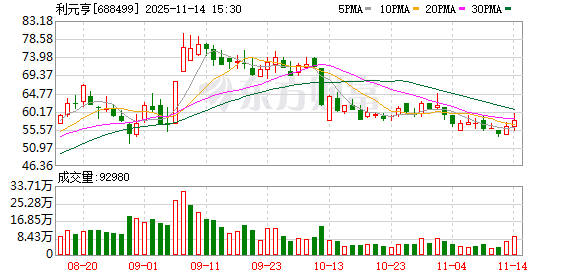
Core Viewpoint - The company Li Yuanheng has shown a significant increase in financing activities and a positive growth trend in revenue and net profit, indicating strong market interest and operational performance [1][2]. Financing Activities - On November 14, Li Yuanheng's stock rose by 2.93% with a trading volume of 540 million yuan. The financing buy-in amount for the day was 59.88 million yuan, while the financing repayment was 45.27 million yuan, resulting in a net financing buy-in of 14.61 million yuan [1]. - As of November 14, the total financing and securities lending balance for Li Yuanheng was 550 million yuan, which accounts for 5.62% of its market capitalization. This financing balance is above the 80th percentile of the past year, indicating a high level of activity [1]. - In terms of securities lending, on November 14, Li Yuanheng repaid 585 shares and sold 300 shares, with a selling amount of 17,400 yuan. The remaining securities lending balance was 515 shares, valued at 29,900 yuan, which is below the 10th percentile of the past year, indicating low activity [1]. Business Performance - As of September 30, Li Yuanheng had 24,600 shareholders, an increase of 9.92% from the previous period. The average number of circulating shares per shareholder decreased by 9.02% to 6,861 shares [2]. - For the period from January to September 2025, Li Yuanheng achieved a revenue of 2.424 billion yuan, representing a year-on-year growth of 4.37%. The net profit attributable to shareholders was 47.49 million yuan, showing a significant increase of 109.14% year-on-year [2]. Dividend and Shareholding Structure - Since its A-share listing, Li Yuanheng has distributed a total of 87.24 million yuan in dividends, with 35.32 million yuan distributed over the past three years [3]. - As of September 30, 2025, among the top ten circulating shareholders, the E Fund National Robot Industry ETF ranked as the fourth largest shareholder with 1.8612 million shares, marking it as a new shareholder. The Dongfang Alpha Industry Pioneer Mixed A Fund ranked seventh with 1.1441 million shares, also a new shareholder. Meanwhile, the AVIC New Start Flexible Allocation Mixed A Fund has exited the top ten circulating shareholders list [3].
政策+资本双轮驱动,卫星产业ETF(159218)盘中连续第四日揽金!海能达、利元亨、国机精工逆市飘红
Sou Hu Cai Jing· 2025-11-15 01:18
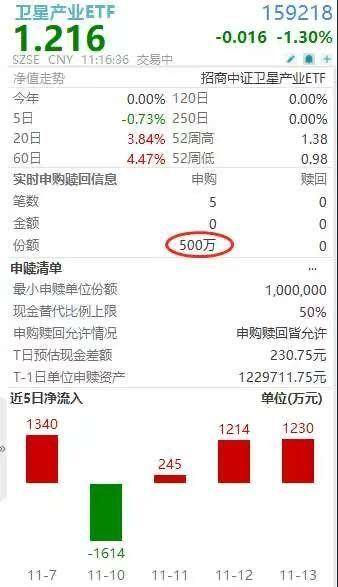
Industry Overview - The satellite sector is currently experiencing a weak consolidation, with the satellite industry ETF (159218) down by 1.30% as of 11:09 AM, although there has been a net inflow of nearly 5 million, marking four consecutive days of inflows [1] - Domestic commercial space companies have made significant progress in reusable launch vehicle technology, with Deep Blue Aerospace's "Star Cloud No. 1" and Star River Power's "Wisdom Star No. 1" both completing their engine tests and entering the countdown to their maiden flights, indicating a potential reduction in satellite launch costs [3] - The Long March 7 rocket successfully launched the Remote Sensing Satellite 46 into its designated orbit, which will be used for disaster prevention and resource exploration [3] Company Developments - China Aerospace Science and Technology Corporation is set to launch the "China Space Tour" project, marking a substantial step forward in commercial space tourism [3] - SpaceX has introduced a more affordable Starlink home package in the U.S., reducing the monthly fee to $40, which is expected to enhance user penetration in satellite internet services [3] - Recent financing activities in the commercial space sector, including companies like "Infinite Aerospace" and "Starry Space," indicate continued capital optimism for the industry chain [3] Policy Support - The Ministry of Industry and Information Technology (MIIT) has set clear goals in its guidance issued in August 2025, aiming to develop over 10 million satellite communication users by 2030, providing solid policy support for the long-term development of the industry [3]

利元亨:关于2024年员工持股计划股票出售完毕暨终止的公告
Zheng Quan Ri Bao· 2025-11-14 14:12
证券日报网讯 11月14日晚间,利元亨发布公告称,截至本公告披露日,公司2024年员工持股计划持有 的公司213,460股股票已通过集中竞价交易方式全部出售完毕,所持有的资产均为货币性资产。根据相 关规定,后续将根据规定进行相关资产清算和分配等工作,并终止2024年员工持股计划。 (文章来源:证券日报) ...
利元亨(688499) - 广东利元亨智能装备股份有限公司关于2024年员工持股计划股票出售完毕暨终止的公告
2025-11-14 10:46
证券代码:688499 证券简称:利元亨 公告编号:2025-064 广东利元亨智能装备股份有限公司 关于 2024 年员工持股计划股票出售完毕暨终止的公告 根据《上海证券交易所科创板上市公司自律监管指引第 1 号——规范运作》 《广东利元亨智能装备股份有限公司 2024 年员工持股计划管理办法》等相关规 定,后续将根据规定进行相关资产清算和分配等工作,并终止 2024 年员工持股 计划。 特此公告。 广东利元亨智能装备股份有限公司董事会 一、2024 年员工持股计划基本情况 公司分别于 2024 年 7 月 17 日召开第三届董事会第二次会议和第三届监事会 第二次会议、2024 年 8 月 2 日召开 2024 年第三次临时股东大会,审议通过《关 于〈广东利元亨智能装备股份有限公司 2024 年员工持股计划(草案)〉及其摘要 的议案》《关于〈广东利元亨智能装备股份有限公司 2024 年员工持股计划管理办 法〉的议案》等相关议案,具体内容详见公司分别于 2024 年 7 月 18 日、2024 年 8 月 3 日在上海证券交易所网站(www.sse.com.cn)披露的相关公告。 截至 2024 年 11 月 ...
利元亨:2024年员工持股计划股票出售完毕并终止
Xin Lang Cai Jing· 2025-11-14 10:37
利元亨公告称,截至公告披露日,公司2024年员工持股计划所持213,460股公司股票已通过集中竞价交 易全部出售完毕,资产均为货币性资产。该计划于2024年完成股票购买,累计买入213,460股,占当时 总股本0.1448%,成交均价26.34元/股,成交总金额562.23万元。后续公司将按规定进行资产清算和分配 等工作,并终止该员工持股计划。 ...
利元亨股价涨5.09%,南方基金旗下1只基金重仓,持有34股浮盈赚取97.58元
Xin Lang Cai Jing· 2025-11-14 03:00
Group 1 - The core point of the article highlights the recent performance of Liyuanheng, which saw a 5.09% increase in stock price, reaching 59.22 CNY per share, with a trading volume of 288 million CNY and a turnover rate of 2.97%, resulting in a total market capitalization of 9.992 billion CNY [1] - Liyuanheng, established on November 19, 2014, and listed on July 1, 2021, specializes in the research, production, and sales of intelligent manufacturing equipment, providing high-end equipment and factory automation solutions for industries such as lithium batteries, automotive parts, precision electronics, security, and rail transportation [1] - The revenue composition of Liyuanheng's main business includes 80.56% from lithium battery manufacturing equipment, 12.23% from value-added accessories and services, 3.62% from intelligent warehousing equipment, 2.72% from automotive parts manufacturing equipment, and 0.87% from equipment in other fields [1] Group 2 - From the perspective of major fund holdings, data shows that one fund under Southern Fund has a significant position in Liyuanheng, with the Southern SSE STAR Market Composite ETF Link A (023731) being the ninth largest holding, and it has gained approximately 97.58 CNY in floating profit today [2] - The Southern SSE STAR Market Composite ETF Link A (023731) was established on April 8, 2025, with a latest scale of 97.6034 million CNY and has achieved a return of 37.79% since inception [2] Group 3 - The fund managers of the Southern SSE STAR Market Composite ETF Link A (023731) are Yang Kaining and Pan Shuiyang, with Yang having a cumulative tenure of 1 year and 11 days, managing a total fund size of 1.28 billion CNY, achieving a best return of 65.99% and a worst return of -0.16% during his tenure [3] - Pan Shuiyang has a cumulative tenure of 1 year and 253 days, managing a total fund size of 7.828 billion CNY, with a best return of 81.45% and a worst return of -6.44% during his tenure [3]