
Hymson(688559)

Search documents
海目星(688559) - 海目星:关于实际控制人及其一致行动人权益变动触及1%刻度的提示性公告
2026-02-10 10:17
证券代码:688559 证券简称:海目星 公告编号:2026-007 海目星激光科技集团股份有限公司 关于实际控制人及其一致行动人权益变动触及 1%刻度的 提示性公告 公司实际控制人赵盛宇先生及其一致行动人南京盛世海康创业投资合伙企业(有限合伙)、盐 城海合恒辉一号创业投资合伙企业(有限合伙)、泰安海合恒辉二号投资合伙企业(有限合伙)保 证向本公司提供的信息真实、准确、完整,没有虚假记载、误导性陈述或重大遗漏。 二、权益变动触及 1%刻度的基本情况 海目星激光科技集团股份有限公司(以下简称"公司")于 2026 年 2 月 10 日收到 股东泰安海合恒辉二号投资合伙企业(有限合伙)(以下简称"泰安海合")出具的《关 于权益变动比例触及 1%刻度的告知函》。2025 年 12 月 23 日至 2026 年 2 月 10 日期间, 泰安海合通过集中竞价方式和大宗交易方式累计减持公司股份 1,572,000 股,持有公司 股份数量由 12,234,000 股变动至 10,662,000 股,导致泰安海合及其一致行动人占公司总 股本的比例由 27.55%减少至 26.92%,权益变动触及 1%刻度,具体情况如下: 本 ...
海目星(688559.SH):泰安海合累计减持157.2万股公司股份
Ge Long Hui A P P· 2026-02-10 10:17
Core Viewpoint - The company, HaiMuxing (688559.SH), reported a significant change in shareholding by its shareholder, Tai'an Haihe Henghui No. 2 Investment Partnership, which has reduced its stake in the company, impacting the overall shareholding structure [1] Summary by Relevant Sections - **Shareholder Activity** - Tai'an Haihe reduced its shareholding by 1,572,000 shares from 12,234,000 shares to 10,662,000 shares between December 23, 2025, and February 10, 2026 [1] - This reduction led to a decrease in the shareholding percentage from 27.55% to 26.92% [1]
海目星:泰安海合累计减持157.2万股公司股份
Ge Long Hui· 2026-02-10 10:15
Core Viewpoint - The company, HaiMuxing (688559.SH), reported a significant change in shareholding by its shareholder, Tai'an Haihe Henghui No. 2 Investment Partnership, which has reduced its stake in the company, impacting the overall shareholding structure [1] Summary by Relevant Sections - **Shareholder Activity** - Tai'an Haihe reduced its shareholding by 1,572,000 shares from 12,234,000 shares to 10,662,000 shares between December 23, 2025, and February 10, 2026 [1] - This reduction led to a decrease in the shareholding percentage from 27.55% to 26.92%, indicating a change that touches the 1% threshold [1]
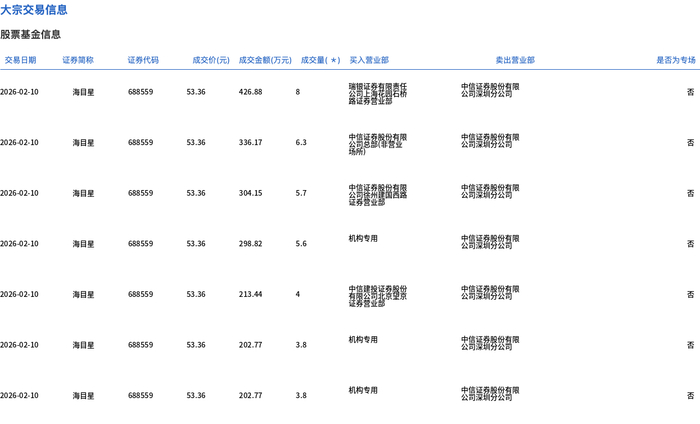
海目星今日大宗交易折价成交37.2万股,成交额1985万元
Xin Lang Cai Jing· 2026-02-10 09:31
Summary of Key Points Core Viewpoint - On February 10, a block trade of 372,000 shares of Haimeixing was executed, amounting to 19.85 million yuan, which represented 6.03% of the total trading volume for the day. The transaction price was 53.36 yuan, reflecting a discount of 7.36% compared to the market closing price of 57.6 yuan [1]. Group 1: Trading Details - The block trade involved a total of 372,000 shares of Haimeixing, with a transaction value of 19.85 million yuan [1]. - The transaction price of 53.36 yuan was lower than the market closing price of 57.6 yuan, indicating a discount of 7.36% [1]. - The total trading volume for the day was significantly impacted by this block trade, accounting for 6.03% of the total [1]. Group 2: Transaction Breakdown - Multiple transactions were recorded on February 10, with various buying and selling departments involved, including institutional and specialized trading firms [2]. - The highest transaction amount recorded for Haimeixing was 426.88 thousand yuan, with a total of 8 transactions noted [2]. - The trading activity included participation from different brokerage firms, indicating a diverse interest in the stock [2].

散热技术革命!海目星携手北美AI巨头卡位核心赛道
Quan Jing Wang· 2026-02-10 01:55
Core Insights - The dual explosion of edge AI and data center demands is driving a revolution in cooling technology across consumer electronics and industrial applications [1][2] - Advanced cooling solutions such as VC heat pipes, microchannel liquid cooling, and diamond films are becoming essential to meet the increasing thermal management needs [1] - The laser equipment sector is crucial for the mass production of these advanced cooling technologies, with companies like HaiMuxing emerging as key suppliers in the global supply chain [1] Group 1: Company Overview - HaiMuxing has developed core laser technologies that cover the entire cooling path, positioning itself as a critical equipment supplier for the cooling revolution [1] - The company's laser equipment is essential for the manufacturing of VC heat pipes, meeting the stringent requirements for Apple's ultra-thin 0.3mm VC heat pipes [1] - HaiMuxing's laser devices for microchannel liquid cooling (MCL) can be combined with VC heat pipes to create hybrid cooling solutions suitable for high-performance computing scenarios [1] Group 2: Market Position and Collaborations - HaiMuxing's laser equipment addresses industry challenges in the high-precision, low-damage processing of diamond materials, which are crucial for next-generation cooling solutions from companies like NVIDIA and TSMC [2] - The company's technology has been validated by top global ecosystems, and it has established deep collaborations with North American tech giants, successfully integrating into key supply chains [2] - HaiMuxing has made significant breakthroughs in AI cooling applications, with confirmed orders and shipments for its MCL laser equipment, reinforcing its competitive edge through continuous innovation [2] Group 3: Growth Potential - The explosive growth in cooling demands from edge AI and data centers positions HaiMuxing to benefit from market expansion, providing strong momentum for revenue growth [2] - The company's growth logic is undergoing systematic re-evaluation as it capitalizes on the increasing need for advanced cooling technologies [2]
海目星激光科技集团股份有限公司员工持股计划完成股票非交易过户的公告
Xin Lang Cai Jing· 2026-02-09 19:16
Group 1 - The core point of the announcement is the completion of the employee stock ownership plan, which involves the transfer of shares to the employee stock ownership account [1][2] - The employee stock ownership plan was approved by the company's board and shareholders, with a total of 60 employees participating and a total subscription amount of 73,550,161.02 yuan, corresponding to 3,356,922 shares [1][2] - The shares were transferred at a price of 21.91 yuan per share, representing 1.3549% of the company's total share capital [2] Group 2 - The employee stock ownership plan has a duration of 120 months, with shares unlocking in two phases at 16 months and 28 months, each phase releasing 50% of the shares based on performance assessments [3] - The company will continue to monitor the implementation of the employee stock ownership plan and fulfill its information disclosure obligations as required by law [3]
合合信息:2月9日召开董事会会议

Mei Ri Jing Ji Xin Wen· 2026-02-09 11:15
Group 1 - The company, Hehe Information, announced that its 25th meeting of the second board of directors will be held on February 9, 2026, combining in-person and communication methods [1] - The meeting will review documents including a proposal for establishing a market value management system [1] Group 2 - The article discusses the trend of young leaders, specifically those born in the 2000s, taking on significant roles in A-share companies, highlighting a 26-year-old who has become both chairman and general manager shortly after returning from studying at a prestigious American university [1] - The emergence of these young executives presents a significant challenge to meet investor expectations [1]
海目星(688559) - 海目星:员工持股计划完成股票非交易过户的公告
2026-02-09 09:45
证券代码:688559 证券简称:海目星 公告编号:2026-006 海目星激光科技集团股份有限公司 员工持股计划完成股票非交易过户的公告 本公司董事会及全体董事保证本公告内容不存在任何虚假记载、误导性陈述 或者重大遗漏,并对其内容的真实性、准确性和完整性承担法律责任。 根据公司《2025 年员工持股计划(草案)》的相关规定,本次员工持股计划 的存续期为 120 个月,自本次员工持股计划草案经公司股东会审议通过且公司公 告最后一笔标的股票过户至员工持股计划名下之日起计算。本次员工持股计划所 获标的股票分两期解锁,解锁时点分别为自公司公告最后一笔标的股票过户至本 次员工持股计划名下之日起满 16 个月、28 个月,每期解锁的标的股票比例分别 为 50%、50%,各年度具体解锁比例和数量根据业绩考核结果计算确定。 公司将持续关注本次员工持股计划的实施进展情况,并按照相关法律法规的 规定及时履行信息披露义务。敬请广大投资者注意投资风险。 二、本次员工持股计划完成股票过户的情况 根据实际认购和最终缴款的审验结果,本次员工持股计划最终参与认购的员 工为 60 人,最终认购份额为 73,550,161.02 份,每份份额 ...
固态电池行情引爆,海目星凭技术“底牌”成市场焦点
Quan Jing Wang· 2026-02-09 04:14
Group 1 - The core viewpoint of the news is that the solid-state battery industry is accelerating its commercialization process, driven by favorable policies and technological advancements [1][2]. - The Ministry of Industry and Information Technology has identified 2026-2027 as critical years for the commercialization of solid-state batteries, incorporating it into the "14th Five-Year Plan" strategic focus [1]. - Companies like BYD have initiated GWh-level equipment tenders, and Hongqi has successfully trial-produced solid-state battery packs, indicating significant progress in engineering validation [1]. Group 2 - Haimeixing has developed a micro-embossed ultra-thin coating technology that can control coating thickness between 0.5-4 micrometers, significantly thinner than traditional methods, and has achieved international leading parameters in trial lines for sulfide solid-state batteries [1][2]. - The ultra-thin multi-layer coating technology addresses the volume expansion issue of high-silicon anode materials, reducing coating thickness by over 80% compared to traditional processes [2]. - The company has secured the first GWh-level lithium metal solid-state battery mass production equipment order in the industry, positioning itself as a leader in dual technology routes [2]. Group 3 - The solid-state battery equipment market is projected to grow at a compound annual growth rate of 103% from 2024 to 2030, with the market size expected to exceed 59.2 billion yuan by 2030 [2]. - Haimeixing's stock has seen a maximum increase of over 194% in the past year, yet its current market capitalization stands at 14.59 billion yuan, suggesting potential for further value reassessment [3].
股市必读:海目星(688559)2月6日主力资金净流出854.3万元
Sou Hu Cai Jing· 2026-02-08 17:19
Trading Information Summary - On February 6, 2026, the stock of Haimuxing (688559) closed at 56.42 yuan, up 1.04%, with a turnover rate of 2.99% and a trading volume of 74,100 lots, amounting to a transaction value of 418 million yuan [1] - On the same day, the net outflow of funds from major investors was 8.543 million yuan, while retail investors saw a net inflow of 36.9543 million yuan [1][4] Company Announcements Summary - Haimuxing Laser Technology Group Co., Ltd. held its 22nd meeting of the third board of directors on February 6, 2026, where it approved the proposal for its wholly-owned subsidiary Chengdu Haimuxing to transfer 5% of its equity in Huachuan Xingguang to former supervisor He Changtao, reducing its holding from 80% to 75% [1][3] - The company also approved a proposal to conduct foreign exchange hedging business to mitigate exchange rate fluctuation risks, which will be submitted for shareholder meeting approval [1][2] - A temporary shareholder meeting is scheduled for February 25, 2026, to discuss the foreign exchange hedging proposal, with the record date for shareholders set for February 10, 2026 [2] Foreign Exchange Hedging Business - The foreign exchange hedging business aims to mitigate exchange rate risks and will involve trading instruments such as forward foreign exchange contracts, foreign exchange swaps, and foreign exchange options [2][3] - The maximum trading margin and premium for the hedging business will not exceed 300 million yuan, and the maximum contract value held on any trading day will not exceed 1 billion yuan [2][3]