
TRINA(688599)

Search documents
公司问答丨天合光能:公司在青海西宁合计投建35GW直拉单晶项目 其中一期20GW已投产
Ge Long Hui· 2025-12-26 07:28
Group 1 - The company, Trina Solar, has invested in a total of 35GW of monocrystalline silicon production capacity in Xining, Qinghai [1] - The first phase of the project, which is 20GW, has already been put into operation [1] - The second phase, consisting of 15GW, has not yet commenced production [1]

新能源发电行业2026年投资策略:反内卷大势不改,新技术推动升级
Bank of China Securities· 2025-12-26 06:19
Overview - The report maintains a "stronger than market" rating for the renewable energy sector, highlighting that the demand for offshore wind power in China and Europe is increasing, leading to a rise in foundation demand and profit recovery for wind turbines. The "anti-involution" policy is expected to continue driving the photovoltaic sector, particularly with the expansion of perovskite technology. Overall, while short-term installation demand for renewable energy globally may be weak, there are structural opportunities in the market [1]. Key Points Supporting the Rating - The "anti-involution" trend is stabilizing wind turbine prices, enhancing profitability for manufacturers. China's offshore wind projects are becoming economically viable, contributing significantly to installed capacity. The demand for offshore wind in Europe and emerging markets is also on the rise [3]. - In the photovoltaic sector, the "anti-involution" policy remains the main theme, with a focus on the potential for capacity exits in battery and module production, as well as the industrialization potential of perovskite technology. Investment should prioritize growth-oriented new technology directions and the main industry chain benefiting from the "anti-involution" trend [3]. Investment Recommendations - For wind power, the report suggests prioritizing investments in the turbine segment, which is expected to recover profitability, and in the foundation segment that is progressing quickly in Europe. The offshore wind market is projected to grow significantly, with a focus on deep-sea projects [3]. - In the photovoltaic sector, the report emphasizes the importance of monitoring the "anti-involution" policy's impact on the industry, particularly regarding the exit of inefficient capacity and the enhancement of efficiency in battery and module production [3]. Long-term Outlook for Renewable Energy Demand - The report indicates that China's renewable energy demand is expected to remain robust in the long term, with an average annual installation capacity of over 400GW projected from 2025 to 2035. This is driven by the country's energy security needs and the ongoing transition to a low-carbon economy [13][16]. - The "136 Document" is noted for guiding the development of renewable energy projects towards market-oriented pricing, which is expected to stabilize project returns and promote high-quality development in the sector [31]. Photovoltaic Sector Insights - The report anticipates a moderate decline in photovoltaic installations in 2026 due to a phase of pre-installation in 2025, with projected installations of 290GW in 2025 and 180GW in 2026, reflecting a year-on-year decrease of 38% [33]. - The report highlights that the European photovoltaic market is facing growth challenges, with a forecasted installation of 64.2GW in 2025, indicating a slight decline. The U.S. market is also expected to experience pressure on growth due to policy adjustments [34][37]. Perovskite Technology Potential - Perovskite technology is identified as a key area for enhancing competitiveness in the photovoltaic manufacturing sector, with expectations for significant breakthroughs in industrialization by leading manufacturers in 2026 [33][44].




研判2025!中国光伏检测设备行业相关政策、发展现状、企业分析及未来前景展望:光伏产业供过于求,导致行业内企业业绩短期承压[图]
Chan Ye Xin Xi Wang· 2025-12-26 01:17
Core Viewpoint - The photovoltaic testing equipment industry is experiencing rapid growth driven by the expansion of photovoltaic cell and module production capacity, leading to increased demand for testing equipment and higher quality standards in production processes [1][3][6]. Industry Overview - Photovoltaic testing equipment is essential for assessing the performance, quality, safety, and reliability of photovoltaic components and systems, playing a crucial role in the development of the photovoltaic industry [3][4]. - The market size of China's photovoltaic testing equipment industry is projected to reach 2.101 billion yuan in 2024, representing a year-on-year increase of 4.9% [1][7]. Industry Policies - Recent government policies have been implemented to promote the development of the photovoltaic industry, including guidelines for updating and replacing equipment to improve efficiency standards [4][6]. - The 2024-2025 energy conservation and carbon reduction action plan emphasizes the construction of large-scale photovoltaic bases in desert areas, which will further drive the demand for testing equipment [4][6]. Market Dynamics - The cumulative installed capacity of photovoltaic systems in China increased from 204.2 GW in 2019 to 886.66 GW in 2024, with new installations rising from 30.1 GW to 277.17 GW during the same period [6]. - The rapid growth in installed capacity is expected to lead to increased demand for testing equipment to ensure quality control and operational efficiency [6][10]. Competitive Landscape - The photovoltaic testing equipment market is dominated by a few large manufacturers from Europe, the United States, and Japan, while domestic companies in China are rapidly improving their technology and quality [8][9]. - Key players in the Chinese market include Shanghai Optoelectronics Technology Co., Ltd., Shenzhen Huashengchang Technology Co., Ltd., and others, with varying performance and revenue trends [8][9]. Development Trends - The industry is moving towards greater automation and intelligence in testing processes, integrating visual defect detection systems to enhance production efficiency and reduce labor costs [10][11]. - As the focus shifts from quantity to quality, there is an increasing demand for high-performance testing equipment, prompting continuous technological innovation within the industry [11]. - Global expansion is accelerating, with Chinese companies establishing production bases in Southeast Asia and the Middle East to meet international market demands and comply with global testing standards [12].


上游材料价格上升 光伏组件厂商相继上调组件报价
2 1 Shi Ji Jing Ji Bao Dao· 2025-12-26 00:06
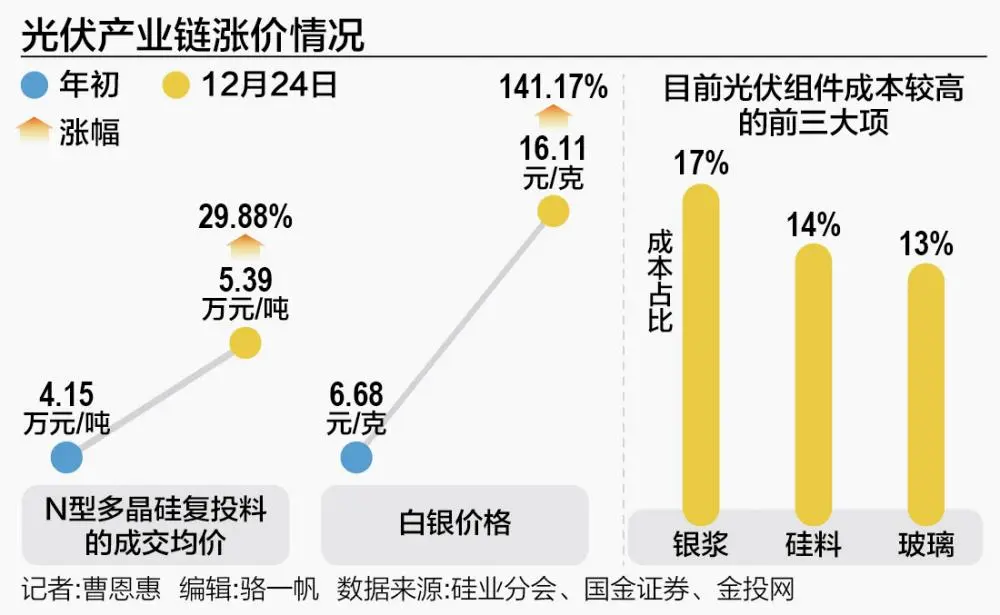
Core Viewpoint - The recent price increase of photovoltaic (PV) modules is primarily driven by rising upstream material costs, particularly silver paste, which has seen significant price hikes due to surging silver prices [1][4]. Group 1: Price Increases and Market Dynamics - Major PV manufacturers like Longi Green Energy and JinkoSolar have raised module prices by 0.02 to 0.05 yuan per watt, citing increased costs of upstream materials [1]. - Silver futures and spot prices have reached historical highs, with increases of over 130% and 150% respectively this year [1]. - Despite the price increases in upstream materials, the price of PV modules has only risen by less than 2% this year, lagging behind other components like silicon wafers and battery cells, which have seen increases of over 19% and 15% respectively [4][6]. Group 2: Cost Structure Changes - The cost structure of PV modules has shifted, with silver paste now accounting for 17% of the total cost, surpassing silicon materials, which have decreased in cost share due to falling prices [3]. - The average transaction price of N-type multi-crystalline silicon has risen from 41,500 yuan/ton at the beginning of the year to 53,900 yuan/ton by December 24, marking a 29.88% increase [4]. Group 3: Investment Returns and Market Sentiment - The internal rate of return (IRR) for PV projects has been negatively impacted by declining feed-in tariffs, with current IRR expectations for domestic projects ranging from 6% to 7%, down from previous standards of 7% to 7.5% [5][6]. - There is a strong correlation between module prices and IRR, suggesting that rising module prices could deter investment in new installations [6]. Group 4: Future Outlook and Demand - The demand for PV modules is currently limited, and expectations for rapid market growth are diminishing, with the industry facing a potential inflection point in demand growth [8]. - The National Energy Administration reported that from January to October, China added 252.87 GW of new PV capacity, but the market is expected to stabilize rather than experience rapid growth in the future [8].
白银狂飙141%,硅料大涨,光伏组件想涨价却涨不动
21世纪经济报道· 2025-12-25 23:34
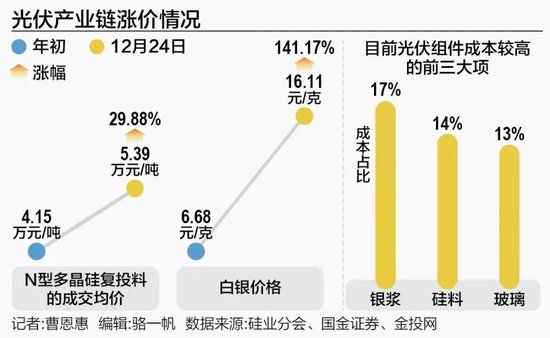
Core Viewpoint - The recent price increase of photovoltaic (PV) modules is primarily driven by rising upstream material costs, particularly silver paste, which has seen significant price hikes due to the surge in silver prices [1][5][6]. Group 1: Price Increases and Cost Structure - Major PV module manufacturers, including Longi Green Energy and JinkoSolar, have raised their module prices by 0.02 to 0.05 yuan per watt due to increased costs of upstream materials [1]. - Silver paste has become the largest cost component in PV modules, accounting for 17% of the total cost, followed by silicon materials at 14% and glass at 13% [5]. - The average price of N-type multicrystalline silicon has risen from 41,500 yuan/ton at the beginning of the year to 53,900 yuan/ton by December 24, marking a 29.88% increase [6]. - The spot price of silver has increased from 6.68 yuan/gram to 16.11 yuan/gram, reflecting a 141.17% rise [6]. Group 2: Market Dynamics and Investment Returns - The price increase of upstream materials has not effectively translated to module prices due to concerns over the internal rate of return (IRR) for downstream solar power plant operators, which has been negatively impacted by recent policy changes [6][7]. - The IRR for domestic PV projects has decreased to a range of 6% to 7%, down from previous standards of 7% to 7.5% [6][7]. - There is a strong correlation between module prices and the IRR for solar power plants, indicating that any price increase in modules could dampen installation demand [7]. Group 3: Future Price Expectations and Market Demand - Industry experts suggest that module prices need to reach at least 0.8 yuan/W to ensure profitability for integrated module companies, with some estimates suggesting a target range of 0.88 to 0.99 yuan/W [9]. - The current average price for N-type TOPCon modules is 0.698 yuan/W, with a slight increase of 0.7% noted recently [9]. - Despite the desire for price increases, the limited market demand poses challenges for driving module prices higher in the short term [10]. - The newly released data indicates that China's newly installed PV capacity reached 252.87 GW from January to October, but the growth rate is expected to slow down, leading to uncertainty in future demand [10].

白银狂飙141%,硅料大涨,光伏组件想涨价却涨不动
Xin Lang Cai Jing· 2025-12-25 23:31
Core Viewpoint - The recent price increase of photovoltaic (PV) modules is primarily driven by rising upstream material costs, particularly silver paste, which has seen significant price hikes due to soaring silver prices [1][3][4]. Group 1: Price Increases and Market Dynamics - Major PV manufacturers like Longi Green Energy and JinkoSolar have raised module prices by 0.02 to 0.05 yuan per watt due to increased costs of raw materials [1][3]. - Silver futures and spot prices have surged, with increases exceeding 130% and 150% respectively this year [1][3]. - The price increase of PV modules has lagged behind other components in the supply chain, with module prices rising less than 2% compared to significant increases in silicon wafers and battery cells [4][12]. Group 2: Cost Structure Changes - The cost structure of PV modules has shifted, with silver paste now accounting for 17% of the total cost, surpassing silicon materials which have decreased in cost share [11][12]. - The average transaction price of N-type multi-crystalline silicon has risen from 41,500 yuan per ton at the beginning of the year to 53,900 yuan per ton by December 24, marking a 29.88% increase [12]. - The price of silver has increased from 6.68 yuan per gram to 16.11 yuan per gram, reflecting a 141.17% rise [12]. Group 3: Investment Returns and Market Sentiment - The internal rate of return (IRR) for PV projects has been negatively impacted by declining electricity prices, with current IRR estimates for domestic projects ranging from 6% to 7% [4][13]. - There is a strong correlation between module prices and the IRR for solar power plants, suggesting that rising module prices could deter investment due to lower expected returns [5][13]. - Industry experts express skepticism about the sustainability of the recent price increases, questioning whether they can be maintained in the face of limited market demand [6][14]. Group 4: Future Market Outlook - The China Photovoltaic Industry Association has not provided forecasts for new installed capacity for 2026, indicating increased uncertainty regarding future demand [8][16]. - From January to October, China's newly installed PV capacity reached 252.87 GW, attributed to a surge in installations earlier in the year [8][16]. - The global PV market is expected to experience a slowdown in growth, with future demand projected to stabilize rather than increase rapidly [9][16].
7家组件厂齐涨2-6分!未来组件价格大概率还将继续上涨
Xin Lang Cai Jing· 2025-12-25 13:34
Group 1 - The core viewpoint of the article is that the recent surge in photovoltaic component prices is both inevitable and a result of rising costs in the supply chain, particularly due to the increase in silver prices [8] - Major manufacturers such as Longi and JA Solar have initiated price increases of 2-4 cents, followed by Trina Solar raising prices by 5-6 cents, Tongwei by 3-4 cents, and others, leading to a general increase in component prices to 0.70 yuan/W or higher [2] - The price increase has created tension in the downstream solar power station sector, which is struggling to accept the higher costs due to declining profitability from the implementation of policy 136 [2][6] Group 2 - Many smaller component manufacturers are hesitant to raise prices due to fears of contract cancellations, as evidenced by reports of contracts being voided shortly after agreements were made [3][4] - The primary reason given by component manufacturers for the price hikes is the soaring cost of silver paste, which has become the largest cost component in solar modules, accounting for 17% of total costs [6][7] - The current situation presents a dilemma where rising production costs compel manufacturers to increase prices, while reduced profitability for solar power stations makes it difficult for investors to accept these price hikes [7]


天合光能:公司合计持有T1 Energy 45877960股普通股股票
Zheng Quan Ri Bao Zhi Sheng· 2025-12-25 13:17
(编辑 丛可心 袁冠琳) 证券日报网讯 12月25日,天合光能在互动平台回答投资者提问时表示,截至目前,公司合计持有 T1Energy45877960股普通股股票,占T1截至2025年12月18日总普通股股本的17.4%。公司目前暂未出售 T1股份,因此无法准确计算股权投资收益。公司与T1未来将深入进行合作,共同开拓北美市场。 ...
天合光能:公司2025年储能系统出货预计超5GWh
Zheng Quan Ri Bao Zhi Sheng· 2025-12-25 13:17
(编辑 丛可心 袁冠琳) 证券日报网讯 12月25日,天合光能在互动平台回答投资者提问时表示,公司2025年储能系统出货预计 超5GWh,2026年储能系统出货预计超15GWh,公司力争实现在未来成为全球储能行业排名前五的企 业。 ...
天合光能:公司没有任何应披露而未披露的重大信息
Zheng Quan Ri Bao Wang· 2025-12-25 11:42
证券日报网讯12月25日,天合光能在互动平台回答投资者提问时表示,截至目前,公司没有任何应披露 而未披露的重大信息。 ...