LAPLACE(688726)

Search documents
光伏早盘收跌近5%,多家公司公告澄清与马斯克合作
第一财经· 2026-02-05 04:28
Core Viewpoint - The recent interest in space photovoltaic technology has led to significant stock price fluctuations in the solar industry, but many companies have clarified that they have not engaged in any concrete projects with Elon Musk's team, highlighting the uncertainty surrounding the commercialization of space photovoltaic technology [2][4][9]. Group 1: Market Reactions - As of February 5, the Wind Photovoltaic Index fell by 4.56%, with several stocks, including Aotwei and Maiwei, dropping over 10% [2]. - In contrast, the space photovoltaic sector saw a temporary surge, with Jinko Solar hitting a 20% limit-up, alongside TCL Zhonghuan and others [3]. Group 2: Company Announcements - Multiple companies, including Jinko Solar, have issued announcements denying any collaboration with Musk's team, stating that they have not signed any agreements or received orders related to space photovoltaic projects [4][6]. - Dual Energy and Guosheng Technology also clarified that they have not engaged in any space photovoltaic business and that their current operations remain unaffected [5][6]. Group 3: Industry Insights - The space photovoltaic technology is still in the exploratory and verification stages, with significant uncertainties regarding its commercialization [9][10]. - The China Photovoltaic Industry Association emphasized that the development of any technology requires mature manufacturing capabilities and long-term reliability verification [9]. - Current space photovoltaic technologies, such as gallium arsenide (GaAs) and perovskite, face challenges in terms of cost and stability, with GaAs being the mainstream material but prohibitively expensive for large-scale deployment [10]. Group 4: Economic Considerations - The cost of electricity generated from space photovoltaic systems is currently estimated to be 2-3 USD per kilowatt-hour, significantly higher than the 0.03-0.05 USD per kilowatt-hour for ground-based photovoltaic systems [10]. - Without a drastic reduction in launch costs and a doubling of photovoltaic efficiency, the economic viability of space photovoltaic technology remains questionable [10].






光伏早盘收跌近5%,多家公司公告澄清与马斯克合作!协会:太空光伏仍处验证初期
Di Yi Cai Jing· 2026-02-05 03:59
Core Viewpoint - Multiple companies have denied the existence of executable projects in collaboration with Elon Musk's team, indicating significant uncertainty in the industrialization process of "space photovoltaics" [1][2][3][4][5][6] Company Responses - JinkoSolar (688223.SH) announced that it has not engaged in any cooperation with Musk's team and has no existing orders related to "space photovoltaics," emphasizing that the technology is still in the preliminary exploration stage [2] - Shuangliang Energy (600481.SH) stated that it has not confirmed any revenue related to commercial space projects in the past two years and that the development of related business faces uncertainty [2] - Guosheng Technology (603778.SH) clarified that it does not provide "space photovoltaic" systems and that its products are primarily used in terrestrial power plants [2] - High Measurement Technology (688556.SH) confirmed it has not engaged in any "space photovoltaic" business or collaborations [3] - Jingcheng Machinery (300316.SZ) reiterated that the application scenarios for "space photovoltaics" are still in the exploratory phase, with significant uncertainty in the industrialization process [4] Industry Insights - The "space photovoltaic" technology is still in the early stages of exploration and verification, according to industry experts [5][6] - The mainstream material for space photovoltaics remains gallium arsenide (GaAs), which, despite its high cost, has undergone long-term in-orbit verification [5][6] - Current cost estimates for space photovoltaics are significantly higher than terrestrial photovoltaics, with estimates of $2-3 per kilowatt-hour compared to $0.03-0.05 for ground-based systems [6]
拉普拉斯今日大宗交易折价成交28万股,成交额2038.12万元
Xin Lang Cai Jing· 2026-02-04 09:40
| 交易日期 证券简称 | | 证券代码 | 成交价(元) 成交金额(万元) 成交量(*) 买入营业部 | | | | 卖出营业部 | 是否为专场 | | --- | --- | --- | --- | --- | --- | --- | --- | --- | | 2026-02-04 | 拉曾拉斯 | 688726 | 72.79 28 | 2038.12 | 机构专用 | 泰部任务管委员严 | | Ka | 2月4日,拉普拉斯大宗交易成交28万股,成交额2038.12万元,占当日总成交额的0.69%,成交价72.79 元,较市场收盘价73.9元折价1.5%。 ...

解密钙钛矿电池:凭何扛起太空算力引擎重任?校企联合攻关+马斯克赋能,光伏核心风口强势回归
Xin Lang Cai Jing· 2026-02-03 12:52
Group 1 - Zairun New Energy focuses on the research and development of perovskite battery core materials and equipment, with a strong emphasis on high-purity and high-stability products suitable for large-scale production [1] - The company has completed multiple pilot tests and its product performance has been validated by third-party authorities [1] - Zairun's high-radiation-resistant perovskite precursor materials enhance battery stability in extreme space environments, positioning the company to become a core supplier in the space photovoltaic supply chain [1] Group 2 - Aotwei is a leading domestic photovoltaic equipment enterprise, with early layouts in perovskite production line equipment and technology covering key processes such as laser etching and thin film deposition [2] - The company's self-developed laser repair equipment significantly improves battery yield and is at the forefront of industry standards [2] - Aotwei's equipment optimizes battery manufacturing processes to meet the stringent requirements of space photovoltaic applications, potentially making it a core supplier in this sector [2] Group 3 - Haiyou New Materials is a core supplier of photovoltaic packaging materials, focusing on the development of POE films and back sheets for perovskite batteries [3] - The company has developed radiation-resistant packaging films that ensure long-term stable operation of perovskite batteries in space environments [3] - As the space photovoltaic market scales, Haiyou is positioned to become a key supplier of packaging materials for perovskite batteries [3] Group 4 - Gaoce Co., Ltd. is a leading domestic company in photovoltaic cutting equipment and silicon wafer processing, actively developing ultra-thin silicon cutting technology for perovskite batteries [4] - The company's ultra-thin silicon wafers, with thicknesses as low as 50μm, meet the lightweight requirements of perovskite batteries [4] - Gaoce's technology supports the stringent demands of space photovoltaic applications, positioning it to become a core supplier of silicon wafers for perovskite batteries [4]


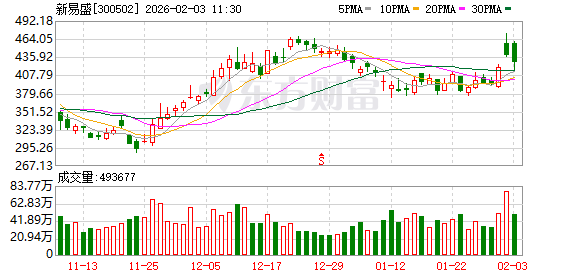
300502 成交额再度A股第一
Shang Hai Zheng Quan Bao· 2026-02-03 05:00
Market Overview - A-shares experienced a collective rise in major indices, with the Shanghai Composite Index closing at 4031.07 points, up 0.38%, and the Shenzhen Component Index rising by 0.93% [2] - The total trading volume in the Shanghai and Shenzhen markets reached 161.69 billion yuan by midday [2] Sector Performance - The commercial aerospace sector saw significant gains, with multiple stocks hitting the daily limit up, including Aerospace Development and JuLi Sockets [4] - The photovoltaic sector continued to strengthen, with stocks like Shuangliang Energy and JunDa Co. reaching their daily limit up shortly after market open [4] - The chemical sector also experienced a rally, with WanFeng Co. achieving a fourth consecutive limit up [9] Key Stocks - Aotewei reached a 20% limit up, while other stocks such as Dike Co. and Maiwei Co. saw increases of over 10% [6][7] - JunDa Co. announced a share placement to fund research and production of space photovoltaic battery products, and it also invested 30 million yuan for a 16.67% stake in Shanghai Xingyi Xinneng [8] Industry Insights - According to CICC, the development of commercial aerospace is driving the space photovoltaic sector towards a new phase of technological upgrades and industrial delivery [8] - Guosheng Securities noted that the demand for space photovoltaic energy is expected to become a new growth area, driven by the global demand for space energy and the restructuring of supply chains [8] - The chemical industry is expected to evolve with a shift from market share focus to profitability, alongside opportunities for high-end export replacements due to declines in Europe and Japan [9][10]



拉普拉斯今日大宗交易折价成交28.3万股,成交额1761.39万元
Xin Lang Cai Jing· 2026-02-02 09:46
| | | | | | 机构专用 | | | --- | --- | --- | --- | --- | --- | --- | | 交易日期 2026-02-02 | 证券简称 拉普拉斯 | 证券代码 688726 | 成交价(元) 成交金额(万元) 成交量( * ) 买入营业部 62.24 1761.39 | 28.3 | | 卖出营业部 华泰证券股份有限 公司上海静安区广 | 2月2日,拉普拉斯大宗交易成交28.3万股,成交额1761.39万元,占当日总成交额的1.43%,成交价62.24元,较市场收盘价63.19元折价1.5%。 ...

"太空光伏"概念走热,部分企业触发交易异常,业内: 目前仍处于0到1阶段
Di Yi Cai Jing· 2026-02-02 07:45
Core Viewpoint - The "space photovoltaic" concept has become a major focus in the secondary market, significantly influenced by Tesla CEO Elon Musk's endorsements, with the relevant index rising 19.83% in the past month, outperforming the CSI 300 index's 1.18% increase [1] Group 1: Market Performance - The space photovoltaic concept index has seen a substantial increase, with notable stocks such as JunDa Co., Ltd. rising by 84.62%, Mingyang Smart Energy increasing by 60.22%, and Jiejia Weichuang up by 44.04% over the past 20 days [1] - Several photovoltaic companies have experienced significant stock price surges, triggering trading anomalies, with stocks like Dongfang Risen and Laplace exceeding a cumulative price deviation of 30% over multiple trading days [3] Group 2: Technology and Feasibility - Space photovoltaic energy involves utilizing solar photovoltaic technology in outer space to generate and supply energy, with the potential for direct power transmission to Earth or powering satellites and space stations [3] - The feasibility of space photovoltaic technology is supported by the abundant sunlight in space and the ability to deploy photovoltaic components on satellites, with near-Earth orbit satellites experiencing over 60% sunlight exposure [3] - Despite the market enthusiasm, the industry faces significant uncertainties regarding the maturity and long-term reliability of the technology, as well as the economic viability required for large-scale commercialization [4][5] Group 3: Industry Insights - Industry insiders indicate that the application scenarios for space photovoltaic technology are still in the exploratory phase, with many companies in the secondary market not yet supplying products to commercial space satellite companies [4] - Analysts emphasize that space photovoltaic technology is currently in the early stages, requiring validation of technical routes and economic benefits for large-scale commercial applications [5] - The current cost of space photovoltaic energy is estimated to be around $2-3 per kilowatt-hour, significantly higher than ground photovoltaic costs of $0.03-0.05 per kilowatt-hour, highlighting the economic challenges ahead [6] Group 4: Future Outlook - Companies like Trina Solar and HaiMuxing express optimism about the future of space photovoltaic technology, with ongoing collaborations with leading aerospace institutions to accumulate practical experience [6] - The commercial viability of space photovoltaic technology is projected to gradually materialize over the next 10 to 15 years, driven by decreasing launch costs and breakthroughs in battery technology [7]




“太空光伏”概念走热,业内:目前仍处于0到1阶段
Di Yi Cai Jing Zi Xun· 2026-01-30 13:27
Core Insights - The "space photovoltaic" concept has gained significant attention in the secondary market, largely influenced by Tesla CEO Elon Musk's endorsements [2] - The Wind Space Photovoltaic Index has risen by 19.83% over the past month, outperforming the Shanghai and Shenzhen 300 Index, which increased by 1.18% [2] - Several photovoltaic companies have experienced substantial stock price increases, with JunDa Co., Ltd. rising by 84.62% and Mingyang Smart Energy increasing by 60.22% in the last 20 days [2] Market Performance - The stock prices of companies like Dongfang Risen and Laplace have shown abnormal fluctuations, with price deviations exceeding 30% over consecutive trading days [3] - The space photovoltaic sector is characterized by its potential to harness solar energy in outer space, providing power to satellites and space stations [3] Industry Challenges - Despite the market enthusiasm, the commercialization of space photovoltaics faces significant uncertainties related to technology maturity and economic viability [4] - Industry insiders indicate that the application scenarios for space photovoltaics are still in the exploratory phase, with many companies not yet supplying products to commercial satellite firms [4] Technological Considerations - Current leading materials for space photovoltaics include gallium arsenide, which is costly at approximately 1000 RMB per watt, and perovskite, which faces stability issues in extreme space conditions [5] - The cost of electricity generated from space photovoltaics is estimated to be 2-3 USD per kilowatt-hour, significantly higher than the ground-based photovoltaic cost of 0.03-0.05 USD per kilowatt-hour [5] Future Outlook - Several A-share listed companies express optimism about the future of space photovoltaics, with potential market size reaching trillions as technology advances [5] - Companies like Trina Solar and HaiMuxing are actively collaborating with leading aerospace institutions to develop practical applications for space solar energy [5] - The commercialization of space photovoltaics is projected to gradually occur over the next 10 to 15 years as launch costs decrease and battery technologies improve [6]
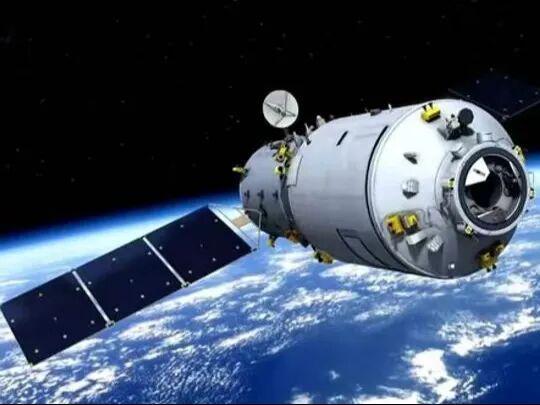
“太空光伏”概念走热 部分企业触发交易异常 业内:目前仍处于0到1阶段
Di Yi Cai Jing· 2026-01-30 12:05
Core Viewpoint - The "space photovoltaic" concept has become a major focus in the secondary market, significantly influenced by Tesla CEO Elon Musk's endorsements, with the relevant index rising 19.83% in the past month, outperforming the CSI 300 index by 18.65% [1] Market Performance - The space photovoltaic concept index has shown strong performance, with notable stock increases: JunDa Co., Ltd. up 84.62%, Mingyang Smart Energy up 60.22%, Jiejia Weichuang up 44.04%, Dier Laser up 41.54%, and Tuori New Energy up 35.94% over the past 20 days [1] - Several photovoltaic companies have experienced significant stock price surges, triggering trading anomalies, such as Dongfang Risheng and Laplace, both exceeding a cumulative price deviation of 30% within a short period [2] Industry Insights - Space photovoltaic energy refers to utilizing solar photovoltaic technology in outer space to generate and supply energy, with the potential to transmit power wirelessly to Earth or supply satellites and space stations [2] - The rationale for space photovoltaics includes abundant sunlight in space and the feasibility of deploying photovoltaic components on satellites, with near-Earth satellites experiencing over 60% sunlight exposure [2] Challenges in Industrialization - Despite the rising stock prices, the industry faces significant uncertainties regarding the industrialization of space photovoltaics, including technological maturity and economic viability for large-scale commercialization [3] - Current applications of space photovoltaics are still exploratory, with many companies in the secondary market not yet supplying products to commercial space satellite companies [3] - Analysts indicate that space photovoltaics are in the early stages of development, requiring validation of technology and economic benefits for large-scale applications [3] Technological Considerations - Gallium arsenide is the mainstream material for space photovoltaics, but its high cost (approximately 1000 RMB per watt) poses challenges for large-scale deployment [4] - Perovskite technology shows promise but has stability concerns in extreme space conditions, necessitating further validation [4] - Multiple technological routes are being explored, with a focus on solving power and cost issues as critical for the commercialization of space energy solutions [4] Cost Analysis - Current estimates suggest that the cost of electricity from space photovoltaics is around $2-3 per kilowatt-hour, compared to $0.03-0.05 per kilowatt-hour for ground-based photovoltaics, indicating a potential cost disparity of up to 100 times [5] - Companies like Trina Solar and HaiMuxing express optimism about the future of space photovoltaics, citing collaborations with leading aerospace institutions and advancements in reusable rocket technology [5] Commercialization Timeline - Predictions indicate that space photovoltaics may gradually commercialize over the next 10 to 15 years, contingent on decreasing launch costs and breakthroughs in battery technology [6]
“太空光伏”概念走热,部分企业触发交易异常,业内:目前仍处于0到1阶段
Di Yi Cai Jing Zi Xun· 2026-01-30 11:37
Core Viewpoint - The "space photovoltaic" concept has gained significant attention in the secondary market, largely influenced by Tesla CEO Elon Musk's endorsements, with the relevant index rising 19.83% in the past month, outperforming the CSI 300 index by 18.65% [1] Market Performance - The space photovoltaic concept index has seen a notable increase, with specific stocks like JunDa Co., Ltd. rising by 84.62%, Mingyang Smart Energy by 60.22%, and Jiejia Weichuang by 44.04% over the past 20 days [1] - Several photovoltaic companies have experienced stock price surges, triggering trading anomalies, such as Dongfang Risheng and Laplace, which saw price deviations exceeding 30% [3] Technology and Feasibility - Space photovoltaic energy involves utilizing solar photovoltaic technology in outer space to generate and supply energy, with the potential for direct power transmission to Earth [3] - The advantages of space photovoltaic systems include abundant sunlight and reduced atmospheric interference, making them a viable option for satellite power supply [3] Industry Challenges - Despite the market enthusiasm, the space photovoltaic industry faces significant uncertainties regarding technological maturity, long-term reliability, and economic viability for large-scale commercialization [4][5] - Current applications are still in the exploratory phase, with many companies not yet supplying products to commercial space satellite firms [5] Technological Development - Various technological routes are being explored, with gallium arsenide being the mainstream material, but its high cost poses challenges for large-scale deployment [5][6] - The cost of space photovoltaic energy is currently estimated at $2-3 per kilowatt-hour, significantly higher than ground-based photovoltaic costs of $0.03-0.05 per kilowatt-hour, indicating a need for cost reduction and efficiency improvements [6] Future Outlook - Companies like Trina Solar and HaiMuxing express optimism about the future of space photovoltaic technology, citing collaborations with leading aerospace institutions and advancements in reusable rocket technology [6][7] - The commercial viability of space photovoltaic systems is projected to develop over the next 10 to 15 years, contingent on decreasing launch costs and breakthroughs in battery technology [7]