PAB(000001)

Search documents
透视银行三季报:超30家净息差收窄 债市波动拖累非利息收入
Bei Ke Cai Jing· 2025-11-05 11:12
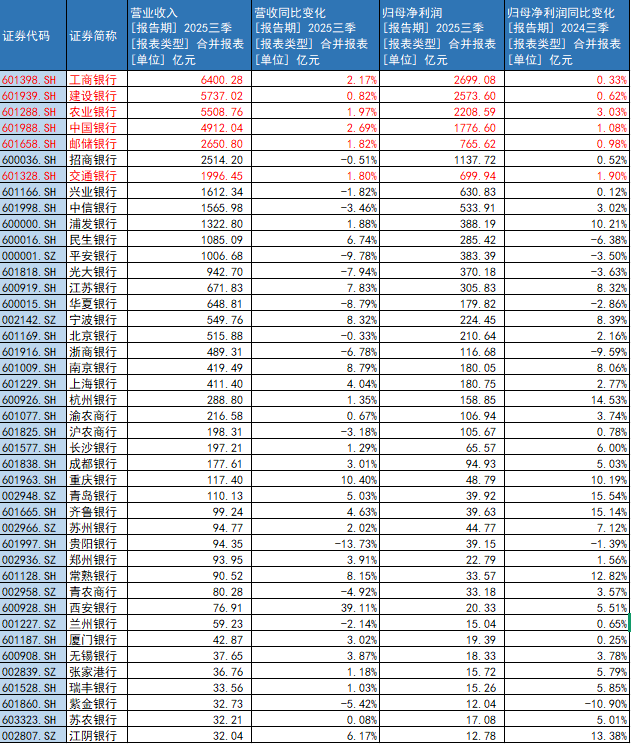
Core Insights - The overall performance of A-share listed banks in the first three quarters of the year is positive, with over 80% achieving year-on-year growth in net profit attributable to shareholders [2][3] - The growth in net profit is primarily driven by stable net interest income and improved asset quality, despite a decline in non-interest income due to bond market fluctuations [2][3] - The six major banks collectively reported over 1 trillion yuan in net profit, marking a significant milestone [3][4] Financial Performance - Among the 42 listed banks, 35 reported year-on-year growth in net profit, while only 7 experienced a decline [3][4] - The top four state-owned banks (Industrial and Commercial Bank of China, China Construction Bank, Agricultural Bank of China, and Bank of China) all achieved growth in both revenue and net profit [4][5] - Industrial and Commercial Bank of China led in revenue with 640.03 billion yuan, a 2.17% increase year-on-year, and a net profit growth of 0.33% [4][6] Non-Interest Income and Market Impact - Many banks faced a decline in non-interest income due to volatility in the bond market, with several banks reporting significant losses in fair value changes [9][10] - For instance, China Merchants Bank reported a fair value loss of 8.83 billion yuan, transitioning from profit to loss [10][12] - The decline in non-interest income is attributed to reduced earnings from bond and fund investments [10][13] Interest Income Trends - Some banks, particularly city commercial banks, saw substantial growth in interest income, with Xi'an Bank's interest income increasing over 60% [7][8] - Conversely, banks like Guiyang Bank and Capital Bank reported declines in interest income of 12.29% and 17.34%, respectively [8][9] Net Interest Margin - The overall net interest margin for listed banks has narrowed compared to the end of the previous year, although some banks have seen a recovery from the second quarter [16][20] - As of the end of the third quarter, Xi'an Bank's net interest margin was 1.79%, reflecting a 0.43% increase from the end of the previous year [16][17] - The stability of net interest margins in the fourth quarter will depend on the banks' ability to optimize their liability structures and find high-quality investment opportunities [20]







10月6家银行收到超千万罚单 行长任职资格罕见被否
2 1 Shi Ji Jing Ji Bao Dao· 2025-11-05 09:25
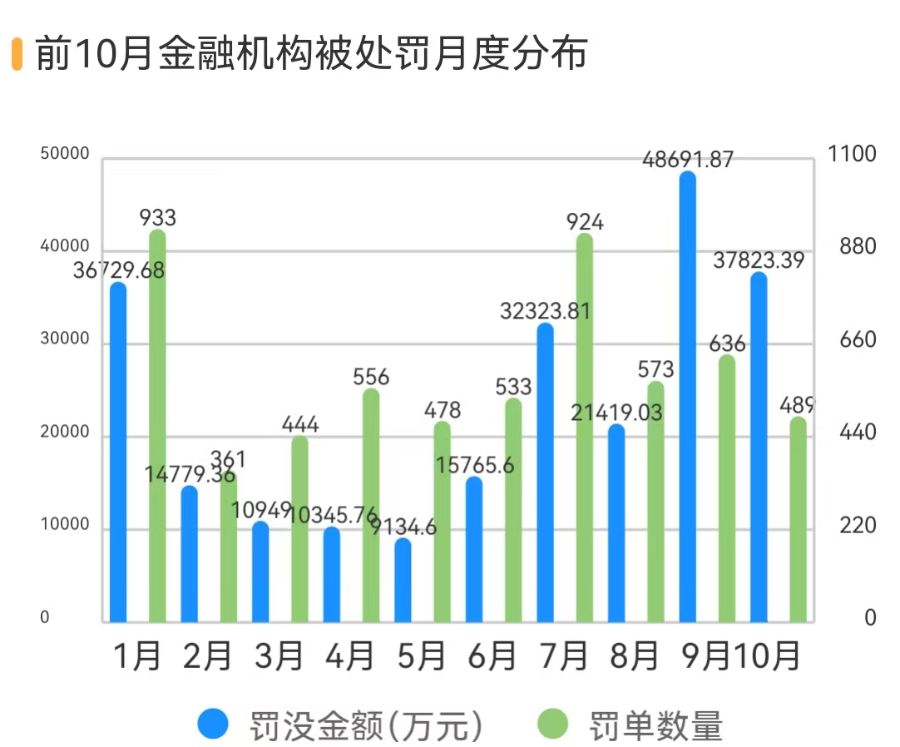
Core Insights - In October, financial institutions received 489 fines, a year-on-year decrease of 2.59%, but the total penalty amount reached 378 million yuan, a significant increase of 223.08% compared to the previous year [1][3] Summary by Categories Penalty Overview - The number of fines issued in October decreased compared to the first three months of the year, but the total penalty amount remains substantial, with October being the second highest for penalties this year, following September [1][3] Institution-Specific Penalties - Banks received 310 fines, a month-on-month decrease of 24.39% - Insurance companies received 108 fines, a month-on-month decrease of 16.92% - Securities firms received 16 fines, a month-on-month decrease of 42.86% - Futures and private equity fines also decreased, while insurance asset management companies remained stable compared to the previous month [5] Major Fines - Six fines in October exceeded 10 million yuan, with the largest fines against banks for issues related to corporate governance, loans, interbank transactions, and asset quality management [8][9] Compliance Cases - Five major compliance cases were highlighted, including: 1. Wenkang Securities faced criticism for issuing incorrect bond rates and results due to improper management of the issuance process [10] 2. Jintou Futures was ordered to rectify its operations after significant losses due to ineffective risk management [11] 3. A rare case of a bank president's qualification being denied due to non-compliance with regulatory requirements [13] Compliance Trends - There was a notable increase in penalties for improper loan issuance, with 19 fines issued, reflecting a year-on-year increase of 111.11% [14] - Penalties related to internal control management also rose, with 32 fines issued, a month-on-month increase of 52.38% [15] Penalty Rankings - China Agricultural Development Bank had the highest penalty amount in October, continuing its trend from the third quarter [18] - Zhongcheng Trust received the largest penalty among non-bank institutions, totaling 6.6 million yuan for various compliance violations [21]

平安银行股份有限公司关于聘任宋菁为资产托管部副总经理的公告
Zheng Quan Ri Bao Wang· 2025-11-05 04:49
平安银行股份有限公司 2025年11月5日 平安银行股份有限公司研究决定,聘任宋菁为平安银行股份有限公司资产托管部副总经理。 特此公告。 ...

平安银行股份有限公司关于资产托管部副总经理(主持工作)离任的公告
Zheng Quan Ri Bao Zhi Sheng· 2025-11-05 04:39
Core Viewpoint - Ping An Bank has announced that Huang Wei will no longer serve as the Deputy General Manager of the Asset Custody Department (acting) [1] Group 1 - The company has made a decision based on operational needs regarding the leadership of the Asset Custody Department [1] - The company will comply with regulatory requirements to manage the departure process of the Deputy General Manager of the Asset Custody Department [1]
中金:银行已进入高质量发展阶段 高股息投资成为主要范式
智通财经网· 2025-11-05 00:09
Group 1 - The core viewpoint is that stability is likely to characterize the banking industry's performance in 2026, with expected steady year-on-year growth in revenue and profit for listed banks, primarily due to a further narrowing of net interest margin pressure [1][2] - Credit growth may slow down further, driven by weak credit demand and insufficient risk compensation, while social financing growth will depend on fiscal policy [1][2] - After several years of fee reductions and the digestion of high base pressure, the growth rate of fee income is expected to stabilize and rebound [2] Group 2 - Small and micro enterprises, along with retail customer exposures, remain the main sources of non-performing loans, but corporate business exposures are expected to maintain stability or even show an improving trend in net non-performing loan generation rates [2] - The industry is likely to see accelerated supply-side reforms, evidenced by a rapid decrease in the number of bank licenses, leading to improved competition and operational landscape [2] - The banking sector has entered a high-quality development phase, with only a few listed banks achieving double-digit growth, and high-dividend investment becoming the main paradigm [3]
银行业2025年三季报综述:业绩稳健性凸显,引领银行价值回归
Shenwan Hongyuan Securities· 2025-11-04 14:41
Investment Rating - The report maintains a positive outlook on the banking sector, indicating a potential return to a valuation of 1 times net asset value [4][7]. Core Insights - The banking sector has demonstrated steady performance, with a year-to-date revenue growth of 0.8% and a net profit growth of 1.5% for the first nine months of 2025, reflecting a stable regulatory environment supporting bank profitability [10][14]. - The report highlights a shift in focus from scale to balance in credit growth, with banks increasingly pursuing a "quantity-price balance" strategy [4][7]. - The cost of liabilities has improved more significantly than the decline in asset pricing, leading to a stabilization of net interest margins, which is expected to continue into the next year [4][7]. - Asset quality remains stable but shows signs of divergence, particularly with rising risks in small and micro businesses [4][7]. - The report suggests that the current dividend yield of the banking sector has returned to an attractive range, indicating a significant disconnect between stable earnings and stock holdings, which could lead to a value recovery [4][7]. Summary by Sections Performance Overview - The banking sector's performance has been characterized by a steady increase in revenue and profit, with state-owned banks showing better-than-expected stability and regional banks leading in performance [11][12][15]. - The report notes that the revenue growth of state-owned banks has turned positive, with non-interest income contributing significantly to this growth [12][15]. Credit Growth and Strategy - The report indicates a gradual abandonment of scale-driven growth, with banks focusing on achieving a balance between volume and pricing in their lending practices [4][7]. - The credit growth rate for listed banks decreased by 0.3 percentage points to 7.7% in Q3 2025, with state-owned banks maintaining a growth rate of approximately 8.5% [4][7]. Profitability and Asset Quality - The net interest margin for listed banks remained stable at 1.5%, with a slight quarter-on-quarter increase of 3 basis points in Q3 2025 [4][7]. - The overall non-performing loan ratio remained stable at 1.22%, indicating manageable risk levels across the sector [4][7]. Investment Recommendations - The report recommends focusing on leading banks and undervalued regional banks as key investment opportunities, suggesting that the recovery in valuations is supported by stable earnings and attractive dividend yields [4][7].

股份行前三季度盈利承压 4家营收净利双降
Di Yi Cai Jing· 2025-11-04 12:24
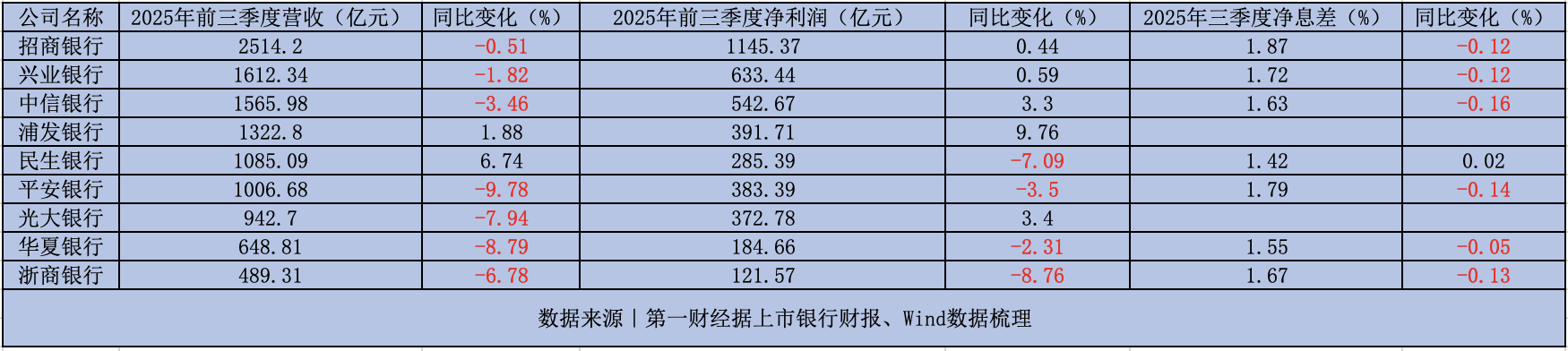
Core Insights - The overall profitability of A-share listed joint-stock banks faces significant pressure, with both revenue and net profit showing a year-on-year decline [1][2] - Among the nine listed banks, total revenue reached approximately 1.12 trillion yuan, down 2.56% year-on-year, while net profit was 406.1 billion yuan, with a nearly 1% decrease [1][2] Revenue and Profit Performance - The top-performing bank, China Merchants Bank, reported revenue of 251.42 billion yuan, a slight decline of 0.51%, and net profit of 114.54 billion yuan [3][5] - Shanghai Pudong Development Bank was the only bank to achieve "double growth," with revenue increasing by 1.88% to 132.28 billion yuan and net profit rising by 9.76% to 39.17 billion yuan [5] - Four banks, including Ping An Bank and Huaxia Bank, experienced a decline in both revenue and net profit [5][6] Net Interest Margin and Asset Quality - The net interest margin (NIM) remains under pressure but shows signs of stabilization, with most banks reporting a year-on-year decline [7][8] - The average non-performing loan (NPL) ratio for the nine banks was 1.24%, with China Merchants Bank having the lowest at 0.94% [10][11] - The overall asset quality remains stable, with five banks reporting a decrease in NPL ratios compared to the end of the previous year [1][11] Non-Interest Income and Market Trends - Non-interest income growth is uneven, with China Merchants Bank leading in wealth management, achieving a nearly 20% increase in fee and commission income [9] - The capital market's increased activity has positively impacted some banks' agency and custody businesses, although overall non-interest income growth remains weaker than that of state-owned banks [9] Risk Management and Future Outlook - The provisioning coverage ratio is under pressure, with seven out of nine banks showing a decline [12][13] - Analysts suggest that the asset quality of small and micro loans remains a concern, but overall risks are manageable due to ongoing policy support [13]


股份行前三季度盈利承压,4家营收净利双降
Di Yi Cai Jing Zi Xun· 2025-11-04 11:40
Core Insights - The overall profitability of A-share listed joint-stock banks faces significant pressure, with both revenue and net profit showing a year-on-year decline [1][2] - Among the nine listed banks, total revenue reached approximately 1.12 trillion yuan, down 2.56% year-on-year, while net profit was 406.1 billion yuan, with a nearly 1% decrease [2][3] - Leading banks like China Merchants Bank and Shanghai Pudong Development Bank performed relatively well, with the latter being the only bank to achieve "double growth" in both revenue and net profit [4] Revenue and Profit Performance - China Merchants Bank led with a revenue of 251.42 billion yuan, a slight decline of 0.51%, and a net profit of 114.54 billion yuan, an increase of 0.44% [3][4] - Shanghai Pudong Development Bank reported a revenue increase of 1.88% to 132.28 billion yuan and a net profit growth of 9.76% to 39.17 billion yuan [4] - Other banks like Ping An Bank, Everbright Bank, Huaxia Bank, and Zheshang Bank experienced declines in both revenue and net profit [4] Net Interest Margin and Asset Quality - The net interest margin (NIM) remains low but shows signs of stabilization, with five banks reporting a decrease in non-performing loan (NPL) ratios compared to the end of the previous year [1][6] - The average NPL ratio for the nine banks was 1.24%, with China Merchants Bank having the lowest at 0.94% and Huaxia Bank the highest at 1.58% [9][10] - The NIM for major banks like China Merchants Bank, Ping An Bank, and Industrial Bank showed a year-on-year decline, while Minsheng Bank saw a slight increase [6][7] Non-Interest Income and Market Trends - Non-interest income growth varied, with China Merchants Bank leading in wealth management, achieving a nearly 20% increase in fee and commission income [8] - The capital market's increased activity has positively impacted some banks' agency and custody businesses, although overall non-interest income growth remains weaker than that of state-owned banks [8] - Analysts suggest that wealth management, investment banking, and custody services are becoming new differentiators among joint-stock banks [8] Asset Quality and Risk Management - The overall asset quality of joint-stock banks remains stable, with a slight decline in NPL ratios and sufficient risk coverage [9][11] - Seven out of nine banks experienced a decline in their provision coverage ratios, with Ping An Bank showing the largest drop [11] - The risk management focus includes monitoring the asset quality of small and micro enterprises and unsecured retail loans, with expectations for stable asset quality in the coming year [12]
9家股份行三季报透视:5家不良率降,零售AUM增长成亮点
Nan Fang Du Shi Bao· 2025-11-04 09:59
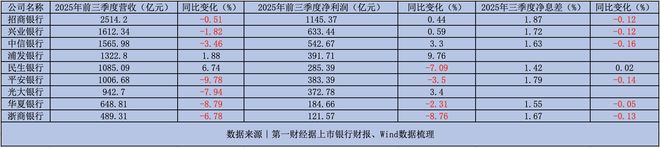
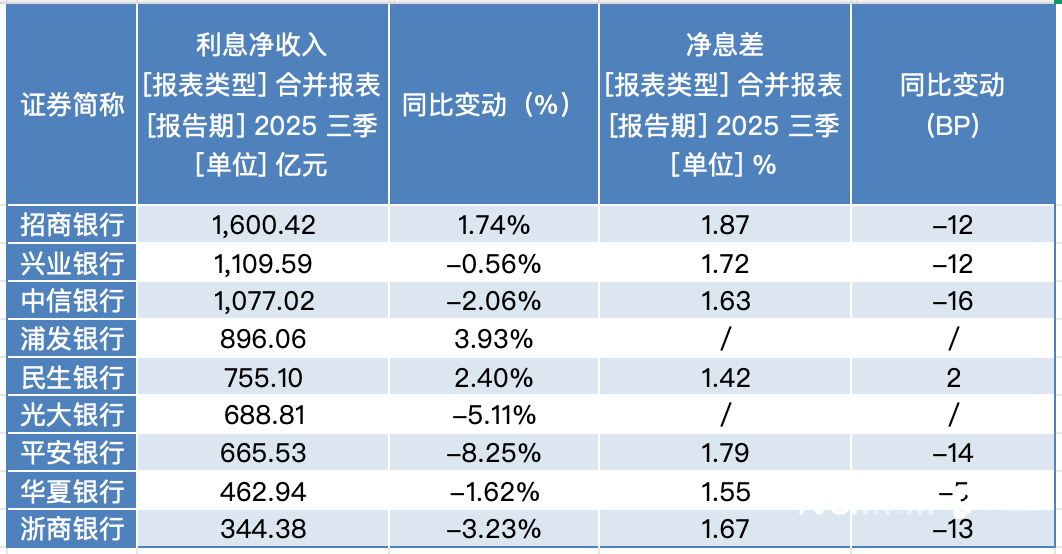
Core Viewpoint - The performance of nine A-share listed joint-stock banks in the third quarter of 2025 shows a mixed picture, with seven banks experiencing a year-on-year decline in operating income and five banks seeing a drop in net profit. Only Shanghai Pudong Development Bank achieved growth in both metrics [1][2]. Financial Performance - Among the nine banks, only Shanghai Pudong Development Bank and Minsheng Bank reported year-on-year growth in operating income, while four banks, including China Merchants Bank and Industrial Bank, saw an increase in net profit [2][3]. - China Merchants Bank led in operating income with CNY 251.42 billion, followed by Industrial Bank and CITIC Bank with CNY 161.23 billion and CNY 156.60 billion, respectively. Zhejiang Commercial Bank ranked last with CNY 48.93 billion [2]. - Minsheng Bank recorded the highest operating income growth rate at 6.74%, while Ping An Bank experienced the most significant decline at -9.78% [2]. Net Profit Analysis - China Merchants Bank maintained the highest net profit at CNY 113.77 billion, with a slight increase of 0.52%. Shanghai Pudong Development Bank saw a notable increase of 10.21% in net profit [3]. - The only bank to achieve growth in both operating income and net profit was Shanghai Pudong Development Bank, which reported a 1.88% increase in operating income [3]. Interest Income and Net Interest Margin - Six banks reported a year-on-year decline in net interest income, with the overall industry facing pressure on net interest margins, although the rate of decline has narrowed [4][6]. - China Merchants Bank led in net interest income with CNY 160.04 billion, showing a 1.74% increase, while Ping An Bank faced the largest decline at -8.25% [5][6]. Asset Quality - The asset quality of the banks showed mixed results, with five banks reporting a decline in non-performing loan (NPL) ratios, while three banks saw an increase [7][9]. - China Merchants Bank maintained the best asset quality with an NPL ratio of 0.94%, while Ping An Bank's NPL ratio was 1.05% [8][9]. Retail and Corporate Loan Trends - The third quarter of 2025 revealed a shift in loan structure, with corporate loans expanding while retail loans showed weakness. Three banks reported negative growth in retail loans [10][12]. - Among the banks, only Shanghai Pudong Development Bank, China Merchants Bank, and CITIC Bank saw growth in personal loans, while others experienced declines [11][12]. Retail Asset Under Management (AUM) - Several banks reported strong growth in retail AUM, with China Merchants Bank managing CNY 16.60 trillion in retail customer assets, an increase of 11.19% [12][14]. - Shanghai Pudong Development Bank's retail AUM reached CNY 4.62 trillion, reflecting a growth of 19.07% [13].


股份制银行板块11月4日涨2.44%,中信银行领涨,主力资金净流入17.63亿元
Zheng Xing Xing Ye Ri Bao· 2025-11-04 08:48
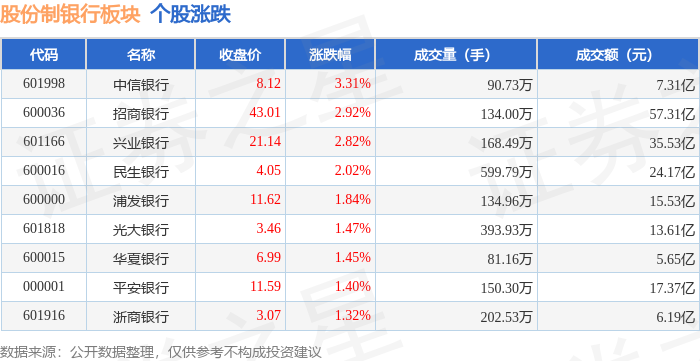
Core Viewpoint - The banking sector, particularly the joint-stock banks, experienced a notable increase of 2.44% on November 4, with CITIC Bank leading the gains, despite the overall decline in major stock indices [1] Group 1: Market Performance - The Shanghai Composite Index closed at 3960.19, down 0.41%, while the Shenzhen Component Index closed at 13175.22, down 1.71% [1] - CITIC Bank's stock price rose by 3.31% to 8.12, with a trading volume of 907,300 shares and a transaction value of 731 million [1] - Other notable performers included China Merchants Bank, which increased by 2.92% to 43.01, and Industrial Bank, which rose by 2.82% to 21.14 [1] Group 2: Capital Flow - The joint-stock banking sector saw a net inflow of 1.763 billion in main funds, while retail investors experienced a net outflow of 664 million [1] - Specific banks like Shanghai Pudong Development Bank had a main fund net inflow of 413 million, while retail investors saw a net outflow of 251 million [2] - Ping An Bank recorded a main fund net inflow of 294 million, with retail investors also experiencing a net outflow of 165 million [2]