PAB(000001)

Search documents
5家银行不良率下降,零售AUM增长成亮点
Nan Fang Du Shi Bao· 2025-11-06 23:10
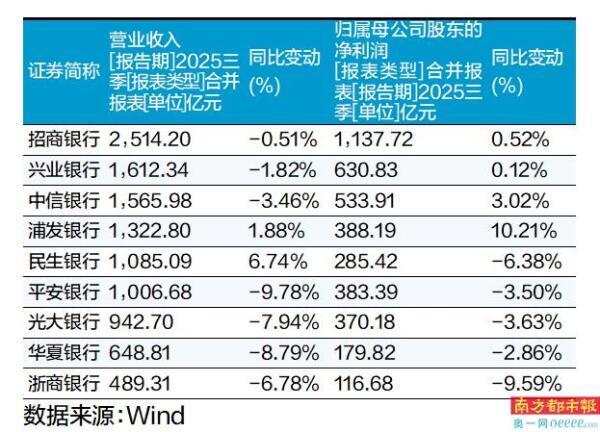
Core Viewpoint - The performance of A-share listed joint-stock banks in the third quarter of 2025 shows a mixed picture, with seven banks experiencing a year-on-year decline in operating income and five banks reporting a drop in net profit. Only Shanghai Pudong Development Bank achieved growth in both metrics [1][2][3]. Group 1: Revenue Performance - Among the nine listed joint-stock banks, only Shanghai Pudong Development Bank and Minsheng Bank reported year-on-year revenue growth, with Minsheng Bank achieving the highest growth rate of 6.74% [2]. - China Merchants Bank led in revenue scale with 2,514.20 billion yuan, followed by Industrial Bank and CITIC Bank with 1,612.34 billion yuan and 1,565.98 billion yuan, respectively [2][3]. - Ping An Bank experienced the most significant revenue decline at -9.78%, while several other banks, including Everbright Bank and Huaxia Bank, also saw declines exceeding 6% [2][3]. Group 2: Net Profit Analysis - China Merchants Bank maintained the highest net profit at 1,137.72 billion yuan, with a slight increase of 0.52% year-on-year. Shanghai Pudong Development Bank saw a notable increase of 10.21% in net profit [3]. - The banks that reported a decline in net profit include Zhejiang Commercial Bank, which had the largest drop at -9.59%, along with Minsheng Bank, Ping An Bank, and others experiencing varying degrees of decline [3]. Group 3: Interest Income and Net Interest Margin - Interest income growth varied significantly, with China Merchants Bank leading at 1,600.42 billion yuan and a 1.74% increase. Shanghai Pudong Development Bank had the highest growth rate in interest income at 3.93% [5]. - The net interest margin faced pressure across the industry, with CITIC Bank experiencing the largest decline of 16 basis points. Only Minsheng Bank reported a slight increase of 2 basis points [5][6]. Group 4: Asset Quality and Provision Coverage - The asset quality of joint-stock banks showed resilience, with a mixed performance in non-performing loan (NPL) ratios. China Merchants Bank had the best NPL ratio at 0.94%, while several banks saw slight increases in their NPL ratios [8]. - Provision coverage ratios decreased for most banks, with China Merchants Bank still leading at 405.93%, despite a decline of 6.05 percentage points [9][10]. Group 5: Loan Structure - The loan structure indicates a shift towards corporate loans, with all five banks reporting growth in corporate loans, while personal loan growth was weak for several banks [11][12]. - China Merchants Bank led in personal loan balance with nearly 3.7 trillion yuan, while corporate loan growth was particularly strong for CITIC Bank, which saw a 10.45% increase [11][12].





融通旗下部分开放式基金新增国联民生证券股份有限公司为销售机构及开通相关业务的公告
Shang Hai Zheng Quan Bao· 2025-11-06 18:38
Group 1 - The core announcement is about the partnership between Rongtong Fund Management Co., Ltd. and Guolian Minsheng Securities Co., Ltd. to enhance investment services starting from November 7, 2025 [1] - Rongtong Fund will allow Guolian Minsheng Securities to sell certain open-end funds and will introduce regular investment and conversion services [1] - Investors can only convert fund shares within the same fee structure, meaning front-end charged shares can only be converted to other front-end charged shares, and the same applies for back-end charged shares [1][2] Group 2 - The announcement also details the addition of Ping An Bank as a sales platform for the Rongtong Tongheng 63-month regular open bond fund, effective from November 7, 2025 [6] - Investors using the Ping An Bank platform will benefit from a discount on the front-end subscription fee for the fund, with specific discount rates to be announced by the sales institution [6] - The fee discount applies only to normal subscription periods and does not include back-end fees or fees during the fund's fundraising period [6]


银行业“反内卷”热潮涌动,基层“最后一公里”待破局
Bei Jing Shang Bao· 2025-11-06 13:35
Core Viewpoint - The banking industry is undergoing a profound transformation from competitive logic to development models, driven by policies aimed at preventing "involution" and promoting efficiency [1][3]. Group 1: Industry Response - Multiple banking associations and institutions are actively responding to the call to end "involution" by promoting self-regulation and discouraging blind expansion and price wars [3][4]. - The Baise Banking Association has initiated self-regulatory agreements among 27 member banks to prohibit malicious low-price competition and encourage innovation and service enhancement [3][4]. - Other regions, such as Qingyang, are also exploring local strategies to resist "involution" and promote sustainable development [4]. Group 2: Institutional Actions - Some banks are implementing specific measures to combat "involution," including commitments to compliance, stable growth, and reasonable pricing [5]. - Major banks like ICBC and Guangfa Bank have emphasized the importance of resisting "involution" and focusing on long-term value rather than short-term metrics [5][6]. Group 3: Challenges in Execution - Despite the industry's efforts, there are still significant challenges at the grassroots level, including the persistence of practices like indicator swapping among employees [6][7]. - The pressure of year-end performance assessments leads to aggressive marketing tactics, which can undermine the goals of reducing "involution" [6][8]. Group 4: Recommendations for Change - Experts suggest that the banking sector should shift from focusing on short-term metrics to long-term indicators such as customer retention and satisfaction [9][10]. - A three-dimensional governance framework is proposed, emphasizing regulatory guidance, industry collaboration, and institutional transformation to shift the competitive logic from "scale competition" to "value creation" [9][10]. Group 5: Strategic Transformation - Banks are encouraged to transition from being "funding intermediaries" to "service intermediaries," focusing on wealth management, supply chain finance, and digital finance [11]. - The transformation requires banks to leverage their core advantages and integrate into broader economic ecosystems while nurturing specialized talent [11].


上市银行哪家强?齐鲁银行净利增16.14%,常熟银行净息差2.57%保持领先
Mei Ri Jing Ji Xin Wen· 2025-11-06 10:23
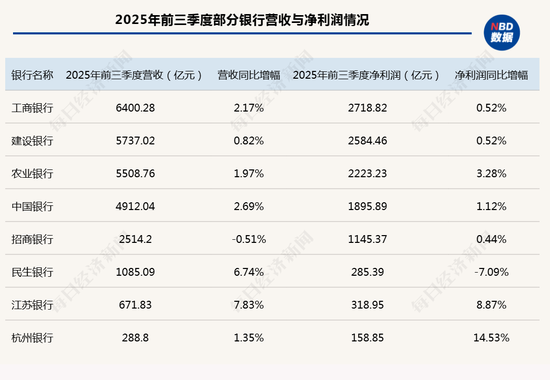
Core Insights - The overall performance of A-share listed banks in the first three quarters of 2025 reflects a stable total, improved structure, and significant differentiation amid a gradually recovering macroeconomic environment [1][10] - Revenue growth remains robust, with over 60% of listed banks reporting year-on-year increases, driven by optimized asset structures and a focus on non-interest income [2][10] - The net interest margin (NIM), a key profitability driver, is under pressure, posing challenges to the banking industry's profit model [1][7] Revenue Growth Resilience - More than 60% of A-share listed banks achieved positive year-on-year revenue growth in the first three quarters of 2025, indicating effective support for the real economy [2][4] - There is a clear structural differentiation in growth dynamics among banks of different sizes, with larger banks showing stable revenue while some smaller banks exhibit stronger growth [4][10] Bank Performance Data - Key performance metrics for selected banks in the first three quarters of 2025 include: - Industrial and Commercial Bank of China: Revenue of 6400.28 billion, 2.17% growth; Net profit of 2718.82 billion, 0.52% growth - Agricultural Bank of China: Revenue of 5508.76 billion, 1.97% growth; Net profit of 2223.23 billion, 3.28% growth - Minsheng Bank: Revenue of 1085.09 billion, 6.74% decline; Net profit of 285.39 billion, 7.09% decline - Jiangsu Bank: Revenue of 671.83 billion, 7.83% growth; Net profit of 318.95 billion, 8.87% growth [3][4] Performance of State-Owned Banks - State-owned banks maintain a leading position in revenue due to their large asset scale and extensive customer base, with revenue growth rates above 1.5% for major banks [4][6] - Despite a stable net profit growth, the overall growth rates are moderate, reflecting the challenges of achieving high growth from a large base [4][6] Performance of Smaller Banks - Some smaller banks and regional banks demonstrate significant growth potential, with Minsheng Bank and Jiangsu Bank showing revenue growth rates of 6.74% and 7.83%, respectively [4][6] - The ability of these banks to achieve rapid profit growth is attributed to precise customer targeting, effective cost management, and supplementary income from non-interest sources [6][10] Net Interest Margin Challenges - The net interest margin for listed banks is generally declining, primarily due to factors such as the decrease in loan market quotation rates and adjustments in existing mortgage rates [7][8] - State-owned banks and some joint-stock banks experience a decline in NIM by approximately 15 basis points, while Postal Savings Bank sees a more significant drop of 21 basis points [8][9] Resilience in NIM - Some banks, like Minsheng Bank, show resilience with a slight increase in NIM, indicating effective business structure management in response to interest rate fluctuations [9][10] - Regional banks like Ningbo Bank exhibit smaller declines in NIM compared to the industry average, showcasing the effectiveness of their localized service models [9][10] Future Outlook - The banking sector's operating environment is expected to gradually improve with the continued effectiveness of macroeconomic policies, although differentiation among institutions is likely to persist [10] - Large banks need to leverage technology to enhance their comprehensive service advantages, while smaller banks must focus on deepening their niche markets to establish competitive strengths [10]




警惕平安信用卡征信修复陷阱,黑灰产利益链暗藏玄机
Jin Tou Wang· 2025-11-06 08:14
Core Viewpoint - The rise of illegal proxy complaint services in the credit card sector has led to a systematic and industrialized approach, exploiting vulnerable debtors through deceptive practices and false advertising [1][2]. Group 1: Industry Trends - The illegal proxy complaint industry is increasingly using social media and short video platforms to promote fraudulent services, claiming to have internal bank partnerships that can eliminate bad credit records at no cost [1]. - The operational model of these illegal services is highly covert, luring debtors with "free consultations" and subsequently charging high fees under the guise of "deposit + final payment" [1]. Group 2: Consumer Impact - Debtors, such as individual Zhang, have fallen victim to these scams, paying significant sums (e.g., 5,000 yuan) for services that were never delivered, leading to personal information being sold to loan platforms and resulting in harassment [6]. - The fraudulent activities have severe consequences, including being placed on risk lists by banks due to falsified documents, which further complicates the debtor's financial situation and leads to a cycle of increasing debt [6]. Group 3: Regulatory Response - In response to the rampant illegal activities, regulatory bodies and financial institutions are developing a multi-dimensional governance system to disrupt the customer acquisition chain of these black and gray market operations [7]. - Initiatives such as the "Qinglang Pujiang" special action plan for 2025 will focus on illegal financial intermediaries, while financial institutions are employing big data models to identify and block abnormal complaint behaviors [7].

翻遍9家银行财报,我发现行业洗牌的秘密藏在这些数字里
3 6 Ke· 2025-11-06 02:03
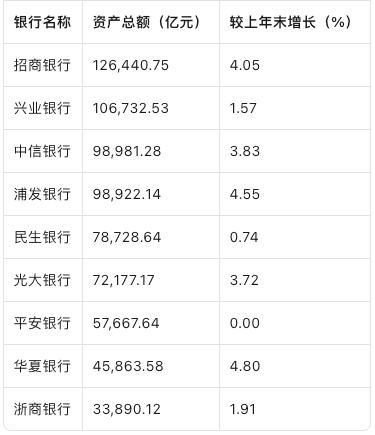
Core Insights - The overall performance of the nine listed joint-stock banks in China showed a decline in both revenue and net profit for the first three quarters of the year, with total operating income at 1.12 trillion yuan, down 2.56% year-on-year, and net profit at 406.1 billion yuan, down nearly 1% [1][3] Group 1: Performance Overview - Among the nine banks, four experienced declines in both revenue and net profit, while some banks managed to achieve growth in both metrics [1][4] - The top joint-stock banks by asset size are China Merchants Bank (12.64 trillion yuan), Industrial Bank (10.67 trillion yuan), and CITIC Bank, with Shanghai Pudong Development Bank showing the fastest growth rate at 4.55% [1][2] Group 2: Revenue and Profit Analysis - Only Minsheng Bank and Shanghai Pudong Development Bank reported year-on-year revenue growth, with increases of 6.74% and 1.88%, respectively; the remaining seven banks saw revenue declines, with Ping An Bank experiencing the largest drop at 9.8% [3][4] - In terms of net profit, only four banks, including Shanghai Pudong Development Bank, reported growth, with the latter achieving a 10.21% increase, making it the leader in profit growth among joint-stock banks [4] Group 3: Net Interest Income and Margin - Net interest income, a key indicator of banks' operating income, showed mixed results, with only three banks reporting growth; China Merchants Bank led with 160.04 billion yuan, up 1.74% [5][6] - The net interest margin (NIM) faced pressure, with most banks experiencing declines; China Merchants Bank maintained the highest NIM at 1.87%, while CITIC Bank saw the largest drop of 16 basis points [7] Group 4: Asset Quality and Risk Management - The non-performing loan (NPL) ratio improved for most banks, with China Merchants Bank having the lowest NPL ratio at 0.94% [9][10] - However, the provision coverage ratio decreased for seven banks, with Ping An Bank showing the largest decline of 21.11 percentage points; Shanghai Pudong Development Bank's coverage ratio increased by 11.08 percentage points, indicating enhanced risk mitigation [10][11]


债市成拖累?多家银行非息收入承压,央行重启国债买卖有何利好
Xin Lang Cai Jing· 2025-11-06 00:38
Core Viewpoint - The bond market's volatility has significantly impacted the non-interest income and overall revenue growth of listed banks in China during the first three quarters of the year [1][3][7]. Group 1: Non-Interest Income Decline - Among 42 A-share listed banks, 24 reported a year-on-year decline in non-interest income, with 8 banks experiencing a drop in net investment income [1][2]. - For instance, China Merchants Bank reported a 4.23% decrease in non-interest net income, primarily due to reduced bond and fund investment returns [3][4]. - Ping An Bank's revenue fell by 9.8%, influenced by declining loan rates and market volatility affecting non-interest income [3]. Group 2: Fair Value Changes - The significant drop in fair value changes has also been a major factor in revenue growth decline, with China Merchants Bank reporting a cumulative loss of 8.827 billion yuan in fair value changes for the first three quarters [4]. - Other banks like Everbright Bank and Huaxia Bank also reported losses in fair value changes, amounting to 4.982 billion yuan and 4.505 billion yuan, respectively [4]. - Analysts noted that fair value changes are highly influenced by bond market fluctuations, with smaller banks being more affected due to a higher proportion of FVTPL assets [4]. Group 3: Future Outlook and Central Bank Actions - The People's Bank of China announced the resumption of government bond trading operations, which is expected to help lower bond yields and benefit banks' non-interest income [11][12]. - Some bank executives expressed uncertainty about future non-interest income growth due to ongoing market volatility, suggesting that the bond market may remain in a fluctuating state [9][10]. - Analysts believe that the resumption of government bond trading will provide a safety net for the bond market, potentially stabilizing yields and supporting both bond and equity markets in the long term [12][13].

翻遍9家银行财报,我发现行业洗牌的秘密藏在这些数字里
凤凰网财经· 2025-11-05 13:27
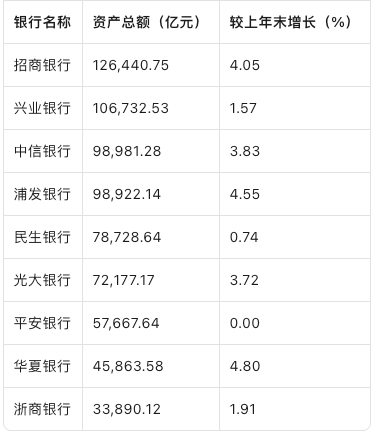
Core Viewpoint - The overall performance of the nine listed joint-stock banks in China showed a decline in both revenue and net profit for the first three quarters, indicating a challenging environment for the banking sector [2][5]. Group 1: Overall Performance - The nine joint-stock banks collectively achieved an operating income of 1.12 trillion yuan, a year-on-year decrease of 2.56%, and a net profit of 406.1 billion yuan, down nearly 1% year-on-year [2][5]. - There is a notable divergence in performance among the banks, with four banks experiencing declines in both revenue and profit, while others managed to achieve growth [2][5]. Group 2: Individual Bank Performance - As of the end of Q3, China Merchants Bank led with total assets of 12.64 trillion yuan, followed by Industrial Bank at 10.67 trillion yuan, with Shanghai Pudong Development Bank showing the fastest growth rate of 4.55% [3][4]. - Only Minsheng Bank and Shanghai Pudong Development Bank reported year-on-year revenue growth of 6.74% and 1.88%, respectively, while the remaining seven banks saw declines, with Ping An Bank experiencing the largest drop at 9.8% [7][8]. Group 3: Net Interest Income - Among the nine banks, only three reported an increase in net interest income, with China Merchants Bank leading at 160.04 billion yuan, a growth of 1.74% [11][12]. - The net interest margin pressure remains a common challenge, with most banks experiencing a decline in this metric, except for Minsheng Bank, which saw a slight increase [13][14]. Group 4: Asset Quality - Most banks reported a decrease in non-performing loan (NPL) ratios, with China Merchants Bank having the lowest at 0.94%, while the others ranged between 1% and 1.5% [15][16]. - The provision coverage ratio decreased for most banks, with Ping An Bank showing the largest decline of 21.11 percentage points [17]. Group 5: Future Outlook - The banks face challenges in narrowing net interest margins in a low-interest-rate environment, and the potential impact of "deposit migration" due to stock market recovery will test their adaptability [17].

翻遍9家银行财报,行业洗牌的秘密藏在这些数字里
Feng Huang Wang Cai Jing· 2025-11-05 13:19
Core Insights - The overall performance of the nine listed joint-stock banks in China showed a decline in both revenue and net profit for the first three quarters, with total operating income of 1.12 trillion yuan, down 2.56% year-on-year, and net profit of 406.1 billion yuan, down nearly 1% [1][4] Group 1: Performance Overview - Four banks experienced a decline in both revenue and net profit, while two banks, Minsheng Bank and Pudong Development Bank, achieved revenue growth [1][4] - Among the nine banks, only Pudong Development Bank reported both revenue and net profit growth, with a net profit increase of 10.21%, making it the leader in profit growth among joint-stock banks [5][11] Group 2: Asset Scale and Growth - As of the end of Q3, China Merchants Bank led with total assets of 12.64 trillion yuan, followed by Industrial Bank at 10.67 trillion yuan, with Pudong Development Bank showing the fastest growth rate of 4.55% [2][3] Group 3: Revenue and Profit Analysis - Revenue performance varied significantly, with only Minsheng Bank and Pudong Development Bank achieving positive year-on-year growth rates of 6.74% and 1.88%, respectively [4][5] - The largest revenue declines were observed in Ping An Bank and Everbright Bank, with decreases exceeding 6%, and Ping An Bank experiencing a 9.78% drop [4][5] Group 4: Net Interest Income and Margin - Net interest income showed a mixed performance, with only three banks reporting growth, while six banks saw declines, the largest drop being 8.25% at Ping An Bank [6][7] - The net interest margin pressure remains a challenge for all listed joint-stock banks, with only Minsheng Bank showing a slight increase in net interest margin [8] Group 5: Asset Quality - Most banks reported a decrease in non-performing loan (NPL) ratios, with China Merchants Bank having the lowest NPL ratio at 0.94% [9][10] - The provision coverage ratio declined for seven banks, with Ping An Bank experiencing the largest drop of 21.11 percentage points [10][11] Group 6: Future Outlook - The banks face challenges in narrowing net interest margins in a low-interest-rate environment, and the upcoming year-end performance will be critical for their strategies [11]
10月6家银行收到超千万罚单,有行长任职资格罕见被否
21世纪经济报道· 2025-11-05 11:29
Core Viewpoint - In October, financial institutions received 489 fines, a year-on-year decrease of 2.59%, but the total penalty amount reached 378 million yuan, a significant increase of 223.08% compared to the previous year [2]. Group 1: Penalty Overview - The number of fines in October decreased significantly compared to the first three months of the year, but the total penalty amount remains high, with October being the second highest this year after September [4]. - Regulatory bodies such as the National Financial Supervision Administration, the People's Bank of China, the China Securities Regulatory Commission, and the State Administration of Foreign Exchange all issued fewer fines in October [7]. - Banks received a total of 310 fines, a month-on-month decrease of 24.39%, while insurance companies received 108 fines, down 16.92%, and securities firms received 16 fines, down 42.86% [9]. Group 2: Major Fines - In October, six fines exceeded 10 million yuan, with the largest fine against a bank for issues related to corporate governance, loans, interbank transactions, bills, asset quality, and non-performing asset management [12]. - The largest fine was against the Bank of China, amounting to 97.9 million yuan, for various management failures [13]. - Other significant fines included China Minsheng Bank (28.62 million yuan), Agricultural Bank of China (27.2 million yuan), and Ping An Bank (18.8 million yuan) for similar management issues [14]. Group 3: Compliance Cases - Five Mining Securities was criticized for publishing incorrect coupon rates and issuance results during a bond issuance process, failing to comply with relevant regulations [15][16]. - Tianjin Investment Futures was ordered to rectify its operations due to ineffective risk isolation between its brokerage and proprietary trading businesses, leading to significant losses [17]. - A rare case occurred where the qualification of a bank president was denied due to non-compliance with regulatory requirements, highlighting increased scrutiny on corporate governance in small and medium-sized banks [18]. Group 4: Compliance Characteristics - There was a more than double increase in fines for illegal loan issuance, with 19 fines issued in October, reflecting a year-on-year increase of 111.11% [21]. - Fines related to internal control management also increased, with 32 fines issued in October, a month-on-month increase of 52.38% [23]. Group 5: Penalty Rankings - China Agricultural Development Bank had the highest penalty amount in the third quarter and continued to lead in October [27]. - Zhongcheng Trust received the largest penalty among non-bank institutions in October, with a fine of 6.6 million yuan for various violations [29].