TCL TECH.(000100)

Search documents
取消出口退税+“太空光伏”新亮点,光伏ETF(159857)标的指数涨超3%
Ge Long Hui· 2026-01-14 04:59
②天合光能分布式光伏组件最新报价上调3分/瓦; ③太空光伏作为商业航天板块中的核心分支,其"价值量大、通胀趋势、高壁垒"的逻辑优势正逐步 获得市场认可。 今日光伏板块延续近期涨势,TCL科技、太阳能分别涨7.98%、4.13%,带动光伏ETF(159857)标 的指数上涨3.54%,自去年12月17日以来累计上涨15%。 消息面上: ①今年4月1日起,取消光伏等产品增值税出口退税,预计将引发2026年Q1的抢出口潮。 开源证券指出,取消光伏产品出口退税,倒逼行业摒弃低价竞争策略,加速缺乏竞争力的产能、企 业出清,"反内卷"措施将利好头部企业。东兴证券认为太空光伏或成行业第二成长曲线,利好HJT、钙 钛矿新技术。 (责任编辑:刘静 HZ010) 【免责声明】本文仅代表作者本人观点,与和讯网无关。和讯网站对文中陈述、观点判断保持中立,不对所包含内容 的准确性、可靠性或完整性提供任何明示或暗示的保证。请读者仅作参考,并请自行承担全部责任。邮箱: news_center@staff.hexun.com 深市规模最大的光伏ETF(159857)跟踪的是光伏产业指数,该指数从市场中选取涉及硅料、硅 片、电池片、组件等制造 ...


TCL科技2025年预盈42.1亿元至45.5亿元,同比最高预增191%
Ju Chao Zi Xun· 2026-01-14 02:34
1月13日,TCL科技发布2025年度业绩预告,公司归属于上市公司股东的净利润预计盈利42.1亿元至45.5亿元,较上年同期的15.64亿元增长169%至191%;扣 除非经常性损益后归属于上市公司股东的净利润预计盈利28.9亿元至32.0亿元,较上年同期的2.98亿元大幅增长869%至973%;基本每股收益预计为0.2174元 至0.235元,较上年同期的0.0842元/股实现显著提升。 半导体材料板块中,中环领先秉持"国内领先,全球追赶"战略,巩固了国内领先地位,全年营业收入超57亿元,营收及出货量继续稳居国内第一。针对光伏 产业因产业链各环节过剩引发的剧烈波动,TCL中环坚持产品技术创新和全球化战略,推进组织变革以改善盈利能力,具体业绩情况可参考其同日发布的 2025年度业绩预告。 茂佳科技方面,持续扩大领先优势,TV代工业务稳固行业领先地位,显示器代工业务保持高速成长,同时积极拓展商用显示、电竞显示器等高附加值产品 代工领域,盈利能力显著增强。此外,公司其他业务板块经营稳健,持续为整体收益贡献力量。 对于业绩大幅变动的原因,公告指出,公司聚焦半导体显示、新能源光伏和半导体材料三大核心主业,持续强化经营 ...

TCL科技2025年归母净利预增169%-191%,达42.1-45.5亿元!
Cai Fu Zai Xian· 2026-01-14 02:16
Core Viewpoint - TCL Technology Group Co., Ltd. is expected to achieve a net profit attributable to shareholders of 4.21 billion to 4.55 billion yuan for the year 2025, representing a year-on-year increase of 169% to 191% [1] - The company has demonstrated strong profitability with a significant increase in net profit excluding non-recurring gains and losses, projected to be between 2.89 billion and 3.20 billion yuan, reflecting a year-on-year surge of 869% to 973% [1] Group 1: Financial Performance - TCL Huaxing has implemented a "leading strategy," achieving operating revenue exceeding 100 billion yuan and net profit surpassing 8 billion yuan, with operating cash flow net exceeding 40 billion yuan, indicating high-quality growth [1] - The company has maintained competitive advantages in large-size products such as TVs and commercial displays, while experiencing rapid growth in the small and medium-size product sectors [1] Group 2: Strategic Developments - TCL Technology completed the acquisition of 100% equity in the former LG Display (China) Co., Ltd., enhancing its capacity advantage in the large and medium-size LCD panel market [1] - The company has increased its stake in Shenzhen Huaxing Optoelectronics Semiconductor Display Technology Co., Ltd., effectively improving its net profit attributable to shareholders [1] Group 3: Technological Advancements - The expansion of TCL Huaxing's G5.5 generation printed OLED production line and the construction of the world's first high-generation printed OLED production line mark significant steps in the commercialization of next-generation display technologies [1] - In the semiconductor materials sector, TCL Zhonghuan has solidified its leading position in the domestic market, achieving operating revenue exceeding 5.7 billion yuan [2] Group 4: Market Position and Challenges - TCL Zhonghuan is experiencing significant fluctuations in the photovoltaic industry due to oversupply across various segments, but is focusing on product innovation and global strategies to improve profitability [2] - The company’s TV OEM business remains industry-leading, with display manufacturing experiencing rapid growth and enhanced profitability through the expansion into high-value-added product areas [2]
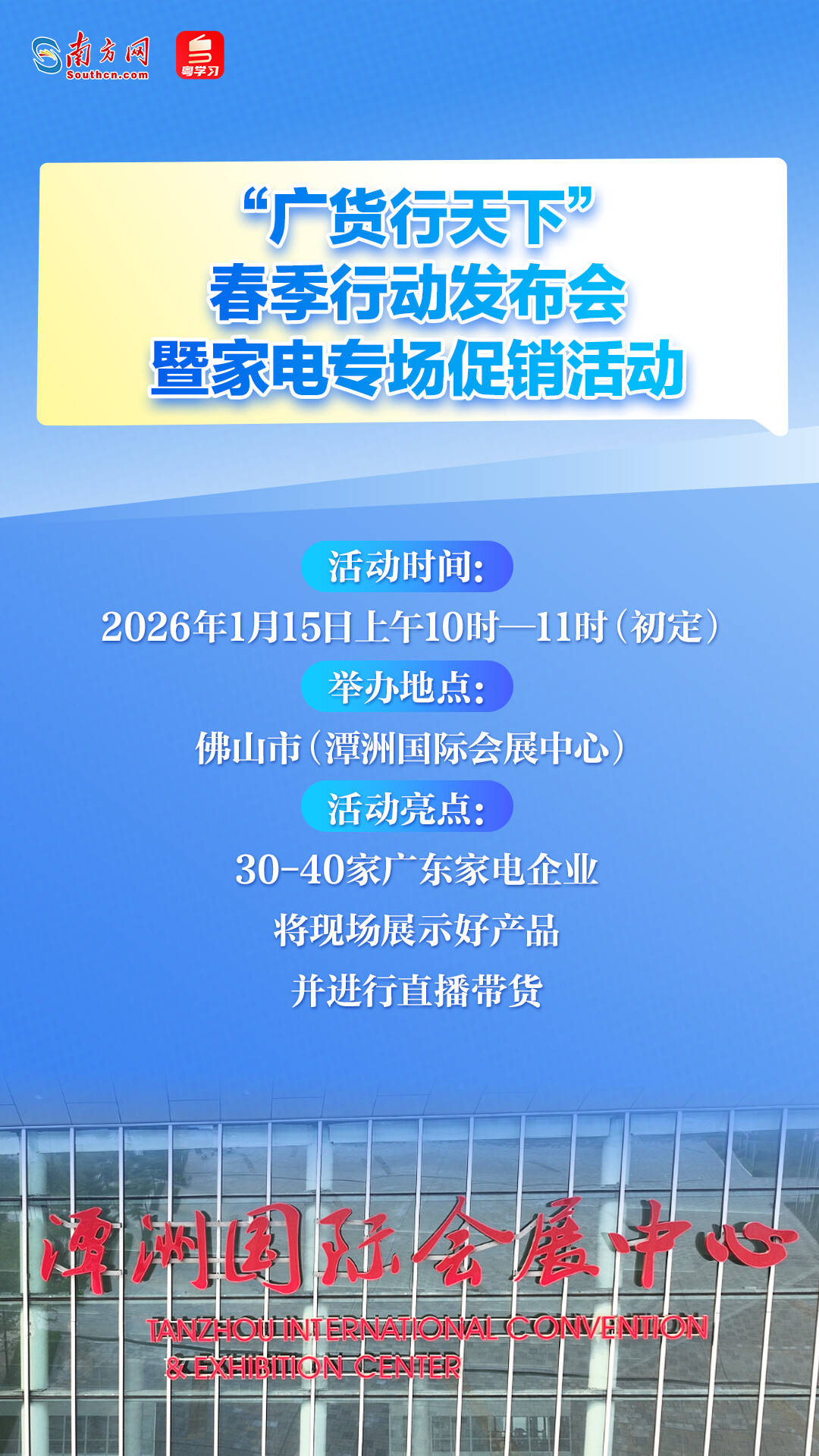
展十八般武艺!“广货行天下”春季行动明天启动
2 1 Shi Ji Jing Ji Bao Dao· 2026-01-14 01:45
Core Insights - Guangdong's manufacturing sector is showcasing its diverse capabilities, from smart home appliances to high-end mobile phones, fashion apparel, gourmet food, and modern agriculture, emphasizing innovation and quality development [1][2][6][9][21] Group 1: Food Industry - Guangdong's food industry is projected to achieve a revenue of 896.87 billion yuan in 2024, with soy sauce production accounting for over 60% of the national output and mooncake exports representing 90% of the total [2] - The food sector is characterized by a "smart brewing" approach, integrating traditional flavors with modern technology, leading to a "delicious revolution" driven by digitalization and biotechnology [2][3] - The province has established several billion-yuan sub-clusters in various food categories, including sauces, health foods, and traditional snacks, showcasing its strong industrial foundation [2] Group 2: Home Appliances - Guangdong's home appliance exports account for nearly 50% of the national total, with the Greater Bay Area's smart appliance industry representing about 30% of the global market [6][8] - The industry employs a "combination of strengths" strategy, integrating research, manufacturing, and branding while localizing production to penetrate global markets [6][8] - Major companies like Midea and Hisense are expanding their global footprint with numerous R&D centers and manufacturing bases, enhancing their competitiveness [6][8] Group 3: Agriculture - Guangdong's agricultural output is robust, with grain production capacity increasing from 12.38 million tons in 2021 to 12.98 million tons in 2025, achieving a record high in yield per unit area [9][10] - The province leads the nation in the production of lychees and pomelos, with the lychee industry alone generating over 9 billion yuan in value [12] - The agricultural sector is supported by a modernized marine ranching initiative, positioning Guangdong as a leader in fishery production and output [10][12] Group 4: Textile and Apparel - Guangdong's textile and apparel industry boasts the highest number of enterprises in the country, with 4,240 registered companies and a production output of 3.44 billion garments in 2024 [21][23] - The industry employs a "fast response and flexible attack" strategy, utilizing data-driven customization and intelligent production to enhance efficiency [21][23] - Significant advancements in digital transformation are evident, with companies adopting AI and big data to streamline operations and reduce production times [23][24] Group 5: Cultural and Tourism - Guangdong's cultural tourism sector is leveraging traditional customs and modern marketing strategies to attract visitors, particularly during the Spring Festival [17][19] - The "Please Come to Guangdong for the New Year" campaign aims to enhance the province's appeal as a travel destination through various cultural events and activities [19][20] - The integration of local culture, food, and entertainment is designed to create immersive experiences for tourists, showcasing Guangdong's rich heritage [17][21]



高猛增520%,A股批量晒出超级“战报”,一晚7家官宣净利翻倍
Zheng Quan Shi Bao· 2026-01-14 00:39
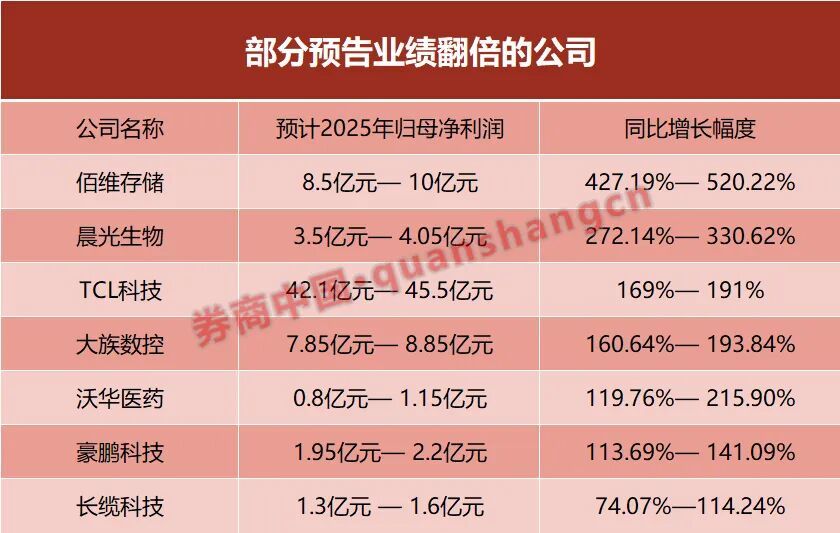
Core Viewpoint - A-share companies are expected to report significant profit growth for 2025, with several companies projecting year-on-year increases exceeding 100% [1][2]. Group 1: Company Performance Forecasts - Baiwei Storage anticipates a net profit of 850 million to 1 billion yuan for 2025, representing a year-on-year growth of 427.19% to 520.22% [2][4]. - Chenguang Biological expects a net profit of 350 million to 405 million yuan for 2025, with a growth rate of 272.14% to 330.62% [2][9]. - TCL Technology forecasts a net profit of 4.21 billion to 4.55 billion yuan for 2025, indicating a growth of 169% to 191% [2][9]. - Dazhu CNC predicts a net profit of 785 million to 885 million yuan for 2025, with a growth of 160.64% to 193.84% [2][10]. - WoHua Pharmaceutical expects a net profit of 80 million to 115 million yuan for 2025, with a growth rate of 119.76% to 215.90% [2][11]. - Haopeng Technology anticipates a net profit of 195 million to 220 million yuan for 2025, with a growth of 113.69% to 141.09% [2][11]. - Changlan Technology forecasts a net profit of 130 million to 160 million yuan for 2025, with a growth of 74.07% to 114.24% [2][11]. Group 2: Factors Driving Growth - Baiwei Storage attributes its significant profit growth to a recovery in storage prices and the delivery of key projects, leading to improved sales revenue and gross margins [4][5]. - Chenguang Biological's growth is driven by increased revenue and gross profit from its plant extraction business, particularly in chili red and other products [9]. - TCL Technology's growth is supported by its focus on semiconductor displays, new energy photovoltaics, and semiconductor materials, achieving high-quality growth with substantial revenue and cash flow [9]. - Dazhu CNC's growth is fueled by rising demand for high-layer boards and PCB manufacturing driven by AI infrastructure investments [10]. Group 3: Market Trends and Investment Opportunities - The report from CICC highlights that the upcoming earnings disclosures may reveal sectors and companies with improved or exceeding expectations, which could attract investor attention [2]. - Key areas of focus include sectors benefiting from AI technology, such as TMT, innovative pharmaceuticals, energy storage, and solid-state batteries, which are entering a growth cycle [11][12]. - The report suggests that companies with overseas expansion strategies, particularly in home appliances, engineering machinery, and non-ferrous metals, may present reliable growth opportunities [11][12].



TCL科技集团股份有限公司 2025年度业绩预告
Xin Lang Cai Jing· 2026-01-13 23:04
Core Viewpoint - TCL Technology Group expects a year-on-year increase in performance for the fiscal year 2025, focusing on sustainable high-quality development in its core businesses of semiconductor displays, new energy photovoltaics, and semiconductor materials [2][4]. Group 1: Performance Forecast - The performance forecast period is from January 1, 2025, to December 31, 2025, with anticipated growth compared to the previous year [2]. - The company has communicated with its auditing firm regarding the performance forecast, and there are no discrepancies in the data content as of now [3]. Group 2: Reasons for Performance Changes - TCL Huaxing is implementing a leading strategy, achieving over 100 billion yuan in revenue and exceeding 8 billion yuan in net profit, with operating cash flow exceeding 40 billion yuan, indicating high-quality growth [4]. - The company completed the acquisition of 100% of LG Display (China) Co., Ltd., enhancing its capacity layout for large and medium-sized LCD panels [4]. - TCL Zhonghuan achieved over 5.7 billion yuan in revenue, maintaining its leading position in the domestic semiconductor materials sector [4]. Group 3: Business Operations - The company is experiencing significant fluctuations in the photovoltaic industry but is committed to innovation and global strategies to improve profitability [5]. - The TV OEM business has solidified its industry-leading position, while the display OEM business is growing rapidly, expanding into high-value-added product areas [5]. - Other business segments are performing steadily and continue to contribute to overall revenue [6].
陆家嘴财经早餐2026年1月14日星期三
Wind万得· 2026-01-13 22:45
Group 1 - A-shares experienced a decline on January 13, with the Shanghai Composite Index down 0.64% to 4138.76 points, ending a 17-day winning streak. The total trading volume reached a record high of 3.7 trillion yuan [1] - The U.S. President Trump announced the cancellation of all talks with Iranian officials, and the U.S. State Department urged citizens to leave Iran immediately. Iran's military claimed to have enhanced its capabilities in response to security threats [1] - The Federal Reserve Chairman Powell is under criminal investigation, with former financial officials criticizing the Trump administration's actions. Global central bank leaders are drafting a statement in support of Powell [1] Group 2 - Trump threatened to impose a 25% tariff on countries doing business with Iran, prompting a response from China's Foreign Ministry, which emphasized the need to maintain the stability of global supply chains for critical minerals [4] - The Ministry of Industry and Information Technology held a meeting with representatives from key industries, emphasizing participation in industry rule-making and self-regulation to resist "involution" [4] - The Ministry of Civil Affairs and other departments introduced 14 measures to promote high-quality development in elderly care services, with the elderly population expected to reach 310 million by 2024 and over 400 million by 2035 [4] Group 3 - The Hong Kong Hang Seng Index rose 0.9% to 26848.47 points, with medical stocks performing well. Southbound funds recorded a net purchase of 1.296 billion Hong Kong dollars [6] - The ETF management scale of Huaxia Fund surpassed 1 trillion yuan, marking a milestone in the domestic ETF market [6] - Two "commercial aerospace" concept stocks received regulatory warnings for inaccurate and incomplete information disclosures [6] Group 4 - A survey indicated that over 70% of insurance investment officers are optimistic about the investment outlook for 2026, with a preference for increasing equity asset allocations [7] - As of January 13, 186 listed companies had been investigated by institutions, with a focus on sectors like brain-computer interfaces and commercial aerospace [7] - More than 140 companies in the A-share market released performance forecasts for 2025, with 63 companies expecting profit increases [7] Group 5 - Companies in the mining sector are expected to see significant profit growth in 2025 due to rising gold prices, with companies like Chifeng Jilong Gold and Zijin Mining forecasting substantial profit increases [8] - The passing of David Webb, a prominent activist investor in Hong Kong, has raised concerns about the impact on the market [8] - China Europe Fund announced the suspension of certain fund activities, indicating a tightening of investment conditions [8] Group 6 - The Ministry of Industry and Information Technology outlined a plan for the development of industrial internet platforms, aiming for over 450 influential platforms by 2028 [11] - The Ministry of Commerce announced the continuation of anti-dumping duties on imported solar-grade polysilicon from the U.S. and South Korea [11] - A new round of high-value medical consumables procurement is set to open bidding, involving 12 types of medical consumables [11] Group 7 - Jiangsu Province released an "Artificial Intelligence+" action plan, targeting a trillion-yuan industry scale by 2027 [12] - The used car market in China is projected to exceed 20 million transactions in 2025, with a notable increase in the share of electric vehicles [12] - Significant advancements have been made in the development of high-performance sodium-ion battery materials [12] Group 8 - The global hedge fund industry achieved a 12.6% return in 2025, marking the strongest annual performance since the 2009 financial crisis [20] - JPMorgan reported a fourth-quarter revenue of $45.798 billion, exceeding market expectations, despite a decline in investment banking performance [20]



全球大公司要闻 | 美国放宽对英伟达H200芯片出口中国的管制
Wind万得· 2026-01-13 22:45
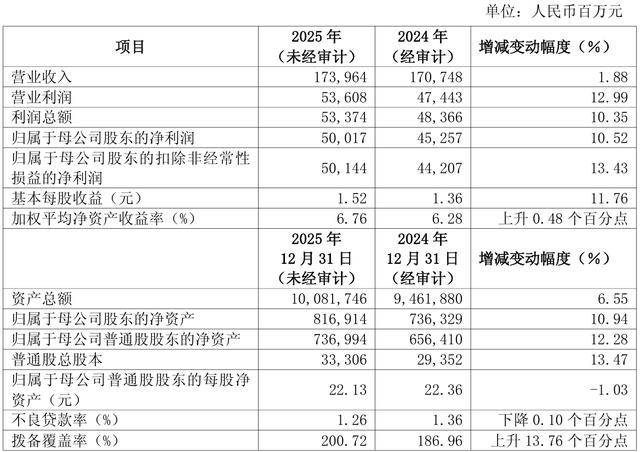
Group 1 - Nvidia has received a regulatory easing from the US for exporting H200 chips to China, and the company clarified it will not require customers to pay for undelivered products despite previous rumors of strict payment terms [2] - Rongbai Technology signed a procurement agreement with CATL worth over 120 billion yuan for lithium iron phosphate cathode materials, expected to supply 3.05 million tons from Q1 2026 to 2031, positively impacting future performance [2] - Microsoft is integrating ChatGPT into Office 365 to enhance productivity and collaborating with Walmart to strengthen AI recommendation systems on its e-commerce platform, reinforcing its position in enterprise software and cloud computing [2] Group 2 - Debon Logistics plans to voluntarily delist, with a cash option registration date set for February 6, 2026, and the stock will resume trading on January 14, 2026, aiming to optimize its capital structure [5] - Fulin Precision plans to raise 3.175 billion yuan through a private placement to CATL at 13.62 yuan per share for a project to produce 500,000 tons of high-end energy storage lithium iron phosphate, deepening cooperation in the new energy sector [5] - Baiwei Storage expects a net profit of 850 million to 1 billion yuan in 2025, a year-on-year increase of 427.19% to 520.22%, driven by recovering demand in the storage chip market [5][6] Group 3 - TCL Technology anticipates a net profit growth of 169% to 191% in 2025, primarily due to improved profitability in its semiconductor display business and rapid development in the new energy photovoltaic sector [3] - TCL Zhonghuan expects a net loss of 8.2 billion to 9.6 billion yuan in 2025, a reduction from a loss of 9.818 billion yuan the previous year, with positive operating cash flow [6] - Pudong Development Bank projects a net profit of 50.017 billion yuan in 2025, a year-on-year increase of 10.52%, driven by improved asset quality and steady growth in intermediary business income [7]





12场促销+18场配套活动!“硬核”广货何以能行天下?
Sou Hu Cai Jing· 2026-01-13 19:44
Group 1 - The core initiative "Guangdong Products Going Global" aims to boost market expansion and sales for local enterprises, with a series of promotional activities scheduled for the first quarter of 2026 [1] - A total of 12 promotional events will be held, including 10 offline and 2 online, with a focus on various product categories such as home appliances, mobile phones, and food [16][20] - The Guangdong home appliance industry has a significant impact, accounting for nearly 50% of the national export share, with the Guangdong-Hong Kong-Macao Greater Bay Area's smart home appliance industry representing about 30% of the global market [12][16] Group 2 - Guangdong's manufacturing sector is characterized by a diverse industrial ecosystem, encompassing all 31 manufacturing categories, with 15 of them leading nationally [27] - The region's manufacturing capabilities include a complete supply chain in sectors like textiles and home appliances, enhancing responsiveness and reducing costs [27] - The transition from traditional manufacturing to intelligent manufacturing is evident, with automation and AI technologies significantly improving production efficiency across various industries [28][29]

上市公司动态 | 浦发银行2025年净利增10.52%;东鹏饮料净利预增30.46%-37.97%;TCL科技营收破千亿,净利预增169%-191%
Sou Hu Cai Jing· 2026-01-13 19:04
Group 1: Shanghai Pudong Development Bank - The bank reported a net profit of 50.017 billion yuan for 2025, an increase of 10.52% year-on-year [1][2] - Total operating income reached 173.964 billion yuan, reflecting a growth of 1.88% compared to the previous year [2] - The bank's total assets exceeded 1 trillion yuan, reaching 1,008.1746 billion yuan, a 6.55% increase from the previous year [3] Group 2: Dongpeng Beverage - Dongpeng Beverage expects a net profit between 4.34 billion and 4.59 billion yuan for 2025, representing a year-on-year growth of 30.46% to 37.97% [4] - The anticipated operating income is projected to be between 20.76 billion and 21.12 billion yuan, indicating a growth of 31.07% to 33.34% [4] Group 3: TCL Technology - TCL Technology forecasts a net profit of 4.21 billion to 4.55 billion yuan for 2025, marking a significant increase of 169% to 191% year-on-year [5][6] - The company expects to surpass 100 billion yuan in operating revenue, with net profit exceeding 8 billion yuan [5] Group 4: Changjiang Electric Power - Changjiang Electric Power reported a net profit of 34.167 billion yuan for 2025, a 5.14% increase year-on-year [8] - The total operating revenue for the year is expected to be 85.882 billion yuan, reflecting a growth of 1.65% [8] Group 5: China Gold - China Gold anticipates a net profit of 286 million to 368 million yuan for 2025, a decrease of 55% to 65% year-on-year [21] - The decline is attributed to market fluctuations and reduced consumer traffic [21] Group 6: LaKala - LaKala expects a net profit between 1.06 billion and 1.2 billion yuan for 2025, representing a growth of 202% to 242% year-on-year [22] - The increase is primarily due to significant investment income from stock holdings [22] Group 7: Baiwei Storage - Baiwei Storage projects a net profit of 850 million to 1 billion yuan for 2025, indicating a year-on-year increase of 427% to 520% [23] - The growth is driven by improved sales and gross margins in the AI sector [23] Group 8: Shengxin Lithium Energy - Shengxin Lithium Energy forecasts a net loss of 600 million to 850 million yuan for 2025, similar to the previous year's loss [24] - The company attributes the loss to industry supply-demand dynamics and increased exchange losses [24] Group 9: Zhongguancun Online - Zhongguancun Online expects a net loss of 580 million to 700 million yuan for 2025, a significant increase from the previous year's loss of 243 million yuan [25] - The losses are linked to increased promotional investments in overseas markets [25] Group 10: Huaxia Happiness - Huaxia Happiness anticipates a net loss of 16 billion to 24 billion yuan for 2025, a substantial increase from the previous year's loss of 4.817 billion yuan [26] - The decline is due to reduced project turnover and high financial costs [26]